Picking the right cold email platform used to be straightforward. A handful of tools existed, most sales teams picked the one their peers recommended, and that was the end of it. Today, a quick search returns hundreds of options—many of them launched in the past eighteen months—and nearly every landing page promises "AI-powered outbound" and "unlimited scale." The result? Decision paralysis for the very people who need to move fast: sales leaders, growth teams, and founders running lean operations.
This cold email tools comparison cuts through the noise. Instead of ranking brands—which change positioning every quarter—we're comparing capabilities. The features below are what separate a production-grade outbound email platform from a side project that will cost you pipeline six months from now.
According to McKinsey's 2024 B2B Sales Report, more than two-thirds of B2B buyers now prefer remote or digital engagement over in-person meetings. Outbound prospecting through email has become the primary growth lever for thousands of revenue teams—which explains why the market for cold outreach platform features has exploded, and why getting your email outreach stack right is no longer optional.
What a Modern Cold Email Platform Should Actually Do?
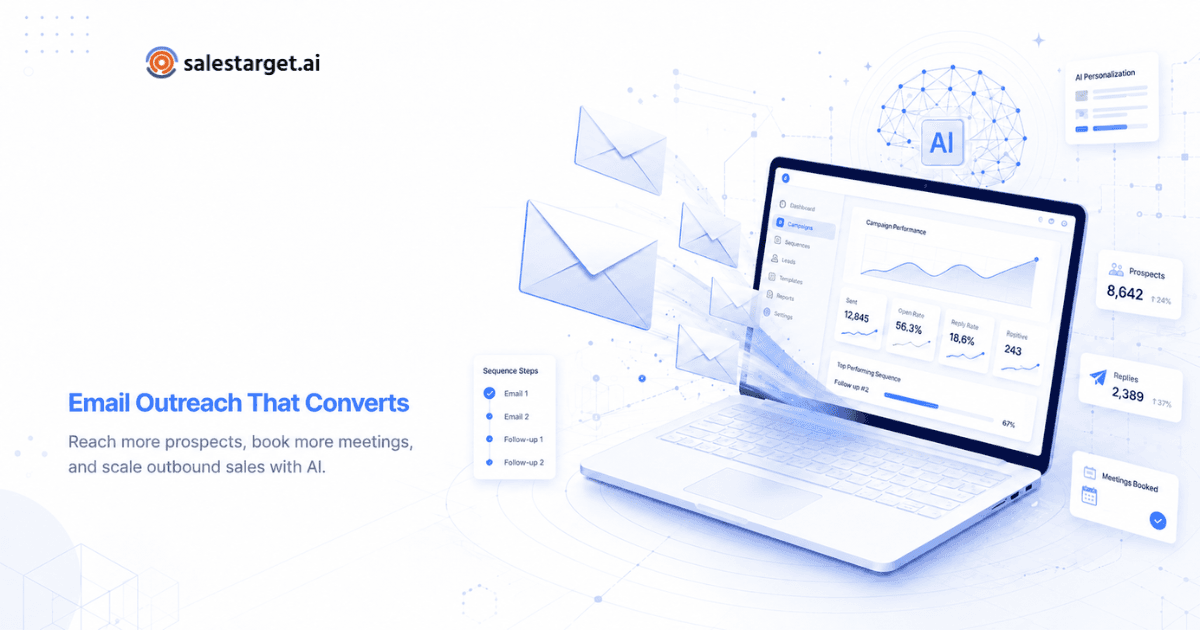
Before diving into the comparison, it helps to agree on what "modern" means. A best outbound platform in 2026 isn't just a tool that sends bulk emails. It's an end-to-end system that handles:
- Campaign automation & sequences – Multi-step drip campaigns with conditional logic that adapts based on prospect behavior.
- AI personalization – Dynamic first lines, variable blocks, and tone adjustment generated per-prospect, not per-list.
- Deliverability infrastructure – Inbox rotation, email warm-up, domain health monitoring, and bounce management working behind the scenes.
- Analytics & reporting – Reply rates, meeting-booked attribution, sequence performance, and A/B test results.
- CRM integration – Native sync with Salesforce, HubSpot, Pipedrive, or your custom stack—no manual CSV exports.
- Multichannel outreach – Layering LinkedIn touches, calls, or SMS alongside email sequences inside a single workflow.
If a tool can't cover these pillars, it probably belongs in the "side project" column. For a deeper look at how traditional tools compare to AI-driven ones, that breakdown is worth reading alongside this article.
Cold Email Platform Comparison: Capability-Level Breakdown
Rather than comparing logos, use this cold email software comparison table to benchmark any platform you're evaluating against the features that genuinely drive pipeline.
| Feature / Capability | Basic Cold Email Tools | Modern Outbound Platforms |
|---|---|---|
| AI Personalization | Template merge tags only | Per-prospect AI copy, tone matching, research-backed first lines |
| Inbox Rotation | Single sending account | Automatic rotation across unlimited inboxes |
| Email Warm-Up | Third-party add-on required | Built-in warm-up with reputation monitoring |
| Sequence Automation | Linear drip sequences | Conditional branching, behavior triggers, auto-pause on reply |
| Multichannel Support | Email only | Email + LinkedIn + calls + SMS in unified workflows |
| CRM Sync | CSV export / Zapier | Native bi-directional sync with major CRMs |
| Deliverability Monitoring | Basic open/bounce rates | Domain health scores, spam-test previews, blocklist alerts |
| Analytics & Reporting | Opens and clicks | Reply rates, meeting attribution, revenue influence dashboards |
| Team Collaboration | Single-user or shared login | Role-based access, shared templates, team-level analytics |
| Compliance & Safety | Unsubscribe link | GDPR/CAN-SPAM automation, sending-limit guardrails, audit logs |
Features That Separate Real Outbound Platforms from Side Projects
The table above gives you the snapshot. Below is the reasoning behind each row—why it matters, and what to probe for during an email outreach platform evaluation.
Deliverability Infrastructure
Nothing else matters if your emails land in spam. A serious cold email platform builds deliverability into the foundation—not as an afterthought plug-in. That means automated inbox rotation across dozens of sending accounts, integrated email warm-up that ramps volume gradually, and real-time domain-health dashboards. Google Workspace and Microsoft 365 both enforce tighter sending limits than they did two years ago, so platforms that support unlimited inboxes and warm-up natively have a structural advantage.
AI Personalization
Merge tags are table stakes. AI email outreach generates custom opening lines referencing a prospect's recent LinkedIn post, funding round, or job change. Teams report 2–4× reply-rate improvements when they move from template-based sends to genuine AI personalization—because prospects instantly spot the difference.
Unlimited Inbox Scaling
Growth teams that outgrow a five-inbox limit hit a wall fast. Modern outbound platforms let you connect unlimited sending accounts, rotate automatically, and monitor reputation per-inbox. This is the single biggest operational bottleneck in outbound email—and the feature most often missing from shortlist evaluations.
Automation & Sequences
A linear "send email → wait 3 days → send follow-up" sequence is 2019 thinking. Campaign automation in 2026 means conditional branching: different paths based on opens, clicks, and replies. Auto-pause on positive response. Tag and archive on opt-out. Behavior-driven email sequences save reps hours and keep prospects from receiving tone-deaf follow-ups.
Analytics That Matter
Open rates are increasingly unreliable as a north-star metric thanks to Apple's Mail Privacy Protection and corporate proxy opens. The analytics that count are reply rates, positive-reply rates, meetings booked, and pipeline generated. If a platform can't attribute a booked meeting back to a specific email sequence and variant, you're flying blind. According to HubSpot's State of Sales 2024, teams that track downstream conversion metrics outperform peers by 28% in quota attainment.
CRM Integration
Your cold email stack should talk to your CRM without friction. Native bi-directional sync with Salesforce, HubSpot, or Pipedrive means contact statuses update in real time—no duplicate records, no stale data, no manual imports. This is where sales engagement platforms earn their keep.
Team Collaboration
Solo-founder tools break down the moment you hire a second SDR. Look for role-based permissions, shared template libraries, and team-level dashboards. Choosing a team-ready platform now avoids a painful migration later.
Compliance & Safety
GDPR, CAN-SPAM, and CASL compliance isn't optional. Modern platforms automate opt-out handling, enforce sending-limit guardrails, and maintain audit logs. If you sell to enterprise accounts or operate in regulated markets, this is non-negotiable.
Common Mistakes Buyers Make When Choosing a Cold Email Platform
After helping dozens of teams evaluate outbound tools, the same missteps keep coming up:
- Choosing on price alone. A $29/month tool that tanks your domain reputation will cost you far more in lost pipeline than a $99/month platform with proper deliverability infrastructure.
- Ignoring deliverability until it's too late. Most teams don't realize emails are hitting spam until reply rates collapse—and by then, domain recovery takes weeks.
- Buying disconnected tools. One tool for sending, another for warm-up, a third for verification, a fourth for analytics. Every integration point is a failure point.
- Not testing scalability. A tool that works for 500 emails/week may buckle at 5,000. Pressure-test volume limits during the trial, not after you've committed.
- Ignoring reporting depth. If you can't answer "which sequence generated the most meetings this month," you can't optimize.
Building the Right Cold Email Stack
The most effective outbound teams in 2026 aren't stitching together six-point solutions. They're consolidating around a core cold outreach platform that handles sending, deliverability, personalization, and analytics natively—then plugging in two or three purpose-built tools around it.
A lean, effective stack typically looks like this:
- Email outreach platform (sequences, AI copy, deliverability, analytics)
- CRM (deal tracking, contact management)
- Lead database (prospect sourcing—Apollo, ZoomInfo, or similar)
- Email verification service (pre-send list cleaning)
When these pieces connect through native integrations rather than middleware, you eliminate data lag and reduce the manual work that kills SDR productivity. One SaaS team case study showed a 40% reduction in time-to-first-meeting after consolidating from five tools down to two.
How to Evaluate a Cold Email Platform: Buyer Checklist
Use this checklist during trials and demos. Any platform worth your investment should check every box:
- ☐ Deliverability: Built-in warm-up, inbox rotation, domain health monitoring
- ☐ AI Personalization: Per-prospect copy generation, not just merge tags
- ☐ Unlimited Inboxes: No artificial cap on connected sending accounts
- ☐ Sequence Automation: Conditional branching, auto-pause, behavior triggers
- ☐ Analytics: Reply rates, meeting attribution, A/B testing, revenue dashboards
- ☐ CRM Integration: Native sync with Salesforce, HubSpot, or your primary CRM
- ☐ Multichannel: LinkedIn, call, and SMS steps inside the same workflow
- ☐ Team Features: Role-based access, shared templates, team reporting
- ☐ Compliance: Automated opt-outs, sending guardrails, audit logs
- ☐ Scalability: Performance holds at 10× your current volume
- ☐ Security: SOC 2, data encryption, SSO support
- ☐ Support: Responsive onboarding, dedicated CSM for mid-market and up
Who Needs a Modern Cold Email Platform?
The short answer: anyone whose revenue depends on outbound prospecting. But the urgency varies by role:
- Sales Leaders need visibility into sequence performance across the team and the ability to enforce messaging standards without micromanaging.
- Growth Teams need to run rapid experiments—new verticals, new ICPs, new messaging angles—without waiting for engineering support.
- Founders need a platform they can operate solo today and hand off to an SDR hire tomorrow without rebuilding from scratch.
- Agencies need white-label capabilities and multi-client dashboards that keep accounts separated cleanly.
- B2B SaaS companies running product-led growth alongside outbound need tight CRM integration so sales-assisted motions don't collide with self-serve signups.
- Recruiters increasingly rely on cold email at scale — the same deliverability and personalization principles apply.
According to LinkedIn's Global Talent Trends, recruiter outreach volume grew 35% year over year—proof that outbound email isn't just a sales play anymore.
A Framework, Not a Product Recommendation
The market for cold email software is crowded, noisy, and moving fast. New tools launch every week, and incumbents rebrand features every quarter. Chasing "the best" platform is a losing game.
Instead, use the framework above. Benchmark every tool against the capabilities that drive results: deliverability, AI personalization, inbox scaling, conditional automation, meaningful analytics, and native CRM integration. If a platform can't demonstrate strength across those pillars during a trial, it doesn't belong on your shortlist — regardless of price or brand recognition.
The teams that consistently build pipeline aren't the ones with the flashiest tools. They're the ones that chose infrastructure over aesthetics, depth over breadth, and execution over hype.