The average B2B sales team uses more than a dozen tools across their outbound workflow. A database for prospecting. A separate enrichment layer. Another platform for intent data. A CSV export, a manual import, a field-mapping exercise — and finally, a CRM that's three steps behind reality before the SDR ever writes the first email.
That's not a tech stack. That's a bottleneck.
According to Salesforce's State of Sales report, sales reps spend only 28% of their week actually selling. The rest is absorbed by administrative tasks, tool-switching, and the slow, grinding work of getting prospect data from where it lives to where it's needed. This problem isn't new. But the cost of ignoring it has gotten steeper — and the tools to solve it are finally catching up.
The Real Cost of a Fragmented Sales Stack
Outbound used to be simpler. Pull a list, add contacts to a sequence, dial and email. The data wasn't perfect, but the process was linear.
What's happened since is a paradox: as the martech and salestech ecosystem expanded, individual tools got more powerful while the overall workflow got worse. Teams now subscribe to a prospecting database, a contact enrichment API, a buyer intent provider, a sales engagement platform, and a CRM — each of which requires its own login, its own data model, and its own budget justification.
Forrester research consistently finds that tool proliferation is one of the leading causes of SDR underperformance. The friction isn't just technical. When a rep has to switch between five platforms to build a single qualified lead, the cognitive cost compounds. Context is lost. Momentum breaks. And the lead that seemed warm an hour ago is now sitting in a queue.
The data quality problem makes this worse. HubSpot reports that B2B contact data decays at roughly 22–30% annually. When enrichment happens days or weeks after discovery — because the tools aren't connected — a meaningful portion of what gets imported into the CRM is already stale. Emails bounce. Sequences hit dead ends. Pipeline metrics look healthier than actual pipeline is.
Revenue teams that have tried to solve this by adding more integrations are finding diminishing returns. The answer isn't more connectors. It's a different architecture entirely.
What a Modern Sales Intelligence Platform Actually Delivers
The phrase "sales intelligence" is used loosely. It shows up in pitch decks for contact databases, intent providers, and CRM enrichment tools alike. But there's a meaningful distinction between a tool that gives you data and a platform that gives you intelligence.
Data is a list of companies in a target industry. Intelligence is knowing which of those companies are actively evaluating a category you sell into, have recently received funding, and have a VP of Sales who joined in the last 90 days — and surfacing all of that in one place before you write the first touchpoint.
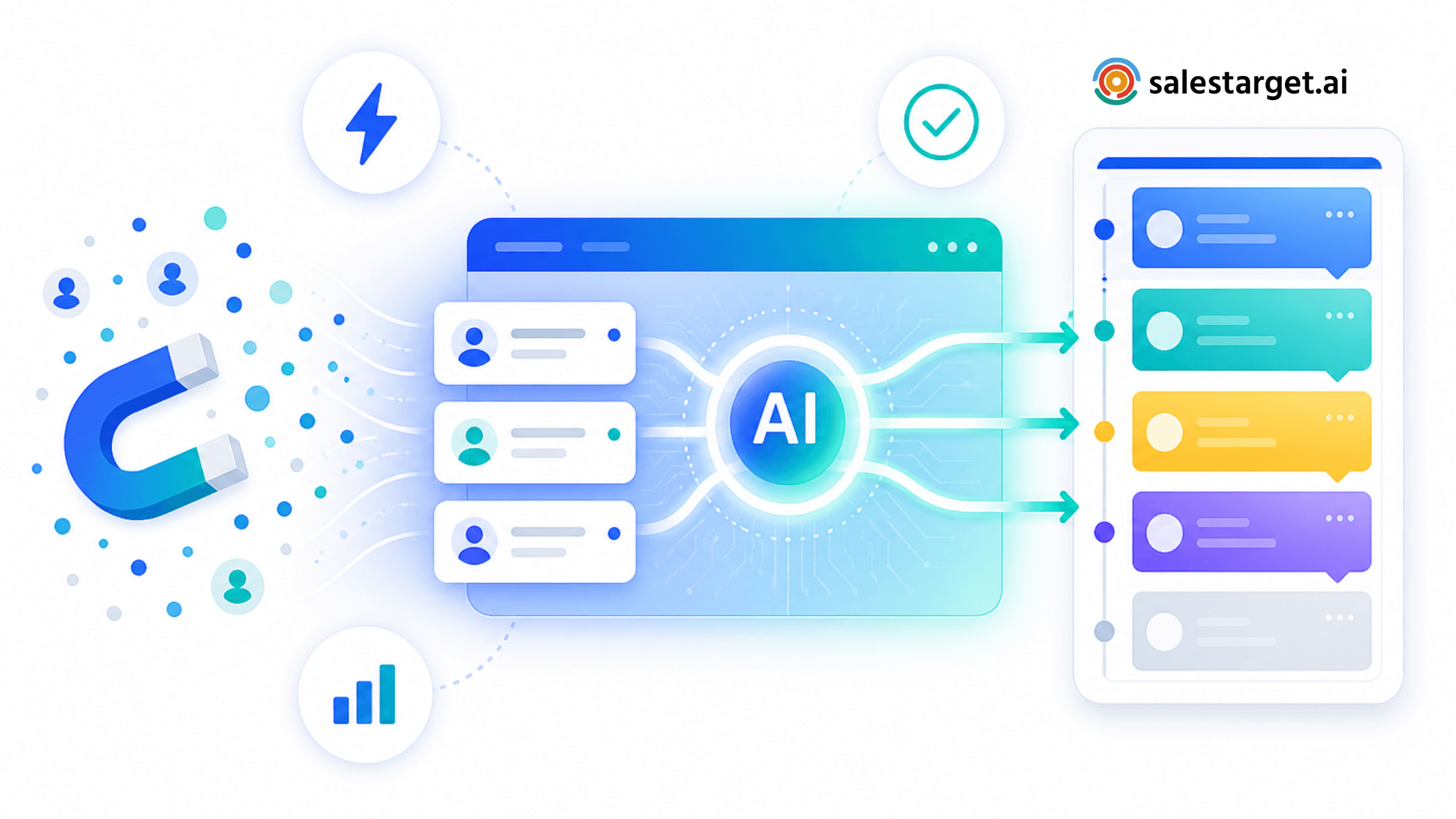
A genuine sales intelligence platform does four things simultaneously:
- Discovers leads that match your ICP across a large, multi-sourced database.
- Enriches those leads with verified contact details, firmographics, and technographic data at the point of discovery.
- Scores them using buyer intent signals and behavioral indicators.
- Activates them by pushing enriched, scored records directly into your outreach tools or CRM — without a manual handoff.
The workflow consolidation isn't a convenience feature. It's the core value proposition. When discovery, enrichment, and intent scoring happen in a single motion, SDR productivity compounds. When CRM sync is native rather than bolted on, data quality holds.
AI-Powered Prospecting and Intent-Based Lead Discovery
The shift from keyword-filtered databases to AI-powered prospecting represents a meaningful change in how outbound teams build lists.
Traditional prospecting filters — job title, industry, company size — are still valuable. But they're static. They describe who a company is. They don't tell you whether that company is ready to buy.
Intent data closes that gap. By tracking behavioral signals across the web — content consumption patterns, review site visits, search behavior, and topic engagement — intent platforms surface accounts that are actively in a buying cycle, not just ones that match a demographic profile.
The most effective AI prospecting tools now combine both layers in a single search experience. A rep can define an ICP using firmographic and technographic filters, then layer in intent topics to isolate accounts that fit the profile and are showing buying behavior. The result isn't a longer list — it's a better one.
SalesTarget.ai's Lead Explorer is built around this model. With access to over 840 million professional profiles and 96 million business entities, the platform supports both natural-language AI search and advanced filter stacking across industry, role, company size, revenue, tech stack, and intent topics powered by Bombora data. The 30–90 day lookback window on intent signals means teams can prioritize accounts during the actual window when buying conversations are most likely to be open.
Why Verified Contact Data Is the Foundation of Outbound Success
None of the targeting sophistication in the world translates to pipeline if the contact data is wrong.
Deliverability is the first casualty of bad data. Bounced emails trigger spam filters, damage sender reputation, and reduce the effectiveness of every subsequent sequence that follows. McKinsey research on B2B sales effectiveness consistently identifies poor data quality as one of the highest-leverage problems a revenue team can solve.
The distinction that matters here is when data is verified. Many contact databases verify email addresses at the time they're collected — which means the verification age is unknown and potentially years out of date. Point-of-enrichment verification, by contrast, checks contact validity the moment a rep requests it. The difference in deliverability rates is significant.
SalesTarget.ai verifies professional email, personal email, phone number, and mobile at the point of enrichment — not when the data was originally ingested. The platform also includes availability filters (Has Email, Has Phone Number) so reps can confirm contact reachability before spending enrichment credits. The result is a tighter list and cleaner outreach.
For teams running high-volume outbound, SalesTarget.ai's lead validation tools add a further layer of pre-send verification that keeps sequences clean and sender reputation intact.
The Role of Enrichment and Automation in SDR Productivity
Enrichment is where most sales stacks have a seam. The prospecting tool surfaces a name and a company. A separate enrichment platform — or a manual research process — fills in the contact details, company context, and tech stack. Then someone exports a CSV, reformats it for CRM import, maps the fields, and finally activates the record.
That sequence might take 20 minutes per lead in a disorganized stack. Across 50 leads, that's the better part of a day that an SDR should have spent on the phone.
The productivity math is stark. LinkedIn's B2B research has consistently shown that SDRs who spend more time in actual outreach — rather than research and data preparation — produce significantly more pipeline per head. The platform infrastructure determines how much time is available for selling.
SalesTarget.ai's built-in enrichment removes the seam. Finding a lead and enriching it is a single step: select the record, click Enrichments, and the platform returns company firmographics, tech stack, and verified contact details using enrichment credits. No separate tool. No export. No import. The lead is ready to work within the same session.
From there, teams can push directly to their outreach sequences via SalesTarget.ai's email outreach tools, trigger LinkedIn touchpoints through LinkedIn automation, or sync to CRM — all without leaving the platform.
Old Outbound Workflow vs. Unified Intelligence-Driven Workflow
Here's what the contrast looks like in practice.
Old workflow: Prospect in Database A → Export CSV → Import to Enrichment Tool B → Export enriched CSV → Import to CRM → Build sequence in Engagement Platform C → Track results in Analytics Tool D.
Unified workflow: Search with AI or filters in SalesTarget.ai → Enrich in one click → Push to CRM or launch sequence directly.
The difference in time-to-first-touchpoint is measured in hours, not minutes. But the more important difference is in data integrity. Every handoff in the old workflow is an opportunity for records to degrade, fields to mismatch, or intent to expire. The unified workflow keeps the record live from discovery through activation.
For RevOps teams, this also simplifies attribution. When prospecting, enrichment, and outreach happen in one connected system — with native CRM sync — the pipeline data is cleaner and the reporting is more reliable.
Who Benefits Most from a Unified Sales Intelligence Platform
SDRs and BDRs spend less time on research and more time in actual conversations. With AI search and ICP-anchored filters, building a targeted list takes minutes. With built-in enrichment, those leads are ready to work immediately.
Founders and small sales teams without dedicated RevOps resources benefit from the workflow simplification. A single platform with native enrichment, outreach, and CRM tools means less stitching and less vendor management.
RevOps and sales leadership get cleaner data in the CRM, better attribution, and more predictable pipeline metrics. When the data model is consistent from discovery through close, forecasting improves.
Agencies and lead generation teams running outbound for multiple clients benefit from the combination of scale (840M+ profiles, 4,000+ data signals) and precision (ICP filtering + intent scoring) that reduces the time spent building qualified prospect lists per engagement.
The Rise of Signal-Based Selling
The most significant shift happening across enterprise revenue teams right now is the move from volume-based outbound to signal-based selling.
Volume-based outbound operates on the assumption that contact reach and sequence volume drive pipeline. It's a numbers game. Signal-based selling operates on a different assumption: that timing and relevance matter more than volume, and that the best outreach happens when there's an actual buying trigger in play.
Gartner research on B2B buying behavior has shown that buyers progress 57–70% through their purchase decision before engaging a vendor. That means the window for meaningful outreach isn't the entire buying cycle — it's the early signal phase, when intent is present but the decision isn't yet made.
Real-time signal discovery — funding rounds, hiring spikes, leadership changes, technology adoption patterns, and intent topic engagement — gives revenue teams a way to identify that window systematically. Rather than spray-and-pray outreach to a static list, signal-based selling focuses effort on accounts where a trigger has made the conversation timely.
SalesTarget.ai's AI Copilot extends this further, enabling reps to layer AI-generated context on top of signal data to build more informed outreach from the start.
Measuring What a Sales Intelligence Platform Should Move
The leading metrics worth tracking when evaluating a sales intelligence platform aren't vanity metrics. They're operational:
- Time to first touchpoint from lead discovery
- Email deliverability rate per sequence
- SDR productive hours per week (time in actual outreach vs. research)
- ICP match rate on generated leads
- CRM data freshness at point of import
- Pipeline velocity from first touch to qualified opportunity
A platform that improves these numbers isn't just a tool upgrade — it's a structural improvement in how revenue is generated. The cost of a fragmented stack isn't visible on a single spreadsheet. It's distributed across dozens of small inefficiencies that, in aggregate, represent meaningful lost revenue.
Pipeline Quality Is a Platform Decision
The B2B revenue teams producing the best outbound results aren't necessarily the ones with the largest headcount or the biggest marketing budgets. They're the ones who've made pipeline quality a platform decision — choosing infrastructure that reduces friction, improves data integrity, and lets their reps spend more time selling.
A unified sales intelligence platform that combines AI-powered prospecting, real-time intent signals, built-in enrichment, verified contact data, and native CRM sync isn't a future-state aspiration. It's a present-tense competitive advantage.
SalesTarget.ai's Lead Explorer is built around this architecture — designed for revenue teams that need to move from search to pipeline without the overhead of a fragmented stack.
The free trial includes 50 credits. No credit card required.