TL;DR
- SaaS outbound is structurally different from general B2B outreach — demo-gated buying, champion-led evaluation, and multi-stakeholder committees require a different cadence, not just different copy
- Coordinated multichannel sequences produce 15% reply rates vs 3.8% for email alone — for SaaS teams with longer sales cycles, that difference compounds into a dramatically different pipeline in 90 days
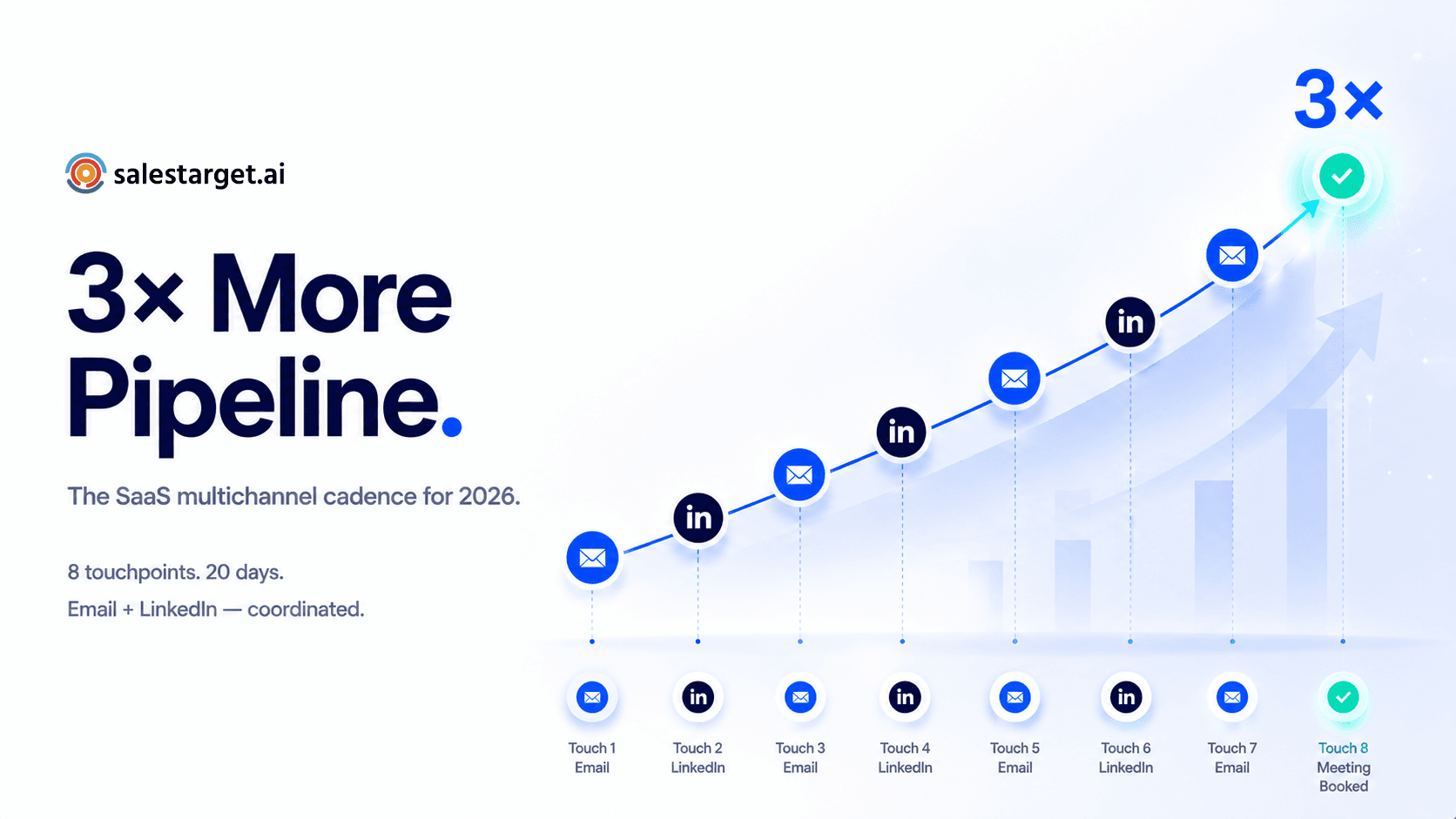
- The SaaS-specific 8-touch cadence: Day 1 email → Day 2 LinkedIn connect → Day 4 email (ROI angle) → Day 6 LinkedIn message → Day 9 email (peer proof) → Day 12 LinkedIn engage → Day 16 email (urgency) → Day 20 final email
- SaaS-specific personalisation signals that outperform generic templates: tech stack fit, recent funding round, headcount growth rate, and product category signals — these are the triggers that create genuine relevance for SaaS buyers
- The Salesforce State of Sales 2026 report found that sales reps spend only 28% of their week actually selling — the rest is administrative work that a coordinated multichannel platform eliminates
- SalesTarget runs this SaaS cadence natively — multichannel outreach, email outreach, and signal-based lead discovery unified in one platform. See how a SaaS team used this to scale: SaaS case study
SaaS sales teams have a problem that general multichannel guides do not address: their buyers are not just hard to reach — they are structurally harder to convert. The demo is gated behind a qualification call. The champion needs to sell internally before budget is approved. The buying committee typically includes three to five stakeholders with different objections and different channels they actually check. Running a generic 5-email sequence at a SaaS VP of Sales and wondering why it produces 2% reply rates is not a personalisation problem. It is a cadence design problem. According to the Salesforce State of Sales 2026 report, sales reps spend only 28% of their week actually selling — the rest is admin, sequencing, and follow-up management that never needed to be manual in the first place. This cadence fixes both problems.
Why SaaS Outbound Requires a Different Cadence
General B2B outreach assumes a relatively short path from first contact to meeting — a prospect reads the email, decides it is relevant, and books a call. SaaS buying does not work this way. Understanding the structural differences is what makes a SaaS-specific cadence necessary rather than optional.
| Factor | General B2B outreach | SaaS outbound | What it means for your cadence |
|---|---|---|---|
| Conversion path | Reply → meeting → proposal | Reply → discovery call → demo → trial → decision | More touchpoints needed before a reply converts to revenue. Nurture longer without burning the relationship. |
| Decision structure | Often one or two decision-makers | 3–5 stakeholders: champion, economic buyer, IT, legal, end users | Contact the champion first, not the economic buyer. The champion sells internally — your job is to arm them. |
| Buying trigger | Price, availability, relationship | Technical fit, integration stack, team adoption risk, ROI proof | Generic outreach fails fast. Every touchpoint must reference something specific to their stack, stage, or situation. |
| Sales cycle | Days to weeks | Weeks to months depending on ACV | 20-day cadence is the right length — long enough to build familiarity, short enough to stay in the buying window. |
| LinkedIn presence | Variable | Very high — SaaS buyers are among the most active LinkedIn users in B2B | LinkedIn touchpoints are disproportionately valuable for SaaS ICPs. Profile views, connection requests, and content engagement all land with higher visibility than in other verticals. |
💡 Who to target first in a SaaS buying committee
For SaaS outbound, target the functional champion first — the person who will feel the pain your product solves most directly. For a sales outreach tool this is the VP of Sales, Head of SDR, or RevOps lead — not the CTO or CFO. The champion can sell internally to the economic buyer once you have their attention. Cold outreach to the economic buyer before the champion is engaged rarely converts because the buyer has no internal advocate to validate the conversation.
The SaaS-Specific Personalisation Signals That Actually Work
Generic personalisation tokens — first name, company name, job title — are table stakes in 2026. Every cold email tool offers them. What separates SaaS outreach that converts from SaaS outreach that gets ignored is the use of signals that reflect what is actually happening at the target company right now.
SaaS personalisation signals ranked by conversion impact
Tech stack fit — highest impact
Knowing what tools a SaaS company already runs tells you three things: their budget tier, their integration requirements, and the specific gap your product fills. "Your team is running HubSpot for CRM — most HubSpot teams that scale past 20 SDRs hit the same prospecting data problem" is not a cold email opener. It is a warm one. SalesTarget's signal discovery surfaces tech stack data before outreach begins — so the first touchpoint is already specific.
Recent funding round — very high impact
A funding event creates the conditions for a purchase decision: new budget, new growth targets, new infrastructure to build. Reaching a Series B SaaS company within 30 days of their raise — before every other vendor does — produces conversion rates 3–5x higher than reaching the same company six months later. The window is short. The signal is public. The outreach angle writes itself: "Most Series B teams rethink their outbound infrastructure in the first 60 days post-raise — is that on your radar?"
Headcount growth rate — high impact
A SaaS company that grew headcount by 40% in the last 6 months is in active scaling mode. Their sales and marketing infrastructure is being stretched. Their outbound volume is increasing. Their data quality problems are compounding. Headcount growth is a proxy for budget allocation and operational pain — both of which make your outreach timely rather than opportunistic.
Product category signals — medium-high impact
SaaS companies in specific product categories — sales engagement, RevOps, data intelligence — are natural buyers of adjacent tools. Knowing their product category tells you the sophistication of their sales motion, what adjacent problems they are likely experiencing, and which competitors they are replacing or evaluating. This context makes the outreach angle sharper without requiring manual research per prospect.
The SaaS Multichannel 8-Touch Cadence: Exact Structure and Timing
This cadence is built for SaaS sales cycles — 20 days, 8 touchpoints, alternating email and LinkedIn in a sequence where each touchpoint advances the conversation rather than repeating the same ask. Salesmotion's 2026 cold outreach research recommends 8–12 touchpoints for complex B2B outreach — the SaaS-specific version below is designed around the demo-gated conversion path and champion-led buying process.
| Touch | Day | Channel | Angle | SaaS-specific note |
|---|---|---|---|---|
| 1 | Day 1 | Problem-led opener with signal hook | Reference the specific signal: funding round, tech stack, or headcount growth. 80–100 words. CTA: "Worth a 15-minute call?" — not "book a demo" at step 1. | |
| 2 | Day 2 | Connection request — credibility signal | 20–30 words. Reference their SaaS product category or company stage — not "I work in sales tech." Creates a face behind the email they received yesterday. | |
| 3 | Day 4 | ROI and efficiency angle | SaaS buyers respond to efficiency arguments. Quantify the cost of the problem: "Most teams at your stage spend 3–4 hours per rep per week on list building alone." 70–90 words. Different subject line from email 1. | |
| 4 | Day 6 | Message (if connected) or profile view (if not) | If connected: 2 sentences bridging the email thread. "Sent you an email about [topic] — wanted to connect here as well." If not connected: second profile view keeps you visible passively. | |
| 5 | Day 9 | Peer proof — SaaS-specific social proof | Reference a similar SaaS company or team archetype — not a named customer unless you have permission to. "Teams at similar Series B stage typically see X within the first 60 days." 60–80 words. This is the trust-building touchpoint. | |
| 6 | Day 12 | Content engagement — genuine interaction | Like or comment on a recent post they made. The comment adds a perspective — not a pitch. SaaS buyers on LinkedIn post frequently about their category; engaging authentically is the highest-converting LinkedIn touchpoint in the sequence. | |
| 7 | Day 16 | Timing and urgency — not pressure | Reference a real timing signal: a quarter close, a product launch window, a hiring surge they are in. "Q3 is typically when teams lock outbound infrastructure — if that timing is relevant for you, worth a quick call before then." 60–80 words. | |
| 8 | Day 20 | Permission-based close — leave the door open | 40–60 words. "If the timing is not right, I'll leave you alone — but if it is, here's why it might be worth 15 minutes." For SaaS buyers specifically: add a low-friction next step — a resource, a case study link, or a question — rather than a hard CTA to book a demo. |
What 3× Pipeline Means for a SaaS Sales Team in Real Numbers
The 3× pipeline claim needs to be grounded in what is actually achievable rather than treated as a marketing headline. Here is what the numbers look like for a realistic SaaS SDR running a coordinated multichannel sequence versus a single-channel email sequence.
📊 SaaS multichannel vs email-only: real numbers
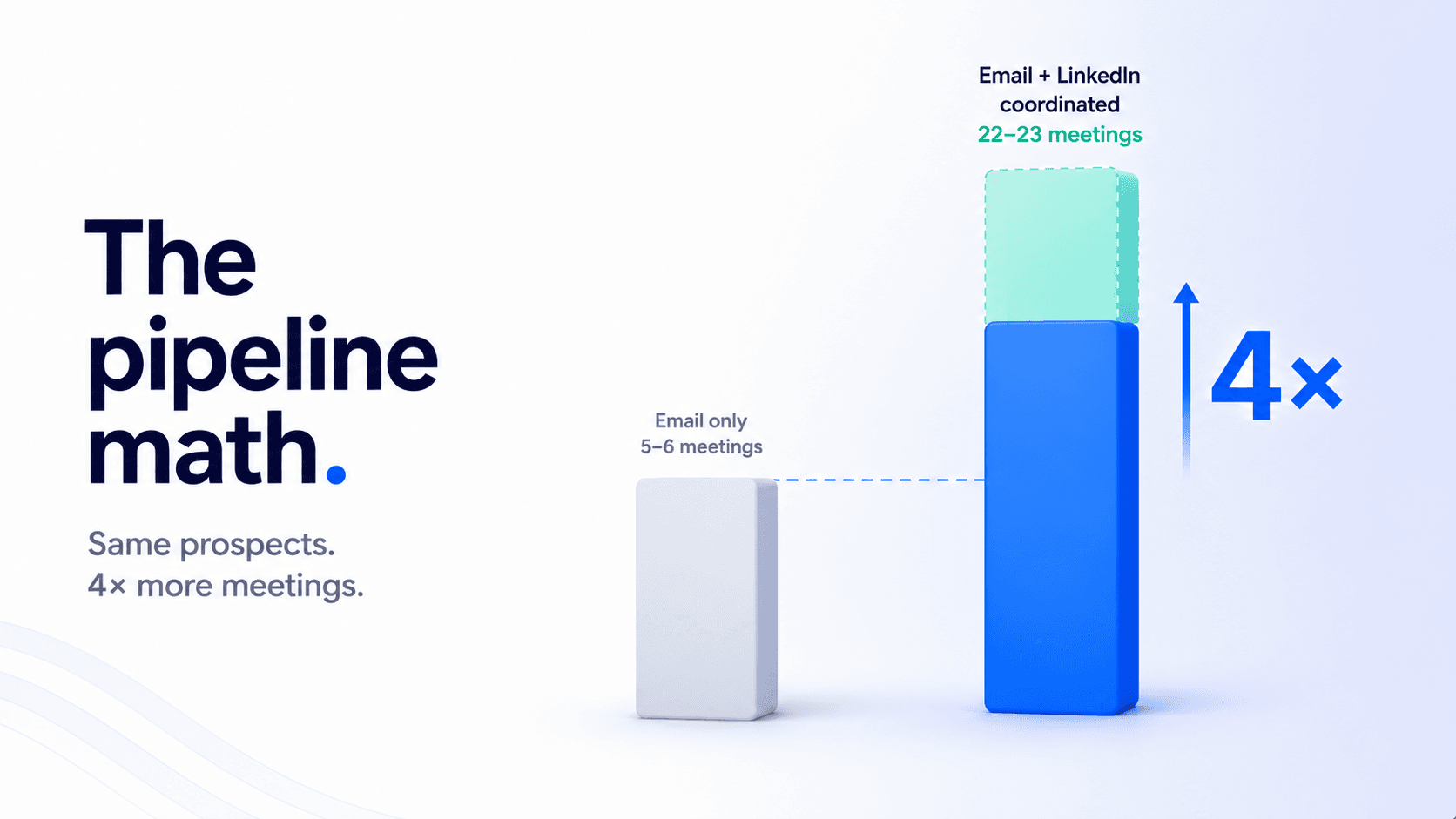
- Email-only reply rate: 3.8% — at 500 prospects per month, this produces 19 replies. Assume 30% of replies convert to discovery calls: 5–6 calls per SDR per month.
- Coordinated multichannel reply rate: 15% — at the same 500 prospects, this produces 75 replies. At the same 30% conversion rate: 22–23 discovery calls per SDR per month — a 4x increase per Enginy.ai's 2026 multichannel data.
- At $50,000 ACV (mid-market SaaS): 5 additional meetings per month × 20% close rate × $50K = $500,000 additional pipeline per SDR per month from the channel coordination alone.
- The compounding effect: SaaS sales cycles run 60–90 days. The pipeline benefit from multichannel outreach in month 1 shows up as closed revenue in months 3–4. Teams that switch to coordinated multichannel outreach in Q1 see the pipeline impact in Q2 revenue — consistently.
SaaS case study: how one team tripled their demo pipeline
SalesTarget's SaaS team case study documents the specific results a B2B SaaS outbound team achieved after moving from single-channel email to a coordinated LinkedIn + email sequence using SalesTarget. The case study covers the before/after on reply rates, demo booking rates, and pipeline generated — with the actual cadence structure they ran.
SaaS-Specific Mistakes in Multichannel Outreach
Pitching the demo too early
SaaS demos are a commitment — they require calendar time, internal alignment, and implicit acknowledgment that the product might be relevant. Asking for a demo in the first two touchpoints is asking a prospect to make a significant commitment before they have any reason to believe the conversation will be worth their time. Ask for 15 minutes first. The demo request comes after they have expressed interest — not as the opening ask.
Targeting the economic buyer instead of the champion
Cold outreach to a CFO or CTO at a SaaS company about a sales productivity tool rarely converts — not because the message is wrong, but because they are not the person who feels the problem. Start with the champion: the VP of Sales, Head of Revenue, or Director of SDR who experiences the pain directly. Once the champion is engaged and interested, they navigate the buying committee internally. Cold outreach that skips the champion and goes straight to the economic buyer almost always stalls.
Generic social proof that does not match their stage
SaaS buyers are highly sensitive to stage mismatches. Telling a Series A company that "enterprise clients like Salesforce use this" creates skepticism rather than credibility. Peer proof works when the peer is at the same stage, same size, and dealing with the same problem. Segment your social proof by company stage (Seed/Series A, Series B/C, growth-stage) and use the relevant proof point for each segment — not a one-size-fits-all customer name drop.
Running email and LinkedIn on independent schedules
The most common implementation failure: both channels are active but neither is aware of the other. A prospect replies to the LinkedIn message and receives the next scheduled cold email two days later — which ignores the reply and repeats the original ask. For SaaS buyers who move carefully and evaluate vendors on responsiveness, this single failure destroys more pipeline than any other sequencing mistake. Reply detection across both channels is the mechanism that separates a coordinated multichannel sequence from two campaigns running in parallel.
How to Run This Cadence in SalesTarget
Running an 8-touch, 20-day cadence across two channels manually is not realistic at any meaningful volume. The platform handles the coordination — what you manage is the strategy, the ICP definition, and the messaging quality.
SalesTarget's multichannel outreach builder lets you configure the full 8-step cadence with exact day intervals, channel assignment per step, and message variants for each touchpoint. LinkedIn steps use cloud-based automation with human-like delays and safe rate limiting built in — the same infrastructure that runs within LinkedIn's safe limits of 20–30 connection requests per day.
For SaaS-specific personalisation, SalesTarget's real-time signal discovery surfaces funding rounds, hiring surges, tech stack data, and product category signals at the point of list building — so the first touchpoint in the cadence is already personalised to what is actually happening at each target company, not just their job title and company name.
When a reply arrives on either LinkedIn or email, SalesTarget's unified reply management pauses the remaining sequence automatically. The prospect enters the CRM pipeline with their outreach history intact — every touchpoint, every channel, every response — so the follow-up conversation has full context without manual logging.
Build your SaaS multichannel sequence — in one platform.
Email outreach, LinkedIn automation, signal-based personalisation, and unified reply management — built for SaaS outbound teams.
✓ 50 credits ✓ 7-day trial ✓ No credit card required