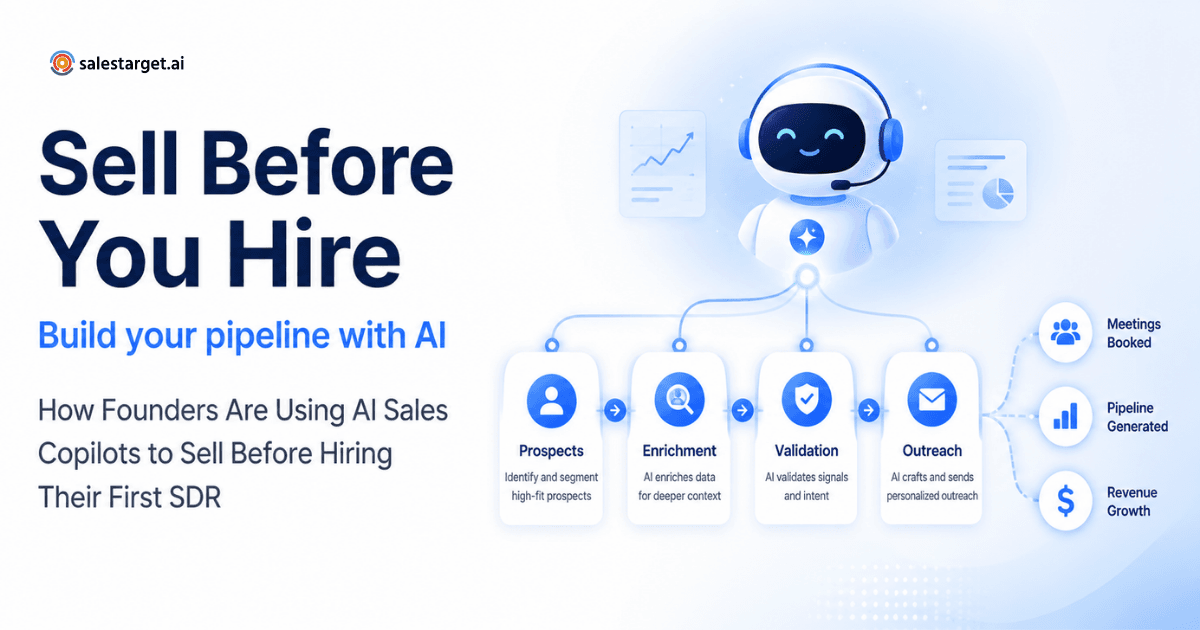
Founders can use a Sales AI Assistant to build a working pipeline before hiring their first SDR. The tool identifies target accounts, enriches missing contact data, validates leads before outreach, ranks prospects by fit, and drafts personalized messages. This lets founders focus on conversations, qualification, and closing while automation handles the repetitive research and follow-up work.
Why Founders Are Turning to AI Before Hiring an SDR ?
Most early-stage founders sell alongside every other job they hold. Hiring a sales development representative is expensive, and the ramp is slow. Base salary, commission, tools, and onboarding can easily push the first-year cost of a single SDR past $100,000.
The mechanical parts of prospecting have not changed. Someone still has to research accounts, find decision makers, verify email addresses, and log activity. According to Salesforce's State of Sales research, reps spend a large share of their week on non-selling tasks. For a founder without an SDR, that overhead lands on the person who should be talking to customers.
An AI Sales Assistant changes the math. It handles the repetitive research, enrichment, and validation work so founders can spend more time in conversations. The goal is to make founder-led sales sustainable long enough to justify a first hire.
5 Ways Founders Use a Sales AI Assistant Before Their First SDR
1. Find and Enrich the Right Prospects
Most founders know their ideal customer profile. Turning that profile into a working list is the slow part. An AI Powered Sales Assistant can pull candidate accounts, then add the missing details: job titles, technologies used, funding stage, headcount, and verified contact information.
This is where lead enrichment becomes practical. Instead of jumping between LinkedIn, company websites, and data tools, founders start with a rough list and let the assistant fill in the gaps. The result is a cleaner prospect list built on real signals. For how this looks in a more mature team, see how AI-powered sales assistants can support account executives.
2. Validate Leads Before Outreach
Enrichment is only useful when the data is accurate. People change jobs. Emails bounce. Companies restructure. Sending outreach to invalid contacts wastes time, hurts sender reputation, and clutters the CRM.
Lead validation checks whether contact data is usable before the founder sends a message. That includes verifying email deliverability, confirming role titles, and flagging duplicate or outdated records. For a founder running outreach personally, this step is the difference between a morning of live conversations and an inbox full of bounces.
3. Prioritize Accounts With the Highest Potential
Not every enriched, validated lead deserves the same attention. An AI Sales Copilot can score prospects on fit signals such as industry, size, tech stack, recent hiring, or funding, so founders work the highest-potential accounts first.
A founder selling to Series A SaaS companies might prioritize accounts that raised in the last 90 days and use a specific data warehouse. The assistant surfaces those first, and the founder spends selling time where the odds are best.
4. Personalize Prospecting Without Doing Everything Manually
Personalization matters, but it does not need to be handmade for every prospect. AI copilots draft opening messages based on account context: recent funding, product updates, hiring patterns, or a pain point tied to the founder's offering.
The founder still edits and approves each message. Instead of writing 25 first drafts, the founder refines 25 drafts that already reference the account's real situation.
5. Keep Follow-Ups Moving While the Founder Focuses on Selling
Deals stall between messages. Founders juggle product, hiring, and customer calls, and follow-ups slip. A Sales AI Assistant can queue reminders, draft polite nudges, and track which threads went cold. That keeps the pipeline moving even in weeks when the founder is stretched thin.
How AI Fits Into a Founder-Led Sales Workflow ?
A clear workflow makes AI useful rather than distracting. A repeatable founder-led sales loop looks like this:
- Discover: Define the target account list.
- Enrich: Add missing company and contact data.
- Validate: Confirm the data is usable.
- Prioritize: Rank accounts by fit and timing.
- Personalize: Draft context-aware outreach.
- Follow up: Manage sequences and reminders.
- Convert: Move real opportunities into calls and demos.
Each step compounds. Better data leads to better targeting. Better targeting leads to relevant outreach, more useful conversations, and less wasted founder time. A good AI copilot supports the mechanical steps so the founder owns the strategic ones. This overview of how modern sales teams use AI sales copilots to reduce manual work shows how the loop scales as teams grow.
An illustrative calculation
Consider a founder who researches 20 prospects a day and spends about 10 minutes per account gathering context, verifying details, and drafting a message. That is roughly 200 minutes, more than three hours, for a single batch. Over a five-day week, the founder loses more than 16 hours to prospecting mechanics alone.
If AI-assisted research, enrichment, and validation cut the per-prospect time to three or four minutes, the same batch takes about 60 to 80 minutes. That difference is not theoretical productivity. It is time the founder can spend on discovery calls, product demos, or pricing conversations. (This is an illustrative calculation, not industry research.)
What Founders Should Automate - and What Should Stay Human ?
A useful rule: automate the repetitive, keep the judgment.
Good candidates for automation:
- Account research and enrichment
- Contact discovery and validation
- Prospect scoring and prioritization
- First-draft outreach copy
- Follow-up sequencing and reminders
- CRM logging and note capture
Should stay founder-led:
- Ideal customer profile decisions
- Live discovery calls and demos
- Qualification and disqualification
- Pricing and negotiation
- Product feedback loops
- Closing conversations
Founders sell credibility as much as product. That part does not delegate to software.
When Is It Time to Hire Your First SDR?
A few signs usually appear together. The founder consistently generates more qualified conversations than they can run. The prospecting process is documented and repeatable. Conversion from outreach to meeting is stable. Revenue can support the loaded cost of the hire with a reasonable payback window.
Hiring earlier often produces a struggling SDR with no playbook. Hiring later caps growth. AI-assisted selling extends the runway on both sides and gives the eventual SDR a working process to inherit.
What to Look for in AI Sales Assistant Software ?
Founders evaluating AI Sales Assistant Software should focus on how the tool fits an early-stage workflow, not on feature counts. The best AI Sales Assistant Software for a founder typically includes:
- Accurate lead enrichment across firmographic and contact data
- Reliable lead validation with email verification
- Prospect scoring based on transparent signals
- Native CRM integration
- Personalization that references real account context
- Follow-up automation with human review
- Simple, fast setup
Avoid tools that promise guaranteed replies, meetings, or revenue. No software delivers that. What good tools do is remove hours of low-value work so the founder can focus on conversations.
Build Pipeline Before You Build the Team
Do not wait until your first SDR arrives to build a real sales process. Use AI to run the repetitive prospecting work now, so the pipeline is real on day one of your hire. Explore SalesTarget's AI Sales Copilot and start building a cleaner, more focused pipeline this week.
Build Pipeline Before You Build the Sales Team
Founder-led selling with AI is not a shortcut. It is a way to spend more of the founder's limited time on the conversations that close deals. Sourcing, enrichment, validation, prioritization, and follow-up are exactly what modern AI tools handle well.
When your first SDR starts, they will not walk into an empty pipeline. They will inherit a working process, cleaner data, and a repeatable rhythm. That is a better position for both the founder and the hire.