A sales copilot is an AI assistant that works alongside sales reps - finding leads, drafting outreach, surfacing deal risks, and recommending the next action - rather than replacing the human in the loop. The hard part is almost never deciding to use one. It is deciding how to roll one out so that reps actually adopt it, pipeline impact becomes measurable, and the deployment survives past the first excited month.
This guide is for sales leaders, RevOps teams, and founders who have already decided - or are close to deciding - to introduce a sales copilot. It skips the "what is it" explanation (see our deep-dive on how AI sales copilots work and their use cases for that) and focuses on the practical rollout: what to pilot, what to measure, which workflows to redesign, and the failure modes that quietly kill most deployments.
If you are evaluating a copilot that is built around the full outbound motion - lead search, campaign generation, and revenue analytics in one surface - the SalesTarget.ai Copilot is the reference product used in the examples below.
👉 Explore SalesTarget.ai Copilot
What "Rolling Out" a Sales Copilot Actually Means
A sales copilot rollout is not a software install. It is a change in how reps spend their day, how managers coach, how pipeline reviews run, and how success is measured. Treating it as a tool deployment is the single most common reason copilot programs stall.
A rollout has four layers that need to move together:
- Workflow redesign — which steps the copilot owns, which steps the rep owns, where the handoffs happen.
- Data readiness — the CRM fields, lead sources, and ICP definitions the copilot will read from and write to.
- Measurement — the KPIs that will prove (or disprove) that the copilot is working, defined before you turn it on.
- Adoption — the enablement, incentives, and manager rituals that get reps to use it on real deals, not just in training.
The rest of this article walks through each layer in the order a real deployment would hit them.
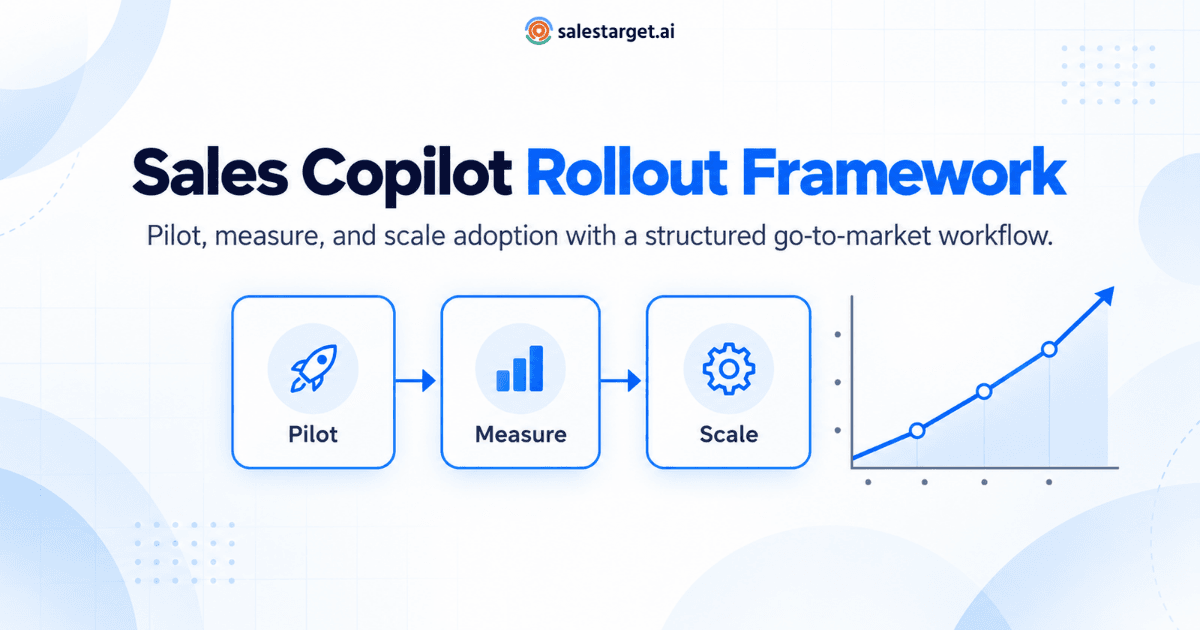
Step 1: Pick a Pilot Scope You Can Actually Learn From
Pilot scope is where most rollouts go wrong. Teams either pilot too narrowly ("one rep, one week") and learn nothing generalisable, or they pilot too broadly ("the entire SDR team on every workflow") and cannot tell what caused which outcome.
A pilot that produces real signal
- 3–5 reps, not 1 and not 15. Enough to see variance in adoption styles; small enough that you can coach each one individually.
- One segment and one motion - e.g. mid-market SaaS outbound via email + LinkedIn. Not "all outbound everywhere."
- 30 to 45 days. Shorter and you cannot see a full cycle; longer and you lose the energy of a defined pilot.
- A paired control group - reps on the same segment running the current motion. Without this, every pipeline change gets attributed to the copilot regardless of cause.
What to carve into the pilot
Give the copilot ownership of the parts of the workflow where it has a clear edge: ICP translation into search filters, first-draft email sequences, follow-up prioritisation, and campaign performance read-outs. Keep the rep clearly in charge of discovery calls, objection handling, pricing conversations, and the final send-approve decision.
Step 2: Redesign the Rep + Copilot Workflow
A copilot bolted onto an unchanged workflow produces the same results as the old workflow — just with a new tab open. The point of a rollout is to redesign how work moves between the human and the AI.
A working division of labour
- Copilot owns: prospect search across contact databases, list-building against the ICP, first-draft email sequences personalised by role and industry, follow-up timing, and campaign analytics summaries.
- Rep owns: ICP refinement, approving sends on any new campaign, live conversations (calls, demos, replies), negotiation, and the final judgment call on each deal.
- Shared with explicit handoffs: reply triage (copilot drafts, rep approves), deal-stage updates (copilot proposes based on activity, rep confirms), and sequence iteration (copilot suggests variants, rep picks).
Example: a redesigned outbound day
An SDR running an outbound motion with the copilot might start the day by asking it to list the 25 highest-signal accounts to re-engage based on open and reply data. The copilot drafts personalised follow-ups for the top 10. The SDR spends the saved time on three live discovery calls and reviews reply drafts in-between. By mid-afternoon, the copilot has produced a short list of accounts where sequences should be paused and where cadences should be lengthened. The SDR approves and moves on.
That is a very different day from "SDR spends four hours in a database tool, two hours writing emails, and one hour on calls." The rollout succeeds or fails on whether that redesign actually happens.
Step 3: Define Your Success Metrics Before You Turn It On
If you define KPIs after the pilot starts, you will end up measuring whatever looks good. A rigorous rollout fixes the scorecard in advance.
30-day leading indicators
- Rep adoption rate — percentage of pilot reps using the copilot for at least one named workflow five days a week.
- Time saved per rep per week on administrative work (list-building, drafting, reporting).
- Volume of personalised outreach sent per rep.
- Email reply rate on copilot-drafted sequences versus the control group.
60-day workflow indicators
- Meetings booked per rep per week.
- Pipeline generated per rep (SQO or equivalent stage).
- Sequence quality score — manager rubric on tone, personalisation, and relevance.
- Follow-up compliance rate — percentage of leads that received the full planned cadence.
90-day outcome indicators
- Opportunities created and their stage progression.
- Pipeline-to-close velocity change versus control.
- Cost per meeting booked.
- Rep net promoter score for the copilot — would they keep it, change it, or drop it?
A copilot that passes the 30-day adoption bar but fails the 90-day pipeline bar is a tooling problem. A copilot that fails the adoption bar is a change-management problem. Separating the two matters.
Step 4: Get Your Data Ready Before Go-Live
A sales copilot is only as useful as the data it reads from. Rolling one out onto a messy CRM, a vague ICP, and inconsistent stage definitions is how you get beautifully drafted emails sent to the wrong people.
Pre-launch data checklist
- Write down the ICP in a single page — firmographics, technographics, titles, geographies, exclusions. Vague ICPs produce vague lead lists.
- Audit stage definitions in the CRM so the copilot's "at-risk deal" flags match what reps and managers actually mean.
- Clean up duplicate accounts and contacts; a copilot that enriches duplicates will multiply the mess, not fix it.
- Standardise lead sources. If "LinkedIn", "LI", and "Sales Nav" are three different values, your analytics layer will lie to you.
- Decide which fields the copilot can write to and which are rep-only. Field governance matters more at this stage than feature config.
Step 5: Manage Adoption Like a Change Program
Rep adoption is where most pilots die quietly. A copilot that reps "sort of" use produces "sort of" results, and the pilot ends inconclusive.
What actually drives adoption
- A named internal champion — one rep (not a manager) who runs the copilot visibly, in the open, so peers can see the time saved on their next call.
- Workflow-specific enablement, not generic training. "How to use the copilot to clear your reply queue in 30 minutes" beats "Introduction to AI in Sales."
- Weekly manager reviews of copilot output — reviewing drafts, flagged accounts, and reply decisions trains the model and trains the rep simultaneously.
- A visible leaderboard tying copilot-driven activity to meetings booked — not vanity volume metrics.
- Explicit permission to override. Reps need to know they can — and should — reject copilot suggestions. A copilot that reps feel they must obey is one they will quietly route around.
Common Failure Modes to Design Around
Over-automating the first touch
The temptation is to let the copilot send fully automated first-touch sequences at scale. In practice, the reply rates on reviewed-and-approved sends are meaningfully higher, and the brand risk of a bad automated send is high. Keep the human in the loop on first-touch, at least through the pilot.
Measuring activity instead of outcomes
"Emails sent per week" went up 300% is not a win if meetings booked did not move. Define outcome KPIs — meetings, pipeline, closed revenue — alongside activity ones from day one.
Skipping the control group
Without a control, every change in the quarter — a seasonal shift, a new product launch, a competitor stumble — gets attributed to the copilot. Keep two or three reps on the current motion for the duration of the pilot, even when it feels inefficient.
Treating the copilot as the strategy
A sales copilot amplifies the strategy you already have. If your ICP is unclear, your messaging is weak, or your product-market fit is still shaky, a copilot will help you execute the wrong plan faster. Fix the strategy first, then let the copilot scale it.
Letting data debt grow unchecked
Each week the copilot runs on messy data is a week of slightly degraded outputs that reps start to distrust. Make CRM hygiene a weekly ritual, not a quarterly cleanup.
Scaling Past the Pilot: What Comes After 90 Days
A pilot that cleared the 90-day KPIs is not a scaled rollout. Scaling introduces new problems: team-wide variability, segment-specific workflows, manager visibility across larger numbers, and governance over what the copilot is and is not allowed to do.
A sequenced expansion plan
- Document the winning workflows from the pilot as repeatable playbooks — not as tribal knowledge.
- Expand to adjacent segments one at a time, re-running a shortened measurement cycle on each.
- Add role-specific playbooks (AE, SDR, CSM) rather than forcing one workflow across every role.
- Introduce manager dashboards tracking copilot-attributable pipeline, so investment decisions become data-backed.
- Set a quarterly governance review of what the copilot is allowed to do autonomously versus with approval — adoption confidence usually earns more autonomy over time.
The teams that get the most from a sales copilot treat the first 90 days as a learning phase, not a trial. They expect to redesign workflows twice before they stabilise. They staff a part-time program owner — usually from RevOps — through the first two quarters.
Make the Rollout Boring, Make the Results Loud
A good sales copilot rollout should feel deliberately boring from the outside. A clear pilot. Defined KPIs. Weekly reviews. Patient adoption work. The teams that resist the urge to broadcast a flashy launch and instead run a rigorous 90-day deployment are the ones that end up with a copilot everyone uses because it visibly makes their quarter easier.
When you are ready to see what that looks like with a built-for-outbound AI teammate, start with SalesTarget.ai Copilot — it is designed to handle the search, draft, and analytics layers of the workflow redesign described above.