Most sales teams are still running single-channel playbooks in a multi-channel world. They send an email, wait a few days, maybe send one follow-up—and then wonder why reply rates hover around 2–4%. The reality is that your prospects are not ignoring you because your message is bad. They are ignoring you because they only saw it once, in one place, at the wrong time.
AI sales outreach tools are changing that dynamic entirely. By coordinating personalized outreach across both email and LinkedIn, revenue teams are seeing measurably higher engagement—sometimes dramatically so. This article breaks down exactly how that works and gives you a practical framework to implement it today.
What is an AI Sales Outreach Tool ?
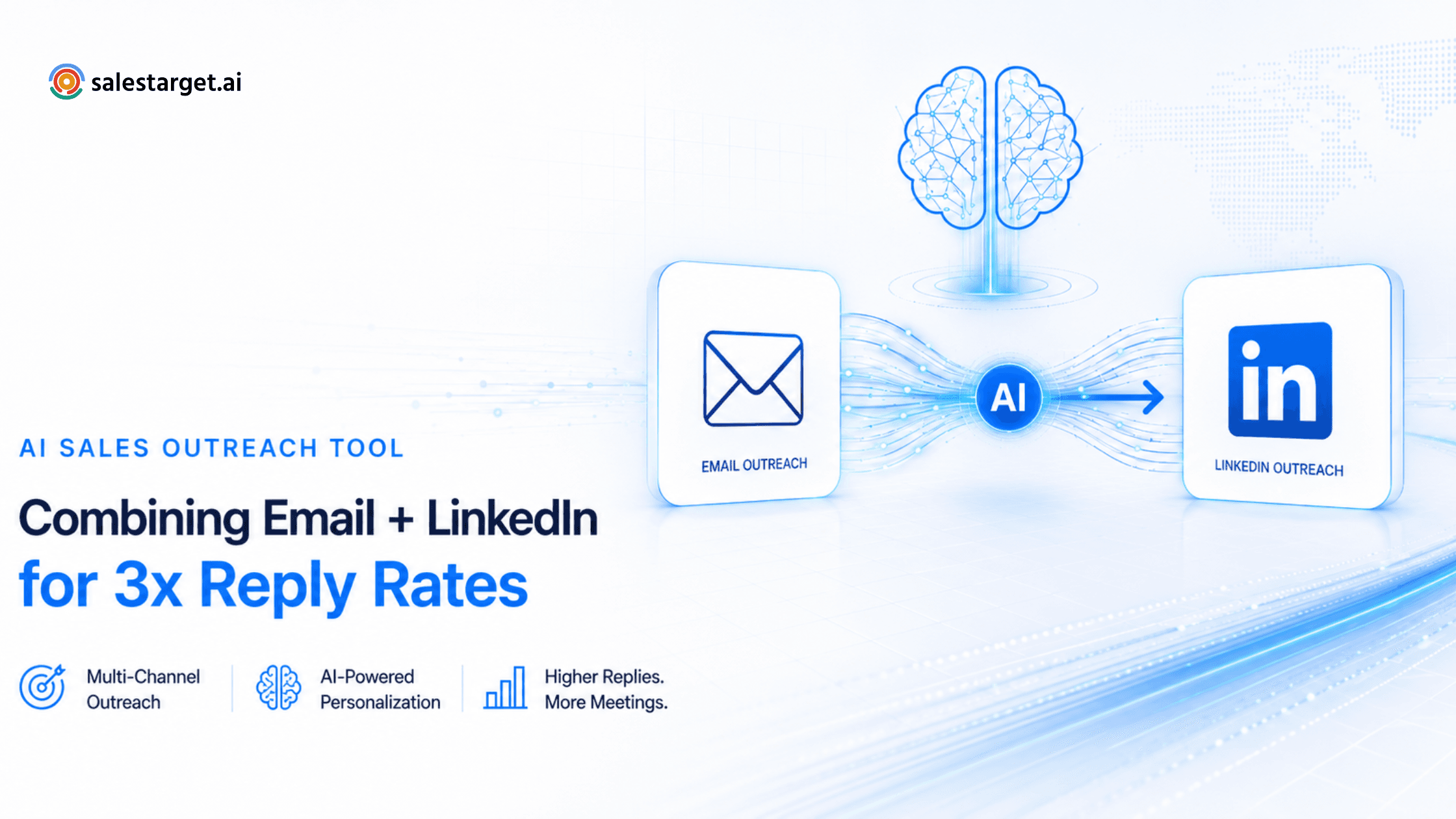
An AI sales outreach tool automates and personalizes outbound sales communication across multiple channels using machine learning. When email and LinkedIn are combined, prospects encounter your message in two distinct contexts—their inbox and their professional social feed—which builds familiarity and trust faster. Coordinated multichannel sequences generate significantly higher reply rates than single-channel approaches because multiple, well-timed touchpoints increase the likelihood that your message lands when your prospect is actually ready to engage.
Why Single-Channel Outreach Is Losing Effectiveness ?
Cold email alone used to work reasonably well. Inboxes were less crowded, spam filters were less aggressive, and buyers were less fatigued by outbound sales messages. That era is over.
Today's B2B buyers receive dozens—sometimes hundreds—of cold emails per week. Deliverability has become harder to maintain. Open rates on cold outreach have declined across most industries, and reply rates are under constant pressure. LinkedIn, on the other hand, still delivers relatively strong engagement, but InMail and connection request spam have started to erode trust there too.
The problem with relying on either channel in isolation is simple: you are betting everything on a single touchpoint that may arrive at the wrong moment, in the wrong context, to someone who has not yet developed any sense of who you are.
Multichannel outreach solves this by distributing your message and building cumulative familiarity. When done thoughtfully—with genuine personalization, not just variable substitution—it produces significantly better outcomes. The teams winning in outbound today are the ones who have mastered the coordination between channels, not just the volume within a single one.
What Is an AI Sales Outreach Tool ?
An AI sales outreach tool is a platform that uses artificial intelligence to automate, personalize, and optimize outbound prospecting across one or more communication channels. Unlike traditional sequencing tools that simply send pre-written templates on a schedule, AI-powered tools actively analyze prospect data, adapt messaging, and make decisions about timing, channel, and content.
The best tools in this category function less like email schedulers and more like intelligent outreach coordinators—systems that understand context and tailor each interaction accordingly. Exploring a modern AI outreach suite gives you a clearer sense of what these capabilities look like in practice.
Core Capabilities
Modern AI sales outreach tools typically include:
- Prospect data enrichment: Pulling signals from LinkedIn profiles, company news, job changes, and funding announcements to inform personalization.
- Sequence orchestration: Managing the timing and order of touchpoints across email, LinkedIn, and sometimes phone or direct mail.
- Dynamic message personalization: Generating unique copy variations based on prospect-specific data rather than generic templates.
- Reply detection and routing: Identifying responses and pausing or adjusting sequences accordingly.
- Performance analytics: Tracking open rates, reply rates, and conversion data by step, channel, and segment.
Why Email + LinkedIn Creates Higher Reply Rates ?
The combination of email and LinkedIn is not arbitrary. It reflects how modern B2B buyers actually move through their professional lives.
Buyer Behavior Has Changed
According to LinkedIn's B2B Institute research, it typically takes multiple brand impressions before a buyer is primed to take action. Buyers today self-educate, move between channels constantly, and make decisions as a committee—not in isolation. Your outreach strategy needs to match the complexity of how they actually behave.
When a prospect receives a thoughtful email from you and then sees a relevant LinkedIn connection request or comment from your account the following day, something important happens: you shift from being a stranger to being a familiar presence. That shift is the foundation of trust, and trust is what converts interest into replies.
Multiple Touchpoints Build Familiarity
There is a concept in marketing called the "mere exposure effect"—the tendency for people to develop a preference for things simply because they are familiar with them. In sales outreach, this translates directly. Coordinated multichannel touchpoints build the kind of familiarity that makes a reply feel natural rather than risky.
📊 Campaign Observation — Proprietary Benchmark
Based on multichannel outreach campaign observations, prospects who received coordinated email and LinkedIn touches generated up to 3x more replies compared to those in email-only sequences. This was particularly pronounced in the second and third week of a sequence, where email-only reply rates tended to plateau while multichannel sequences continued to show engagement.
Reviewing multichannel outreach trends for 2026 shows just how sharply the gap between single-channel and coordinated multichannel performance has widened.
Timing and Context Matter
Email and LinkedIn operate in different psychological contexts. Email is task-oriented—people check it when they are in work mode, often moving through an inbox with intent. LinkedIn is more reflective—people browse it when they are thinking about their careers, industry trends, and professional development.
A message that arrives in both contexts, timed appropriately, catches the prospect at different moments of receptivity. That breadth of coverage is difficult to replicate with any single channel.
A Practical Multichannel Outreach Framework
The following five-step framework is designed for B2B revenue teams who want to run coordinated email and LinkedIn sequences without sacrificing personalization for volume.
Step 1: Prospect Identification
Start by defining your ideal customer profile with precision. That means not just industry and company size, but specific signals: recent funding, hiring trends, technology stack, LinkedIn activity, and role seniority. AI-powered tools can surface these signals automatically, saving hours of manual research per campaign.
Quality of targeting at this stage directly determines everything downstream. A perfectly executed sequence to the wrong audience will still fail.
Step 2: AI Personalization
Before any message goes out, the AI analyzes each prospect's profile and generates personalization anchors—specific details that can be referenced naturally in the outreach. These might include a recent LinkedIn post, a published article, a company announcement, or a mutual connection.
The goal is not to creep the prospect out with hyper-specific surveillance. It is to demonstrate that you have done enough homework to have a real conversation. One well-chosen detail does more for reply rates than three generic value propositions.
Step 3: Email Outreach
Email is typically the first touchpoint in a multichannel sequence. A well-crafted initial email should be short (under 150 words), reference a specific insight about the prospect or their company, make a clear and relevant value statement, and include a low-friction call to action.
Platforms like SalesTarget.ai's email outreach are purpose-built for this kind of personalized, deliverability-focused outreach at scale—so teams can send sequences that feel individual without burning hours on manual writing.
The follow-up email cadence matters too. Two to three follow-ups spaced appropriately, each adding a new angle or piece of value rather than just bumping the original message, consistently outperform single-touch sends.
Step 4: LinkedIn Engagement
LinkedIn engagement should begin shortly after the first email—typically within 24 to 48 hours. This can take several forms:
- Sending a connection request with a personalized note that mirrors the email's theme without duplicating it
- Commenting thoughtfully on a post the prospect has recently shared
- Sending a LinkedIn message that picks up where the email left off
The key is to keep LinkedIn interactions feeling organic. Overly sales-heavy LinkedIn messages will be ignored just as readily as cold emails. Use this channel to add depth and humanity to the relationship you are building.
LinkedIn Outreach automation tools can manage the sequencing and timing of these touches—including connection request follow-ups and message personalization—without requiring manual effort for each prospect.
Step 5: Follow-Up Automation
After the initial email and LinkedIn touchpoints, automated follow-up sequences handle the continuation. The best AI tools will adjust follow-up timing and content based on engagement signals—pausing if a prospect opens an email multiple times (indicating interest that warrants a more human response), or testing a different angle if the first approach generated no engagement at all.
This is where the "AI" part of the tool earns its name. Static templates sent on a fixed schedule are table stakes. Adaptive sequences that respond to behavior are where the real performance gains live.
🚀 Launch Multichannel Free →
Ready to run coordinated email and LinkedIn sequences from a single platform? Start your free multichannel campaign today.
Measuring Success in Multichannel Outreach
KPIs to Track
Effective multichannel outreach measurement goes beyond open rates. The metrics that matter most:
- Reply rate by step: Which touchpoint in the sequence drives the most responses? This reveals where your messaging is landing.
- Positive reply rate: Not just replies, but replies that advance the conversation. A spike in "unsubscribe" replies signals a targeting or messaging problem.
- Meeting booked rate: The ultimate conversion metric for SDR sequences.
- Channel attribution: Which channel—email or LinkedIn—tends to trigger the reply? This informs where to concentrate personalization effort.
- Sequence completion rate: How many prospects make it through the full sequence? High drop-off at a particular step often indicates a messaging problem at that stage.
Future of AI-Powered Multichannel Outreach
The direction of AI in sales outreach is toward greater autonomy and more sophisticated context-awareness. Several trends are worth watching:
Intent signal integration. Future tools will incorporate real-time buyer intent signals—website visit data, content consumption patterns, job change triggers—to initiate and adapt outreach dynamically rather than on a fixed schedule.
Voice and video personalization. AI-generated personalized video and voice messages are beginning to enter outreach workflows, adding a human dimension that text-based communication cannot replicate.
Agent-driven outreach. Rather than executing pre-built sequences, AI agents will increasingly make autonomous decisions about when to reach out, what to say, and which channel to use—based on ongoing analysis of prospect behavior.
Cross-channel conversation continuity. Tools will get better at maintaining a coherent narrative thread across email, LinkedIn, phone, and other channels, so prospects experience a single coherent conversation rather than disjointed touches from different directions.
For GTM teams, staying ahead of these trends means investing in tools and workflows that can adapt as AI capabilities evolve—not just optimizing what is working today.
Single-channel outreach is not dead, but it is increasingly insufficient. B2B buyers move through multiple contexts in their professional lives, and your outreach strategy needs to meet them where they are—with messages that feel relevant, timely, and genuinely personalized.
Combining email and LinkedIn through an AI sales outreach tool is not about doing more outreach. It is about doing smarter outreach: coordinating touchpoints, building familiarity across channels, and using AI to make every interaction feel considered rather than automated.
The 3x reply rate improvement is not a marketing claim—it is what coordinated, personalized, multichannel outreach actually produces when the strategy and execution are aligned.