Any SDR who has worked a bloated lead list knows the pattern. Half the contacts have left the company. A quarter never fit the ICP to begin with. Another chunk work in industries where your product doesn't solve a real problem. By the time you filter out the noise, the "10,000 leads" you paid for become 400 usable ones — and even those need verifying before you can pick up the phone.
That's exactly why the search for a good B2B lead generation provider with industry-specific targeting has become one of the most frequent conversations I have with revenue teams. Generic contact databases don't cut it anymore. Buyers expect relevance in the first sentence of an email. Sales managers expect pipeline that converts, not activity metrics that inflate.
This guide walks through what to look for in a modern provider, why industry filters change everything, and how AI-driven prospecting tools are quietly reshaping how outbound gets done.
Why Industry-Specific Lead Generation Outperforms Generic Prospect Lists?
Cold outreach broken down by industry converts at a materially different rate than blanket outreach. When your subject line references a challenge a healthcare CFO actually faces this quarter — reimbursement pressure, staffing shortages, HIPAA audits — the reply rate doesn't nudge upward. It multiplies.
A few reasons this matters:
- Personalization writes itself. When you're targeting fintech compliance officers, you already know the pain (SOC 2, regulatory shifts, fraud losses). Reps don't need 20 minutes of pre-call research per prospect.
- Response rates climb. In my experience running SDR teams, industry-tight sequences consistently produce reply rates 2–3x higher than horizontal blasts. HubSpot's outbound benchmark data reflects a similar pattern.
- Pipeline quality improves. Deals sourced through relevant messaging tend to close faster because the buyer already sees the fit before the first call.
- CAC drops. You send fewer emails, burn fewer domains, and stop wasting SDR calendars on unqualified discovery.
If you're evaluating vendors right now, this breakdown of B2B lead generation services for tech companies is a useful reference for the tech-focused end of the market.
What Makes a Great B2B Lead Generation Provider?
Not every vendor claiming "100 million contacts" is actually useful. Database size says nothing about how many rows will still be accurate by the time your SDR downloads them. Here's what to actually evaluate in a B2B lead generation provider:
- Data quality and freshness. Ask when records were last refreshed. Anything older than 90 days is a liability.
- Industry segmentation depth. NAICS and SIC codes alone are too broad. Look for sub-industry tags, product-line categorization, and business-model filters.
- Buying intent data. Third-party intent signals (Bombora, G2, or the vendor's own consumption graph) tell you which accounts are researching relevant topics right now.
- Email verification. Real-time SMTP validation, not "we validated it last quarter."
- CRM integration. Salesforce, HubSpot, and Pipedrive sync should be native, bidirectional, and mapped to your custom fields.
- AI enrichment. Job title normalization, seniority tagging, and technographic detection.
- Compliance. GDPR, CCPA, and CAN-SPAM alignment. If the provider is quiet about this, walk away.
- Real-time updates. Job changes, funding rounds, and new hires should trigger updates automatically.
For a deeper look at scoring vendors on these dimensions, this framework for evaluating B2B database providers walks through a scoring model I've recommended to several revenue leaders.
Features Every Modern Sales Team Should Look For
The best lead generation software today is judged less by data volume and more by signal quality. When I sit down with sales managers evaluating tools, these features usually decide the shortlist:
- AI-powered prospecting that surfaces lookalike accounts from your closed-won pipeline
- Buyer intent signals across job postings, tech installs, and web activity
- Verified emails and direct-dial numbers with catch-all detection
- Company enrichment — revenue, headcount, funding stage, growth trajectory
- Contact enrichment — role, tenure, LinkedIn activity, decision-making authority
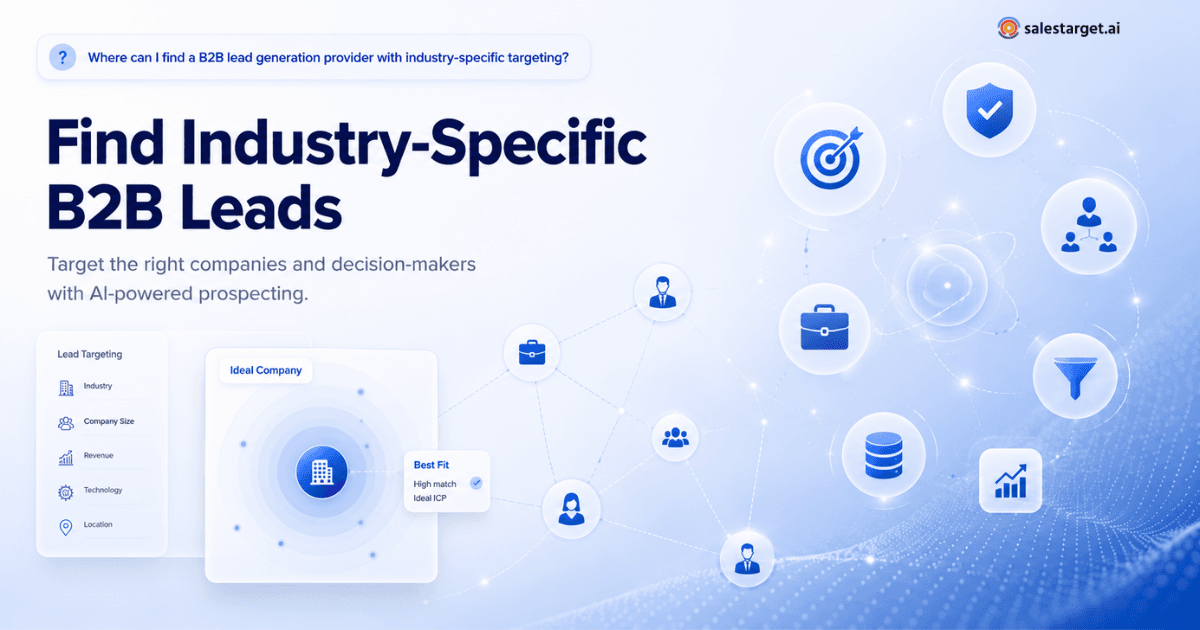
- Smart filtering across firmographic, technographic, and behavioral layers
- Revenue signals like recent funding, IPO activity, or expansion announcements
- Funding data with round size, investors, and use of proceeds
- Technology filters to identify companies running competing or complementary stacks
- Hiring trends as a leading indicator of team expansion and budget
If a platform can only give you a name and a title, it's a directory — not a sales intelligence tool.
Industry-Specific Targeting: Why SDRs and Sales Managers Care
Here's where the abstract becomes concrete. Industry-specific targeting rewrites the outbound playbook for every vertical.
SaaS. An SDR selling to VP Engineering roles at Series B SaaS companies can filter by tech stack (say, teams running Kubernetes and PostgreSQL), recent backend hiring, and a growth rate above 40%. The opening line practically writes itself: "Saw you're scaling the platform team — noticed you're running Postgres at load…"
Healthcare. For a clinical documentation tool, filtering by hospital size, EHR system (Epic vs. Cerner), and recent Joint Commission audit outcomes turns an outreach list into a conversation.
Manufacturing. Selling ERP into mid-market manufacturers? Filter by number of plants, ISO certifications, and whether they've announced supply chain disruptions in the last quarter.
Finance. Compliance software into community banks looks very different from selling into hedge funds. Segmentation by AUM, regulatory footprint, and recent examination cycle is what separates a warm lead from a cold interruption.
Marketing agencies. Filtering by client size, service mix (paid vs. organic vs. creative), and agency growth rate turns generic outreach into a strategic pitch.
The pattern is consistent: the tighter the industry filter, the sharper the messaging, and the higher the reply rate.
How AI Improves B2B Lead Generation
The "AI in sales" pitch has gotten noisy. Strip away the marketing gloss, though, and there are a handful of places where AI actually earns its keep in prospecting workflows:
- AI enrichment fills missing fields (job function, seniority, tech stack) by inferring from public signals.
- Intent scoring ranks accounts by how likely they are to buy in the next 30–90 days.
- Automated segmentation clusters accounts by fit and buying stage without an analyst manually building the query.
- Prospect scoring blends firmographic, intent, and engagement signals into a single number.
- Sales prioritization tells reps what to work first every morning instead of leaving it to gut feel.
- Workflow automation pushes qualified leads into cadences, alerts owners on job changes, and updates the CRM without human touch.
McKinsey's research on AI adoption in sales suggests teams applying these capabilities meaningfully see productivity gains in the 10–20% range — which, for a 20-rep SDR org, is significant.
Common Mistakes Buyers Make
Watching sales teams evaluate providers, I see the same missteps repeated:
- Choosing based on database size. A record that's wrong or stale isn't a lead — it's a headwind.
- Ignoring data freshness. Contact turnover in tech runs at roughly 20% annually. Old data is worse than no data.
- Buying cheap scraped lists. Deliverability tanks, domains get blacklisted, and the "savings" cost you a quarter of pipeline.
- Skipping email verification. Bounces above 3% wreck sender reputation.
- Loose ICP definition. No provider can save you from targeting the wrong companies.
For a more comprehensive rundown of vendors in this space, this list of top B2B data providers is worth reviewing before you commit to a contract.
Comparison Table: Generic Lists vs. Industry-Specific AI Provider
| Dimension | Generic Lead Lists | Industry-Specific AI Provider |
|---|---|---|
| Accuracy | Often 40–60% valid | Typically 90%+ verified |
| Intent Signals | None | Real-time buyer intent |
| Industry Filters | Broad NAICS codes | Sub-industry, tech stack, business model |
| Email Verification | Static or none | Real-time SMTP validation |
| CRM Sync | Manual CSV import | Native bidirectional integration |
| ROI | Low, hard to attribute | Higher reply rates, measurable pipeline |
| Personalization | Generic templates | Signal-driven, role-relevant messaging |
| Scalability | Manual work grows linearly | Automation compounds as data grows |
How Lead Explorer Supports Modern Prospecting
Lead Explorer fits into the category of tools that pair industry-specific filtering with AI-driven data. Rather than serving up a 100-million-row database and hoping reps figure out the filters, it's structured around the way sales teams actually work:
- AI-powered prospect discovery that surfaces accounts matching a defined ICP, plus lookalikes.
- Industry filters with sub-vertical granularity across SaaS, healthcare, finance, manufacturing, and other segments.
- Verified contact data with real-time email checks and direct-dial coverage where available.
- Company intelligence covering firmographics, funding, tech stack, and hiring signals.
- Decision-maker targeting by role, seniority, and buying committee involvement.
- Workflow efficiency through CRM integration and automated updates that keep records fresh.
It isn't a silver bullet - no tool is - but for teams tired of scraping and validating, it removes friction from the top of the funnel.
Take a Closer Look
If you're rethinking how your team sources pipeline, take a look at Lead Explorer and see whether industry-specific targeting could sharpen your outbound motion. No hard sell — just a chance to compare what your current stack surfaces against what a signal-driven workflow can pull in.
The right B2B lead generation provider isn't the one with the biggest number on the marketing page - it's the one that gives your team accurate, industry-specific, intent-rich data that shortens the path to revenue. Quality beats quantity every quarter.
Industry-specific targeting isn't a nice-to-have; it's the difference between an SDR who books three meetings a week and one who books three a day. Combine that with verified contact data, buyer intent, and AI-driven prioritization, and outbound stops feeling like a numbers game.
Tools like Lead Explorer are worth exploring if you're ready to move past static lists and toward a smarter, signal-driven prospecting workflow.