Your SDR built a list of 500 contacts, wrote a sharp three-step sequence, and hit send. Two days later the metrics come in and they're rough, a 12% bounce rate and only three replies, two of them annoyed that the company had already been sold. The copy was fine. The targeting was fine. The data underneath it was rotten.
That's the part most teams blame last, even though it breaks everything first.
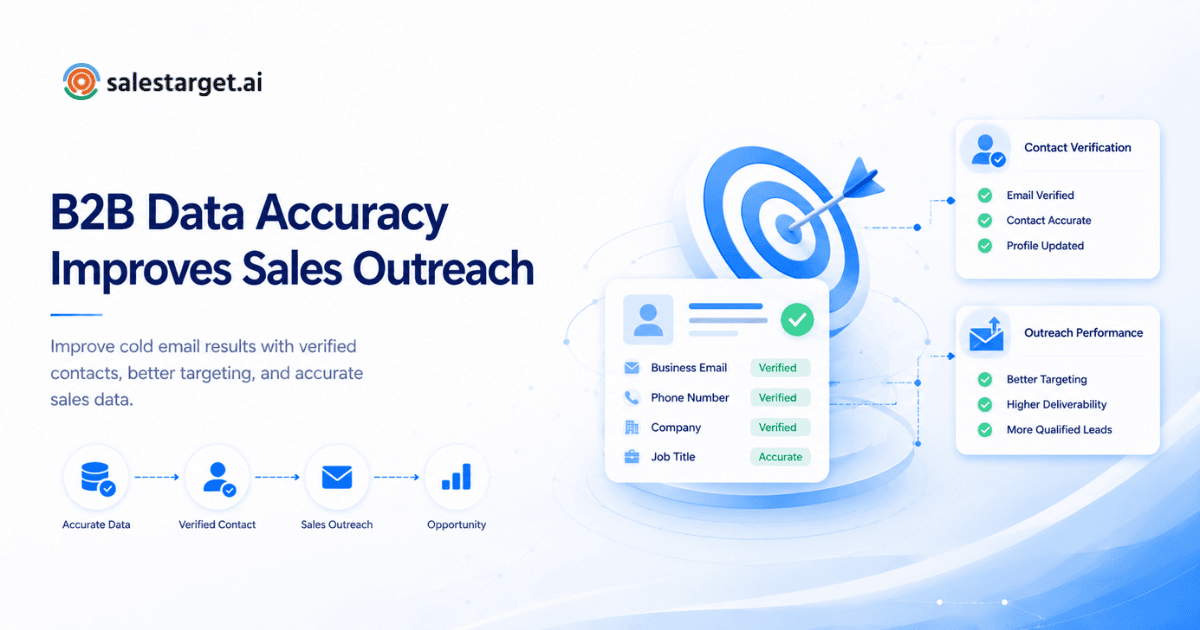
B2B data accuracy is the measure of how closely the information in your contact list matches reality right now: the right person, the right email, the right job title, at the right company. When that data is accurate, your cold email lands in an inbox that's still open, addressed to someone who still holds the role you're targeting. When it isn't, your open rates, reply rates, and sender reputation all take the hit before a single prospect reads a word.
Why Your Cold Email Campaign Fails Before It Starts?
Most cold email campaigns die before the first message goes out, and the cause sits in the list, not the subject line. A sequence built on stale contacts is working against itself from message one.
B2B contact data degrades fast. Research built on MarketingSherpa data, widely cited in B2B data accuracy analysis, puts the average monthly decay rate at 2.1%, which compounds to roughly 22.5% a year. A list pulled in January is carrying real damage by June, and a team that refreshes its data once a year sends to outdated records for eleven months out of twelve.
Job changes drive most of that decay. A contact who moves roles takes their old email, direct line, and title with them, and three fields in your CRM go bad in the same moment. Acquisitions and rebrands wipe out entire domains overnight. None of this shows up as an error message. It shows up as silence, or a bounce that quietly damages the sending domain your whole team relies on for every campaign that comes after.
What Is B2B Data Accuracy and Why It Matters Now?
B2B data accuracy means a contact record matches what's true about that person and that company today, not six months ago. That covers the email address, the direct phone line, the job title, the company name, and the signals that say whether an account is actually in market right now.
The reason this matters more now than five years ago comes down to speed. Average job tenure in tech sits close to two to three years, turnover at SDR and AE level moves even faster, and mailbox providers like Google and Yahoo have tightened the rules bulk senders must follow. A bulk sender whose spam complaint rate creeps past 0.30% risks a hard block, and the recommended operating target sits closer to 0.10%. A list full of dead and mistyped addresses is the fastest way to cross that line, and once you cross it, recovery takes weeks.
The Real Impact of Data Quality on Your Sales Pipeline
How inaccurate contact data kills your open and response rates
An email sent to the wrong person can't get a real reply no matter how sharp the copy is. If the marketing leader you reached out to moved into a CMO role at another company eight months ago, referencing her previous position in your opening message can make your outreach feel uninformed and out of touch. Reply rates fall not because the message was weak, but because the person reading it isn't the buyer you researched. Open rates take a separate hit too: inboxes that no longer exist never register an open at all, so every metric below them gets quietly skewed by data nobody checked.
Bounce rates, sender reputation, and the domino effect
A hard bounce tells a mailbox provider that you're sending to an address that doesn't exist, and providers track that pattern by domain, not by individual contact. Cross a 2% bounce rate and inbox providers start throttling delivery. Cross 5% and blacklisting becomes a real risk. Once a domain gets flagged, every future campaign sent from it pays the price, including the ones built on a perfectly clean list. One bad batch can cost a team weeks of deliverability recovery long after the original list is gone.
Time wasted on bad leads vs. time saved with clean data
Every rep has lived this hour: dial a number that's been reassigned, look up a contact who left eighteen months ago, rewrite a message because the title in the CRM doesn't match LinkedIn. Multiply that across a full prospecting list and the math gets ugly fast. Reps running on verified data skip straight to the conversation. Platforms built for this, like SalesTarget.ai's Lead Explorer, enrich and verify a contact in the same click, so that hour never gets lost chasing a dead end in the first place.
Why verified email addresses matter more than volume
A list of 50,000 unverified contacts will always underperform a list of 5,000 verified ones, since volume can't fix a wrong address. Verified emails convert better simply by landing. Unverified lists trade a short-term sense of reach for a long-term deliverability problem, and that trade rarely pays off once bounce rates start dragging down sender reputation across every sequence that follows.
How to Verify and Enrich B2B Contact Data Before Outreach
Step 1: Run MX and SMTP checks on your contact list
Before a single email goes out, run the list through an MX record check to confirm the domain accepts mail, then an SMTP check to confirm the specific mailbox is live, without sending a real message. This catches dead domains and disabled mailboxes in seconds, and it's the cheapest insurance a list will ever get against a bounce spike. SalesTarget.ai's Email Validator runs MX and SMTP checks plus disposable-email detection in real time, so a list gets cleaned at the point of upload instead of after the first bounce report comes in.
Step 2: Cross-reference with multiple B2B databases
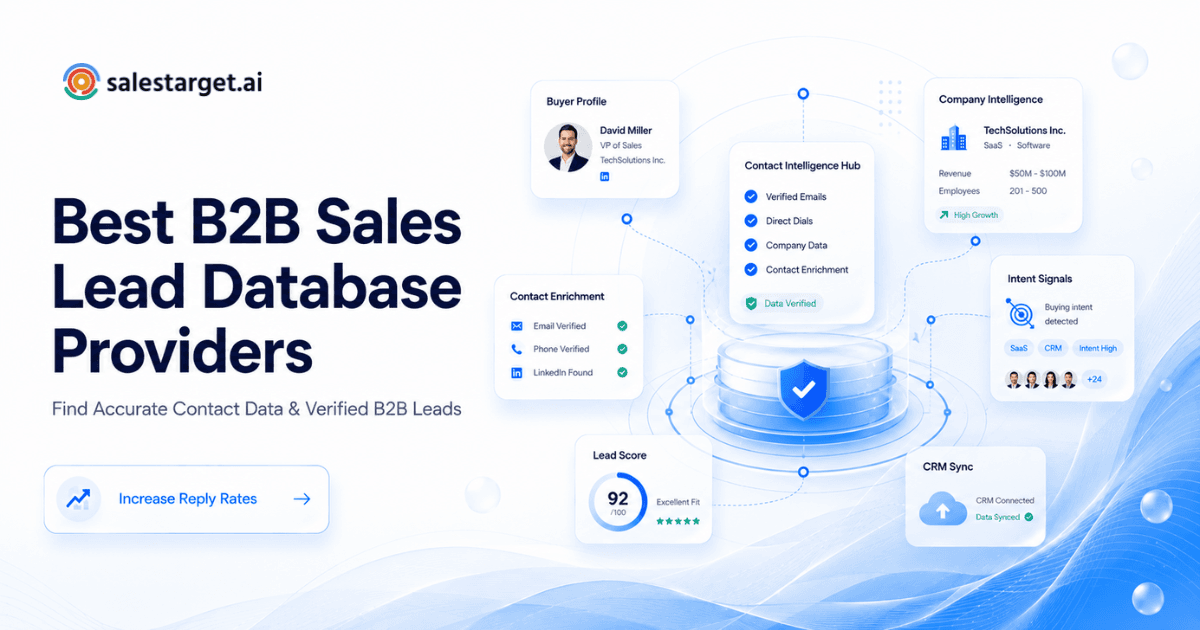
No single data source matches every contact, every company, and every geography. Single-source enrichment commonly tops out around a 30% to 60% match rate, which is why teams that rely on one provider end up with gaps they never notice until a campaign underperforms. Comparing options across multiple B2B sales lead database providers makes that gap visible fast, and running a contact through two or three sources, then keeping the most recent and complete record from each, builds a far stronger profile than trusting any single vendor's claim.
Step 3: Enrich missing fields (job title, company size, intent signals)
A name and an email address aren't enough to prioritize a list. Job title tells a rep who actually owns the decision. Company size and revenue band tell a rep whether the deal is worth the time. Intent signals, tied to real account activity like funding rounds, hiring spikes, and leadership changes, tell a rep when to reach out instead of just who to reach. Skipping this stage means treating all contacts alike, making it difficult to prioritize the prospects most likely to deliver results.
Step 4: Build a contact validation workflow into your prospecting process
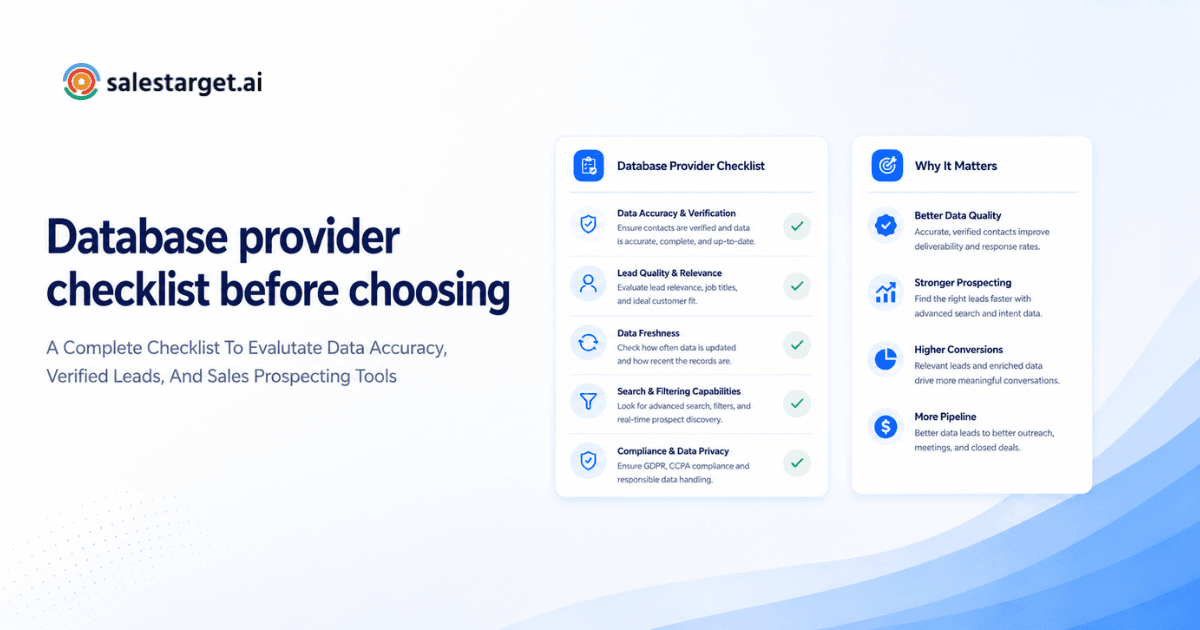
Verification is a habit, not a one-time event, since the data starts decaying again the moment it's confirmed clean. The strongest workflows validate at three points: when a contact first enters the list, right before a sequence launches, and on a recurring schedule for anything sitting in the CRM longer than 90 days. If you're still choosing a provider to build this workflow around, working through a database provider checklist before signing anything saves a lot of cleanup later.
Key Signals That Separate Accurate Data from Junk
Direct email addresses (not info@ or support@)
A generic inbox like info@ or support@ gets read by whoever's turn it is, if anyone reads it at all, and it almost never reaches a decision-maker. A direct email tied to a named person with a confirmed title is the difference between a message that gets filtered and one that gets a reply.
Last-verified dates and data freshness
A contact record without a last-verified date is a guess dressed up as data. Freshness matters more than most teams admit. A field verified yesterday and a field verified eighteen months ago can carry the same confidence score in a spreadsheet, but one of them is close to worthless.
Intent signals tied to account activity
Intent data tells a rep when an account is actually in motion. A funding round, a sudden hiring spike in a department that buys your product, or a new VP starting in the role you sell into are all signals that timing has shifted. A perfectly accurate contact reached at the wrong moment still underperforms a slightly less polished message that lands right after a real trigger event.
Company intelligence and employee count
Job titles drift across companies of different sizes, so a VP at a 20-person startup and a VP at a 2,000-person enterprise rarely make the same kind of decision. Pairing contact data with accurate employee count and revenue range keeps a rep from misjudging authority and budget on the same title.
LinkedIn profile matches and role confirmation
LinkedIn updates faster than almost any other data source. People update it themselves the day they change jobs. Cross-checking a contact against their current LinkedIn profile before a campaign launches catches the job changes that haven't worked their way into a database refresh yet.
Why Choose SalesTarget.ai?
Most of the steps above take real time to run by hand, across separate tools that don't talk to each other. SalesTarget.ai builds them into one workflow instead of five.
840M+ verified profiles with 99% accuracy built into Lead Explorer
Lead Explorer draws from more than 840 million professional profiles and 146 million business entities, with verification built into the search itself instead of bolted on after the fact. A rep searching in plain English or stacking filters by role, seniority, and company size gets contacts checked at 99% accuracy, confirmed at the point of search rather than whenever the record was first scraped.
Email Validator with MX/SMTP checks to stop bounces before they happen
The Email Validator runs MX and SMTP checks, flags disposable addresses, and scores risk before a single send, whether on a fresh list or a bulk import from somewhere else. It's the same check covered in the verification workflow above, run automatically instead of by hand.
Lead enrichment in one click, no manual research
Missing fields like title, company size, and intent topic get filled the moment a lead is found, not after a separate research pass. One click turns a bare name into a full profile with verified contact details attached, on data confirmed at the point of enrichment rather than whenever it was last touched.
Email and LinkedIn outreach run together on verified data
Email Outreach and LinkedIn Outreach pull from the same verified contact record, so a sequence can branch between channels without re-checking the data twice. A rep building a multichannel cadence works from one accurate source instead of stitching two separate tools together by hand.
Auto-logged CRM so your contact data stays fresh
Every email and call lands in the CRM timeline on its own, so a contact record updates itself through the outreach a rep is already doing instead of waiting on a quarterly cleanup. Follow-up tasks get created automatically, which keeps a rep working the account instead of updating a spreadsheet.
Free AI Copilot to refine your outreach strategy
The AI Copilot answers questions about campaign performance, finds leads on request, and flags deals that are going quiet, all inside the same workspace holding the verified data. A rep can ask what's working in plain language instead of building a report first.
Common B2B Data Accuracy Mistakes That Cost Sales Reps Hours Each Week
Trusting old data without refresh cycles
A prospect list that was up to date in January can look very different by July. Teams that build or buy a database once and never revisit it are working against a 2.1% monthly decay rate whether they track it or not, and the gap between what the CRM says and what's actually true keeps growing quietly in the background.
Mixing verified and unverified contacts in the same sequence
Dropping a batch of unverified contacts into a sequence already running on clean data drags the whole list's bounce rate up together, since mailbox providers score reputation at the domain level, not the contact level. One unverified batch can undo the deliverability earned by every verified send that came before it.
Ignoring job title changes and company turnover
A title that's six months stale can send a message about budget authority to someone who no longer has it, or skip past the person who just inherited the decision. Company turnover compounds the problem: an account that was a 50-person startup at the start of the quarter might be a division of a much larger buyer by the end of it.
Skipping email validation and paying in bounce rate penalties
Skipping validation to save a few minutes on send day is the most common shortcut reps take, and it's the one with the steepest bill attached. Gartner research has put the average cost of poor data quality at roughly $12.9 million a year for a typical organization, a figure built from wasted rep hours, blown sequences, and the deliverability damage that follows a bad batch.
Buying lists without deliverability guarantees
A purchased list with no verification guarantee and no last-checked date is a gamble dressed up as a shortcut. The cheaper the list, the more likely it was scraped once and resold many times over, and the buyer absorbs the bounce damage the seller already moved past. Working from a guide on how to choose the right B2B database provider before signing a contract avoids most of this risk entirely.
The Bottom Line: Accurate Data Is the Engine of Cold Email Success
Go back to that SDR from the opening, staring at a 12% bounce rate and two angry replies. None of that traces back to weak copy or a poorly timed send. It traces back to a list that was already broken before the campaign launched, and no clever subject line fixes a wrong email address.
Cold email outreach succeeds or fails on the data underneath it. Verified emails protect sender reputation. Fresh job titles and company data put the message in front of someone who can actually act on it. Intent signals decide whether the timing helps the message or works against it.
SalesTarget.ai builds all of that into one workspace instead of five separate tools. Lead Explorer finds and enriches a contact in the same click, the Email Validator checks it before it ever reaches a sequence, and the CRM keeps every record current through the outreach a rep is already running. The fix for the problem this article opened with isn't a sharper subject line. It's a data layer that doesn't break before the campaign starts.
Build your next list on data that's actually verified, not just collected.