TL;DR
|
The Problem: Most Teams Build the List First
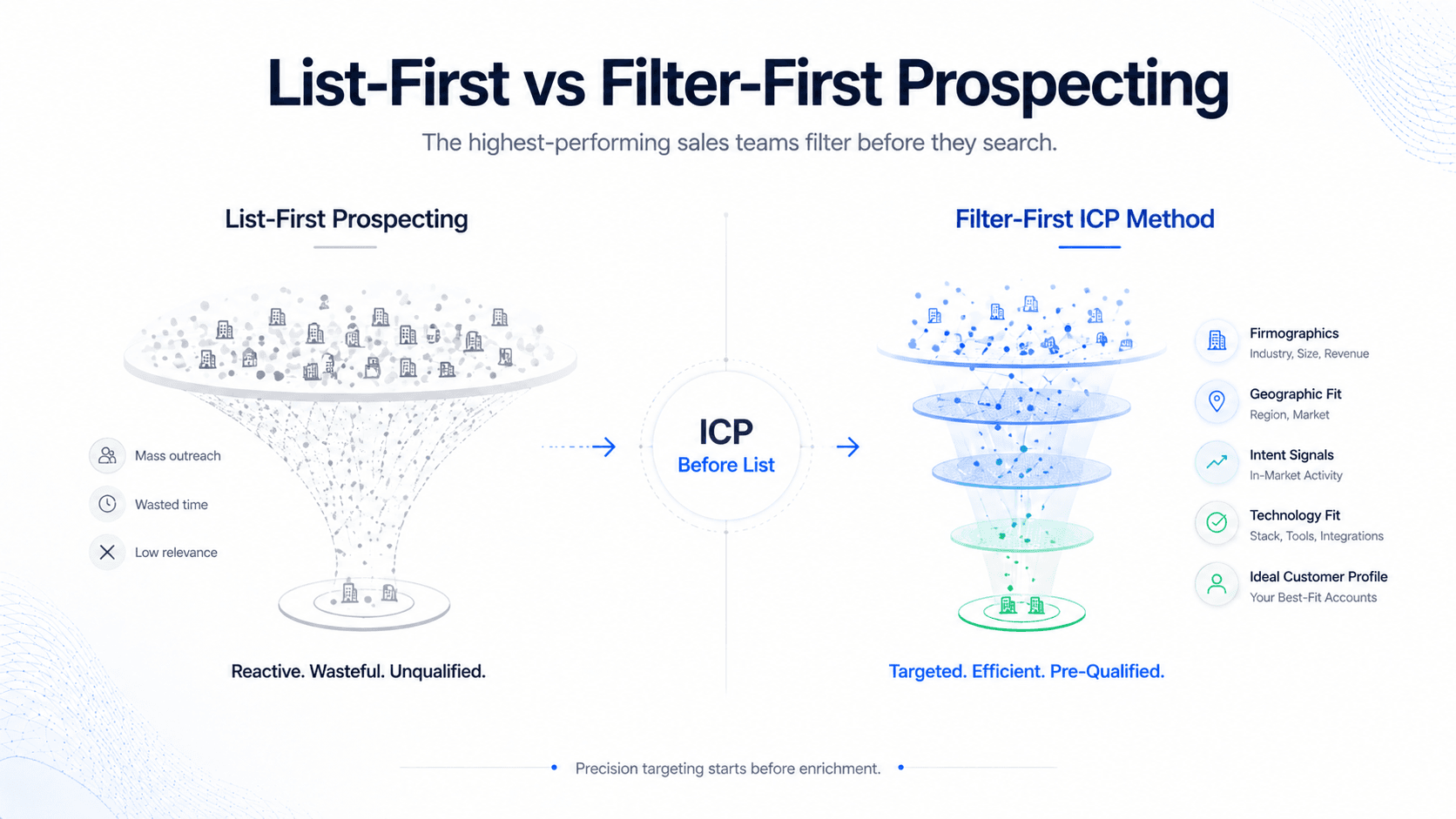
Here is what the standard B2B prospecting workflow looks like for most teams: pull a list from a database, export it, look at who's on it, then decide whether they're a good fit. The ICP definition happens after the fact — often as a rationalisation for why the list is the way it is.
This is backwards. And it is expensive.
When you build the list before you define the ICP, every piece of work downstream — enrichment, scoring, sequencing, personalisation — is happening on a partially unqualified base. You are paying to enrich leads you should never have pulled. You are spending SDR time writing personalised outreach to companies that were never going to buy.
⚠️ The cost of backward prospecting
Research from Salesforce found that the average SDR spends 40% of their time on prospects that will never convert — not because the outreach was bad, but because the company was never a real fit. Defining ICP before the list eliminates this category of wasted effort entirely.
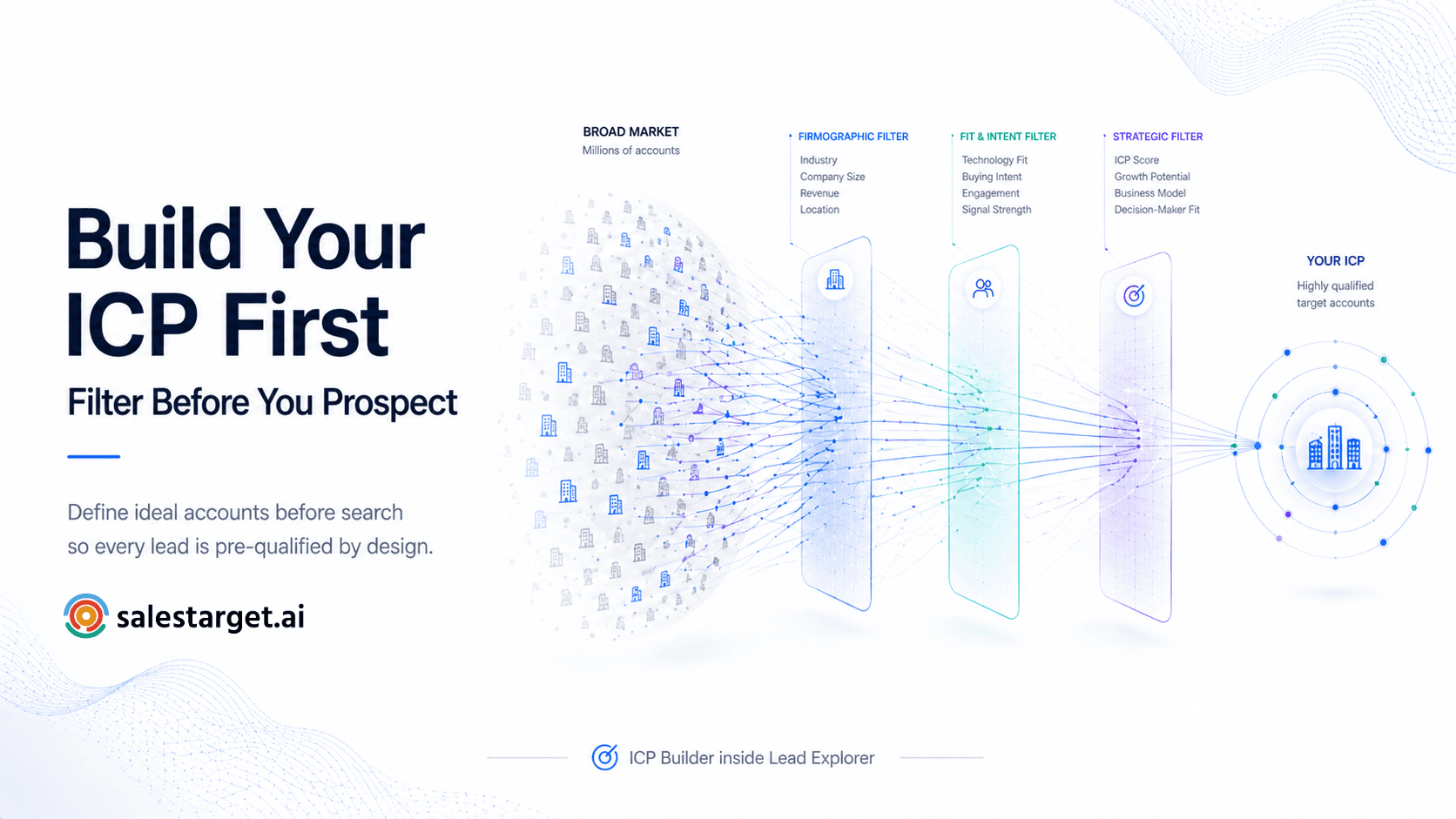
The Filter-First method flips this entirely. You define the ICP — every dimension of it — before you run a single search. The list that comes back is pre-qualified by definition. Every account on it matches your criteria. You have not enriched anyone you should not have reached.
What an ICP Actually Is (and What It Is Not)
An Ideal Customer Profile is a precise definition of the type of company most likely to buy your product, get value from it, and stay. It is not a vague marketing persona ('mid-market SaaS companies'). It is a set of specific, filterable criteria that can be applied to a database.
| ICP is... | ICP is not... |
|---|---|
| A set of specific, filterable criteria applied before building a list | A persona document that sits in a Notion page and rarely gets used |
| Company-level attributes (size, revenue, industry, tech stack) | Individual-level demographics (age, interests, personality type) |
| Defined by your best existing customers — reverse-engineered from revenue | Defined by who you think you should sell to based on intuition |
| Updated regularly as customer data evolves | Set once during onboarding and forgotten |
| The first filter in your prospecting workflow | A post-hoc explanation for why a list looks the way it does |
💡 Key distinction
ICP scoring is different from lead scoring. ICP scoring measures company fit — does this account match the profile of companies that buy and retain? Lead scoring measures individual readiness — is this contact likely to engage now? Both matter. ICP scoring comes first. You filter by ICP before you apply any intent or engagement scoring on top.
The Six Dimensions of a Filterable ICP
A good ICP has six dimensions, all of which should be translatable into searchable filters before you pull a single contact.
| Dimension | What to define | Why it matters | Example |
|---|---|---|---|
| Industry / Vertical | The specific industries your product solves best for — not just 'B2B' | Determines product-market fit at the category level | SaaS, Professional Services, Staffing — not 'technology companies' |
| Company size (headcount) | The employee count range where your product fits operationally | Too small = no budget or process; too large = wrong buying motion | 50–500 employees |
| Revenue | Annual revenue range of your best customers | Revenue signals buying power and sales cycle length | $5M–$100M ARR |
| Geography | Countries, regions, or cities where your ICP is concentrated | Affects compliance, language, and outreach timing | US, Canada, UK — English-language markets only |
| Tech stack | Tools your buyers already use that signal fit or displacement opportunity | Shows operational maturity and integration compatibility | Uses HubSpot or Salesforce, runs outbound sequences |
| Buyer role | The job title or function of the person who buys and champions | Determines who to find inside each qualifying company | VP of Sales, Head of RevOps, Sales Director |
How to Build Your ICP: The Filter-First Method Step by Step
- Step 1 — Start with your best 10–20 customers: Pull the accounts with the highest retention, lowest churn, and highest NPS. These are your ICP anchors — the companies that got the most value from your product.
- Step 2 — Extract the common attributes: What industry are they in? What size? What revenue range? What tools are in their stack? What role did the champion have? Map these patterns across all accounts.
- Step 3 — Identify the negative ICP: Look at your worst customers — highest churn, lowest satisfaction, longest sales cycles. What do they have in common? These become your exclusion filters.
- Step 4 — Translate to filters: Every dimension of your ICP should have a corresponding filter in your prospecting tool. If you can't filter for it, it's not specific enough.
- Step 5 — Set the filters before the search: In SalesTarget.ai's ICP Builder, set every filter before you run the search. Industry, size, revenue, geography, tech stack, buyer role — all defined upfront. Every result that comes back already matches.
- Step 6 — Add intent layer on top: Once your ICP-filtered list is set, add intent topic filters to surface accounts that are also actively researching relevant topics right now. ICP fit + intent signal = Tier 1 priority.
🎯 The Filter-First advantage
SalesTarget.ai's ICP Builder is designed around this model — you define all ICP parameters before running a search across 840M+ professional profiles and 146M+ business entities. The list you pull is pre-qualified by definition. You have not wasted a single enrichment credit on an account that doesn't fit.
ICP Scoring vs Lead Scoring: Understanding the Difference
These two terms are often conflated, but they operate at different levels and answer different questions.
| ICP Scoring | Lead Scoring | |
|---|---|---|
| What it measures | Company-level fit — does this account match the profile of companies that buy? | Individual readiness — is this contact likely to engage or convert now? |
| Data sources | Firmographics, technographics, industry, size, revenue | Behavioural signals, intent data, engagement history, seniority |
| When it applies | Before you build the list — at the search and filter stage | After you have a list — to prioritise which contacts to contact first |
| Output | In / Out — does this company belong on the list at all? | Score 0–100 — which contacts on the list should be contacted first? |
| In SalesTarget.ai | ICP Builder filters applied before the search | Intent Topics + Lead Scoring applied after the list is built |
Both are necessary. But ICP scoring comes first. You do not lead score a company that was never a real fit — you filter them out before they ever reach your enrichment or outreach workflow.
Common ICP Mistakes (and How to Avoid Them)
| Mistake | Why it costs you | Fix |
|---|---|---|
| Defining ICP too broadly ('mid-market B2B') | Every search returns too many results with no shared characteristics | Add at least 4 of the 6 dimensions as hard filters, not guidelines |
| Building ICP from assumed fit, not existing customers | You optimise for the customers you want, not the ones who actually buy and stay | Start from your 10–20 best existing accounts — reverse-engineer from revenue |
| Not defining a negative ICP | You keep pulling accounts that look right on paper but churn in 90 days | Explicitly define which company types to exclude — small teams, wrong verticals, legacy tech stack |
| Setting ICP once and never updating | Your ICP from 12 months ago may not reflect your product's current capabilities | Review your ICP quarterly against recent closed-won and churned data |
| Treating ICP as a list filter, not a company attribute | You re-qualify every lead manually instead of encoding ICP into the search tool | Use SalesTarget's ICP Builder to encode criteria before the search |
| Separating ICP building from list building | You define ICP in a document, then manually filter a list by hand — slow and inconsistent | The ICP should be the search — set filters first, pull list second |
The ICP in Practice: A Before and After
Before (list-first approach)
- Export 500 contacts from a database filtered only by 'VP of Sales'
- Open each record individually to check industry, company size, tech stack
- Manually remove ~40% that don't match what you had in mind
- Enrich the remaining 300 — but you've already paid credits for all 500
- Write personalised outreach for 300 accounts, half of which still won't fit
After (Filter-First method with ICP Builder)
- Set ICP Builder filters: SaaS, 50–500 employees, $5M–$100M revenue, US + UK, uses HubSpot or Salesforce, VP Sales or Head of RevOps
- Search returns only accounts matching all criteria — pre-qualified, every one
- Add Intent Topics filter to surface accounts surging on relevant topics
- Enrich the top-scoring accounts — you spend credits only on real prospects
- Start outreach within the same workflow — no CSV, no import, no switching tools
📊 The output difference
The Filter-First method does not just save time. It changes the quality of the list fundamentally. Every account that gets enrichment credit spent on it, every sequence slot it fills, every piece of personalised outreach written for it — is for a company that actually fits. That is the compounding advantage of ICP-before-list.
Conclusion: Define the ICP Before the List — Every Time
The teams consistently getting the highest reply rates, lowest bounce rates, and shortest sales cycles are not the ones with the biggest databases. They are the ones with the most precisely defined ICPs — applied as filters before the list is built.
SalesTarget.ai's ICP Builder is built around this model. Define every dimension upfront. Layer in intent topic filters to add timing. Run the search. Every result is already pre-qualified. Every credit spent on enrichment is spent on a real prospect.
Not a bigger list. A better-defined one.
Build your ICP before your list — not after.
Lead Explorer + ICP Builder — 840M+ profiles, filtered to fit from the start.
→ Start free — 50 credits Book a demo
50 credits · 7-day trial · No credit card required.