Most sales leaders don't have a pipeline problem. They have a capacity problem. Your SDRs are talented, motivated, and stretched impossibly thin — manually researching prospects, personalizing emails, chasing follow-ups, and logging everything into a CRM that never quite reflects reality.
The solution most teams reach for is headcount. Hire more SDRs. Spend more on salaries, tools, onboarding, and ramp time. And still fall short of quota.
There's a faster, leaner path. An AI-powered sales assistant can handle the volume work your team doesn't have time for — and do it at a scale no human team could match.
What is an AI Powered Sales Assistant and how can it help book more meetings?
An AI-powered sales assistant is software that automates prospecting, outreach, follow-ups, and lead research on behalf of sales reps. It uses machine learning and natural language processing to send personalized emails, identify high-intent buyers, and schedule meetings — enabling revenue teams to book 3–5x more meetings without expanding their SDR headcount.
The New SDR Bottleneck Nobody Talks About
Ask any SDR what a typical Tuesday looks like, and you'll hear the same story. Research a prospect. Write an email. Send it. Wait. Follow up. Repeat — for dozens of contacts a day. It's not that SDRs lack skill; it's that manual prospecting is structurally inefficient for the scale modern B2B sales demands.
The average SDR spends less than 30% of their time actually engaging with prospects. The rest goes to research, CRM updates, and administrative overhead. Meanwhile, buyer expectations have shifted. Decision-makers receive hundreds of generic cold emails weekly. The bar for personalization has never been higher, yet teams have never had less time to meet it.
Follow-up sequences are another silent killer. Research consistently shows it takes 8–12 touches to convert a cold prospect into a booked meeting. Most SDRs stop at three — not because they don't know better, but because there aren't enough hours.
This is the bottleneck no one wants to admit: the process itself is broken, and adding more humans to a broken process doesn't fix it.
Why Traditional SDR Scaling No Longer Works
The instinct to hire when pipeline pressure rises is understandable. But the economics of SDR scaling have changed dramatically. A fully loaded SDR — salary, benefits, tools, and management overhead — costs most companies between $80,000 and $120,000 per year before they book a single meeting. Then add three to four months of ramp time, a 30–40% annual turnover rate, and the reality that performance varies wildly from rep to rep.
Gartner research indicates that by 2026, a significant majority of B2B sales interactions will be influenced by AI — a shift that will fundamentally change how outbound teams operate. Teams scaling purely by adding headcount are running a race with an increasingly unfavorable ROI. (Source: Gartner Sales Research)
There's also the consistency problem. Even your best SDRs have off days. They miss follow-ups, send generic emails under deadline pressure, and can't maintain the same outreach quality across 80 prospects simultaneously. That inconsistency directly impacts pipeline predictability.
Teams using AI-assisted workflows report up to 40% faster prospect engagement compared with traditional SDR-only processes — because the AI doesn't have off days, doesn't forget to follow up, and never runs out of capacity.
What Exactly Is an AI Powered Sales Assistant?
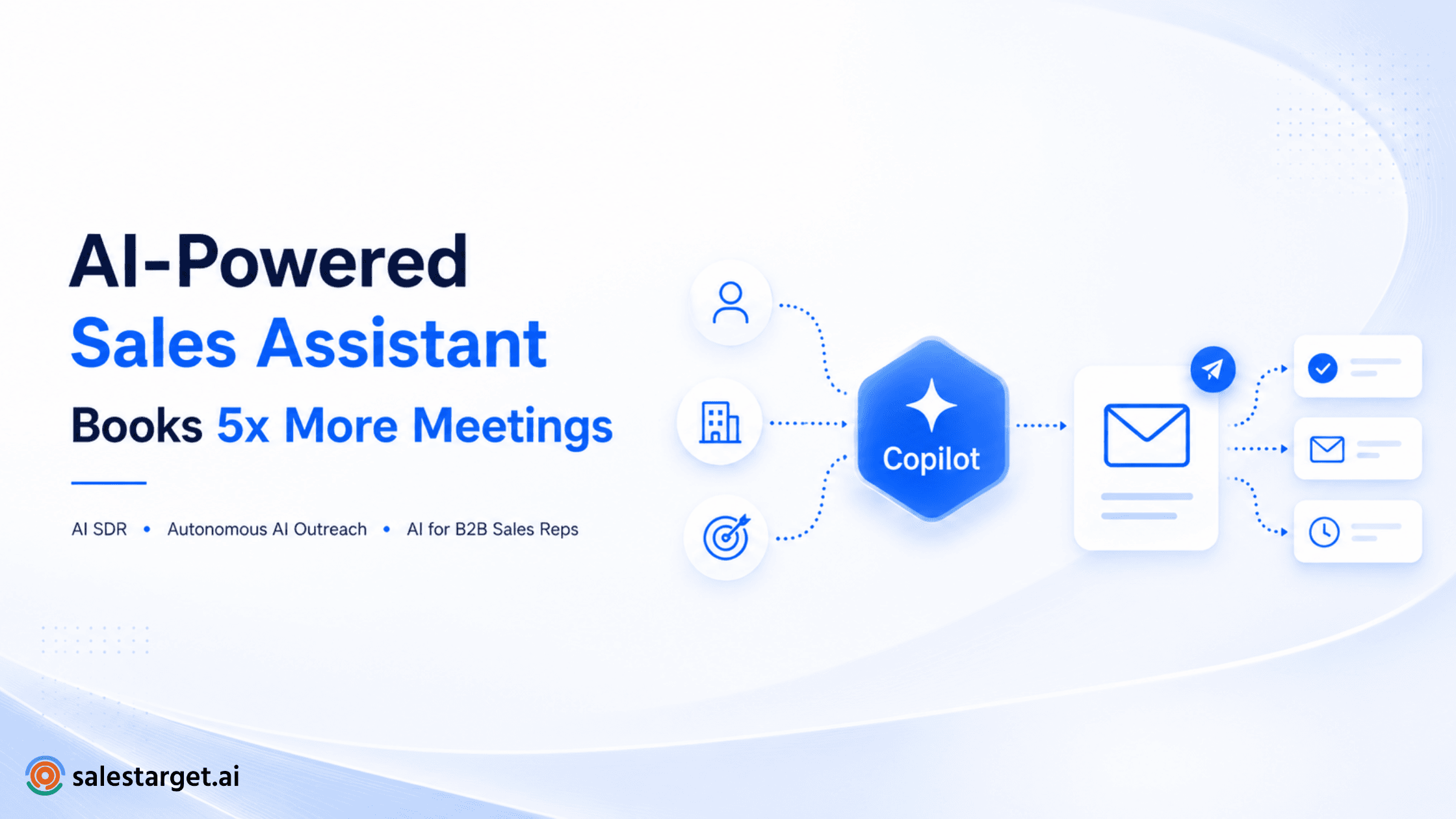
An AI-powered sales assistant is a software layer that uses machine learning, natural language processing, and intent data to perform outbound sales tasks autonomously or in support of a human rep. Think of it less as a chatbot and more as a tireless digital SDR that operates inside your existing sales stack.
It's worth distinguishing between the two main deployment models:
- AI SDR: A fully autonomous agent that identifies prospects, crafts outreach, executes multi-step sequences, and books meetings with minimal human intervention. It operates like an independent SDR — just one that never sleeps and scales instantly.
- AI Copilot: An assistant that works alongside your human reps, suggesting the next best action, drafting personalized emails, scoring leads, and surfacing intent signals — amplifying what each rep can accomplish rather than replacing them.
Both models rely on autonomous AI outreach: the ability to send contextually relevant, personalized messages to prospects without a human writing each one from scratch. For B2B sales reps specifically, AI for B2B sales reps means no more starting with a blank email template. It means walking into every conversation with a complete research brief, a suggested opening, and a follow-up plan already loaded.
Human SDR Tasks vs AI Sales Assistant Tasks
| Human SDR Tasks | AI Sales Assistant Tasks |
|---|---|
| Manually researches prospects one by one | Scans and scores thousands of leads instantly |
| Writes individual emails (slow, inconsistent) | Generates hyper-personalized emails at scale |
| Follows up when remembered | Executes timed, multi-step follow-up sequences automatically |
| Limited to business hours only | Works 24/7 across time zones without fatigue |
| Updates CRM manually (often delayed) | Syncs CRM data in real time after every interaction |
| Learns from personal experience only | Learns from aggregate patterns across all outreach data |
If you're still weighing whether to keep your current SDR structure or shift resources toward AI tooling, a detailed AI SDR vs Human SDR comparison breaks down the cost, performance, and use case differences you should know before making that decision.
The 5 Growth Levers Behind 5x More Meetings
1. Better Prospect Discovery
Manual list-building is slow and prone to stale data. AI sales assistants tap into intent data feeds, technographic signals, and firmographic filters to surface prospects who are actively researching solutions like yours — before they fill out a competitor's form. Instead of blasting a cold list, your team starts with a warm, high-fit cohort every time.
2. Personalized Outreach at Scale
Personalization at scale sounds like a contradiction, but AI resolves it. By pulling in prospect-specific context — recent funding rounds, job changes, published content, company news — the AI generates opening lines and value propositions that feel hand-crafted. HubSpot's research highlights that personalized email sequences consistently outperform generic templates on reply rate and conversion. With AI, every email can have that bespoke quality, even at 10,000 sends per month.
3. Automated Follow-Up Sequences
This is where most teams leak the most revenue. AI sales assistants execute multi-touch sequences across email, LinkedIn, and call prompts — spacing them correctly, adjusting messaging based on engagement signals, and escalating to human reps only when a prospect shows meaningful intent. No lead falls through the cracks because a rep forgot to follow up on day nine.
4. Real-Time Sales Intelligence
Modern AI assistants don't just send emails — they read signals. When a prospect opens an email three times in an hour, visits your pricing page, or matches a profile consistent with previously closed deals, the AI flags it immediately. Your rep gets an alert: 'This prospect is hot — reach out now.' That timing advantage alone can double connect rates.
5. Continuous Learning and Optimization
Unlike a static email template library, AI outreach improves over time. The assistant analyzes which subject lines generate opens, which value propositions drive replies, and which sequences convert to meetings — and iterates automatically. Over weeks and months, the entire outbound engine gets sharper without any manual A/B testing overhead.
How Modern Revenue Teams Use AI Copilots
The AI Copilot model is particularly powerful for teams that aren't ready to go fully autonomous. Here's what a typical AI-augmented workflow looks like in practice:
- Lead Research: The Copilot pre-populates prospect profiles with company context, tech stack details, recent news, and suggested talking points — so the rep walks into every call prepared.
- Email Generation: The rep reviews and approves AI-drafted emails rather than writing from scratch. What used to take 20 minutes takes 90 seconds.
- Prospect Scoring: The AI ranks the rep's pipeline by likelihood to convert, so they focus energy on accounts most likely to move.
- Outreach Automation: Sequences run automatically, with the rep only stepping in when a prospect replies or hits a defined engagement threshold.
- Meeting Scheduling: The AI handles back-and-forth availability coordination, reducing friction between 'interested' and 'booked.'
The result is a rep who functions more like an account executive — spending time on relationship-building and deal strategy — rather than an administrative coordinator.
This workflow shift isn't theoretical. Understanding how AI is changing the SDR role shows why forward-thinking revenue teams are redesigning job functions rather than eliminating them — and how companies can get ahead of that transition now.
AI Copilot + Email Outreach = Revenue Acceleration
Email remains the highest-ROI outbound channel for B2B sales — but only when done right. Generic blasts generate spam complaints. Over-automated sequences train prospects to ignore you. The winning formula is personalized messaging, delivered at the right moment, with smart follow-up logic built in.
That's precisely what the combination of an AI Copilot and email outreach automation delivers. The Copilot handles the intelligence layer — understanding who to contact, what to say, and when to send. The email automation handles execution — ensuring every message goes out on schedule, tracking opens and replies, and triggering conditional follow-up steps based on engagement.
Multi-channel engagement amplifies results further. When an email sequence is paired with coordinated LinkedIn touchpoints and call prompts, response rates improve substantially. Response tracking closes the loop: every interaction feeds back into the AI's model, making future outreach progressively more effective.
For teams managing hundreds of accounts simultaneously, this isn't just a nice-to-have. It's the difference between a predictable pipeline and a chaotic one.
If you're just getting started, you can explore SalesTarget's free AI sales assistant to see how an AI Copilot fits into your current outbound motion before committing to a full platform migration.
Choosing the Right AI Powered Sales Assistant
Not all AI sales tools are equal. Some are primarily email sequencers with a thin AI veneer. Others are genuinely intelligent platforms that learn and adapt. Use this checklist when evaluating your options:
| Feature | Must-Have | What to Look For |
|---|---|---|
| Prospecting Automation | ✔ | Automates lead discovery and list-building from intent signals |
| Email Outreach Automation | ✔ | Sends personalized sequences without manual input per email |
| CRM Integration | ✔ | Bi-directional sync with Salesforce, HubSpot, and others |
| Intent Data | ✔ | Identifies in-market buyers before they raise their hand |
| Lead Enrichment | ✔ | Appends firmographic and contact data automatically |
| Analytics & Reporting | ✔ | Tracks opens, replies, meetings booked, and pipeline impact |
| AI Copilot Capabilities | ✔ | Suggests next best actions, drafts emails, flags hot leads |
| Scalability | ✔ | Handles 10x outreach volume without adding headcount |
Any platform worth considering should handle all eight capabilities natively or through tight integrations. If a vendor checks only four boxes, keep looking.
Common Mistakes Teams Make With AI SDR Adoption
- Treating AI as a set-and-forget tool. AI outreach requires initial calibration — target persona refinement, messaging iteration, and sequence logic review. Teams that deploy it without oversight see mediocre results and incorrectly blame the technology.
- Skipping ICP (Ideal Customer Profile) work. AI amplifies your targeting — but if your ICP is fuzzy, the AI will blast the wrong people faster and at greater scale. Garbage in, garbage out.
- Neglecting human review of AI-generated emails. Early in deployment especially, AI messaging benefits from human editing. Small refinements in tone and phrasing compound into significantly better results over time.
- Failing to integrate with the CRM. An AI assistant working from a disconnected contact list creates duplicate outreach, inconsistent follow-ups, and rep confusion. CRM integration is not optional.
- Measuring vanity metrics instead of pipeline impact. Opens and click rates are interesting. Meetings booked, opportunities created, and revenue generated are what matter. Set the right KPIs from day one.
Hire Your AI Assistant
Stop spending more on SDR headcount while missing revenue opportunities. Let AI handle prospecting, outreach, follow-ups, and sales intelligence so your team can focus on closing deals.