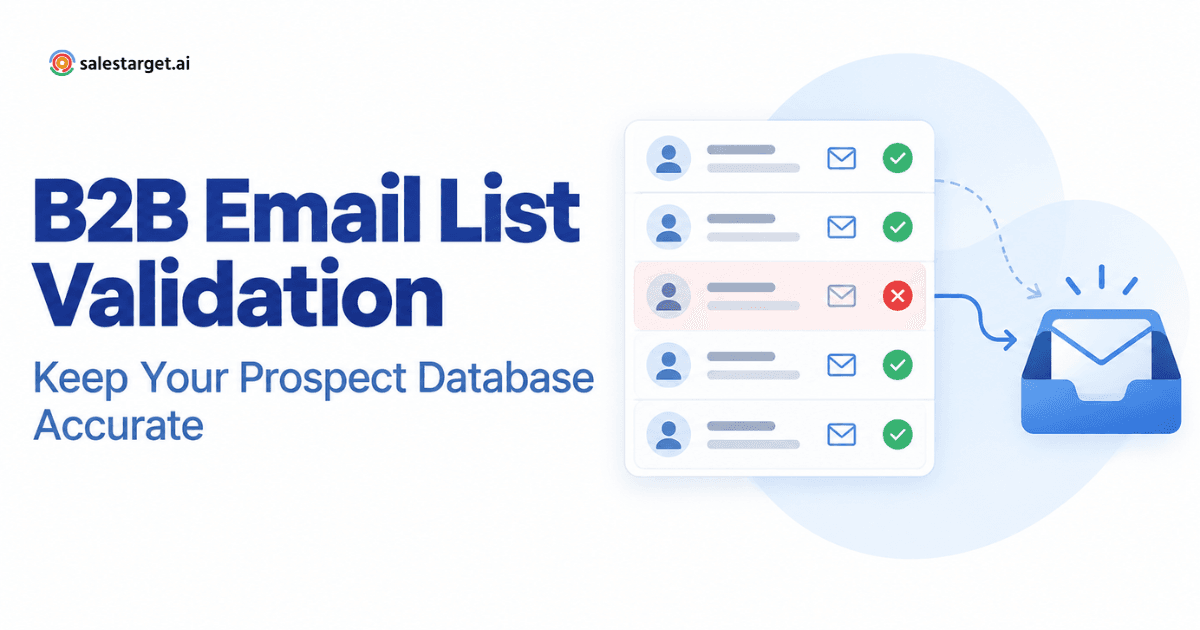
Email list validation is the process of checking whether the addresses in your list are correctly formatted, belong to real domains, and can accept mail before you send. It matters because invalid addresses cause hard bounces, and repeated bounces tell mailbox providers your data is unreliable. Validating before every major send removes those addresses early, which keeps bounce rates low and protects your sender reputation.
Most outbound teams notice a data problem only after it has already cost them. A sequence launches, bounces pile up, and a week later the domain is landing in spam for prospects who were never on the bad list. The copy did not change. The data did.
That is why email list validation belongs in the same conversation as pipeline targets, not just database maintenance. Every record is a small bet on your sending reputation, and when too many bets are bad, the whole program pays.
Why Email List Validation Is a Strategic Priority ?
B2B contact data decays constantly. People change jobs, companies rebrand, and domains expire. The decay stays invisible until you hit send.
Consider an illustrative example, not a benchmark: a team imports 10,000 prospects, and 8% of the addresses are no longer valid. That is 800 hard bounces waiting to happen. The reputational hit can follow the domain into every other campaign it sends that month. Removing those 800 records before launch costs a small validation fee. Leaving them in can cost weeks of weaker inbox placement.
This is risk management, not tidiness. If you are still comparing providers, see how to choose an email verifier tool.
What Email List Validation Actually Checks
Email list validation, email list verification, and email address verification are often used interchangeably. Where teams draw a line, validation confirms an address is structurally sound, while verification confirms the mailbox can receive mail. A good process does both.
Syntax and formatting problems
The first pass catches addresses that could never work: missing @ symbols, spaces, illegal characters, or typos like "gmial.com."
Invalid and inactive email addresses
Next, the tool checks whether the domain exists and has mail servers configured to receive email, known as MX records. It can then ask the server whether the mailbox exists, without sending a message. Invalid email addresses found at this stage are the ones most likely to produce hard bounces.
Risky or disposable addresses
Some addresses are technically deliverable but still risky. These include disposable inboxes, role-based addresses like info@, and catch-all domains that accept every message. Catch-all results deserve extra care in B2B email verification because many corporate domains are configured this way.
Duplicate and outdated records
Duplicates and stale records inflate list size without adding reach. Two SDRs emailing the same person is both a reputation and a brand problem.
How Poor Email Data Affects Deliverability
Mailbox providers judge senders on behavior. High bounces and spam complaints suggest a sender who does not know its audience. Google's email sender guidelines require bulk senders to authenticate their mail and keep spam complaint rates low.
Bounces are defined at the protocol level. Under RFC 5321, the core SMTP standard, mail servers use 5xx reply codes for permanent failures and 4xx codes for temporary ones. Retrying a permanent failure only adds negative signals.
Bad data does not only hurt the bad records. It lowers trust in the sending domain, which affects delivery to your best prospects too. That is why validation sits at the foundation of email deliverability, alongside authentication and sensible sending volumes.
Email List Validation vs. Email List Cleaning
Email list validation answers a narrow question: can this address receive mail? Email list cleaning is the broader discipline of keeping a database usable. It adds deduplication, unsubscribe suppression, retiring unengaged contacts, and enriching incomplete records. For large databases, bulk email list cleaning combines these steps into a single pass.
Think of validation as a gate and cleaning as housekeeping. A list can pass validation and still perform poorly if half the contacts no longer match your ideal customer profile.
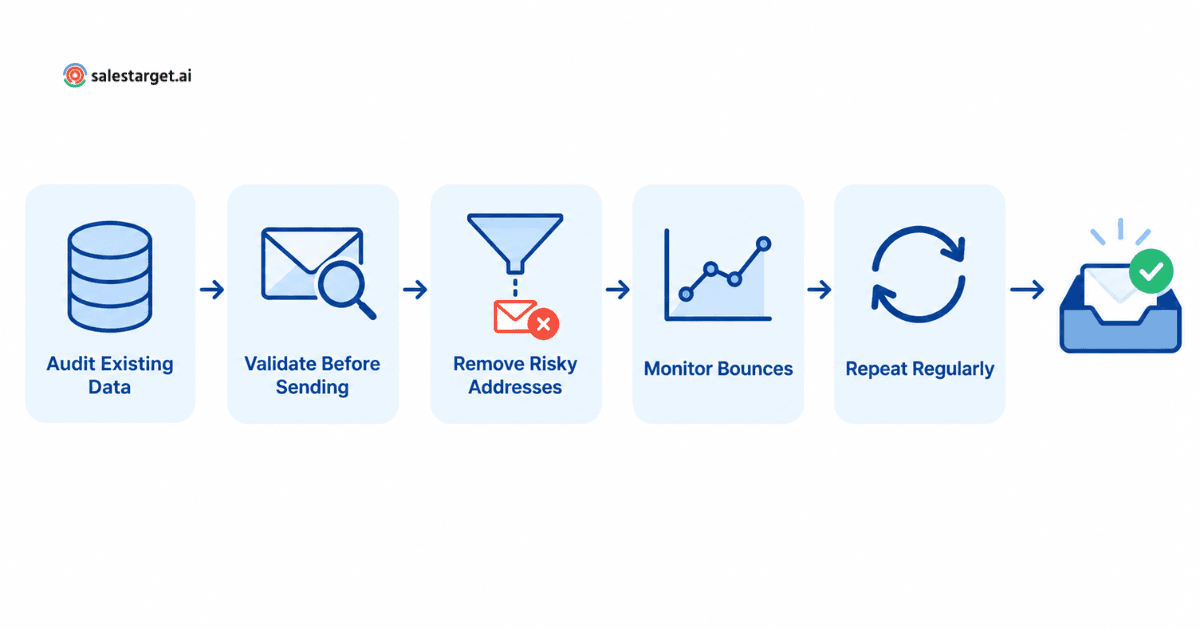
A Practical B2B Email List Validation Process
Start with your existing database
Export your CRM contacts and active sequence lists, run bulk email verification across them, and tag each record by result. This baseline shows how much decay you are carrying and which lead sources produce the most invalid addresses.
Validate before every major campaign
Verify email addresses before sending any new sequence, especially lists from purchased sources, events, or dormant segments. Before any B2B send, confirm three things: the addresses pass validation, authentication (SPF, DKIM, and DMARC) is in place, and the list matches the campaign's target segment.
Remove or suppress risky addresses
Delete clearly invalid records. For risky results such as catch-all or role-based addresses, suppress them from high-volume sends or send them in small, monitored batches.
Monitor bounce and engagement signals
Validation lowers bounces but never removes all of them. Track hard bounces, soft bounces, and replies by campaign. A sudden spike usually points to a specific lead source or import.
Repeat the process regularly
How often should you validate an email list? Most teams benefit from a monthly check on active CRM data and a pre-send check on every new list. Building a monthly CRM email hygiene routine makes this a habit rather than a rescue project.
How to Reduce Email Bounce Rates at Scale
At scale, bounce prevention has to live inside the workflow:
- Validate at the point of entry. Check addresses when they enter the CRM, not months later.
- Set clear send rules. Decide which statuses are safe to send, which need review, and which are blocked.
- Separate risky segments. Send catch-all and unverified contacts in smaller batches so problems surface early.
- Hold lead sources accountable. If one vendor or list keeps failing validation, that is a sourcing decision, not a cleanup task.
The aim is to reduce email bounce rates as a system, not by rescuing individual campaigns after the damage shows up.
Choosing an Email Validation Tool
Not all email verification software handles uncertain results the same way. When comparing options, look at:
- How the tool treats catch-all domains and whether it explains uncertain results
- Bulk upload support and processing speed for large files
- Result categories your team can turn into send rules
- Integration with your CRM or outreach platform
- Data handling and privacy practices
A single status label can hide useful nuance, which is why scoring models help. This breakdown of the email validation safe-to-send score shows how a score can guide practical send decisions.
Why Email List Hygiene Should Be an Ongoing Process
Email list hygiene is not a quarterly spring clean. One-time email database cleaning buys only a short window of accuracy. Teams with stable deliverability treat validation as an operational control: owned by sales or marketing ops, run on a schedule, and reviewed when metrics shift.
This is where a dedicated lead validation step earns its place.SalesTarget.ai's Email Validator is designed for this stage of the workflow, helping teams validate email addresses in bulk and review the results before prospects enter a sequence. That makes validation a standard pre-send checkpoint instead of an occasional fix.
Validate Your Prospect Data Before Your Next Send
Before you launch, run your prospect database through the SalesTarget.ai Email Validator to catch invalid and risky addresses while they are still easy to remove.
Validate your prospect list with SalesTarget.ai →
Email list validation is a revenue safeguard, not an admin chore. Validate before you send, clean on a schedule, and treat bounce rates as an early warning about data quality. Teams that protect their data protect their domain, and keep reaching the buyers who matter.