AI Sales CRM: How Machine Learning Is Reshaping Pipeline Management for SDRs
An AI Sales CRM is a customer relationship management platform enhanced with machine learning that automates pipeline tasks, predicts deal outcomes, and surfaces the highest-intent opportunities. For SDRs drowning in manual data entry and stalled deals, machine learning removes administrative friction, prioritizes the right accounts, and shortens the path from prospect to closed-won. The result: less time logging activity, more time having real conversations.
Why Traditional CRM Workflows Are Breaking Down
For years, SDRs have wrestled with CRMs that feel more like data graveyards than selling tools. Reps spend hours updating fields, logging calls, and reformatting notes instead of running discovery conversations. Salesforce research has long pointed to the same issue: sellers spend less than a third of their week actually selling — the rest disappears into administrative overhead.
That overhead creates real problems. Forecasts drift because pipeline data is stale or incomplete. Managers lose visibility into which deals are slipping. SDRs chase the loudest lead instead of the highest-fit one. And when a rep leaves, the institutional knowledge buried inside their inbox walks out the door with them.
This is why AI-powered CRM tools have moved from "nice to have" to a core part of the modern revenue stack. Teams no longer accept manual hygiene as a fixed cost — they expect the system itself to do the heavy lifting.
What Is an AI Sales CRM?
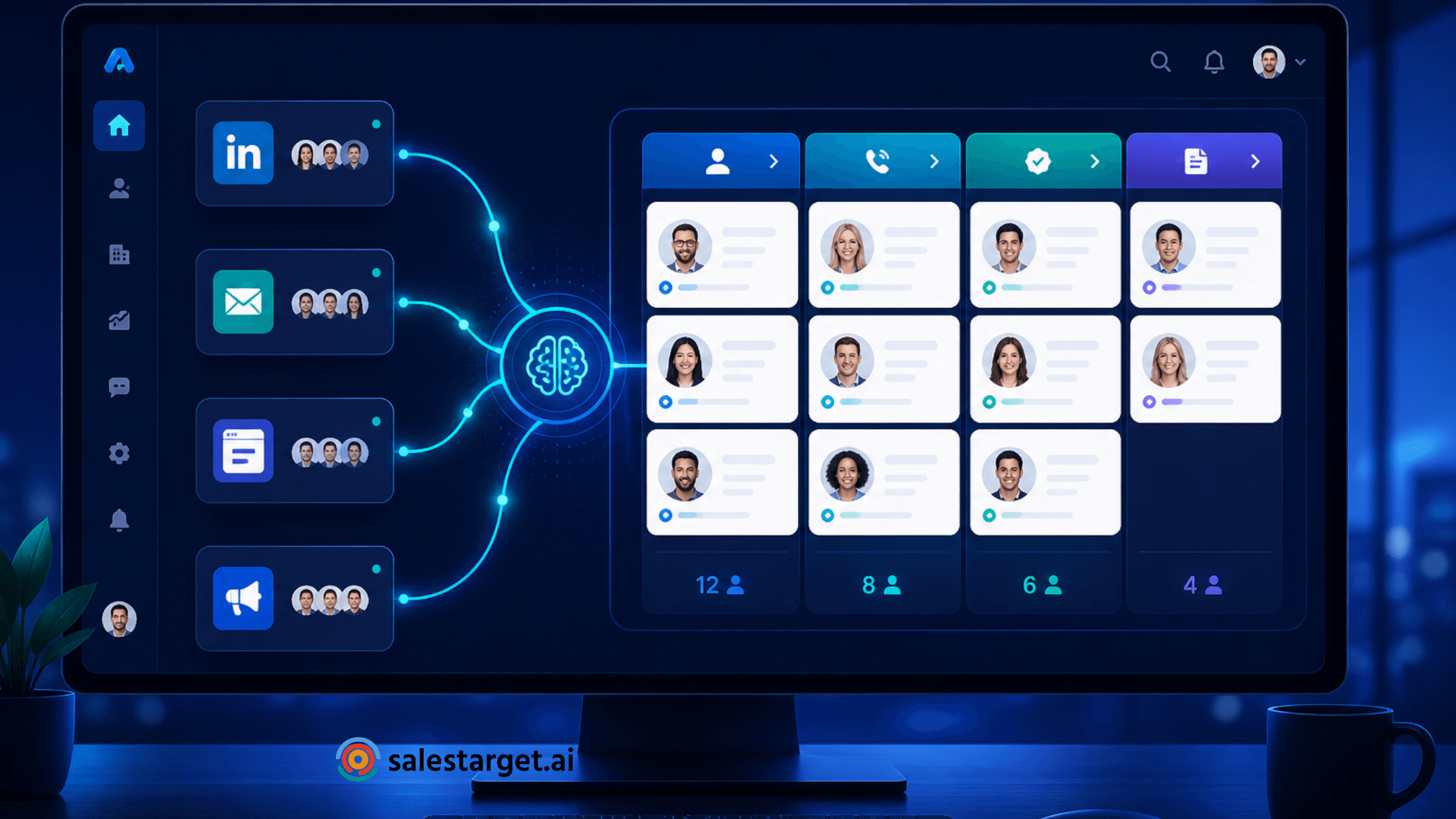
An AI Sales CRM is a customer relationship management platform with machine learning models woven directly into the workflow. Rather than relying on SDRs to remember to log activities or score leads by hand, an intelligent CRM for SDRs ingests signals — emails, meetings, intent data, web behavior, firmographics — and turns them into prioritized actions.
Most AI Sales CRM tools share the same core capabilities:
- Predictive deal scoring based on historical close patterns
- Automated activity capture from email and calendar
- Opportunity prioritization tied to live buying signals
- Forecast modeling that updates in real time
- Pipeline intelligence that flags risk before it bites
Pipeline visibility is where this gets concrete. Good deal pipeline management software doesn't just show you stages — it tells you which deals are healthy, which are stalling, and where the rep should spend the next thirty minutes.
How Machine Learning Is Changing Pipeline Management
Machine learning has shifted CRMs from passive systems of record into active systems of recommendation. Here's where that shift shows up day-to-day for SDRs.
Predicting Deal Outcomes
Older CRMs let reps mark deal probability themselves — which usually meant 50% across the board until the quarter ended. ML models calculate probability from signals the rep can't easily see: response latency, stakeholder engagement depth, similar deals from past quarters, and contact title changes. An SDR sees a clear "likely to close" score rather than a hopeful guess.
Identifying Pipeline Risks
ML doesn't just predict wins. It catches losses early. If a deal hasn't had a meaningful touch in 14 days, or a champion stops opening emails, or a competitor's name shows up in a meeting transcript, the system flags it. SDRs can intervene before the deal goes cold instead of after.
Prioritizing High-Intent Opportunities
Intent signals — content downloads, pricing-page visits, third-party research behavior — used to live in separate tools. An AI Sales CRM merges them into one prioritized work queue. The rep starts the day knowing which 12 accounts to touch, not staring at a list of 400.
Automating Administrative Tasks
Activity logging, meeting summaries, follow-up drafts, contact enrichment — all of it can run in the background. One SDR we spoke with estimated AI automation CRM features saved her about 90 minutes a day, which she reinvested in live conversations.
For a broader playbook on sequencing these automations without losing the human touch, our guide to automated sales pipeline strategies walks through how high-performing teams roll this out stage by stage.
Key Benefits of AI Sales CRM for SDR Teams
The pitch is simple: do less admin, close more deals. The reality is more nuanced — but the gains are real.
- Faster follow-ups. AI-drafted responses cut reply times from hours to minutes.
- Better prioritization. Reps work the right accounts, not just the most recent ones.
- Improved productivity. Less context-switching between tools.
- Stronger pipeline accuracy. Fewer ghost deals inflating the forecast.
- Shorter sales cycles. Cleaner handoffs and better timing on outreach.
Across the SaaS teams we've worked with, a clear pattern is emerging: organizations adopting AI Sales CRM platforms typically report up to 30% shorter sales cycles and roughly 25% more qualified opportunities entering pipeline within the first two quarters of rollout. The shift isn't magical — it's the cumulative effect of small frictions being removed every day.
That pattern lines up with what analysts at Gartner have flagged as one of the most impactful go-to-market investments of the decade: AI-augmented sales tools that move beyond dashboards into active decision support.
These gains compound when CRM data lives alongside engagement, intent, and conversation data. A unified sales intelligence platform prevents the silos that traditionally fragment outbound execution.
What SDRs Should Look for in an AI Sales CRM
Not every "AI" badge means the same thing. When evaluating an intelligent CRM for SDRs, focus on:
- Workflow automation that adapts to your cadence, not generic templates
- Predictive forecasting with explainable confidence scores
- Pipeline analytics that surface deal velocity and stage conversion
- CRM integrations with your engagement, calling, and enrichment tools
- Reporting managers can act on without exporting to a spreadsheet
- AI recommendations tied to specific deals, not generic best practices
If a tool can't show you why a deal is scored a certain way, it isn't really an AI-powered CRM — it's just dashboards in a trench coat.
Fit matters too. A CRM built for outbound sales teams thinks differently than one designed for account management. SDR-first systems prioritize speed, sequencing, and signal capture over relationship history.
The Future of AI Sales CRM
The next phase is autonomy. CRMs will move from suggesting actions to executing them — drafting follow-ups, scheduling meetings, refreshing accounts, and even running early-stage discovery via AI copilots that brief the SDR before the call.
Revenue intelligence is the connective tissue. As McKinsey has noted in its work on AI in B2B sales, the highest-performing organizations treat AI not as a feature but as the operating layer of their entire revenue motion. Predictive forecasting becomes continuous rather than quarterly. Pipeline coverage gets simulated weeks ahead. And SDRs spend almost all of their time on the human work AI can't replicate — the conversations.
Ready to See It in Action?
If you've been wondering whether your team is leaving deals on the table because the CRM is fighting them, the easiest way to find out is to see what one designed around SDRs actually feels like.
AI Sales CRM isn't a productivity gimmick — it's a structural change in how outbound teams operate. Machine learning takes over the repetitive work, surfaces the signals reps can't easily catch, and gives SDRs a clear path through the day. For SDRs, BDRs, sales managers, and RevOps leaders, the question isn't whether to adopt an AI-powered CRM. It's how fast.