Your reps are working lists that went cold three months ago. Your SDRs send 200 emails and get three replies. You're spending budget on contact data that tells you who exists, not who's buying right now.
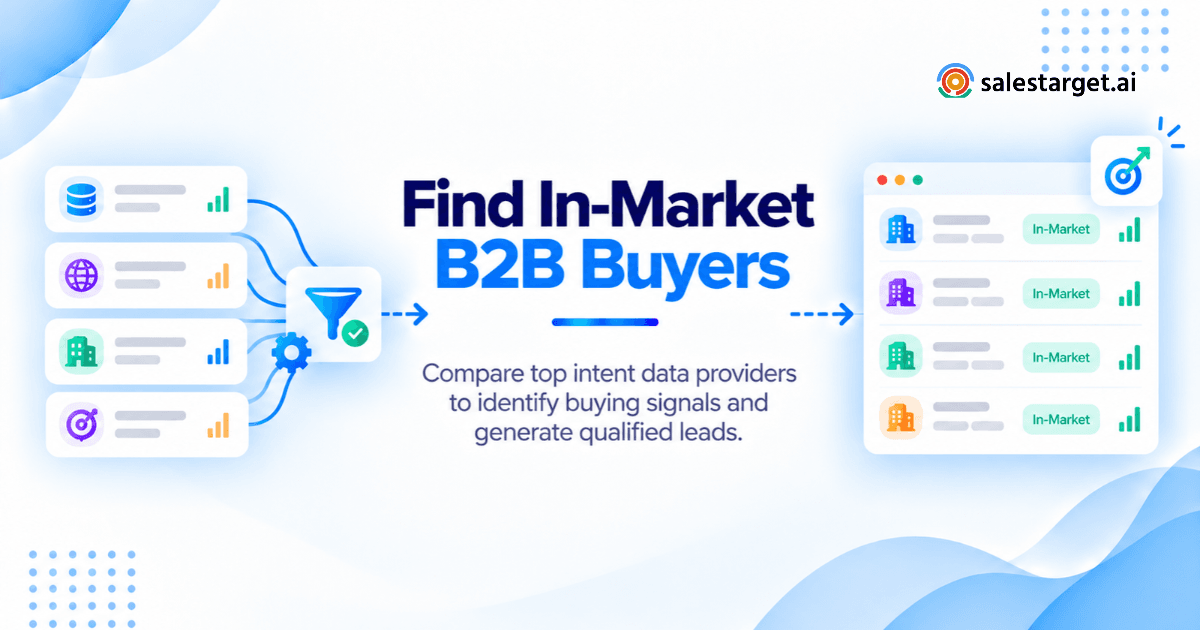
The right B2B intent data provider closes that gap. It tells you which accounts are actively researching your category this week, so your team reaches them first. Not fifth.
This guide covers the 12 best B2B intent data providers, how to evaluate them against each other, and how to build a workflow that turns signals into pipeline.
Best B2B Intent Data Providers: Quick Comparison
Top 12 Intent Data Platforms Compared by Signals, Features, Pricing, and Best Use Cases
| Provider | Signal Type | Contact Data | Outreach Built-In | Best For |
|---|---|---|---|---|
| SalesTarget.ai | Third-party (Bombora) + business events | Yes (840M+ profiles) | Yes (email + LinkedIn + CRM) | All-in-one outbound |
| Bombora | Third-party research signals | No | No | Intent data layer |
| 6sense | Predictive + third-party | Limited | Yes | Enterprise ABM |
| Demandbase | Third-party + ABM signals | Limited | Yes | Buying group targeting |
| ZoomInfo | Third-party + first-party | Yes | Limited | Data + intent bundle |
| G2 Buyer Intent | G2 comparison research signals | No | No | Software categories |
| Cognism | Third-party (Bombora) | Yes | Limited | Global prospecting |
| TechTarget Priority Engine | Content + research intent | Limited | No | Enterprise technology |
| HG Insights | Technographic signals | No | No | Tech-stack buyers |
| Apollo.io | Third-party intent | Yes | Yes (email only) | SMB outbound |
| Leadfeeder | Website visitor signals | Limited | No | First-party site traffic |
| RB2B | Website + person-level signals | Limited | No | Website retargeting |
Best Intent Data Providers for Startups, Sales Teams, Agencies, and Enterprise ABM
Startups and outbound agencies need a provider that ships with contact data and outreach in the same tool. Buying intent signals alone are not enough: you still need to find the right contacts, verify their emails, and reach them before the buying window closes. SalesTarget.ai and Apollo.io serve this use case directly, with SalesTarget.ai adding native LinkedIn automation and a built-in CRM that Apollo lacks natively.
Enterprise ABM teams running coordinated buying-group campaigns trend toward 6sense or Demandbase for account orchestration depth. Mid-market sales teams should look for platforms where intent signals connect directly to sequences. A spike that sits in a dashboard while your SDR manually updates Salesforce is a wasted signal.
Intent Data Provider Comparison: Account-Level Signals vs Contact-Level Data
Account-level intent tells you a company is researching a topic. Contact-level intent tells you who inside that company is doing the research. That distinction decides whether you can act on a signal today or spend three days profiling the account first.
Most third-party providers, including Bombora, G2, and TechTarget, operate at the account level. SalesTarget.ai layers Bombora's account-level intent on top of 840M+ contact profiles so you can identify the signal and find the right decision-maker in a single step.
How We Evaluated the Best B2B Intent Data Providers
Intent Data Sources, Signal Accuracy, and Research Coverage
The strongest providers draw from a wide publisher network, not a single source. Bombora's co-op covers 5,000+ B2B publisher sites, making it the broadest third-party signal source in the market. G2's signals are narrow but highly commercial. Provider-specific networks like TechTarget and HG Insights deliver strong accuracy within their verticals but miss accounts researching outside those channels.
Buyer Identification, Contact Data Quality, and Signal Freshness
A signal without a verified contact is a research exercise. Key questions: Does the platform identify named contacts tied to the intent account? Are emails verified at the moment of enrichment, or from a static scrape months old? Intent signals decay fast. A buying window active three weeks ago may already be closed.
Sales Outreach, CRM Integration, and Workflow Capabilities
The gap between intent data that produces meetings and intent data that produces reports is workflow. Platforms that stop at signals require your team to manually extract accounts, find contacts, enrich them, import into a sequencer, and log results back to a CRM. Every manual step bleeds pipeline velocity.
Pricing Transparency, Setup Costs, and Sales Team Requirements
Watch for platforms that price per intent topic, per seat, and per data credit separately. The published price is rarely what you pay at scale. Factor in the contact enrichment tool, the sequencer, and the CRM you would need to buy separately before comparing sticker prices.
12 Best B2B Intent Data Providers for Lead Generation and Sales Prospecting
SalesTarget.ai: Best for Connecting Intent-Based Prospecting With Email, LinkedIn, and CRM Workflows
SalesTarget.ai is the only platform on this list that covers the full arc: find an in-market account using Bombora intent topics, identify the right contacts from 840M+ verified profiles, verify their emails, reach them via coordinated email and LinkedIn sequences, then track deals in a built-in CRM. No separate enrichment tool. No separate sequencer. No CSV exports.
The Lead Explorer lets you filter by intent topic alongside firmographic and technographic criteria in one search. When you find a match, one click enriches and verifies the contact's email and phone on the spot, then pushes them directly into an outreach sequence or CRM without leaving the platform. For SDRs, founders, and agency teams tired of stitching four tools together to act on one signal, SalesTarget.ai collapses the full workflow into a single workspace.
Bombora: Best for Third-Party B2B Intent Data and Research Activity
Bombora is the backbone of B2B intent data. Its co-op draws from 5,000+ B2B publisher sites, making it the most widely used third-party signal source in the industry. The limitation: Bombora is data-only. You get account-level research signals, not contacts, not sequences, not a CRM. Most sales teams consume Bombora intent through a partner platform like SalesTarget.ai rather than directly.
6sense: Best for Predictive Buyer Intent and Enterprise Revenue Teams
6sense applies machine learning to third-party intent, web activity, and CRM data to predict which accounts are in an active buying cycle. It's built for enterprise ABM teams running coordinated marketing and sales plays across long buying cycles. Setup is complex, and the value compounds over time. Not the right fit for outbound-first teams or early-stage companies.
Demandbase: Best for Account-Based Marketing and Buying Group Intelligence
Demandbase targets enterprise marketing teams that need to orchestrate across multiple stakeholders inside a single target account. Its strength is buying group mapping: identifying who inside an account is engaging across channels and staging them into a coordinated ABM play. It requires adjacent sales tooling to complete the outreach workflow.
ZoomInfo: Best for Buyer Intent Data With B2B Contact Intelligence
ZoomInfo bundles a large B2B contact and company database with Bombora-powered intent signals. The database size is a genuine advantage. The friction points: pricing scales steeply, intent topics are sold separately, and the built-in engagement tools don't match a dedicated sequencer. Teams already using ZoomInfo for data can activate intent without adding a vendor, which is often the deciding factor.
G2 Buyer Intent: Best for Software Comparison and Purchase Research Signals
G2 Buyer Intent captures which accounts are researching your category or a competitor's profile on G2. The signal is highly commercial because visitors arrive specifically to evaluate software. The limitation: G2 signals only fire when someone visits G2. Accounts researching through analyst reports, vendor content, or peer networks don't appear. Best used as a supplementary signal layer.
Cognism: Best for Global B2B Prospecting With Intent Data
Cognism combines its own verified contact database with Bombora intent signals, and its GDPR-compliance focus makes it the preferred option for teams prospecting heavily into European markets. Contact data quality is strong in the UK and EMEA. Outreach tools are limited compared to SalesTarget.ai.
TechTarget Priority Engine: Best for Enterprise Technology Purchase Intent
TechTarget's intent signals come from its own network of IT and technology media properties. Signal quality for enterprise technology buyers is high because the audience self-selects. The coverage is narrow: if your buyers research outside the TechTarget network, you won't see them. Best as a vertical intent layer for enterprise technology companies.
HG Insights: Best for Technographic Data and Technology Buying Signals
HG Insights specializes in tracking which technologies companies currently use and signals when accounts add, drop, or evaluate competing tools. This is a technographic intent signal, distinct from research intent. If your product displaces or integrates with a specific tech stack, HG Insights surfaces accounts in a technology evaluation window. No contact data, no outreach tools.
Apollo.io: Best for Intent-Based Prospecting and Outbound Sales Teams
Apollo.io includes third-party intent signals alongside its B2B database and email sequencing. It's the closest general-purpose alternative to SalesTarget.ai in scope. The key gaps: Apollo's LinkedIn automation requires separate tools, the built-in CRM is basic, and deliverability relies on add-ons. SalesTarget.ai positions itself as a direct Apollo alternative with native LinkedIn outreach, built-in email validation, and a CRM designed for outbound from the start.
Leadfeeder: Best for Identifying Companies Visiting Your Website
Leadfeeder (now part of Dealfront) identifies which companies visit your website by matching IP addresses to company records. It's a first-party intent signal: these accounts visited you, not a third-party research site. Signal volume is limited to your actual traffic, so teams with low-traffic sites get minimal value. Strong as a priority layer for inbound-assisted outbound teams.
RB2B: Best for Website Visitor Identification and Person-Level Signals Where Available
RB2B attempts to match website visits to individual profiles where data is available. Person-level resolution doesn't fire for every visitor, but when it does, the signal specificity is high. Currently focused on US-based traffic. Best used alongside a platform like SalesTarget.ai that can enrich identified contacts and push them into sequences immediately.
The B2B Buying Signals That Separate Active Buyers From General Research
First-Party vs Third-Party B2B Intent Data Providers
First-party signals come from your own properties: website visits, email opens, demo requests, pricing page views. Third-party signals come from the broader web: research activity on industry publications, review sites, and content networks tracked by the provider. First-party signals are high-accuracy but low-volume. Third-party signals are high-volume but noisier. The best programs run both.
For a deeper look at the contact data side of this equation, see our breakdown of the best B2B sales lead database providers and how they compare on coverage, freshness, and accuracy.
Topic Research, Category Interest, and Competitor Comparison Signals
Topic-based intent tracks when a company's collective browsing activity around a specific topic spikes above its historical baseline. A spike on "sales intelligence software" is a category research signal. A spike on a named competitor is a direct comparison signal with higher commercial urgency: that account is actively building a shortlist.
Website Visits, Pricing Page Activity, and Product Evaluation Signals
A prospect reading your blog once reads differently from one who visits your pricing page three times in a week. Tiered intent scoring based on page type, visit frequency, and session depth converts raw traffic into a ranked priority list your SDRs can actually work.
Hiring, Funding, Technology Changes, and Business Trigger Events
SalesTarget.ai's Lead Explorer tracks business trigger events including funding rounds, hiring spikes, leadership changes, and company awards on a 30 to 90 day lookback window. A company that just hired a VP of Sales or closed a Series B has buying capacity and an active agenda. That's a different signal from passive research intent, and it's actionable faster.
Account-Level Intent vs Contact-Level Intent: The Identification Gap
The gap between "this company is researching" and "reach this specific person today" is where most intent programs stall. Closing it requires a platform that maps account-level signals to contact-level data without a manual export step in between.
From Intent Signals to Qualified B2B Leads: A Practical Sales Workflow
Identify In-Market B2B Buyers Using Intent Topics and ICP Filters
Start with accounts showing intent spikes on topics relevant to your solution. Layer your ICP filters on top: industry, company size, geography, revenue range, tech stack. Accounts matching both criteria are your priority list for the week. Everything else is secondary.
Score Target Accounts Using Firmographic, Technographic, and Purchase Intent Data
Score accounts across three dimensions: ICP fit (firmographic), technology alignment (technographic), and signal strength and recency (intent). Accounts scoring high across all three move to active outreach immediately. Accounts scoring high on fit but low on intent go into a nurture track.
Find Decision-Makers and Buying Committee Contacts Within High-Intent Accounts
Once an account qualifies, map the buying committee: economic buyer, technical evaluator, and internal champion. SalesTarget.ai's Lead Explorer lets you filter by role, seniority, and department within a matched account to pull the full contact set in a single search, then enrich and verify all of them in one click.
Enrich and Verify Contact Details Before Starting Outreach
Verified emails and current phone numbers cut bounce rates and protect sender reputation. SalesTarget.ai's Email Validator runs MX record checks, SMTP verification, and disposable-email detection at the point of enrichment, not at upload time. The data reflects where the contact works today, not six months ago.
Build Relevant Email and LinkedIn Sequences Around Buyer Research Signals
Reference the intent signal in your outreach without making it feel like surveillance. A message that connects to the topic your prospect is researching gets a higher reply rate than a generic pitch. SalesTarget.ai's Email Outreach and LinkedIn Outreach run as a coordinated multichannel sequence from a single campaign, so every touchpoint reinforces the same message across both channels.
Move Engaged Prospects Into the CRM and Track Sales Opportunities
When a prospect replies, their activity auto-logs to SalesTarget.ai's built-in CRM. The rep sees the full intent history, outreach timeline, and deal stage in one view. The next follow-up task creates automatically after each interaction. Teams using this workflow report 3.2X faster deal cycles and 91% follow-up completion rates.
B2B Intent Data Software Pricing and the Real Cost of Finding Sales-Ready Buyers
Intent Data Pricing: Standalone Providers vs All-in-One Sales Platforms
Standalone intent providers like Bombora or G2 Buyer Intent charge for access to signals only. You still need a data platform, an enrichment tool, a sequencer, and a CRM. All-in-one platforms like SalesTarget.ai bundle all four into one subscription. For teams accounting for total revenue tech stack cost, the unified model typically wins.
Subscription Fees, Data Credits, User Seats, and Intent Topic Limits
Watch for per-topic pricing on dedicated intent platforms. Some providers charge per intent topic monitored, with the most commercially valuable topics locked behind higher tiers. Add per-seat fees, data credit limits, and implementation costs before comparing headline prices. The published rate is rarely the all-in cost.
Hidden Costs of Contact Enrichment, Integrations, and Outreach Tools
A platform that provides signals but not contacts sends you to an enrichment vendor. Most charge per contact enriched. Add that cost to the intent subscription, the sequencer, and the CRM, and the true cost of a "lower-price" intent provider can run two to three times what you planned.
Cost per Qualified Opportunity vs Cost per Intent Signal
The right metric is not cost per signal. It's cost per qualified opportunity that reaches your pipeline. Five hundred noisy signals at a low per-signal price is more expensive than fifty high-fit, actionable signals that your team converts into meetings. Measure output, not input volume.
Choosing the Right Intent Data Platform for Your Sales Motion
Affordable B2B Intent Data Providers for Small Businesses and Startups
Startups need intent data that ships with contact data and outreach in one tool. Paying separately for signals, enrichment, and a sequencer is not viable at early stages. SalesTarget.ai and Apollo.io are the practical options, with SalesTarget.ai adding LinkedIn automation and a CRM that early-stage teams need to manage pipeline without a heavy RevOps investment.
Buyer Intent Data Platforms for SaaS Companies and Outbound Agencies
SaaS companies typically run outbound in parallel with content and paid demand. Agencies running outbound for multiple clients need scalable sequencing and multi-account management. SalesTarget.ai's unlimited inbox model makes agency-scale outreach practical without exponential seat costs.
Enterprise Intent Data Platforms for Account-Based Marketing
Enterprise ABM needs deep account orchestration and buying group mapping. 6sense and Demandbase are built for that marketing layer. The tradeoff: neither replaces an outbound sales tool. Many enterprise teams run a dedicated ABM platform for marketing coordination alongside SalesTarget.ai for SDR-led prospecting.
Intent Data Providers With CRM Integration and Sales Automation
Any intent provider worth using should push signals into your CRM automatically. The standard integrations are Salesforce, HubSpot, and Zapier. Platforms requiring manual CSV exports to sync with your CRM introduce delays that kill the time-sensitive value of an intent signal.
Standalone Intent Data vs Unified Sales Intelligence and Outreach Platforms
A standalone intent provider is a signal layer. It tells you who might be buying. A unified platform tells you who might be buying, finds the verified contact, reaches them across email and LinkedIn, and tracks the deal. For teams measuring pipeline velocity, the unified approach creates a measurable advantage.
The 14-Day Intent Data Test: Validate Signals Before Committing to a Provider
Days 1 to 3: Build a Target Account Sample and Select Intent Topics
Pull a sample of 50 to 100 ICP-fit accounts. Select 5 to 10 intent topics that map directly to your solution category. This is your control set for the test. Don't start outreach yet.
Days 4 to 7: Check Signal Freshness, Account Match Rates, and Contact Coverage
For each account showing an intent spike, verify: when did the signal fire? What percentage of your ICP list showed any signal? Of those that fired, can you identify named contacts with verified contact data? A platform that flags intent but can't surface a verifiable contact at the matched account fails at step one.
Days 8 to 14: Run Controlled Outreach and Compare Early Engagement
Run a split: outreach to intent-flagged accounts vs a control group of ICP-fit accounts with no intent signal. Track open rates, reply rates, and meetings booked. You're testing whether the signal predicts engagement, not just whether it exists.
Scorecard: Data Quality, Qualified Replies, Meetings, and Total Cost
Grade each provider across: signal freshness (under 30 days preferred), account match rate against your ICP list, contact coverage within matched accounts, reply rate lift vs control, meetings booked, and total cost including enrichment and tooling. Any provider that can't demonstrate a measurable reply lift over your control group is not delivering commercial intent.
Why Choose SalesTarget.ai
Identify In-Market Accounts With Bombora Intent Topics and ICP-Based Filtering
SalesTarget.ai's Lead Explorer pulls Bombora's third-party intent signals directly into its prospecting interface. You filter by intent topic and ICP criteria simultaneously, so accounts that match intent AND fit your customer profile surface together. No switching between platforms, no data exports, no manual cross-referencing.
Find Decision-Makers Using B2B Lead Data and Contact Enrichment
With access to 840M+ verified professional profiles and 146M+ business entities, SalesTarget.ai lets you identify specific contacts within an intent-flagged account in the same step. Filter by role, department, seniority, and location. One-click enrichment pulls verified email, personal email, phone, and mobile immediately. See how Lead Explorer works.
Reach High-Priority Prospects Through Email and LinkedIn Outreach
SalesTarget.ai coordinates email and LinkedIn outreach inside a single campaign sequence. When a prospect doesn't reply on email, the LinkedIn step fires automatically within the same flow. Context carries across channels, so your prospect sees a coherent conversation, not disconnected cold touches from two separate tools. Teams using this workflow see 35% faster campaign creation and 2.4X more meetings from the same lead list.
Reduce Invalid Contacts With Built-In Email Verification
Every contact enriched in SalesTarget.ai runs through MX record checks, SMTP verification, and disposable-email detection before reaching a sequence. Invalid contacts don't make it into your outreach. That keeps bounce rates low and sender reputation high, protecting deliverability across your entire domain. 90% of emails are validated before sending.
Manage Replies, Follow-Ups, and Sales Opportunities in One CRM
When a prospect replies, the deal auto-creates in SalesTarget.ai's CRM. Every email, call, and LinkedIn interaction logs to the deal timeline automatically. Follow-up tasks generate based on reply intent, so reps work the next action instead of digging through an inbox. No data entry. No sync lag. The full intent-to-close workflow stays in one place.
Use AI Copilot for Prospect Research, Messaging, and Campaign Planning
SalesTarget.ai's AI Copilot handles the research and writing work that slows prospecting down. Ask it to find accounts matching a specific ICP in plain language, generate a personalized email sequence for a new segment, or flag deals going quiet in the pipeline. The Copilot operates across your CRM, campaigns, and lead database in one query, not three separate tools.
Intent Data Mistakes That Waste Sales Budgets and Rep Time
Mistaking Topic Research for Confirmed Purchase Readiness
An intent signal says a company is researching a topic at a higher rate than usual. It does not confirm a budget, a decision timeline, or a vendor shortlist. Reps who treat every intent spike as a "ready to buy" signal burn call capacity on accounts still in early discovery. Layer qualification signals on top of intent before committing outreach resources.
Contacting the Wrong People at High-Intent Accounts
A company showing strong buying intent for sales intelligence tools is not worth much if your SDR reaches the Facilities Manager. Account-level intent is only actionable when paired with contact-level precision. Find the economic buyer, the technical evaluator, and the internal champion within that account before you send the first message.
Paying Multiple Vendors for Overlapping Intent Sources
Many sales teams unknowingly pay for Bombora intent through two different platforms simultaneously. Cognism licenses Bombora. ZoomInfo licenses Bombora. SalesTarget.ai uses Bombora. If you're subscribed to two platforms drawing from the same co-op, you're paying twice for the same signal. Audit your tech stack before adding another intent data layer.
Using Old Signals or Low-Quality Contact Data
Intent signals have a shelf life. A buying window that peaked six weeks ago may have closed with a competitor. A perfect intent match is worthless if the contact email bounces. Fresh signals paired with real-time verification are the minimum standard for any intent data program.
Tracking Intent Scores Without Measuring Sales Pipeline Results
The most common intent data mistake at the leadership level: measuring signal volume and match rates instead of pipeline created and meetings booked. Intent data exists to generate revenue, not reports. If your weekly review tracks "accounts showing intent" but not "meetings booked from intent-sourced accounts," you're optimizing a vanity metric.
Final Verdict: Choose Intent Data That Your Sales Team Can Act On
Most teams that buy intent data end up with a dashboard full of account names and no clear path from signal to conversation. The platform tells you who might be buying. The gap between that and a booked meeting falls on your reps to close manually.
The B2B intent data providers that create real pipeline close that gap: signal to contact, contact to sequence, sequence to CRM, CRM to closed deal. There is no reason to manage that workflow across four separate tools.
SalesTarget.ai connects every step in one platform. Bombora intent topics surface in-market accounts. The Lead Explorer finds verified decision-maker contacts within those accounts. Email and LinkedIn outreach run as a single coordinated sequence. The built-in CRM tracks every deal without manual input. The AI Copilot handles research, messaging, and pipeline review.
If your current intent data setup requires a CSV export before you can send one email, you're not running a workflow. You're running a manual process dressed up as automation. Start with SalesTarget.ai and see how fast an intent signal becomes a booked meeting.