Best AI Sales Assistant Software in 2025–2026: What Actually Moves the Needle
It's 9 AM. Your SDR opens five tabs: a prospect database to find leads, a LinkedIn tab to manually verify titles, a Google Doc to draft an email, a CRM to log notes, and a sequencer to schedule the follow-up.
By 10 AM, they've sent three emails.
That's not a workflow problem. That's a tooling problem — and it's why the conversation around the best AI sales assistant software has shifted from "nice to have" to an operational necessity for any team running outbound at scale.
The Shift From Manual Sales Work to AI-Assisted Execution
The outbound sales motion of 2022 was largely about volume. More reps, more sequences, more touchpoints. The data showed it worked — until it didn't.
By 2025, buyer inboxes had caught up. According to Gartner's research on B2B buying behaviour, the average B2B buying journey now involves 10 or more stakeholders and multiple self-service touchpoints before a rep is ever contacted. Generic sequences got ignored. Reply rates dropped. Hiring more SDRs to send more of the same emails stopped being a growth strategy.
AI sales assistants aren't just autocomplete for emails. McKinsey's 2024 State of AI report found that sales and marketing functions are among the top three areas where organizations report measurable revenue impact from AI adoption. The category has matured into platforms that can find prospects, understand their context, write relevant outreach, and surface where deals are stalling — all within a single workflow.
This shift matters because the teams winning at outbound right now aren't necessarily bigger. They're more precise.
What Actually Makes an AI Sales Assistant Useful?
Not all AI tools for sales teams deliver the same value. Some are expensive databases. Others are decent email writers wrapped in AI branding. The question to ask before evaluating any platform is: what bottlenecks does it actually remove?
Prospect intelligence at depth
Being able to describe your target buyer in plain language and get a verified list back — filtered by role, industry, company size, and intent signals — is genuinely time-saving. The alternative is hours of manual list building.
Sequence generation that fits context
AI-generated emails only work when they're built around the prospect's actual situation: their industry, their role, their pain point. Generic templates with a first-name variable are not personalization.
Workflow continuity
The best AI sales assistant platforms keep you in one environment. Forrester's research on B2B sales highlights that context-switching between tools is one of the leading contributors to SDR burnout and declining productivity. Switching between a prospecting tool, a CRM, an email tool, and a sequencer introduces friction that compounds across a team.
CRM syncing and deal visibility
Reps shouldn't have to remember what happened in the last touchpoint. AI sales workflow tools that integrate with CRM data — or include their own — eliminate the "I forgot to log that" problem.
Research assistance on demand
Being able to ask questions about a prospect or a campaign's performance in plain language, rather than digging through dashboards, is an underrated productivity multiplier.
Hidden Bottlenecks Most Sales Teams Ignore
The tools conversation often focuses on features. But the real problem is usually invisible — it's the friction between tools, not the tools themselves.
Context switching
A rep who moves between five tools to complete one outreach task doesn't have a research problem or a writing problem. They have a context-switching problem. A University of California study found that it takes an average of 23 minutes to fully regain focus after an interruption. Every switch costs focus and time.
Repetitive prospect research
Manual qualification — checking LinkedIn profiles, cross-referencing company size, verifying email formats — is low-value, high-time work. It's also exactly what AI is good at.
Delayed follow-ups
Follow-up timing is one of the highest-leverage variables in outbound sales. Research from the Harvard Business Review found that responding to leads within five minutes makes conversion seven times more likely. The same logic applies to outbound follow-ups: timing is everything, and manual tracking causes it to slip.
Disconnected tools creating data gaps
When your prospecting tool doesn't talk to your CRM, which doesn't talk to your sequencer, you end up with three partial pictures of each deal. The AI can only be as useful as the data it has access to.
Personalization at scale
Writing one highly personalized email is easy. Writing 50 that each feel specific and relevant is where most teams hit a wall. Salesforce's State of Sales report consistently finds that top-performing reps spend significantly more time on personalization than average performers — AI-assisted personalization is what bridges that gap at volume.
How SalesTarget.ai Copilot Fits Into the Modern GTM Stack
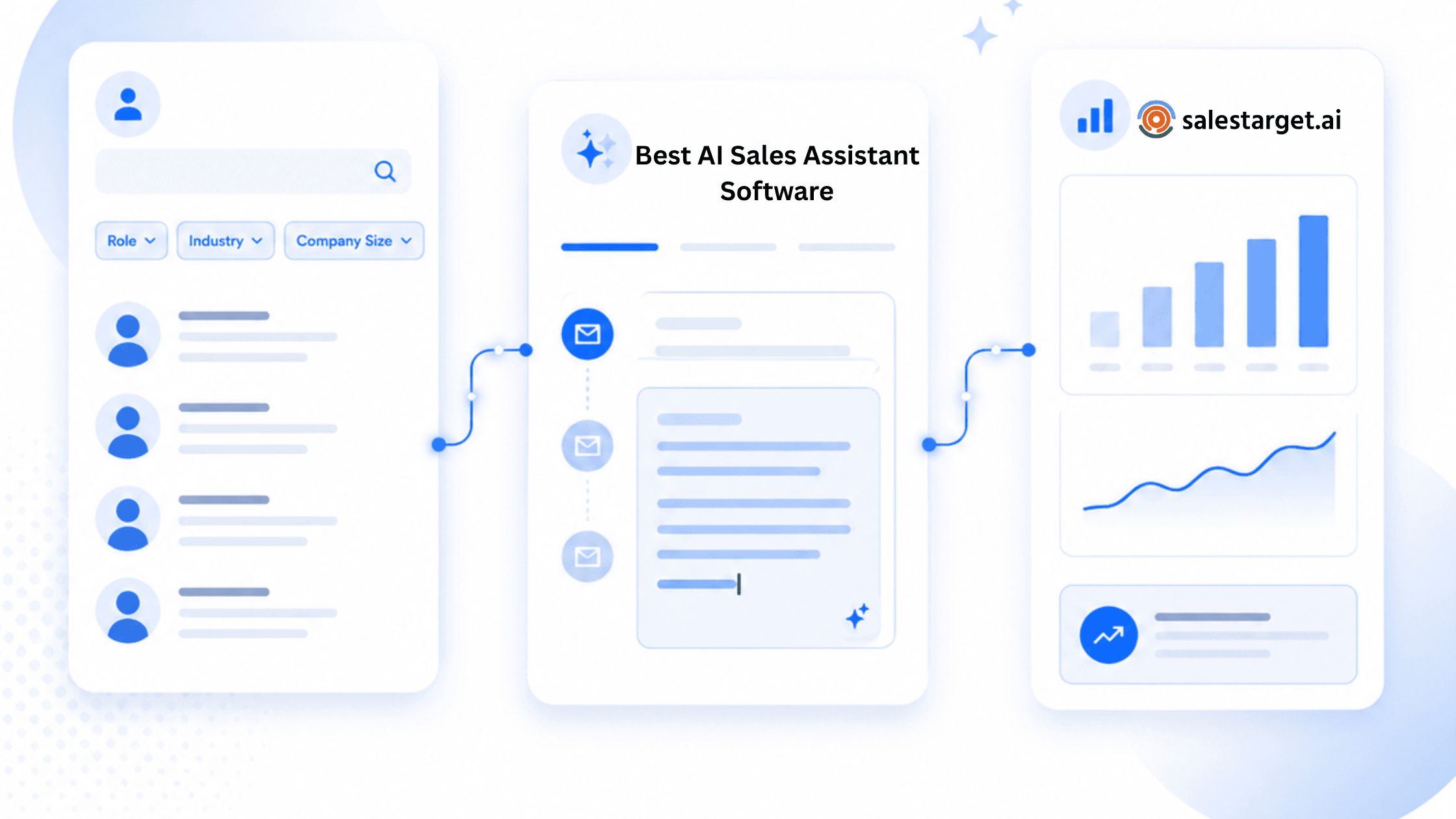
SalesTarget.ai Copilot is built around a simple idea: a sales rep should be able to find a lead, build a campaign, and get a clear picture of what's working — without leaving a single interface.
The Copilot works conversationally. You describe your ideal buyer in plain English. It searches a verified database of 840M+ contacts and returns a targeted list. From there, you can launch a multi-step email sequence — written by the AI for your specific prospect's industry, role, and company context — and track results without switching tools.
- Email outreach (salestarget.ai/email-outreach) is built into the Copilot workflow — sequences are generated, not templated
- LinkedIn outreach (salestarget.ai/linkedin-outreach) is available as a parallel channel within the same platform
- CRM functionality (salestarget.ai/crm) lets reps query deals and tasks in plain language — no dashboard clicking
- Email validation (salestarget.ai/email-validator) happens as part of lead sourcing, reducing bounce risk before campaigns launch
The result is a platform that removes the tool-switching bottleneck while keeping the output quality high enough that outreach feels written, not generated.
Real-World Use Cases
SDR teams
For a team of SDRs running 20–30 outreach sequences simultaneously, the biggest time sink is usually research and personalization. An AI sales assistant that generates contextually relevant sequences from a prospect description — and flags which campaigns are underperforming — compresses the daily grind into fewer steps.
Solo founders
Founders doing their own outbound face a different constraint: they're not full-time salespeople. Tools that require hours of setup or complex dashboards don't fit. A conversational AI that surfaces leads and writes outreach on demand aligns better with how a founder actually works.
B2B agencies
Agencies need to move fast across multiple client accounts. The ability to define a buyer profile, generate a campaign, and start tracking results quickly — without rebuilding workflows from scratch per client — is where AI sales productivity software earns its place.
Outbound consultants
Consultants often inherit messy setups and need to show results quickly. An AI assistant that can summarize where deals are stuck and generate follow-up copy on demand is genuinely useful in that context.
Lean B2B startups
Pre-Series A companies where the founding team is running sales don't have time to master complex enterprise platforms. AI tools built for fast execution with a low learning curve deliver faster time-to-pipeline.
Where AI Sales Assistants Are Heading
From task automation to decision support. Gartner predicts that by 2026, 65% of B2B sales organizations will transition from intuition-based to data-driven decision-making — AI sales tools are the primary driver of that shift.
Deeper context, not just data. LinkedIn's B2B Sales Benchmark research notes that buyers are significantly more likely to engage with outreach that demonstrates genuine understanding of their business context. Tools that can incorporate company news and role-specific pain points will separate from those relying on variable insertion.
Unified workflows over best-of-breed stacks. Teams are starting to evaluate platforms that reduce the tool count rather than add to it. Querying your pipeline in plain language is already possible and will become standard.