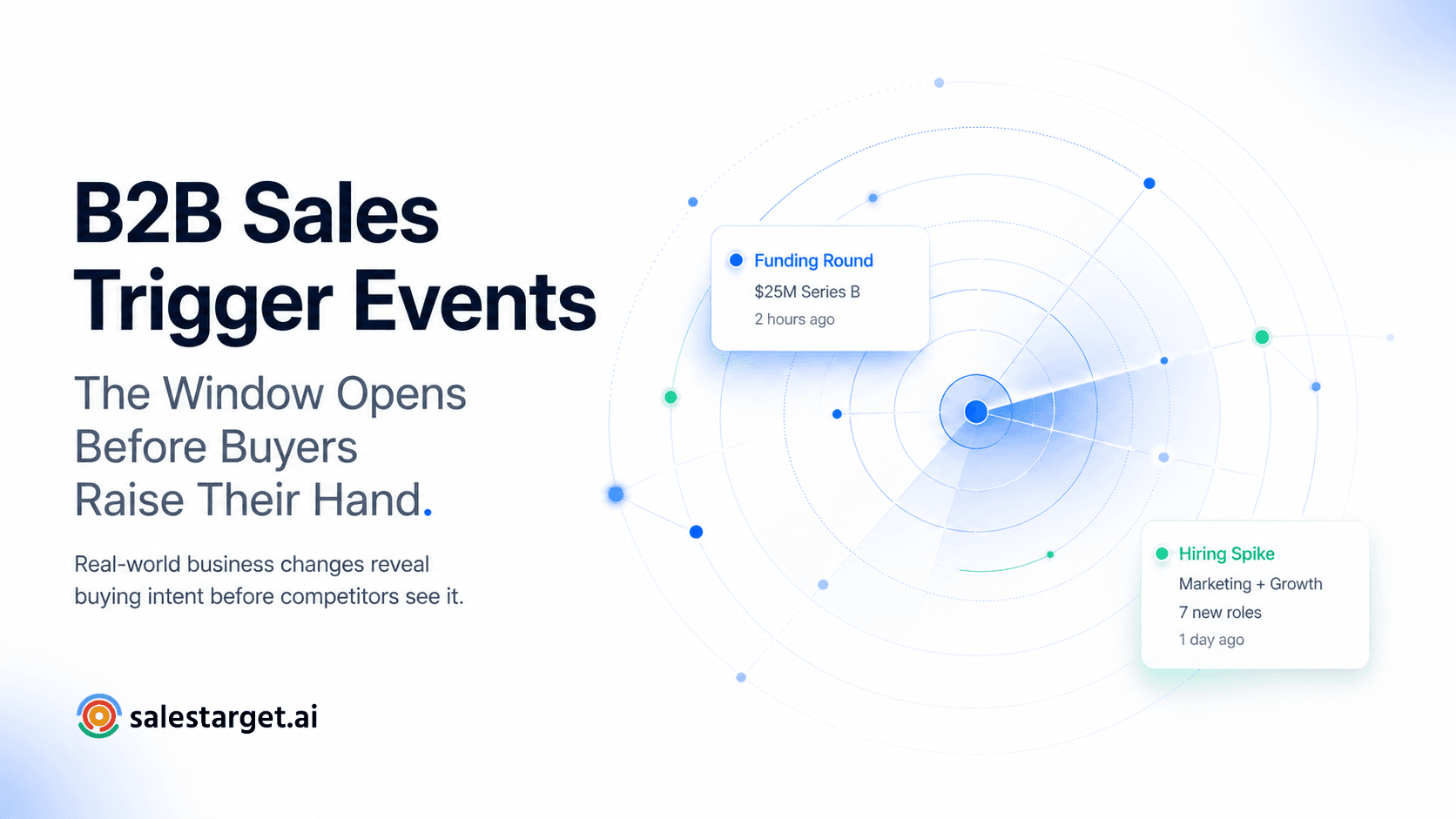
- A B2B sales trigger event is a real-world change at a company that signals it may be entering a buying cycle — before it ever raises its hand
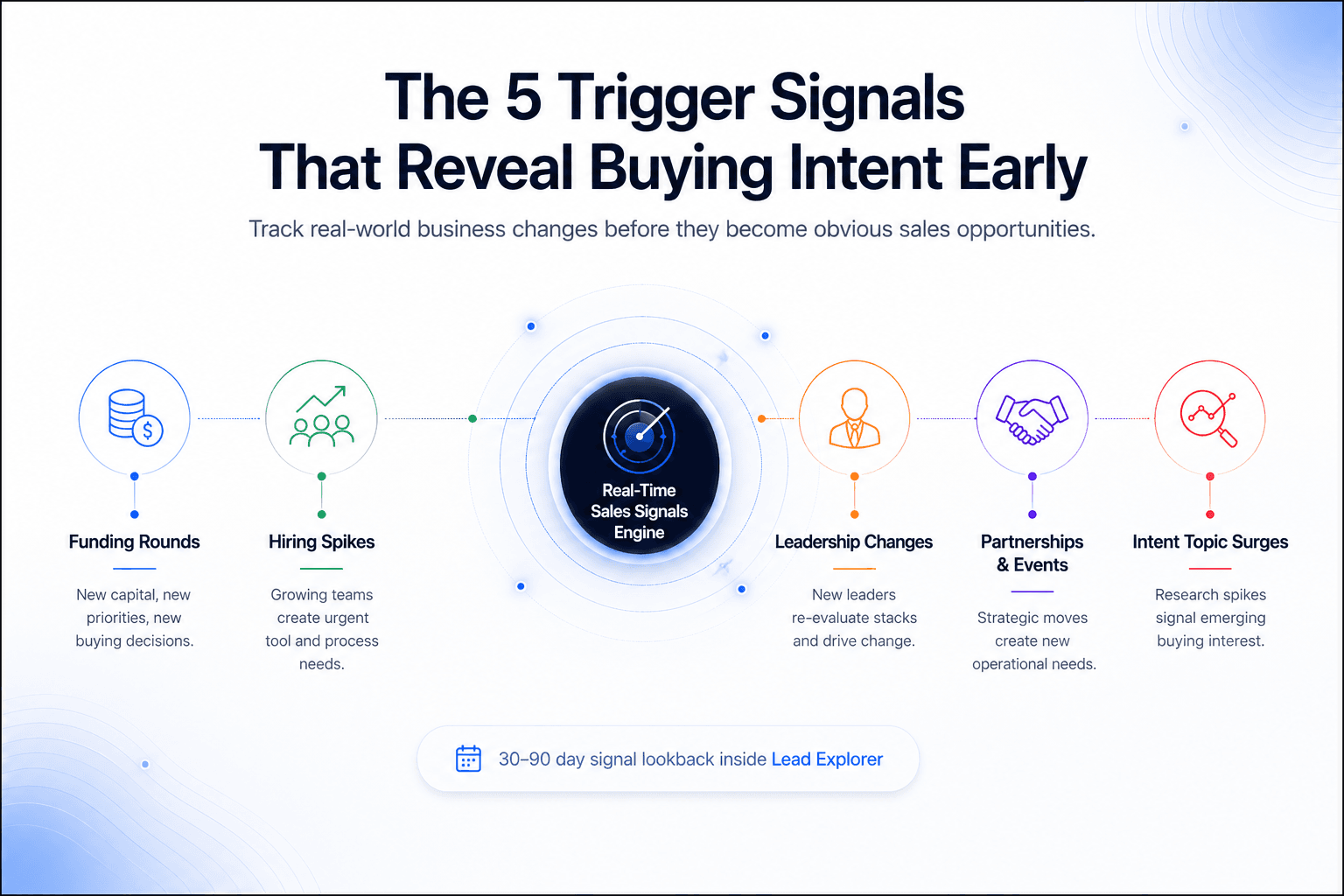
- The five trigger categories: funding rounds, hiring spikes, leadership changes, partnerships/company events, and intent topic surges
- Every trigger has a window — typically 2–6 weeks — before the signal normalises and your competitive advantage disappears
- The mistake most teams make: waiting too long. Reaching out 6 weeks after a funding round is outreach, not timing. Reaching out in week 1 is signal-driven prospecting
- SalesTarget.ai's real-time signal discovery tracks all five trigger categories with a 30–90 day lookback inside Lead Explorer
- The playbook: match each trigger type to a specific outreach angle — not a generic pitch dressed up with a reference to the news item
What Is a B2B Sales Trigger Event?
A sales trigger event is a real-world change at a prospect company that signals it may be entering a buying cycle — without that company having explicitly expressed interest in your product.
Trigger events work because business change creates buying pressure. A company that just raised a Series B has budget to deploy and growth targets to hit. A company that just hired a new VP of Sales is likely re-evaluating its sales stack. A company that just announced a major new partnership may need new infrastructure to support it. These are not coincidences — they are causal relationships between business events and procurement decisions.
The SDR who reaches out on the back of a trigger event is not doing cold outreach. They are doing well-timed, contextually relevant outreach — and the response rates reflect the difference.
💡 Why timing matters
The window on a trigger event is narrow. A funding round announcement creates maximum buying urgency in weeks 1–4. By week 8 the new budget is already allocated, the vendor conversations are already in progress, and your outreach lands as one of many follow-ons rather than a timely, relevant first touch. The value of trigger data is not knowing the event happened — it is knowing fast enough to act while the window is open.
The Five B2B Sales Trigger Categories
SalesTarget.ai's real-time signal discovery tracks five trigger categories inside Lead Explorer with a 30–90 day lookback window. Here is what each signal means, when to act, and exactly how to position your outreach.
1. Funding Rounds
A company that just raised funding has three things your outreach should connect to: new budget, new growth targets, and pressure to deploy capital intelligently. This is one of the highest-intent trigger signals in B2B sales.
| Funding stage | Signal strength | What it means | Outreach window |
|---|---|---|---|
| Pre-seed / Seed | Medium | Early-stage team building out foundational stack — limited budget but open to tools that scale | 2–6 weeks post-announcement |
| Series A | High | First significant capital deployment — actively building sales, marketing, and operations stack | 1–4 weeks post-announcement |
| Series B / C | Very high | Scaling aggressively — upgrading existing tools, adding new capabilities, hitting growth targets | 1–3 weeks post-announcement |
| Series D+ | High | Late-stage growth or pre-IPO — consolidating vendor stack, adding enterprise capabilities | 1–4 weeks post-announcement |
📝 Funding round outreach angle
Do not lead with "Congratulations on your funding." Everyone does this. Lead with what the funding means operationally: "Most Series B teams we work with are rethinking their outbound stack in the first 60 days post-raise — is that on your radar at [Company]?"
2. Hiring Spikes
Rapid hiring — especially in Sales, RevOps, Marketing, or Engineering — is one of the most reliable early buying signals in B2B. Headcount growth creates tool needs, process gaps, and budget pressure to solve them.
| Hiring signal | What it indicates | Relevant product categories | Outreach window |
|---|---|---|---|
| SDR / BDR hiring spike | Building or scaling an outbound function — needs prospecting, sequencing, enrichment tools | Prospecting platforms, lead data, outreach automation | 1–4 weeks after job posts appear |
| Sales leadership hire (VP Sales, CRO) | New leader will re-evaluate existing stack within 90 days — classic 'new broom' buying cycle | CRM, sales intelligence, coaching, enablement | 1–3 weeks after LinkedIn announcement |
| RevOps / Sales Ops hiring | Sophisticating their data and process infrastructure — operational tool purchases incoming | Data enrichment, CRM integration, analytics | 2–4 weeks after job post |
| Engineering / DevOps spike | Technical infrastructure build-out — relevant for dev tools, security, cloud | Dev tools, security, infrastructure | 1–4 weeks after job posts appear |
📝 Hiring spike outreach angle
Reference the job posting category, not the individual post: "I noticed [Company] is building out its SDR team — teams scaling outbound this fast typically hit prospecting data quality issues in the first 30 days. Is that something on your radar?"
3. Leadership Changes
A new executive hire — especially in Sales, Marketing, RevOps, or the C-suite — is one of the most reliable triggers for a vendor evaluation. New leaders re-evaluate existing tools within their first 90 days as a matter of standard practice. They also bring their own preferences and relationships from previous roles.
| Leadership change | Buying signal | Typical window for evaluation |
|---|---|---|
| New VP of Sales / CRO | Will re-evaluate entire sales stack — CRM, intelligence, prospecting, sequencing | 30–90 days post-start date |
| New CMO / VP Marketing | Will re-evaluate marketing automation, intent data, demand gen tools | 30–90 days post-start date |
| New Head of RevOps / Sales Ops | Will audit data quality, CRM configuration, enrichment and scoring tools | 30–60 days post-start date |
| New CEO / COO | Strategic re-evaluation — may trigger broader vendor consolidation | 60–90 days post-start date |
📝 Leadership change outreach angle
Do not reference that you saw their LinkedIn post. Reference the operational reality of a new role: "Most [VP Sales] we speak to re-evaluate their prospecting stack in the first 60 days — even if they're happy with it, they want to know if there's something better. Is that a conversation worth having?"
4. Partnerships, Awards, and Company Events
Major announcements — new product launches, strategic partnerships, industry awards, office openings, or market expansions — signal that a company is in growth mode and has operational needs that come with that growth.
| Event type | What it signals | Relevant outreach angle |
|---|---|---|
| New strategic partnership announced | Integration or go-to-market work ahead — operational and technical needs | Connect your product to the infrastructure required to execute the partnership |
| Major product launch | Go-to-market activation — needs sales and marketing tools to support the launch | Position your tool as part of the launch GTM stack |
| Industry award or recognition | Company is growing and reputation-conscious — wants best-in-class tools | Reference the recognition as validation of their trajectory, then pivot to growth challenges |
| Office opening / geographic expansion | New market entry — needs local data, outreach, compliance tools | Help them build out the new market prospecting infrastructure |
| M&A activity | Post-merger integration — tools likely to be evaluated and consolidated | Position your tool as the standard across both entities |
📝 Company event outreach angle
Reference the business implication, not the announcement itself: "The [Company] and [Partner] announcement suggests you're expanding your GTM in [market] — is outbound prospecting infrastructure part of what you're building out?"
5. Intent Topic Surges (Bombora)
Intent topic surges are the most directly actionable signal — a company's research activity on topics related to your product has spiked significantly above its normal baseline. This is captured via Bombora's Data Co-op across 20,100+ B2B topics and a 30–90 day lookback window.
Unlike the other four trigger categories, intent data does not require a public announcement — it is visible research behaviour happening across thousands of publisher sites, invisible to the prospect but tracked and surfaced for you.
| Surge score | Signal interpretation | Outreach priority |
|---|---|---|
| 60–100 | Company is actively in-market — multiple team members researching relevant topics at high intensity | Tier 1 — contact same day, highest personalisation |
| 40–59 | Early research signals — company is evaluating options but not yet at peak intent | Tier 2 — add to sequence this week |
| 20–39 | Slight above-baseline activity — monitor but do not act yet | Tier 3 — watch list |
📝 Intent surge outreach angle
Use the intent signal to inform your angle, not to cite it: "Is [relevant topic] on your radar right now at [Company]?" frames the conversation without revealing that you've been monitoring their research activity.
The Trigger Event Outreach Playbook
Each trigger type maps to a specific outreach angle. The mistake most teams make is using the trigger as a generic opener ('Congratulations on your funding!') rather than connecting it to a specific operational implication.
| Trigger event | Wrong opener | Right opener | Window |
|---|---|---|---|
| Series B funding | Congrats on the funding! | Most Series B teams rethink their outbound stack in the first 60 days post-raise — is that on your radar at [Company]? | Week 1–3 |
| SDR hiring spike | I saw you're hiring SDRs — we help SDR teams. | Scaling an SDR team this fast typically surfaces data quality issues within 30 days — is prospecting data something you're working on? | Week 1–2 |
| New VP of Sales | Congrats on the new role! | Most VPs re-evaluate their prospecting stack in the first 60 days. Even if you're happy with it — worth a 15 min compare? We work with [similar companies]. | Week 2–4 |
| New partnership announced | Saw the [Partnership] news! | The [Company]/[Partner] partnership suggests a [market] GTM push — is outbound infrastructure part of what you're building for that? | Week 1–2 |
| Intent topic surge (60+) | Generic pitch. | Is [intent topic] on your radar at [Company] right now? It's the conversation we keep having with [industry] teams. | Same week |
How SalesTarget.ai Surfaces Trigger Events Inside Lead Explorer
SalesTarget.ai's real-time signal discovery tracks all five trigger categories — funding rounds, hiring spikes, leadership changes, company events, and Bombora intent surges — with a 30–90 day lookback window, directly inside Lead Explorer.
The workflow:
- Step 1 — Set ICP filters: Industry, size, revenue, geography, tech stack via ICP Builder. This ensures every trigger-surfaced account is already a qualified fit.
- Step 2 — Add signal filters: Select the trigger categories you want to surface — funding, hiring, leadership, events, intent topics. Set lookback window (30, 60, or 90 days).
- Step 3 — Review surfaced accounts: Accounts appear ranked by signal recency and ICP fit. The most recently triggered, best-fit accounts surface first.
- Step 4 — Enrich in one click: Unlock verified contacts, tech stack, and firmographics via point-of-discovery enrichment — checked live at the moment you pull the record.
- Step 5 — Act while the window is open: Push to CRM or launch outreach sequence directly from Lead Explorer. No exports. No switching tools. No delay.
💡 The window is the advantage
Trigger data is only valuable if you act on it while the signal is fresh. The 30–90 day lookback window in SalesTarget.ai's signal discovery is there precisely so you can calibrate how recent the trigger needs to be for your outreach motion. A 7-day-old funding round is a different conversation than a 60-day-old one.
Frequently Asked Questions
What are B2B sales trigger events?
B2B sales trigger events are real-world changes at prospect companies that signal they may be entering a buying cycle — without explicitly raising their hand. Common triggers include funding rounds, rapid hiring, leadership changes, major partnerships or company announcements, and intent topic surges. Each trigger creates a time-sensitive window where outreach is more likely to be relevant and well-received.
How do I use a funding round as a sales signal?
A funding round signals new budget, new growth targets, and operational needs that come with scaling. The key is reaching out in weeks 1–3 post-announcement — not weeks after everyone else already has. Lead with the operational implication ('Most Series B teams we work with rethink their prospecting stack in the first 60 days post-raise') rather than a generic congratulatory opener.
What buying signals mean a company is ready to buy?
The strongest combination is ICP fit + multiple overlapping trigger signals. A company that just raised funding, is actively hiring SDRs, and is surging on intent topics related to your product is a Tier 1 account. Any single signal is meaningful. Multiple overlapping signals from the same company in the same window is your highest-priority outreach target.
How do I find companies that just raised funding?
SalesTarget.ai's real-time signal discovery surfaces funding rounds, alongside hiring spikes, leadership changes, and company events, within a 30–90 day lookback window inside Lead Explorer. Filter by ICP first, then add the funding signal filter to surface qualifying companies that recently raised — in the right stage range for your product.
How far back should I look at trigger events?
It depends on the trigger type and your sales cycle. For funding rounds and leadership changes, the highest-value window is typically within 2–4 weeks of the event. For hiring spikes, 1–6 weeks. For intent surges, act within the same week — intent signals peak and fade fast. The 30–90 day lookback in SalesTarget.ai's signal discovery is a maximum range; tighter windows produce higher-relevance outreach.
Conclusion: The Window Is the Strategy
Most B2B outreach is sent to the right company at the wrong time. Trigger event prospecting flips this — it identifies the right company at the exact moment something has changed that makes your product newly relevant.
SalesTarget.ai's real-time signal discovery tracks all five trigger categories with a 30–90 day lookback window, surfaced inside Lead Explorer alongside ICP filters and point-of-discovery contact enrichment. The trigger fires, you act, the window is still open.
The companies buying your product this quarter are already showing signals. The question is whether you'll see them before your competitors do.
See the signals before your competitors do.
Real-time signal discovery — 5 trigger categories, 30–90 day lookback, inside Lead Explorer.
50 credits · 7-day trial · No credit card required.