TL;DR
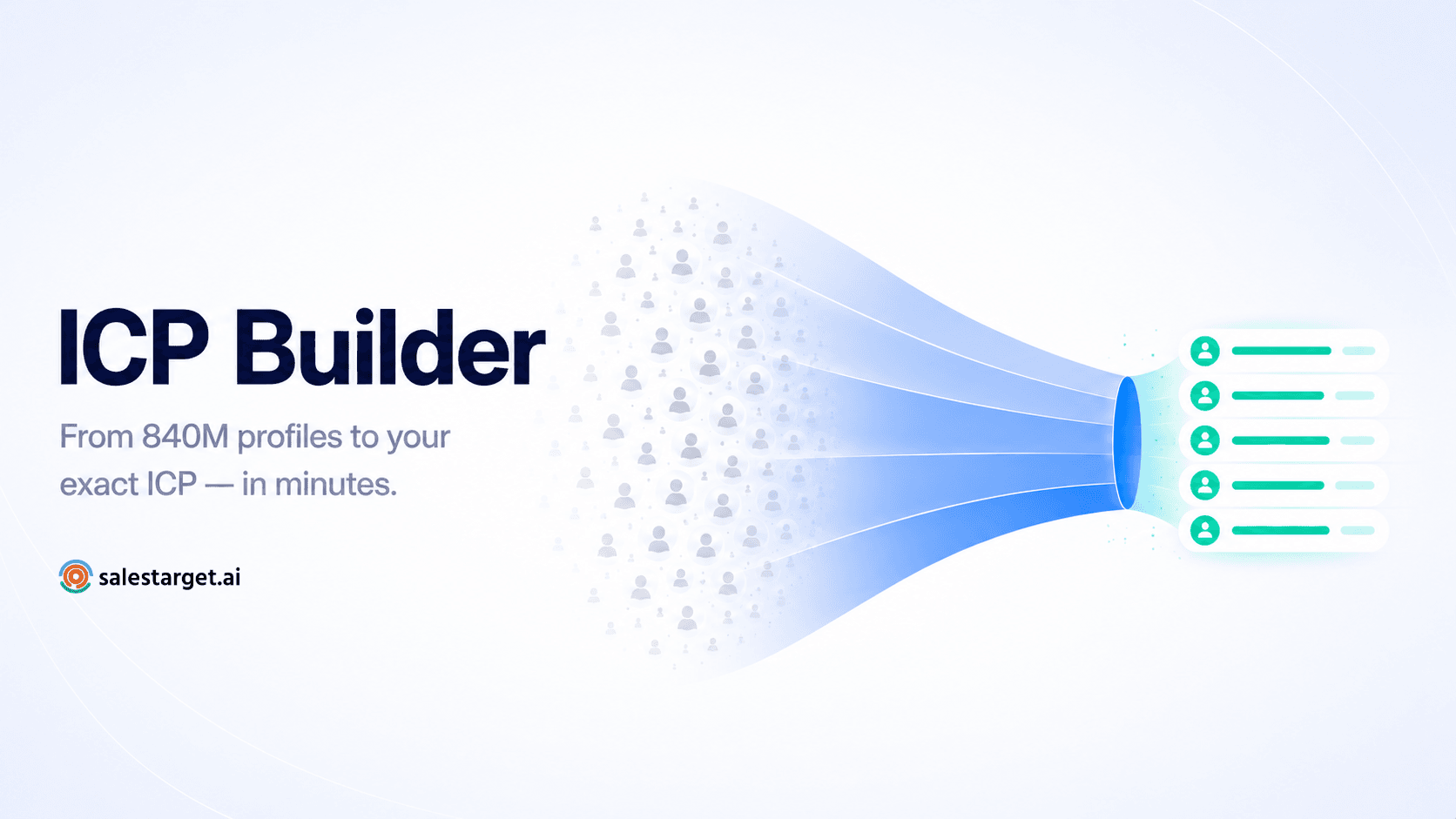
- An ICP builder tool is software that auto-matches a prospect database to your defined customer profile — replacing manual filter-by-filter list building with a single validated search
- Companies with a clearly defined ICP achieve 68% higher win rates than companies without one (SiriusDecisions / TOPO research, cited widely 2025–2026)
- ICP-aligned deals cost 50% less to acquire and convert at 30–50% higher rates than out-of-profile deals (Leadriver / HubSpot 2026)
- Manual filtering — industry + headcount alone — is not ICP targeting. A real ICP has five dimensions: firmographic, technographic, intent, role criteria, and trigger events
- 64% of B2B sales rep time is spent on prospects who will never convert — the direct cost of weak ICP targeting (LinkedIn Sales Solutions data, 2026)
- SalesTarget.ai's ICP Builder applies all five dimensions simultaneously across 840M+ profiles — returning a pre-qualified list in minutes, not hours
The Gap Between "Targeting" and ICP Targeting
68% of B2B companies have not clearly defined their ideal customer profile — and the ones that have see 68% higher win rates, 30–50% higher conversion rates, and deals that cost roughly 50% less to acquire (SiriusDecisions / TOPO, cited in Landbase and Leadriver 2026). The same number appears twice intentionally: the percentage of companies that lack an ICP is the same as the win rate advantage of the companies that have one.
The reason most teams have not defined their ICP is not that they don't understand the concept. It is that the tools available have made it easier to skip. A LinkedIn Sales Navigator filter with industry, headcount, and geography feels like ICP targeting. It is not. It is firmographic shortlisting — one dimension of a five-dimension problem.
The result: 64% of B2B sales rep time is spent on prospects who will never convert (LinkedIn Sales Solutions data via La Growth Machine 2026). That is not a pipeline problem or a messaging problem. It is a targeting problem — and the root cause is a prospect list built without a real ICP.
📊 ICP targeting vs no ICP — the performance gap
- 68% higher win rates — companies with a defined ICP vs those without — SiriusDecisions / TOPO (now Gartner), widely cited 2025–2026
- 30–50% higher conversion rates — ICP-matched vs out-of-profile accounts — Leadriver / HubSpot 2026
- 50% lower customer acquisition cost — ICP-aligned deals vs non-ICP — HubSpot / Leadriver 2026
- 36% higher retention rates — teams aligned on a common ICP definition — Leadriver 2026
- 64% of SDR time wasted on prospects who will never convert — LinkedIn Sales Solutions via La Growth Machine 2026
What an ICP Actually Is (and What It Is Not)
An Ideal Customer Profile is a data model that describes the type of company most likely to buy your product, retain it, and expand — validated against your actual closed-won customers, not built from assumptions. It is not a buyer persona (which describes individuals). It is not a target market (which is too broad). And it is not a LinkedIn Sales Navigator filter (which is just the firmographic layer of what should be a five-dimension profile).
A real ICP in 2026 has five dimensions. Without all five applied simultaneously, the list you build has visible gaps:
| ICP dimension | What it filters for | Without it you miss |
|---|---|---|
| Firmographic | Industry, company size, revenue, headcount, geography | Basic qualifier — the floor, not the ceiling |
| Technographic | Current tech stack — what tools they run | Companies that look right but can't adopt your product, or already run a competitor |
| Intent signals | Active research behaviour — are they in-market right now? | ICP-fit companies that are not in a buying cycle and will not engage for months |
| Role criteria | Decision-maker seniority, department, job title | Contacts at the right company with no budget authority |
| Trigger events | Funding rounds, hiring spikes, leadership changes | ICP-fit companies not yet in a buying window — signals tell you when to act |
Most ICP guides from Apollo, Sybill, and La Growth Machine stop at explaining what these dimensions are — then hand you a template to fill in manually. None connect the ICP directly to a live prospect database. That is the gap that SalesTarget.ai's ICP Builder closes. For a deeper dive on the methodology, see our filter-first ICP guide.
Manual Filtering vs ICP Builder: The Time and Quality Comparison
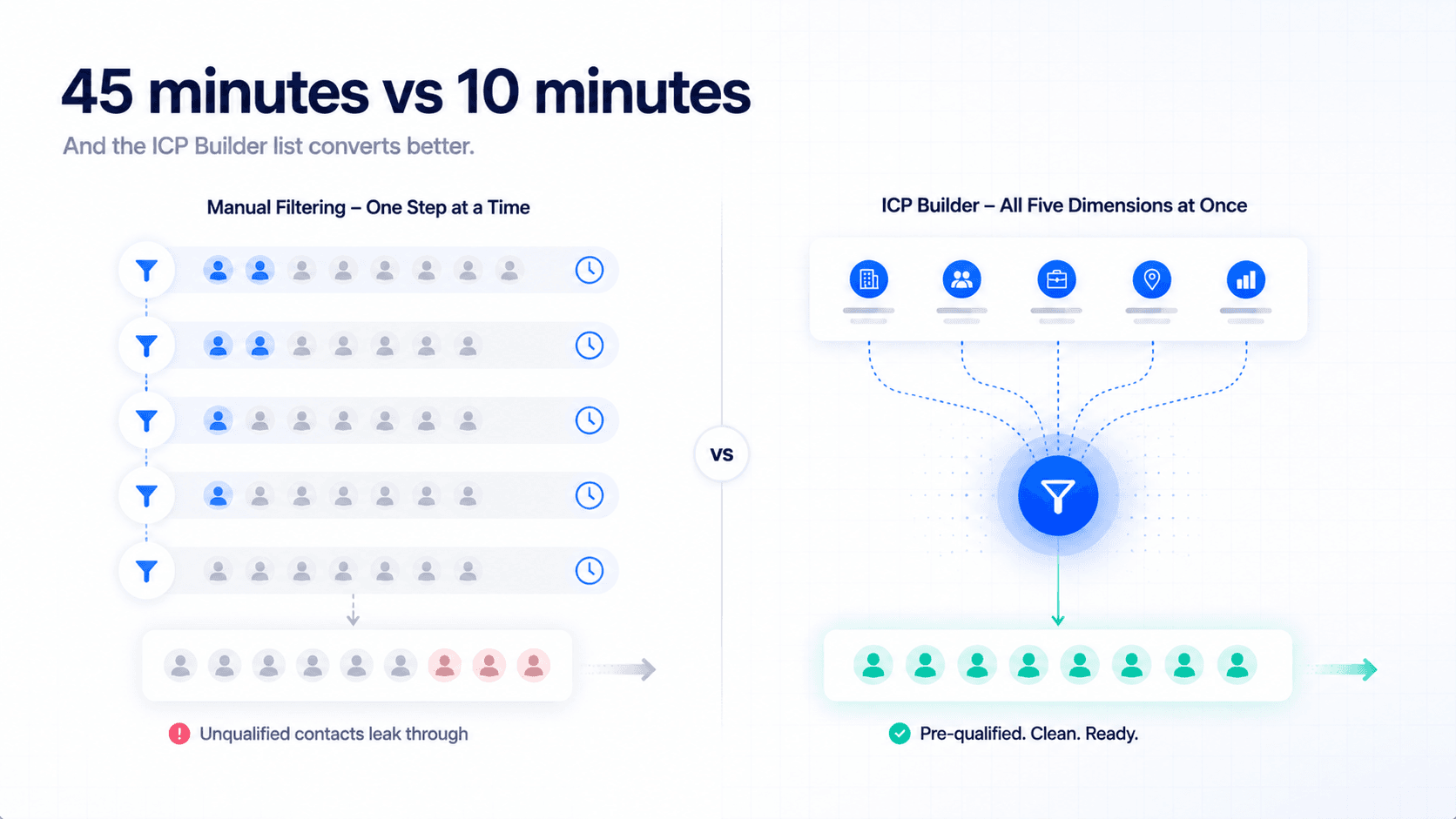
Manual filtering means building a prospect list by applying one filter at a time — industry first, then headcount, then geography, then job title — until the list is small enough to work with. It is the workflow most teams default to because it is what every data platform makes easy. It is also why most prospect lists underperform.
| Manual filter-by-filter | SalesTarget.ai ICP Builder | |
|---|---|---|
| Time to build 100-contact list | 45–90 minutes of manual cross-filtering and qualification | 5–10 minutes — all dimensions applied simultaneously |
| Dimensions applied | Typically 2–3 (firmographic only) | All 5 simultaneously |
| Consistency across reps | Varies — each SDR builds differently | Identical ICP applied every time |
| Post-search qualification | 30–40% of results need manual removal | Minimal — ICP applied before search runs |
| Credit efficiency | Credits spent on contacts that fail qualification | Has Email toggle pre-filters availability |
💡 The consistency problem with manual filtering
When every SDR builds their own list manually, no two lists are built to the same standard. One rep filters for 'SaaS, 51–200 employees'. Another adds technographic criteria. A third skips intent filters entirely. The result: three lists that look similar on a spreadsheet but represent very different targeting quality — and produce very different conversion rates. A saved ICP profile eliminates this entirely.
The 5 ICP Dimensions in SalesTarget.ai — Applied Before the Search Runs
SalesTarget.ai's ICP Builder applies all five ICP dimensions inside a single search across 840M+ professional profiles. The filters run simultaneously — not sequentially — which means every contact returned has already passed all five criteria before a single enrichment credit is spent.
1. Firmographic filters — Industry, company size, revenue range, geography, company age. Applied in Lead Explorer's filter panel alongside every other dimension.
2. Technographic filters — Current tech stack — search by specific tool ('Salesforce', 'HubSpot') or by category ('CRM', 'marketing automation'). Exclusion filters remove companies already running a direct competitor. Applied via the Tech Stack filter in the same search.
3. Intent signals (Bombora) — Bombora intent data — included in every SalesTarget.ai plan — surfaces companies actively researching topics relevant to your product. The same Bombora data that costs $25,000+/year to access through ZoomInfo Advanced is included at every price point in SalesTarget.ai.
4. Role and seniority criteria — Job title, department, and seniority level filters return the decision-makers and influencers your product is actually sold to — not general company contacts with no budget authority.
5. Trigger event signals — Signal Discovery surfaces funding rounds, hiring spikes, leadership changes, and website content changes that indicate a buying window is open. Layering signal filters returns ICP-fit companies that are actively in motion — your Tier 1 accounts.
🎯 The ICP Builder output
Define your ICP once across all five dimensions. Run the search. Every contact has passed firmographic, technographic, intent, role, and trigger criteria simultaneously. Enable the Has Email toggle to add one more layer — filter for contacts with verified email available before committing any credits. No post-search manual review. No credits spent on contacts that fail qualification.
Building an ICP in SalesTarget.ai: A 10-Minute Walkthrough
- Start from your closed-won data (before you open the tool). Pull your last 20 best customers. What industry, headcount, and revenue range appear most? What tools do they use? What role do your champions hold? What triggered the conversation? These patterns are your ICP.
- Apply firmographic filters. Set industry, company size, revenue range, and geography. This is your baseline — typically 50,000–500,000 matching companies in a well-defined ICP.
- Add technographic criteria. Open the Tech Stack filter. Select the tools or categories your best customers use. Add exclusion filters for competitor tools. The list typically narrows by 60–80%.
- Layer intent signals. Add Intent Topic filters matching your product category. Companies remaining now match your firmographic and technographic ICP AND are actively researching. This is when the list transitions from prospect list to in-market account list.
- Set role and seniority filters. Select job titles, departments, and seniority levels your product is sold to. Returns specific decision-maker contacts at ICP-fit, intent-filtered companies.
- Enable Has Email + trigger signals. Enable the Has Email toggle to pre-filter for contacts with verified emails. Add Signal Discovery filters for recent trigger events to prioritise accounts in an active buying window.
- Enrich and act. Unlock enrichment credits. Point-of-discovery verification runs at the moment of enrichment. Push directly to your sequence or built-in CRM.
The Numbers Behind ICP-First Selling
The performance gap between ICP-targeted outbound and generic outbound is one of the most consistently replicated findings in B2B sales research. Across studies from SiriusDecisions, HubSpot, Leadriver, and Gartner, the same conclusion appears: targeting precision is the single highest-leverage variable in pipeline efficiency.
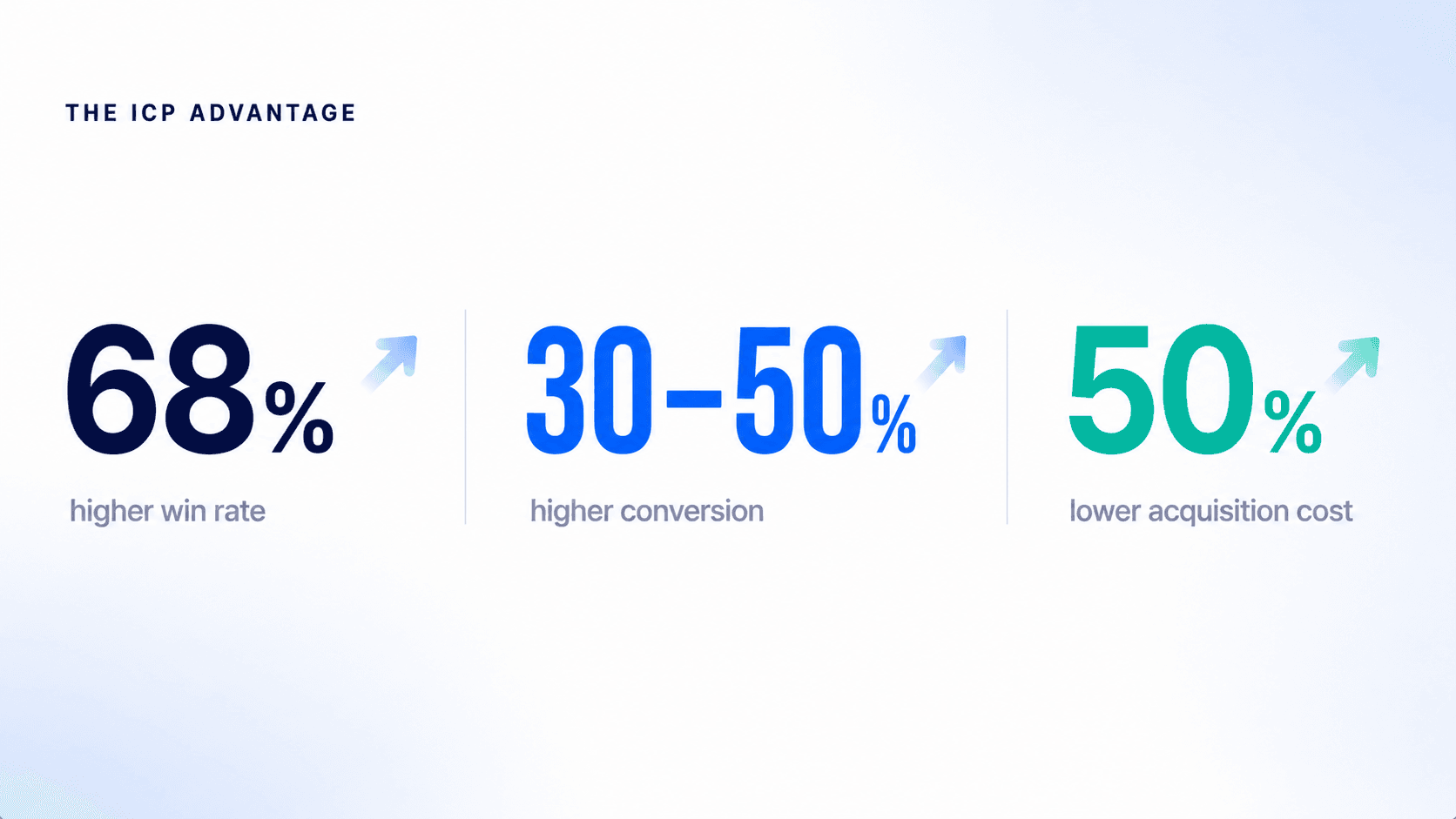
| Metric | Without defined ICP | With defined ICP | Source |
|---|---|---|---|
| Win rate | Baseline | 68% higher | SiriusDecisions / TOPO (Gartner) |
| Sales conversion rate | Baseline | 30–50% higher | Leadriver / HubSpot 2026 |
| Customer acquisition cost | Baseline | ~50% lower | HubSpot via Leadriver 2026 |
| Customer retention | Baseline | 36% higher | Leadriver 2026 |
| SDR time on non-converters | 64% of selling time | Significantly reduced | LinkedIn Sales Solutions via La Growth Machine 2026 |
Conclusion: Most ICP Guides Tell You What to Think. This Tool Does It Automatically.
Every competitor blog ranking for "ICP builder tool" explains what an ICP is and why it matters — then hands you a template spreadsheet and wishes you luck. SalesTarget.ai's ICP Builder is the only tool that connects all five ICP dimensions directly to a live database search across 840M+ profiles, with Bombora intent signals, point-of-discovery verification, and Has Email filtering — all applied before a single enrichment credit is spent.
The 68% win rate advantage is not a product of better messaging or better SDRs. It is a product of targeting the right companies in the first place.
Build your ICP. Let it filter 840M+ profiles automatically.
SalesTarget.ai's ICP Builder matches your profile to verified, intent-filtered contacts — in minutes, not days.
50 credits · 7-day free trial · No credit card required