Your list looks full. Your CRM says you have ten thousand contacts. Then your reps start dialing and half the numbers are dead, a quarter of the emails bounce, and the person you wanted to reach left the company eight months ago. That's not a small annoyance. It's the difference between a rep who books meetings and one who spends the morning chasing ghosts.
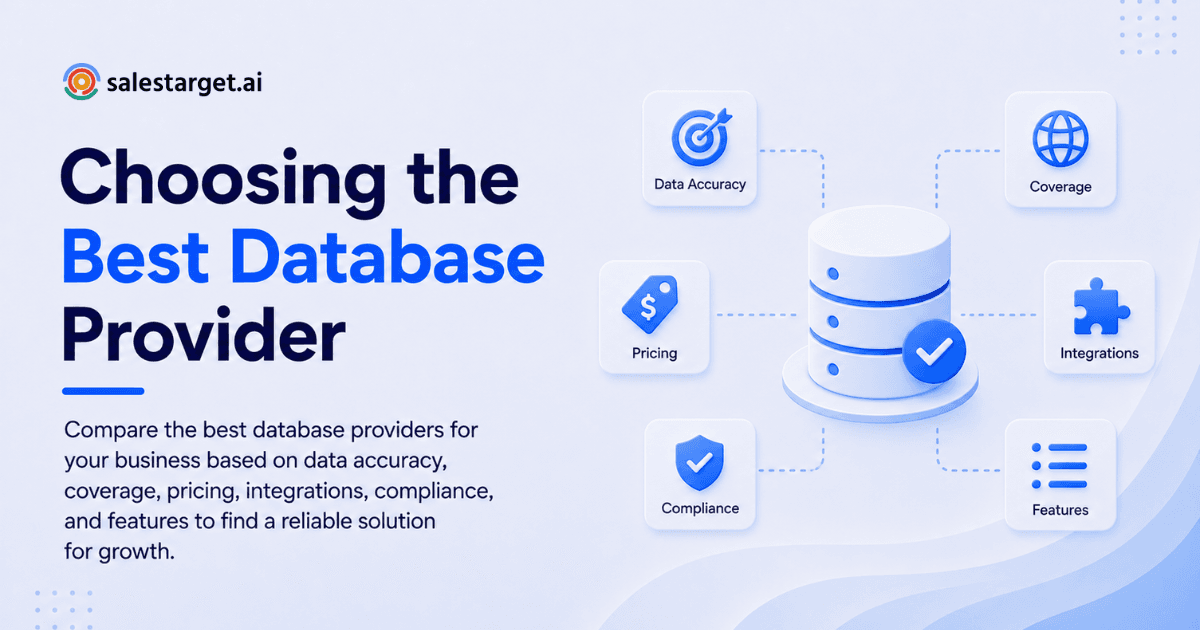
A database provider is the company that supplies the business contact and company records your sales and marketing teams work from: names, titles, emails, phone numbers, firmographics, and buying signals. The best one for your business is whichever provider gives your reps the highest share of accurate, reachable contacts for your specific target market, at a price and workflow that fits how your team actually sells. That usually comes down to five things: data accuracy, coverage of your industry and geography, verification methods, CRM and outreach integrations, and whether you can test the data before you commit to it.
Pick wrong and you pay twice: once for the subscription, once in wasted rep hours and a damaged sender reputation. Pick right and prospecting stops being a guessing game.
What Is a Database Provider?
A database provider maintains and sells access to a structured set of business records: contact details, company profiles, org charts, technographics, and often intent data showing who is actively researching a solution like yours. Providers differ in how they source data (scraping, public filings, user-submitted records, partnerships, or a mix), how often they refresh it, and how they verify it before you see it. Some sell raw exports. Others, like SalesTarget.ai, verify contact information at the moment you find a lead rather than relying on a static snapshot that ages the day it's built.
Why Database Quality Matters for B2B Sales
Accurate Contact Data for Better Prospecting
Accurate data means your rep's first email actually lands in an inbox that still belongs to a real decision-maker. Gartner estimates poor data quality costs the average organization $12.9 million a year, and industry benchmarks put annual B2B contact decay around 22.5 percent once you account for job changes and company moves. A provider that verifies records close to the point of use protects your pipeline from that erosion.
Reducing Bounces and Invalid Contacts
Every bounce is a small hit to your sender reputation, and enough of them get your domain flagged by mailbox providers. A database that pairs contact records with real-time email verification (MX and SMTP checks, disposable-address detection, risk scoring) keeps bounce rates low before you send a single message, not after a campaign has already burned your domain's trust.
Improving ICP and Account Targeting
A provider with deep firmographic and technographic filters lets you build a list of companies that actually match your ideal customer profile: right industry, right size, right tech stack, right buying signals. Vague filters produce vague lists, and vague lists produce low reply rates no matter how good your email copy is.
Saving Sales Teams Time on Manual Research
Salesforce's 2026 State of Sales survey found sellers still lose meaningful chunks of their week to manual data entry and research instead of selling. A provider that hands reps verified, enriched contacts on demand removes that research tax and puts the hours back into calls and follow-ups.
How to Choose the Best Database Provider
Define Your Ideal Customer and Data Needs
Before comparing vendors, write down your ICP: industry, company size band, geography, buyer roles, and the signals that tell you someone is ready to talk. Without this, every provider's pitch sounds equally convincing.
Evaluate Database Data Accuracy
Ask for a published or independently reported accuracy rate, not a marketing claim. Anything meaningfully below the mid-90s in verified email accuracy will cost you in bounces down the line.
Check Industry and Geographic Data Coverage
A provider can look massive on paper and still be thin in your specific vertical or region. Search their database for your actual target list before you sign anything.
Review Search Filters and Prospecting Features
Look for the ability to stack filters (role, seniority, department, revenue, tech stack, intent topics) and search in plain language rather than building a rigid Boolean query by hand.
Check Data Verification and Compliance
Confirm how and when records are verified, and how the provider handles consent and regional data regulations. A provider that verifies at the point of enrichment gives you fresher data than one that verified a record months ago and never touched it again.
Compare CRM Integrations and API Access
Data that has to be exported to a spreadsheet and re-imported into your CRM adds friction and errors at every hop. Native integrations or a clean API save that step entirely.
Test Data Quality Before Making a Purchase
Pull a sample list against your real ICP and manually verify a portion of it before you commit. A short trial run tells you more than any sales deck.
Key Database Provider Features to Compare
Verified B2B Contact Data
This is the baseline: emails and phone numbers that are confirmed reachable, not just plausible-looking strings pulled from an old scrape.
Company Data Enrichment
Good enrichment fills in firmographic gaps (revenue, headcount, industry, funding stage) the moment you find a lead, so your list is usable immediately instead of needing a second cleanup pass.
Real-Time Business Data
Static exports go stale the day they're pulled. Providers that surface live buying signals, funding rounds, hiring spikes, leadership changes, help you reach a company while the opportunity is actually open.
Lead Search and Advanced Filters
The difference between a usable tool and a frustrating one often comes down to filter depth: can you combine role, department, company size, and intent topic in a single search, or are you stuck exporting broad lists and filtering manually afterward?
CRM Database Integration
A provider that pushes enriched leads directly into your CRM or sequencing tool removes the manual export-import cycle where duplicates and dead records tend to creep in.
Email Verification and Validation
Validation should happen before send, not after a bounce report tells you what already went wrong. Look for MX and SMTP checks plus disposable-domain detection built into the workflow.
Database Provider Pricing and Usage Limits
Understand exactly what counts against your usage: a search, an enrichment, a verified email, a verified phone number. Providers structure this differently, and the sticker price rarely tells the full story.
Comparing Database Providers for Different Business Needs
Database Providers for Sales Teams
Sales teams need speed: fast filtering, one-click enrichment, and a direct path from a found lead into an outreach sequence, without a CSV in between.
Database Providers for Marketing Teams
Marketing leans harder on firmographic segmentation and intent data for account-based campaigns, so broader company-level coverage and reliable technographics matter more here.
Database Providers for Small Businesses and Startups
Smaller teams usually need one platform doing data, outreach, and CRM together rather than three separate subscriptions and three separate logins to manage.
Database Providers for Agencies and Consultants
Agencies run multiple ICPs across different client accounts, so flexible workspace separation and volume-friendly enrichment matter more than any single vertical's depth.
Database Providers for Enterprise Sales Teams
Enterprise teams need scale, compliance controls, and integrations that hold up across a large CRM and multiple sales pods working the same market simultaneously.
Database Provider Pricing and Total Cost
Subscription Plans and Contact Credits
Most providers charge through some form of credit system tied to searches, exports, or enrichments rather than a flat per-seat fee, so usage patterns matter as much as the plan tier.
Cost Per Usable Contact
The number that actually matters isn't the price per credit, it's the price per contact that turns out to be accurate and reachable. A cheap list full of dead records costs more in wasted rep time than a pricier, cleaner one.
Data Enrichment and Verification Costs
Some providers bundle enrichment and verification into the base price. Others charge separately for each step, which can quietly double your real cost per lead.
Comparing Database Provider Pricing Across Platforms
Compare providers on cost per usable, verified contact rather than sticker price alone, and factor in whether outreach and CRM tools are included or billed as separate products entirely.
How to Evaluate a Database Provider After You Start Using It
Monitor Contact Accuracy and Bounce Rates
Track bounce rate weekly. A rising trend is an early signal that your data source needs a fresh look, not a reason to just send more volume.
Measure Prospecting Time Saved
Compare how long it takes a rep to build a qualified list before and after switching providers. If the number hasn't moved, the tool isn't earning its keep.
Track Lead Quality and Conversion Rates
Reply rate and meeting-booked rate tell you more about data quality than raw contact volume ever will.
Review Coverage Gaps and Data Usage
Periodically check whether the provider still covers your evolving ICP, especially if you've expanded into new industries or regions since you first signed up.
Why Choose SalesTarget.ai
Most of the problems above come from stitching together a data vendor, a cold email tool, a LinkedIn automation tool, and a CRM that don't talk to each other cleanly. SalesTarget.ai is built to remove that stitching entirely.
Lead Explorer for B2B Prospecting and Enrichment
Lead Explorer searches 840 million-plus verified professional profiles and 146 million-plus business entities, with 4,000-plus intent signals pulled from 50-plus data sources. You can search in plain English or stack Business and People filters (industry, role, seniority, department, size, revenue, location, tech stack), and enrichment happens the moment you find a lead rather than sometime after the fact.
Email and LinkedIn Outreach in One Workflow
Email Outreach and LinkedIn Outreach run in one coordinated flow, so a reply on one channel updates context on the other instead of leaving reps to track two disconnected sequences by hand.
Email Validation and Deliverability Checks
The Email Validator runs MX and SMTP checks and flags disposable addresses before a message goes out, protecting your domain's sender reputation instead of reacting after bounces already happened.
Built-In CRM for Managing Leads and Deals
The CRM pulls campaign leads in automatically, logs every call and email to the lead timeline, and creates follow-up tasks on its own when a lead replies or a meeting wraps up. Teams using it report roughly 3.2 times faster deal cycles and about 91 percent follow-up completion.
AI Copilot for Sales Prospecting
The AI Copilot lets you chat your way to a lead list, generate a full personalized sequence, or check on pipeline health in plain language, free inside the platform, so the grunt work moves faster while strategy stays with the rep.
If you want a deeper side-by-side of how a unified platform stacks up against a standalone database, this comparison of the best database providers for B2B sales walks through it in more detail. You can also see how SalesTarget.ai handles broader company-level sourcing in this guide to a B2B business directory for lead generation, or explore how it compares to point solutions in this head-to-head breakdown.
Common Mistakes When Choosing a Database Provider
Choosing Database Size Over Data Quality
A provider bragging about hundreds of millions of contacts means nothing if half of them are stale. Size without accuracy just means more places for bad data to hide.
Ignoring Contact Verification
Skipping verification to save a step now means paying for it later in bounce rates and a damaged domain reputation.
Overlooking CRM and Sales Integrations
A database that can't connect cleanly to your CRM or outreach tool turns every lead into a manual copy-paste job, and manual steps are where records get lost or duplicated.
Focusing Only on the Lowest Price
The cheapest plan often hides the highest cost per usable contact once you factor in bounces, wasted rep hours, and extra verification fees tacked on separately.
Using Separate Tools for Data, Outreach, and CRM
Every handoff between disconnected tools is a place for a lead to fall through, a duplicate to get created, or a follow-up to get missed. Try building your list, launching a sequence, and logging the reply without leaving one platform, and you'll feel the difference immediately.
Conclusion: Finding the Best Database Provider for Your Business
The pain that started this search, dead numbers, bounced emails, reps burning hours chasing contacts who left the company months ago, comes down to one root cause: data that was accurate once and never got checked again. The fix isn't a bigger database. It's a provider that verifies contacts at the moment your team actually uses them, and connects that data straight into the outreach and CRM tools your reps already work in every day.
That's the gap SalesTarget.ai was built to close: verified B2B data, multichannel outreach, and a CRM in one workspace, so your team spends its time selling instead of stitching tools together. Start free with SalesTarget.ai and see what your pipeline looks like with data you can actually trust.