
Your pipeline has 400 leads, and your reps have no real way to tell which ten matter today. So they work top to bottom, or newest first, or worst of all: whoever replied last gets the attention. A hot buyer sits untouched for three days with the intent signal nobody flagged. Follow-up slips the same way: a prospect opens an email twice, clicks a pricing page, and hears nothing back until the deal goes cold.
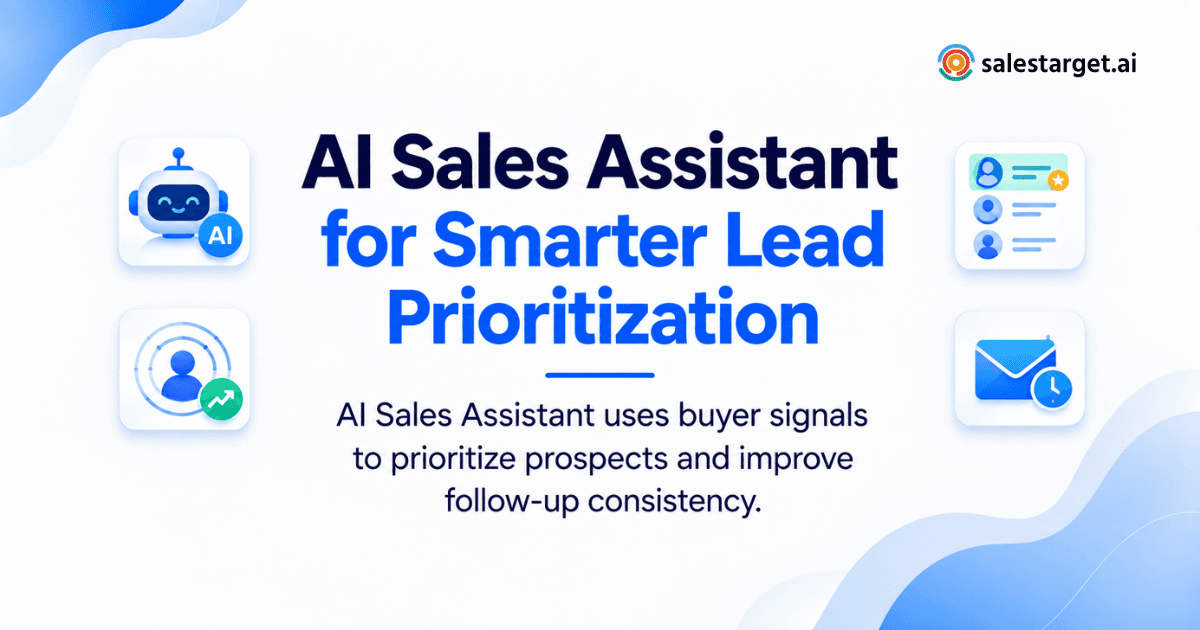
An AI sales assistant fixes this by scoring and ranking leads on real buying signals, not gut feel, then automating follow-up so no prospect goes quiet by accident. It pulls in firmographic data, engagement history, and intent signals, ranks contacts by how close they are to buying, and triggers the next email, LinkedIn touch, or task the moment a signal changes. Reps stop guessing who to call first and start working a list that's already sorted for them.
The Lead Prioritization and Follow-Up Challenges Facing Sales Teams
Most sales teams don't have a lead shortage. They have a triage problem. A rep opens the CRM, sees a list with no ranking logic behind it, and picks based on memory or mood. The highest-intent account, the one that just visited the pricing page twice and downloaded a case study, sits three rows down with a stale "new lead" tag.
Salesforce's State of Sales report found that reps spend 70% of their time on tasks that aren't selling: data entry, list building, and chasing down who to contact next. That's the block of hours prioritization and follow-up automation exist to remove. Teams running AI saw revenue growth at 83%, against 66% for teams without it, per the same report. The gap isn't talent. It's process.
How an AI Sales Assistant Supports Lead Prioritization
How does an AI sales assistant decide which leads to prioritize? It combines firmographic fit, buyer intent, and engagement history into one ranked view, so reps see who's actively in-market before who filled out a form last week.
Combining lead data, buyer intent, and engagement signals
A title and company size tell you fit, not timing. An AI sales assistant layers in intent topics, business events (funding, hiring, leadership changes), and behavior (opens, replies, site visits) to answer a sharper question: who's likely to buy soon.
Using AI lead scoring to rank sales prospects
Static point systems break the moment a market shifts. AI lead scoring updates in near real time, moving a prospect up the list the day they show intent and down when engagement cools. Reps get a ranked queue, not a flat database dump.
Identifying high-intent accounts and contacts
Not every contact at an account deserves equal attention. AI tools flag which individuals inside a target company are researching your category right now, so outreach lands on the person actually shopping.
Giving sales reps a clearer daily prospecting priority
A rep opens their day and sees a short, ranked list with a reason attached to each name. Lead Explorer's scoring builds that list from 4,000+ tracked signals, so the first hour goes to the accounts most likely to convert.
The Role of AI in Sales Lead Scoring and Prospect Qualification
How does AI change lead scoring and qualification? It swaps fixed point values for models that weigh real-time behavior and account context, so a score reflects where a buyer stands today, not weeks ago.
Moving beyond static lead scoring rules
Rules like "add 10 points for a whitepaper download" go stale fast and treat every download the same. AI scoring adjusts weight on the fly: a VP visiting the pricing page counts differently than a student.
Using contact enrichment to improve lead quality
A score is only as good as the data behind it. Enrichment fills in verified email, phone, and seniority the moment a lead is found, so scoring runs on accurate inputs, not a stale record.
Connecting account-level signals with individual buyer data
Buying committees, not single contacts, drive most B2B deals. Tying account signals (funding, hiring, tech stack changes) to individual activity gives reps a fuller read on whether a deal is forming.
Turning prospect activity into actionable sales insights
Data without a next step is noise. An AI Copilot that reads activity and tells a rep "this account re-engaged, send the follow-up now" turns a signal into an action reps actually take.
AI-Powered Sales Follow-Up Across the Buyer Pipeline
How does AI improve sales follow-up? It removes the manual work of remembering when to reach out, keeps timing matched to real engagement, and coordinates email and LinkedIn into one connected conversation.
Automating follow-up tasks, reminders, and sales sequences
Multi-step sequences with built-in pacing mean the second, third, and fourth touch go out on schedule without a rep setting a reminder. Email Outreach builds these from a plain-English audience description in minutes, not an afternoon.
Matching follow-up timing with prospect engagement
A prospect who opens three emails in a day wants a different cadence than one gone quiet for two weeks. AI sales assistants tighten the loop for active buyers and space it out for cold ones.
Coordinating email and LinkedIn outreach
Buyers move between channels without thinking about it. LinkedIn Outreach runs connection requests, DMs, and follow-ups in the same flow as email, so a reply on one channel updates the plan on the other.
Keeping prospect conversations connected to CRM activity
A reply that never reaches the CRM is a lost thread. Every email and call logs automatically to the lead timeline inside the built-in CRM, so the next rep sees the full history, not a blank page.
A Practical AI Sales Assistant Workflow for Lead Prioritization and Follow-Up
What does an AI-driven workflow look like end to end? Six steps: define the target, find and enrich contacts, score and rank them, launch outreach, track engagement, and move qualified conversations into the pipeline.
Define the ideal prospect and priority signals
Start with the filters that matter: industry, seniority, company size, tech stack, and the intent topics that signal real interest. This sets what "high priority" means before any list gets built.
Find and enrich qualified contacts
Search in plain English or stack filters across industry, role, and revenue, then enrich in the same click to surface verified email, phone, and mobile. Lead Explorer pulls from 840M+ profiles, so the list starts accurate.
Score and rank prospects for outreach
Once contacts are enriched, intent-based scoring ranks them by buying signal strength, not alphabetical order. The rep's queue is sorted before the first email goes out.
Launch personalized email and LinkedIn sequences
Push the ranked list straight into a multichannel sequence, no CSV export required. AI content generation personalizes each message by role and industry, so top-of-list outreach reads like it was written for that person.
Track engagement and update lead priority
As replies and clicks come in, the Unibox sorts them by intent (Interested, Follow-Up, Not a Fit) and priority scores update on their own, no rep involved.
Move qualified conversations into the sales pipeline
A lead that responds with genuine interest converts into a CRM deal, full outreach history attached. Ready to see this on your own list? Start a free trial and load your first 50 leads.
Key Capabilities of an AI Sales Assistant for Sales Teams
What should a sales team look for in an AI sales assistant? Prospecting with built-in enrichment, live lead scoring, multichannel engagement, follow-up automation, CRM integration, and next-action recommendations, all in one data set.
AI prospecting and contact enrichment
Search and enrichment happen in one motion, pulling verified data the moment a lead is found, not whenever a database was last scraped, which is where "verified" data from older tools quietly goes stale.
Intelligent lead prioritization and AI lead scoring
Signals from 50+ data sources feed a ranking model that updates with buyer behavior, keeping the priority list current instead of frozen at signup.
Automated email and LinkedIn sales engagement
Sequences run across both channels with AI-generated, varied copy and automatic inbox warm-up, so deliverability holds up as volume scales.
Follow-up automation and activity tracking
Tasks generate on their own when a lead replies or a meeting wraps, and every touch logs to the timeline, no manual note-taking required.
CRM automation and pipeline management
Campaign leads land in the CRM with no import step. A shared pipeline view and dashboard give leaders visibility into deals, meetings, and pending tasks.
AI recommendations for sales tasks and next actions
An AI Copilot flags at-risk deals and suggests the next move, drawing on CRM data and campaign performance rather than a static playbook.
Why Choose SalesTarget.ai
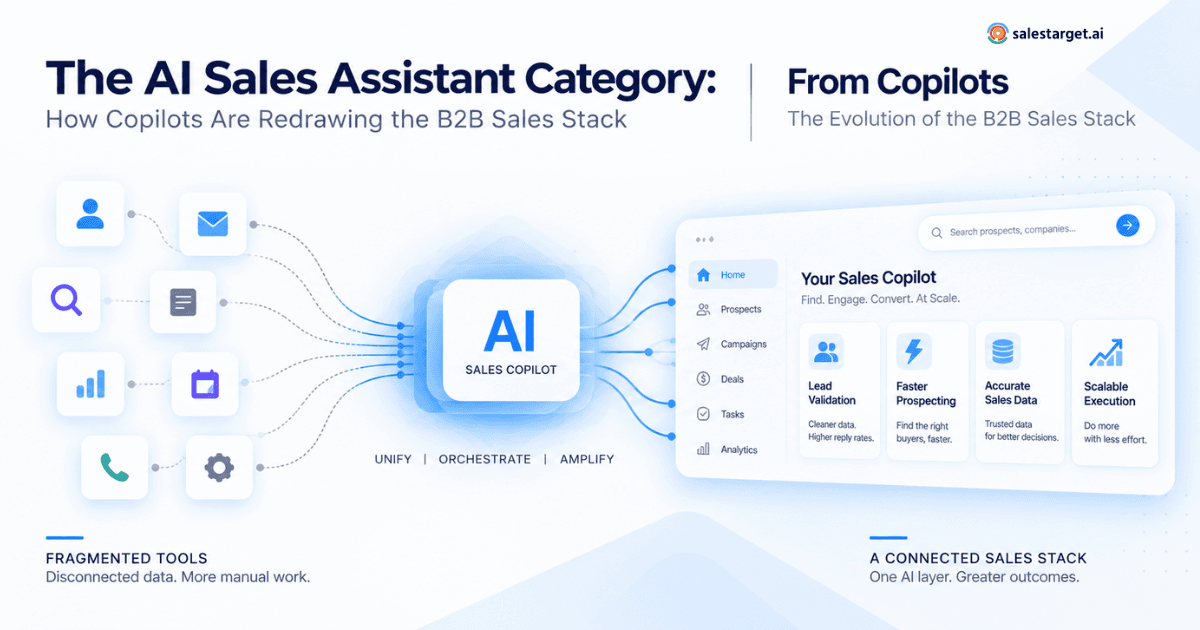
What makes SalesTarget.ai different? It runs prospecting, enrichment, multichannel outreach, validation, and CRM in one platform on one bill, instead of the stitched-together stack most teams run: a data tool, a separate cold-email tool, and a CRM that talks to neither cleanly.
Prioritize leads with verified data and intent signals
Lead Explorer combines 840M+ verified profiles with real-time buying signals, tracked over a 30 to 90 day lookback for funding, hiring, and leadership changes, so rankings run on data that's current.
Combine email and LinkedIn outreach in one workflow
Conditional sequences branch on what a prospect does, a reply, a click, or no response, keeping both channels working from the same playbook.
Validate contact data before sales outreach
The Email Validator checks MX and SMTP records and flags disposable addresses before a send goes out, a big part of why 90% of emails sent through the platform get validated first.
Manage follow-ups through a built-in CRM
Deal Pipeline, Tasks & Follow-Ups, and Activity Tracking sit inside the same workspace as prospecting and outreach, no separate tool required.
Use AI Copilot for prospecting and sales workflow support
Chat to find leads, build sequences, or check what's overdue, in plain language. See how this stacks up: a side-by-side comparison of AI sales assistant software.
Common Gaps in AI Lead Prioritization and Sales Follow-Up
Where do these efforts fall short? Five gaps: trusting a score with no context, running one cadence for every lead, working from stale contact data, keeping outreach and CRM apart, and tracking activity volume instead of pipeline outcomes.
Relying on lead scores without reviewing buying signals
A high score with no visible reason trains reps to stop asking why. A funding round is a different kind of priority than a repeat page visit, and flattening both into "score: 85" hides what a rep needs.
Automating every follow-up with the same cadence
Most vendors skip this: automation isn't the goal, matched timing is. A five-touch sequence spaced three days apart suits a cold list and works against a prospect who's already replied twice this week.
Working with outdated or unverified contact data
Bounce rates climb quietly when a list was enriched months ago and never rechecked. Validation at the point of send, not just collection, is what protects sender reputation.
Separating prospecting automation from CRM activity
A gap most vendors gloss over: when outreach tools and CRM don't share data, reps copy reply status between systems by hand, and that's where hot leads sit untouched for days.
Measuring sales activity instead of pipeline impact
Emails sent and calls made are easy to count and don't say if the pipeline is moving. Conversion by priority tier tells a truer story than volume alone.
Measuring the Impact of AI-Assisted Lead Prioritization
How do you know it's working? Track five numbers: conversion by priority tier, follow-up completion and response rates, time from qualification to first sales action, pipeline share from top-priority leads, and rep productivity.
Lead-to-opportunity conversion by priority level
If high-priority leads aren't converting at a meaningfully higher rate than low-priority ones, the scoring model needs a rebuild, not more volume pushed through.
Follow-up completion and response rates
A completion rate below 90% typically points to a manual step still in the process. SalesTarget.ai customers running CRM-managed follow-up see completion rates around 91%.
Time from qualification to first sales action
The gap between qualification and a rep's first real outreach is where deals quietly die. A task created the moment a lead qualifies closes that gap on its own.
Pipeline contribution from high-priority leads
If top-tier leads make up 20% of the list but only 10% of closed pipeline, the priority signals aren't weighted right.
Sales productivity and follow-up consistency
Teams using an integrated AI sales assistant report saving roughly six hours per rep each week on manual prospecting and admin, hours that go back into selling.
Building a More Consistent Sales Follow-Up Process with AI
What does a consistent process require? Rep time on the strongest signals, prioritization tied to outreach, follow-up visibility across the pipeline, and a scoring model that sharpens as deals close.
Focus rep time on prospects with stronger buying signals
The math is simple: a rep working ten high-intent accounts closes more than a rep working fifty cold ones. Prioritization exists to make sure the first ten get worked first.
Connect lead prioritization with outreach activity
A score that doesn't trigger an action is just a number in a dashboard. Scoring and sequencing need to run in the same system, so a priority shift starts a follow-up on its own.
Keep follow-up actions visible across the sales pipeline
Managers can't coach what they can't see. A shared pipeline view with tasks and deal stages in one place catches leads before they go stale.
Use sales data to refine prioritization over time
Closed-won and closed-lost data should feed back into the scoring model. What predicted a close last quarter is worth more than what the model assumed at setup.
Conclusion: Connecting Lead Priority With Consistent Follow-Up
The problem you started with is the one most sales teams live with every day: too many leads, no clear order to work them in, and follow-up that slips the moment attention shifts. Bad prioritization and inconsistent follow-up aren't two separate problems. They're one problem: a lack of connected, current data driving the next action.
SalesTarget.ai closes that gap by putting prospecting, enrichment, scoring, multichannel outreach, validation, and CRM in a single workspace, so a priority signal turns into a scheduled touch without a rep stitching five tools together. If your team wants a straighter path from "who's most likely to buy" to "reaching out to them today," see how SalesTarget.ai works for B2B sales teams or start a free trial this week.