TL;DR
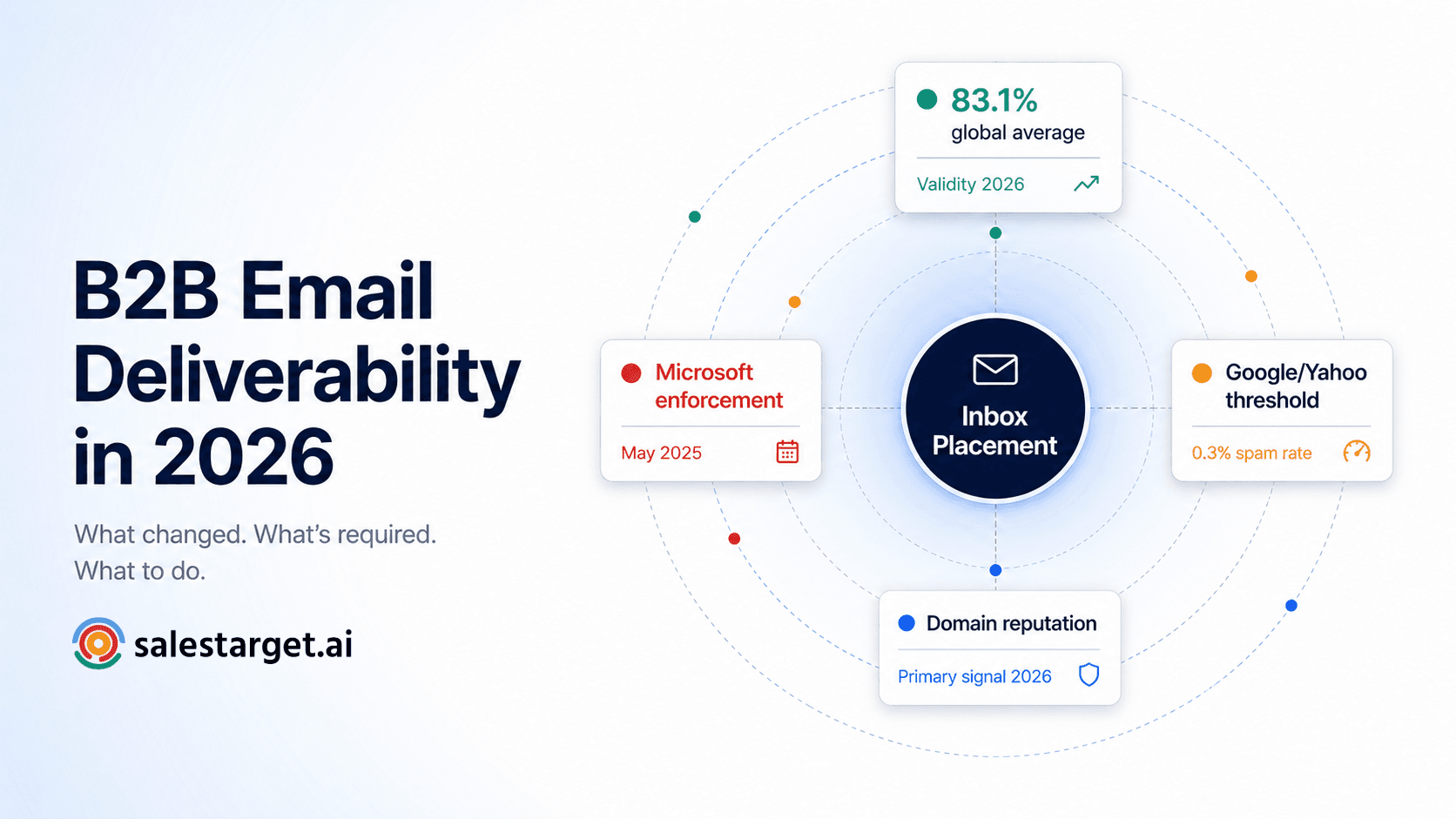
- The global average B2B inbox placement rate is 83.1% — meaning roughly 1 in 6 emails never reaches the inbox, even when technically "delivered" (Validity 2026 Benchmark Report).
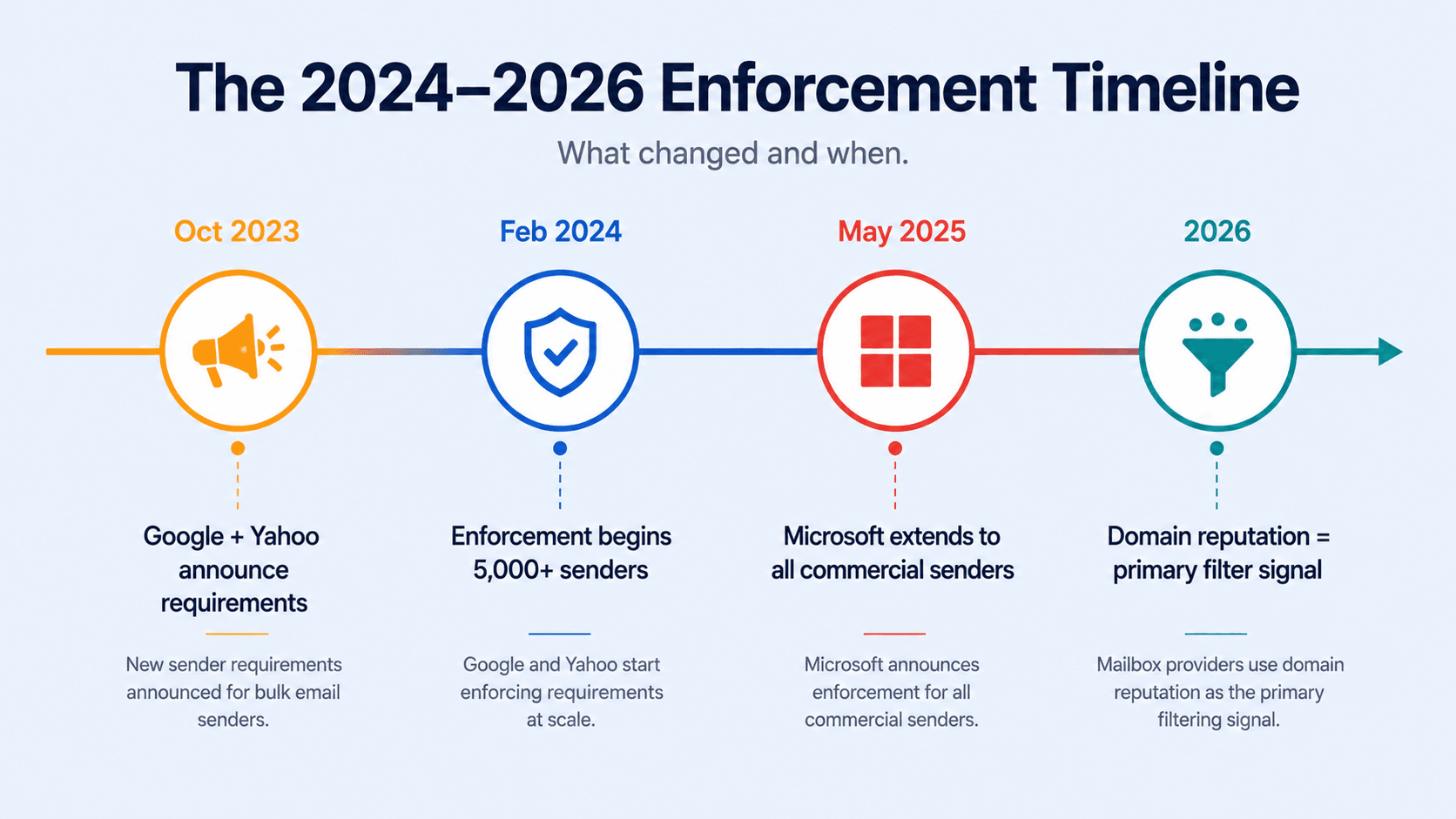
- Google and Yahoo enforced strict bulk sender requirements from February 2024. Microsoft extended requirements to all commercial senders in May 2025. Authentication (SPF, DKIM, DMARC) is now mandatory — not optional.
- In 2026, deliverability failure is caused primarily by data quality, authentication gaps, and engagement signals — not by copy or subject lines.
- Batch and blast is dead. Inbox providers filter based on engagement patterns — sending to unresponsive, unverified contacts actively damages future sends.
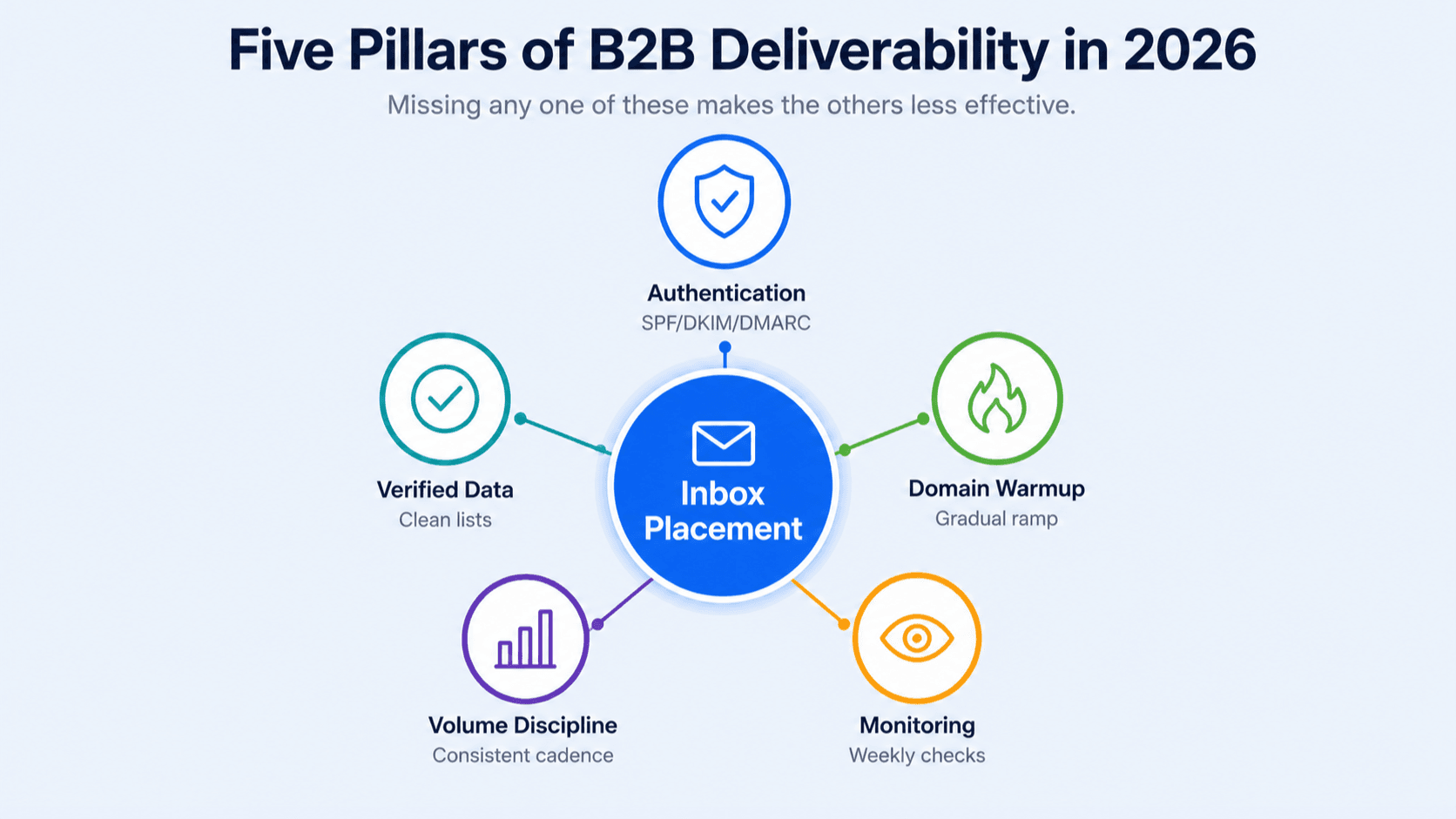
- The five things every B2B outreach team must have in place before sending at scale: authentication, verified lists, sending warmup, volume discipline, and ongoing monitoring.
In 2026, email deliverability is no longer a background technical concern. It's the single most important variable in cold email performance — more important than subject lines, more important than copy, and far more important than sequence structure. A perfectly written email that never reaches the inbox has a 0% reply rate regardless of how good the message is.
The deliverability landscape changed significantly between 2024 and 2026, and many B2B teams haven't caught up. Here's what changed, what the new requirements are, and what every outbound sales team needs to have in place before they send at scale.
Delivery rate vs deliverability rate: the distinction most teams miss
Most email sending tools report a delivery rate — the percentage of emails the receiving server accepted. A 98% delivery rate sounds healthy. But delivery rate and deliverability rate are not the same metric, and confusing them is one of the most common reasons teams don't catch deliverability problems until it's too late.
| Metric | What it measures | What it misses |
|---|---|---|
| Delivery rate | Did the receiving server accept the message? (Technical delivery) | Whether the email landed in inbox, spam, or promotions — it just confirms the server didn't reject it |
| Deliverability rate | Did the email reach the primary inbox? (Inbox placement) | Nothing — this is the metric that actually determines whether anyone sees your email |
You can have a 99% delivery rate and 40% inbox placement — meaning 40% of your emails landed in spam despite being "delivered." According to the Validity 2026 Email Deliverability Benchmark Report, the global average B2B inbox placement rate is 83.1%. One in six emails never reaches a visible inbox. Teams optimising for delivery rate while ignoring inbox placement are measuring the wrong thing.
What changed between 2024 and 2026
The major deliverability changes that B2B teams need to know about, in order of impact:
Google and Yahoo bulk sender requirements (February 2024)
For senders sending 5,000+ emails per day to Gmail or Yahoo addresses: SPF, DKIM, and DMARC authentication became mandatory. Spam complaint rate must stay below 0.3%. One-click unsubscribe is required for marketing emails. These are not guidelines — non-compliance results in rate limiting or outright rejection. As of 2026, these requirements are fully enforced.
Microsoft Outlook enforcement (May 2025)
Microsoft extended its bulk sender authentication requirements to all commercial senders in May 2025. Non-compliant emails to Outlook, Hotmail, and Live.com are outright rejected — not routed to junk, rejected before delivery. For B2B outreach teams, this is significant: many business email addresses run on Microsoft's infrastructure, and Outlook's spam filtering has become the hardest inbox to reliably reach in 2026.
Domain reputation as the primary filtering signal
Gmail, Yahoo, and Microsoft now evaluate sending domain as the primary trust signal above IP reputation. Domain reputation follows you across every ESP, IP address, and infrastructure change. A domain that has historically generated high bounce rates or spam complaints cannot be rehabilitated simply by switching sending tools — the reputation is tied to the domain, not the infrastructure.
Engagement-based filtering
Inbox providers now evaluate sending behaviour at a much more granular level. Sending the same message to large unengaged lists — what used to be called batch and blast — is now actively penalised. Providers track whether recipients open, click, reply, and move emails out of spam. A domain that consistently sends to contacts who never engage builds a pattern that reduces future inbox placement even for entirely separate campaigns to different recipients.
The engagement signal loop
Low-quality data → poor engagement → lower inbox placement → even lower engagement → further reputation damage. The loop compounds. The fix is not better copy — it's cleaner data. Sending to verified, ICP-qualified contacts produces higher engagement naturally, because you're reaching real people who match your target profile. Engagement improves. Inbox placement improves. The loop reverses. Validation is the entry point into the positive version of this cycle.
Five things every B2B team must have before sending at scale
For cold outreach teams specifically, deliverability depends on getting five foundational things right before volume scaling begins. Skipping any of these means building on an unstable base — and the instability will show up eventually, at the worst possible time.
1. Email authentication — SPF, DKIM, DMARC
Authentication is now the table-stakes entry requirement. SPF validates which servers can send from your domain. DKIM adds a cryptographic signature that proves the message hasn't been tampered with. DMARC ties both together and tells inbox providers how to handle emails that fail authentication. All three are required for bulk senders in 2026. Missing any of them means systematic filtering or rejection before your content even gets evaluated.
For a detailed setup walkthrough, see the domain health guide.
2. Verified contact data
Clean, validated contact data is the data-layer foundation of deliverability. Every invalid address that reaches a campaign generates a bounce. Every spam trap hit generates a blacklist signal. Every disposable address generates a zero-engagement signal. All three of these actively damage inbox placement — and all three are preventable with pre-send validation.
Run every list through SalesTarget's Bulk Email Verifier before launching any campaign. Remove Invalid, Spam, Disposable, and Abuse addresses. Keep catch-all addresses under 20% of campaign volume. Re-verify any list older than 90 days — B2B data decays at 22–30% annually, and a list that was clean three months ago already has approximately 6% invalid addresses. For more on the data quality layer, see the Complete Guide to Email Validation.
3. Domain and inbox warmup
A new sending domain has zero reputation with inbox providers. Starting with high volume immediately generates negative signals from low engagement on a domain inbox providers don't yet trust. The standard warmup process — starting at 5–10 sends per day in week one and incrementing gradually — builds a baseline of positive sending history that makes subsequent higher-volume campaigns land more reliably. SalesTarget's email warmup handles this automatically.
4. Volume discipline and sending patterns
Sudden spikes in sending volume look like compromised account behaviour to inbox providers — even when the account is legitimate. A domain that has been sending 200 emails per day for weeks and suddenly sends 5,000 in a day will see deliverability degrade. Consistent, incremental volume growth is what inbox providers reward. Use inbox rotation across multiple sending accounts to scale volume while keeping per-account sending within healthy patterns. For how inbox rotation works and why it matters, see Inbox Rotation Explained.
5. Ongoing monitoring
Deliverability issues compound gradually. Teams that check their metrics only when something goes wrong are always reacting to damage that's already been done. The minimum monitoring stack: Google Postmaster Tools (domain reputation and spam rate for Gmail), Microsoft SNDS (IP reputation for Outlook), and MXToolbox (blocklist status). Check these weekly, not monthly. A problem caught at 2% bounce rate is recoverable in weeks. A problem caught at 8% bounce rate requires months of repair.
Why data quality is a deliverability requirement — not just good practice
The framing that has served outbound teams well for years — "verify your list before sending, it's good practice" — undersells the problem in 2026. Under the current enforcement landscape, sending to unverified lists is not just wasteful. It actively violates the bounce rate and spam rate thresholds that Google, Yahoo, and Microsoft have turned into compliance gates.
A 5% bounce rate on a single campaign can push your domain below the threshold at which Gmail starts systematically filtering your emails. A spam trap hit can trigger immediate blocklist addition. Neither of these is recoverable quickly. And both are prevented entirely by validating your list before you send.
The calculus is straightforward: the cost of pre-send validation (1 credit per address in SalesTarget) is a fraction of the cost of repairing a damaged sender reputation (weeks of suppressed outreach, lost pipeline, potentially a new domain). Treating validation as a compliance step rather than just a "best practice" is the right framing for 2026.
What to check before your next campaign
| Check | Where to check | Target / pass condition |
|---|---|---|
| SPF configured | MXToolbox SPF checker | Valid SPF record present, no syntax errors |
| DKIM configured | MXToolbox DKIM checker | DKIM record present for all sending services |
| DMARC configured | MXToolbox DMARC checker | DMARC record present at minimum p=none |
| Domain not on blocklist | MXToolbox blacklist checker | Zero blocklist appearances |
| Spam complaint rate | Google Postmaster Tools | Below 0.1%. Never above 0.3% |
| Email list validated | SalesTarget Bulk Email Verifier | No Invalid, Spam, Disposable, or Abuse addresses in campaign list |
| Bounce rate on last campaign | Sending tool analytics | Under 2%. If above — verify list before next send |
Clean data is the foundation of everything else.
Authentication, warmup, and volume discipline all matter. But none of them work if your list is full of invalid addresses, spam traps, and disposable inboxes. Validate before every campaign.
✓ 50 credits ✓ 7-day trial ✓ No credit card required
Frequently Asked Questions

See It In Action: Book Your Free Demo
Get a personalized walkthrough and see how it works for your team.
Book My Demo →