AI CRM for Sales
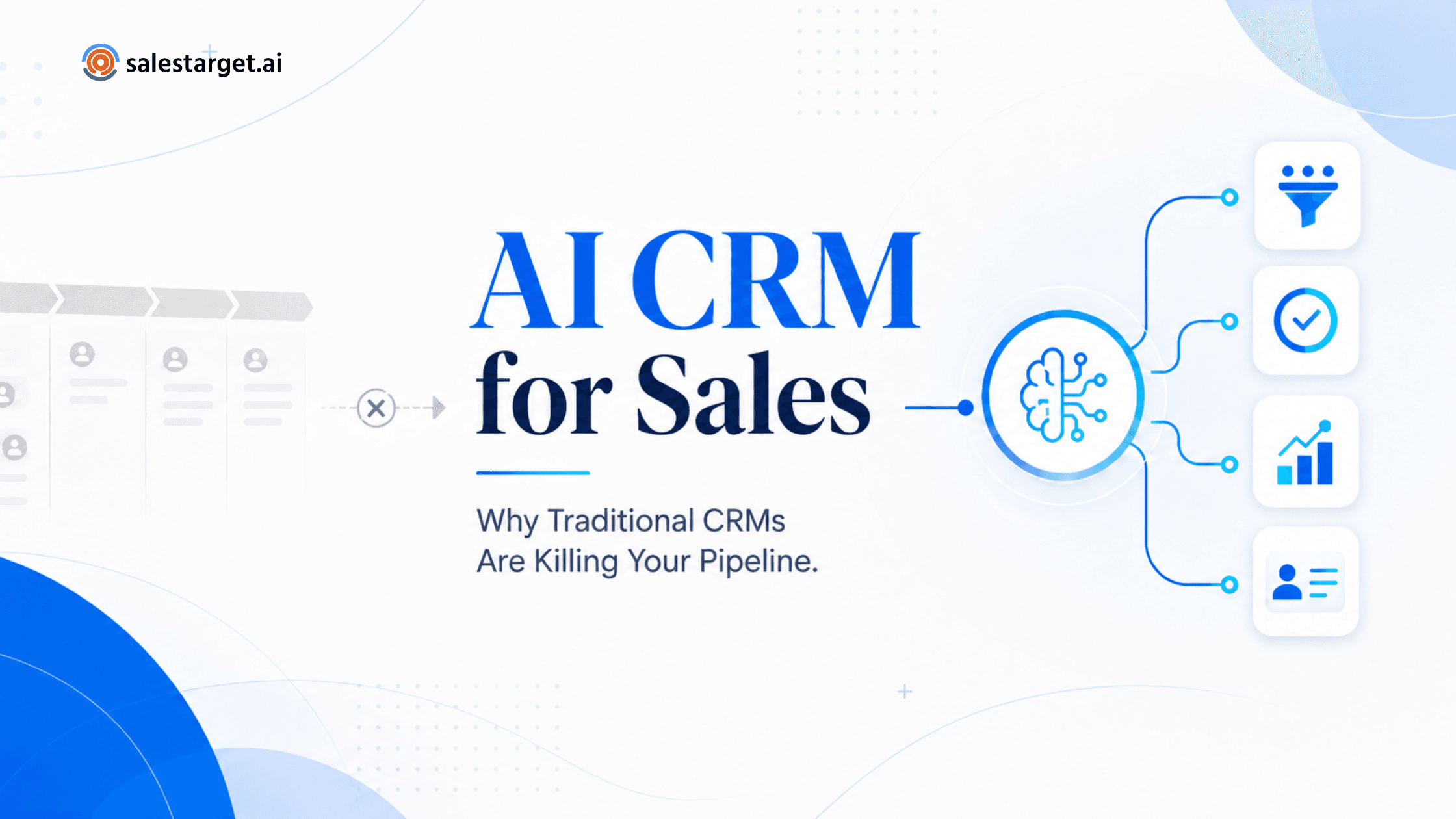
An AI CRM for sales is an intelligent CRM platform that goes beyond storing contact records—it actively captures activity, surfaces follow-up recommendations, detects at-risk deals, and helps SDRs prioritize their pipeline in real time. Companies are replacing traditional CRMs with AI-powered CRM systems because static databases simply can't keep pace with the speed and complexity of modern outbound sales.
Most CRMs weren't built for sellers. They were built for managers.
That distinction matters more than people realize. Traditional CRM platforms were designed to give leadership a dashboard, not to help an SDR move a deal forward on a Tuesday afternoon. The result? Sales teams spend enormous amounts of time feeding a system that rarely feeds anything back.
If your reps are complaining about CRM updates, your pipeline data is unreliable, and your follow-ups keep slipping—your CRM might be the problem, not your team.
The Hidden Cost of Traditional CRMs
Ask any outbound sales rep what they actually do in their CRM, and you'll hear a familiar list: log calls, update stages, add notes, change contact details, mark tasks complete. None of that directly moves a deal forward.
According to McKinsey research on sales productivity, sales reps in B2B organizations spend a significant share of their working hours on non-selling activities—and CRM data entry sits near the top of that list.
Here's what that looks like in practice. Imagine a team of twelve SDRs each spending forty-five minutes per day on CRM updates. That's nine hours of combined selling time lost every single day. Over a quarter, that's roughly six hundred hours that could have gone into prospecting, discovery calls, or follow-ups.
The problem compounds. When reps fall behind on updates, pipeline data becomes stale. Managers run forecasts on records that haven't been touched in two weeks. Deals that were marked "active" are actually cold. Revenue predictions end up being little more than optimistic guesses.
Original Insight: Based on an analysis of modern outbound sales workflows, teams spend up to 25–35% of their CRM time on administrative activities rather than selling. That's a material hit to productivity—and most revenue leaders don't have full visibility into it.
Other downstream effects pile up quickly: missed follow-up windows, contacts that fall through the cracks, duplicate outreach that annoys prospects, and pipeline reviews that devolve into update sessions rather than strategic discussions.
Traditional CRMs create a paradox. The tool meant to organize your sales process ends up disrupting it.
What Is an AI CRM for Sales?
An AI CRM for sales flips the model.
Instead of a passive database that waits for reps to update it, an intelligent CRM software actively monitors sales activity, enriches records automatically, and surfaces insights that help reps take the right action at the right time.
Think of it this way. A traditional CRM is like a filing cabinet with a search bar. An AI-powered CRM is more like a sales analyst sitting next to your rep—one who tracks every email, call, and meeting, flags stalled deals, and tells your SDR exactly who to call next and why.
For CRM for SDRs specifically, this shift is transformative. SDRs operate at high velocity. They're managing dozens of active conversations across multiple accounts at once. A CRM that requires manual upkeep doesn't just slow them down—it creates gaps in coverage that cost pipeline.
Intelligent CRM software changes this by embedding AI throughout the workflow: capturing activities automatically, predicting deal outcomes, and recommending next steps based on actual signal rather than gut feel.
5 Ways AI CRM Helps Sales Teams Win More Deals
1. Automatic Activity Capture
Traditional CRM limitation: Reps manually log every call, email, and meeting. If they're busy or forget, the data doesn't exist.
AI CRM advantage: Modern AI-powered CRM platforms sync automatically with email, calendar, dialer, and LinkedIn activity. Every touchpoint is captured without the rep lifting a finger.
Business impact: Pipeline data stays current without administrative overhead. Managers can trust what they see. Reps stay focused on conversations, not record-keeping.
2. Smart Follow-Up Recommendations
Traditional CRM limitation: Follow-up timing is left to individual memory or generic task reminders. Deals stall because nobody nudged them at the right moment.
AI CRM advantage: AI analyzes engagement signals—email opens, response times, meeting outcomes—and recommends when and how to follow up with each prospect. It learns what works and surfaces those patterns for your team.
Business impact: Follow-up rate increases, deal velocity improves, and fewer opportunities fall through the cracks simply because a rep forgot to circle back.
3. Pipeline Health Monitoring
Traditional CRM limitation: Pipeline reviews rely on what reps have self-reported. Deals that look healthy on paper may be stagnant in reality.
AI CRM advantage: Intelligent CRM software monitors deal activity and flags when engagement drops, stages haven't moved, or expected close dates are slipping. It gives managers a live read on pipeline health rather than a weekly snapshot.
Business impact: Leadership can intervene earlier, coach more effectively, and forecast with greater confidence. Revenue leakage from overlooked deals decreases substantially.
4. Deal Risk Detection
Traditional CRM limitation: Risk is identified after it's too late—usually when a deal lands in "lost" and the team debates what went wrong in a retrospective.
AI CRM advantage: AI-powered CRM systems detect early warning signs: a prospect who hasn't responded in ten days, a champion who left the company, a deal that's missing a key stakeholder conversation. These signals surface in real time.
Business impact: Reps can course-correct while there's still time. Managers can prioritize where to lend support before a deal becomes a casualty.
5. AI-Based Prioritization
Traditional CRM limitation: Reps decide where to focus based on their own judgment—which is often shaped by recency, familiarity, or comfort rather than actual deal potential.
AI CRM advantage: AI scores and ranks deals based on engagement data, historical win patterns, and account fit. Reps get a clear view of where to spend their time to maximize output.
Business impact: High-potential deals receive more attention. Reps spend less time on long shots that feel active but aren't going anywhere. Win rates improve.
Why Outbound Teams Need a CRM Built for Execution
Outbound sales has a different rhythm than inbound. SDRs and BDRs are running multi-touch sequences across dozens of accounts simultaneously. They're managing cold outreach, follow-ups, LinkedIn messages, calls, and re-engagement campaigns—often without a single warm signal to guide them.
Traditional CRMs were not designed for this motion. They assume reps are managing a smaller set of warmer accounts and have time to document each interaction thoughtfully. That assumption breaks down fast in a high-velocity outbound environment.
What outbound teams actually need is a system that tracks every touch across every account automatically, flags when an account goes cold, and helps reps pick up the thread with the right message at the right time. They need AI-powered deal pipeline management that mirrors how outbound actually works—not how managers wish it worked.
Pipeline velocity matters here too. Outbound teams win by moving fast and maintaining coverage. Every hour spent on CRM administration is an hour not spent generating pipeline. A CRM built for execution should reduce friction at every step, not add to it.
The best AI-powered CRM systems understand this. They sit inside the outbound workflow rather than sitting beside it, capturing what happens and guiding what comes next.
How SalesTarget CRM Manager Reimagines CRM for Modern Sales Teams
SalesTarget CRM Manager was built with outbound execution in mind—not as an afterthought, but as the core design principle.
Here's what that looks like in practice.
CRM updates happen automatically. When a rep sends an email, takes a call, or completes a meeting, the activity is logged without any manual input. Records stay accurate. Managers see what's actually happening, not what reps remembered to report.
Pipeline visibility is real-time and intelligent. Rather than showing a static list of deals, SalesTarget surfaces deals that need attention, accounts that have gone quiet, and opportunities where a timely nudge could make a difference. The system doesn't just store data—it acts on it.
For SDRs managing large account lists, the prioritization engine is particularly valuable. Instead of staring at a list of two hundred accounts and deciding where to start, reps get a ranked view based on engagement signals and deal potential. They know exactly who to contact and why.
The platform also eliminates the pipeline review bottleneck. Instead of spending the first twenty minutes of every team call getting status updates, managers can walk in with current data and spend that time on strategy and coaching.
If you want to understand why this matters for your specific context, this piece on why AI sales CRM is essential for B2B teams breaks it down with real use cases. And for teams running outbound-heavy motions, SalesTarget has documented how the platform functions as a CRM built specifically for outbound sales teams—worth reading if you're evaluating whether it fits your workflow.
The goal isn't to replace the sales rep. It's to remove the administrative burden that sits between reps and the work that actually creates revenue.
The CRM You Have Might Be Costing You More Than You Think
AI CRM for sales isn't a trend. It's a response to a real problem that's been growing for years.
Traditional CRMs created the illusion of pipeline visibility while hiding the actual cost of maintaining that illusion—rep time, data accuracy, missed follow-ups, and forecasts built on stale information. The Gartner perspective on sales technology increasingly points toward active intelligence systems over passive record-keeping tools, and the shift is already underway in high-performing sales organizations.
The question isn't whether AI-powered CRM is better. It is. The question is how much longer your team will absorb the hidden productivity tax of managing a system that doesn't manage anything back.
For outbound sales teams running high-volume, multi-touch pipelines, the gap between a traditional CRM and an intelligent CRM software is measured in deals—real deals, lost to friction, missed timing, and manual overhead.
If your pipeline isn't where it should be and your CRM adoption is inconsistent, it's worth looking at whether the tool is part of the problem.
Ready to Replace Your Traditional CRM?
SalesTarget CRM Manager helps outbound sales teams automate CRM updates, get real visibility into pipeline health, and spend more time selling. AI handles the administrative layer. Your reps focus on closing.