It's 9 a.m. on a Monday, and your CRM already looks like a crime scene. Forty new leads came in over the weekend. Half are duplicates of contacts already sitting in someone's pipeline. A handful never got a follow-up because nobody was clearly assigned. And the lead who filled out a demo request at 11 p.m. Friday, practically begging to buy, is buried under cold form-fills from a webinar three months ago.
This is lead overload in practice: missed follow-ups, duplicate records, and poor prioritization that quietly compound into lost revenue. A B2B lead organization tool exists to solve exactly this kind of CRM chaos, and when it's powered by AI, it does the sorting, scoring, and routing work that used to eat hours out of every rep's week.
If your team is still piecing this together manually, our lead management software guide is a good place to see what a properly structured system looks like first.
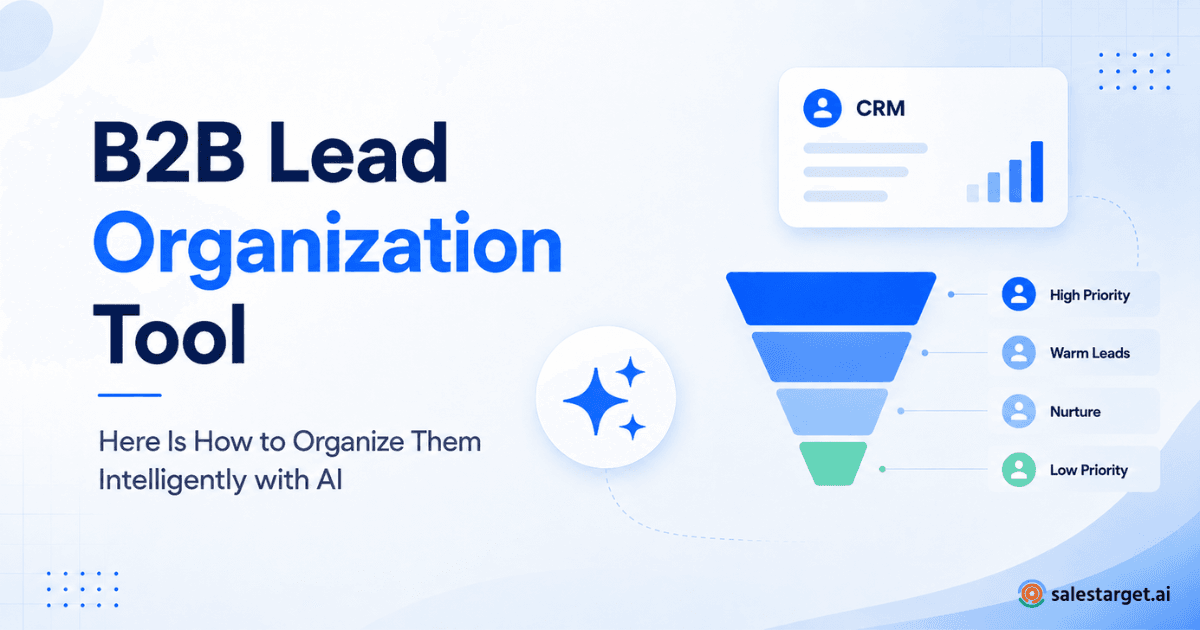
A B2B lead organization tool centralizes, cleans, and structures incoming sales leads so reps always know who to contact next and why. AI makes it more effective by automatically tagging, scoring, and routing leads based on real behavior and intent signals, removing the manual sorting that causes delays, duplicate records, and missed follow-ups in traditional CRM lead management.
Why Traditional Lead Management Breaks Down at Scale
Most sales teams don't set out to build a messy system. It happens gradually. A shared spreadsheet feels fine with a handful of leads, but as volume grows, two reps update the same row at once, statuses fall out of sync, and nobody can tell at a glance which leads are hot and which have gone cold.
Disconnected systems make it worse — marketing automation, the CRM, and outreach tools all live separately, and leads slip through the seams between them. Then there's manual data entry. Industry research puts the share of reps spending an hour or more per day on CRM data entry at roughly 32 percent, according to HubSpot's sales research — time spent typing instead of selling. The result: talented reps end up doing the job of a data clerk, and urgent leads get the same treatment as ones that will never convert.
What Is a B2B Lead Organization Tool?
A B2B lead organization tool is software that centralizes, cleans, categorizes, and prioritizes incoming sales leads so a team always knows who to contact, when, and why. Instead of leads landing in a generic list for a human to sort, the tool structures everything automatically — standardizing fields, flagging duplicates, and grouping leads by industry, deal size, or engagement level.
At its core, it handles three jobs:
- Centralizing lead data from forms, email, ads, and outreach tools into one consistent record
- Categorizing leads by attributes like company size, role, source, and intent signals
- Prioritizing which leads get attention first, based on fit and likelihood to convert
This isn't a replacement for your CRM — it's the layer that makes CRM lead management actually work. A CRM stores information; a lead organization tool keeps that information clean, current, and ranked by what matters most to your pipeline.
How AI Changes Lead Organization Forever
Rules-based automation sorts leads into buckets you define in advance. AI goes further: it learns from how leads actually behave and adjusts as those patterns shift. Here's what that looks like when you organize leads AI-first instead of manually.
Automatic Lead Categorization
AI reads incoming lead data — job title, company size, industry, source — and slots each record into the right segment automatically, with no rep dragging contacts between lists or guessing where a new sign-up belongs.
Smart Lead Prioritization
Not every lead deserves the same urgency. AI models weigh signals like company fit, recent activity, and historical conversion patterns to surface the leads most likely to close, so reps stop guessing which name to call first.
Duplicate Detection
Duplicate records are one of the most common sources of CRM chaos. AI matching catches near-duplicates that simple rule-based checks miss — a lead who filled out three forms under slightly different emails, for instance — and merges them before they cause confusion.
Intent-Based Segmentation
Instead of grouping leads only by who they are, intent-based segmentation groups them by what they're doing right now: pricing page visits, repeated email opens, demo requests — behavior no human reviewing a spreadsheet could track at scale.
Predictive Opportunity Scoring
Predictive scoring goes beyond standard lead scoring by estimating how likely a lead is to become a closed deal within a given window, not just whether it's qualified — a distinction that matters when a rep can only call three of ten leads.
The Hidden Cost of Poor Lead Organization
Disorganized leads quietly drain revenue in ways that rarely show up on a dashboard until the damage is done:
- Lost revenue from leads that fall through the cracks
- Slower response times that hand momentum to competitors
- Pipeline leakage, where deals stall with no clear owner
- Inaccurate forecasting, since messy data can't be trusted
Response time alone tells the story: some research suggests the odds of qualifying a lead can drop by as much as 400 percent once response time passes the five-minute mark, and disorganized records are usually why that window gets missed.
In our own work with sales teams adopting AI-based lead organization, a recurring pattern shows up before automation is introduced: a meaningful share of records in any given pipeline turn out duplicated, incomplete, or routed to the wrong owner — the default outcome when lead intake relies on manual sorting at any real volume.
Key Features to Look for in Lead Organization Software
Not all lead organization software is built the same way. Look for tools that combine these capabilities rather than offering just one:
- Automatic tagging by source, industry, or stage
- Lead enrichment that fills in missing company and role details
- AI scoring that ranks every lead by fit and intent
- Activity tracking logged automatically against the right record
- Workflow automation for routing, reminders, and status updates
- Pipeline visibility managers can check without chasing reps
For a deeper side-by-side look at how different platforms stack up on these criteria, see our breakdown of the best lead management software for modern sales teams.
How AI-Powered CRM Automation Creates a Competitive Advantage
When lead organization runs on AI instead of manual review, the advantage shows up in nearly every part of the sales process.
- Faster qualification, with reps working ranked, pre-segmented leads
- Cleaner CRM records, with fewer duplicates and stale fields
- Better forecasting, built on trustworthy data
- Improved SDR productivity, with less time lost to sorting
- Higher conversion rates from faster response and sharper prioritization
This is precisely the workflow SalesTarget CRM is built around: leads get captured, cleaned, scored, and routed automatically, so reps open their day with a prioritized list instead of a backlog to sort through.
Gartner's research on CRM adoption has long pointed to a related issue: organizations often invest in CRM software without first defining the processes that make it useful, which limits the value they ever get from it. AI-powered automation closes that gap by building structure into the workflow itself, rather than depending on every rep following the same manual process perfectly.
Organize Leads with AI
Stop sorting spreadsheets and chasing duplicates. SalesTarget.ai automatically categorizes every lead, scores buying intent in real time, and routes top opportunities straight to the right rep — so your team spends its time selling, not organizing.
Start Organizing Leads with AI →
Step-by-Step Framework for Organizing Leads Intelligently
Whether you're starting from scratch or fixing a system that's gotten out of hand, here's a practical sequence to follow:
- Centralize lead data from every source — forms, ads, email, events — into a single system of record.
- Clean existing records: merge duplicates, fill missing fields, standardize naming.
- Create AI-based segments using behavior and fit, not static manual lists.
- Automate lead routing so each qualified lead reaches the right rep instantly.
- Score buying intent using signals like page visits, email engagement, and demo requests.
- Monitor engagement signals continuously, since buying intent shifts over time.
- Continuously optimize by reviewing what converts and retraining scoring criteria each quarter.
Step five pairs well with a system that can track lead interactions automatically, since manually logging every touchpoint is exactly the kind of busywork this framework is meant to eliminate.
Manual lead management was never built for the volume today's sales teams handle. Spreadsheets, disconnected tools, and rep-by-rep judgment calls all break down once a pipeline scales past a handful of leads per week.
AI changes that by handling the sorting, scoring, and routing in the background, so your team sees a clean, prioritized list instead of a pile of unsorted contacts — the real difference between a CRM that holds your data and one that helps you act on it. If your pipeline is still organized by hand, it's worth seeing what changes when AI takes over the busywork.