Your CRM Is Supposed to Help You Sell. Is It Actually Doing That?
A practical guide for B2B sales leaders, SDRs, and founders who are tired of fighting their tools
TL;DR
- Most CRMs were built for reporting, not for enabling frontline sellers
- Reps spend less than a third of their week actually selling — the rest goes to maintaining the CRM
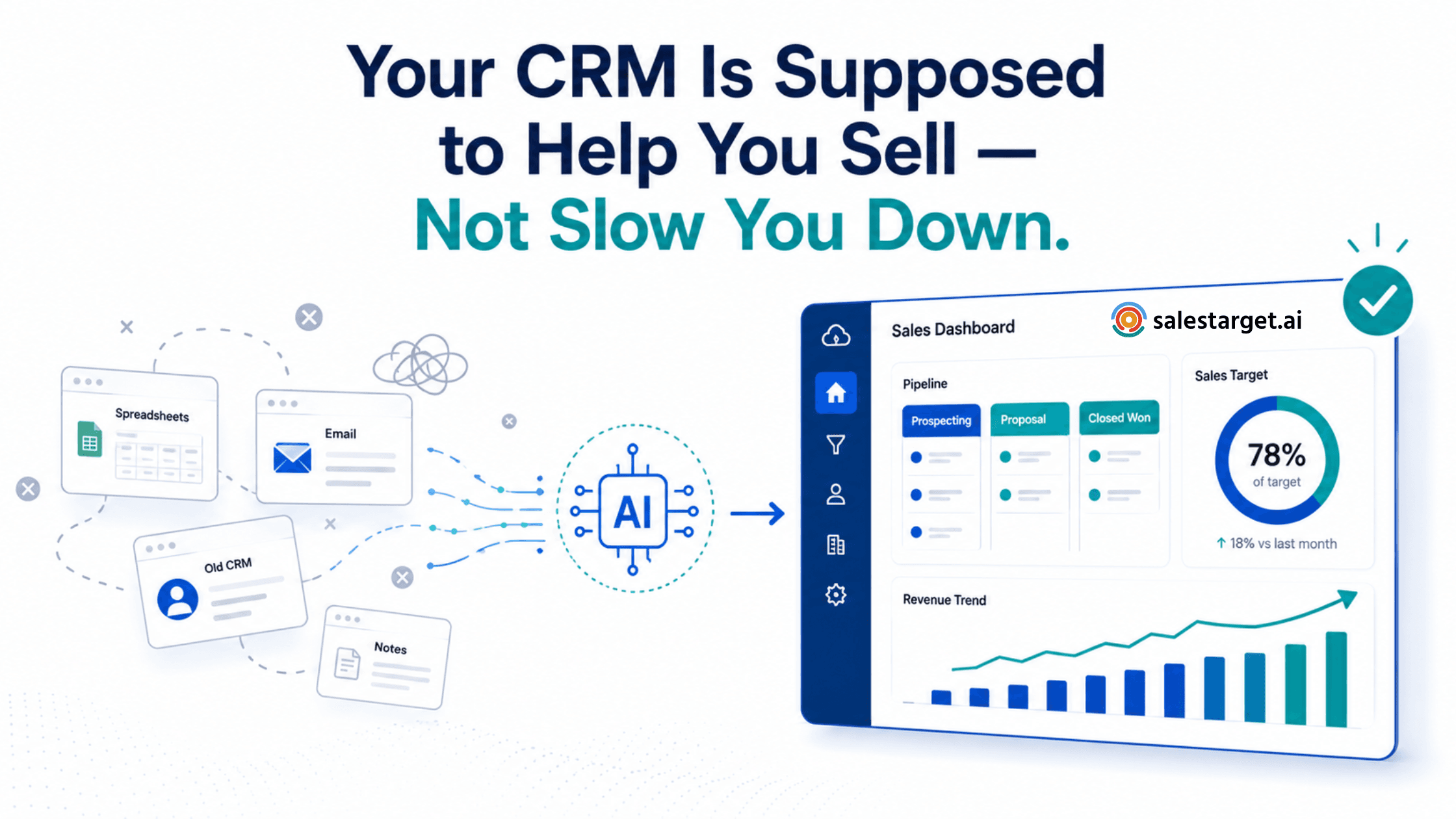
- AI CRM fixes this: predictive prioritisation, automated activity capture, and smarter follow-up
- SalesTarget combines CRM, prospecting, and outreach in one place — so reps manage accounts, not tabs
- The best CRM is the one your team actually uses because it makes their job easier
It's Monday morning. The pipeline review is in two hours. Your reps are scrambling to update deal stages they forgot to log last week, and somewhere in a Slack thread is the note that actually matters.
If that sounds familiar, the problem isn't your team — it's your CRM. Most sales CRM software was built for data entry, not for closing revenue. In 2026, that gap is costing you deals.
What a CRM for Sales Teams Should Actually Do
A CRM for B2B sales isn't just a contact database. It's the operational backbone of your revenue motion — tracking pipeline health, flagging stalled deals, surfacing which accounts need attention today, and telling you where leads are quietly leaking out of the funnel.
Done Wrong
It becomes something your reps work around rather than with — a system that demands more energy to maintain than it returns in insight.
Done Right
It answers questions before you think to ask them — flagging deal risk, surfacing next-best actions, and showing you where the pipeline is strong and where it's leaking.
Why Traditional CRMs Let Teams Down
Most legacy platforms were designed to report to leadership, not to enable frontline sellers. The result:
Manual logging eats rep time
Studies consistently show reps spend less than a third of their week actually selling — the rest goes to maintaining a CRM that should maintain itself. Every minute spent logging is a minute not spent closing.
Insights are always backwards-looking
You see what happened, not what's about to go wrong. By the time the data surfaces a deal at risk, the window to act has often already closed.
Adoption collapses under friction
When a tool slows people down, they find workarounds — and your CRM data is forever one step behind reality. The dashboards look clean but they're not reflecting what's actually happening in the field.
How AI Is Changing CRM for B2B Sales
An AI CRM doesn't just store data — it works with it. Three areas where it makes a real difference:
| Capability | What it does | The outcome |
|---|---|---|
| Predictive Prioritisation | Ranks deals based on historical signals correlated with closed-won outcomes | Reps focus on the right deals — not based on gut feel |
| Automated Activity Capture | Emails, calls, and meetings update the CRM automatically | No manual logging, no data gaps, no rep overhead |
| Smarter Follow-Up | Surfaces next steps based on what worked in similar deals | Every rep's workflow becomes a playbook built from your team's wins |
📊 The shift: Traditional CRM tells you what happened. AI CRM tells you what to do next — and why.
What to Look for in Modern Sales CRM Software
Before you evaluate any platform, hold it to these standards:
Must-Have Capabilities
- ✓ Contact enrichment that runs automatically
- ✓ Pipeline views that reflect reality, not wishful stage updates
- ✓ Outreach and CRM in a single product
- ✓ Automation that removes work rather than creating more of it
Red Flags to Watch For
- ✗ Requires significant manual data entry to stay accurate
- ✗ Reporting tools that only look backwards
- ✗ Outreach managed in a separate tool with no native integration
- ✗ Implementation that takes months before you see value
Where SalesTarget Comes In
SalesTarget was built specifically for B2B sales teams that have outgrown their early-stage tools but don't need the cost and complexity of enterprise software. It combines CRM, AI-powered prospecting, and sales engagement in one place — so reps aren't switching between six tabs to manage a single account.
The AI isn't cosmetic. It flags deal risk, automates logging, and recommends next steps based on what's actually worked for your team. Less time managing the system, more time using it to close.
CRM
Full pipeline visibility and deal management
Prospecting
AI-powered lead finding and enrichment
Engagement
Multichannel outreach with automated sequences
All in one platform — no integration patchwork required
Explore it at salestarget.ai/crm
The Bottom Line
The best CRM for sales teams is the one your team actually uses — not because they're required to, but because it makes their job easier. If yours needs more energy to maintain than it returns in insight, it's not doing its job.
The gap between what legacy tools offer and what modern B2B teams need has never been wider. The good news: the options to fill it have never been better.
See How SalesTarget Helps B2B Sales Teams Close More
Less friction. More revenue. One platform.
Explore SalesTarget CRM →