Increasing the number of calls, emails, and follow-ups has always been the key to outbound sales. However, volume became insufficient at some point.
The number of responses has decreased. Reaching buyers has gotten more difficult. Additionally, the typical SDR devotes more time to scheduling, data entry, and research than to real sales. Sales representatives only dedicate 28% of their week to real selling activity, according to Salesforce data. What about the others? Administrative duties that don't change the pipeline.
An AI sales assistant is specifically designed to address this issue. Doing the labor-intensive tasks that impede your team's progress is preferable to replacing them.
Why Traditional Outbound Sales Workflows Break Down
Most outbound workflows weren't designed for the pace of modern B2B buying. They rely on:
- Manual prospect research across multiple data sources
- Generic email sequences with low personalisation
- Gut-feel follow-up timing instead of behavioural signals
- CRM updates that happen (or don't) based on rep discipline
- Pipeline reviews that are already outdated by the time they're run
The result? Reps burn out. Leads slip through the cracks. And leadership can't get a clear picture of what's actually working.
The deeper issue is that traditional outbound stacks were built for a different era — one where sheer activity correlated more directly with results. That relationship has weakened considerably.
What an AI Sales Assistant Actually Does
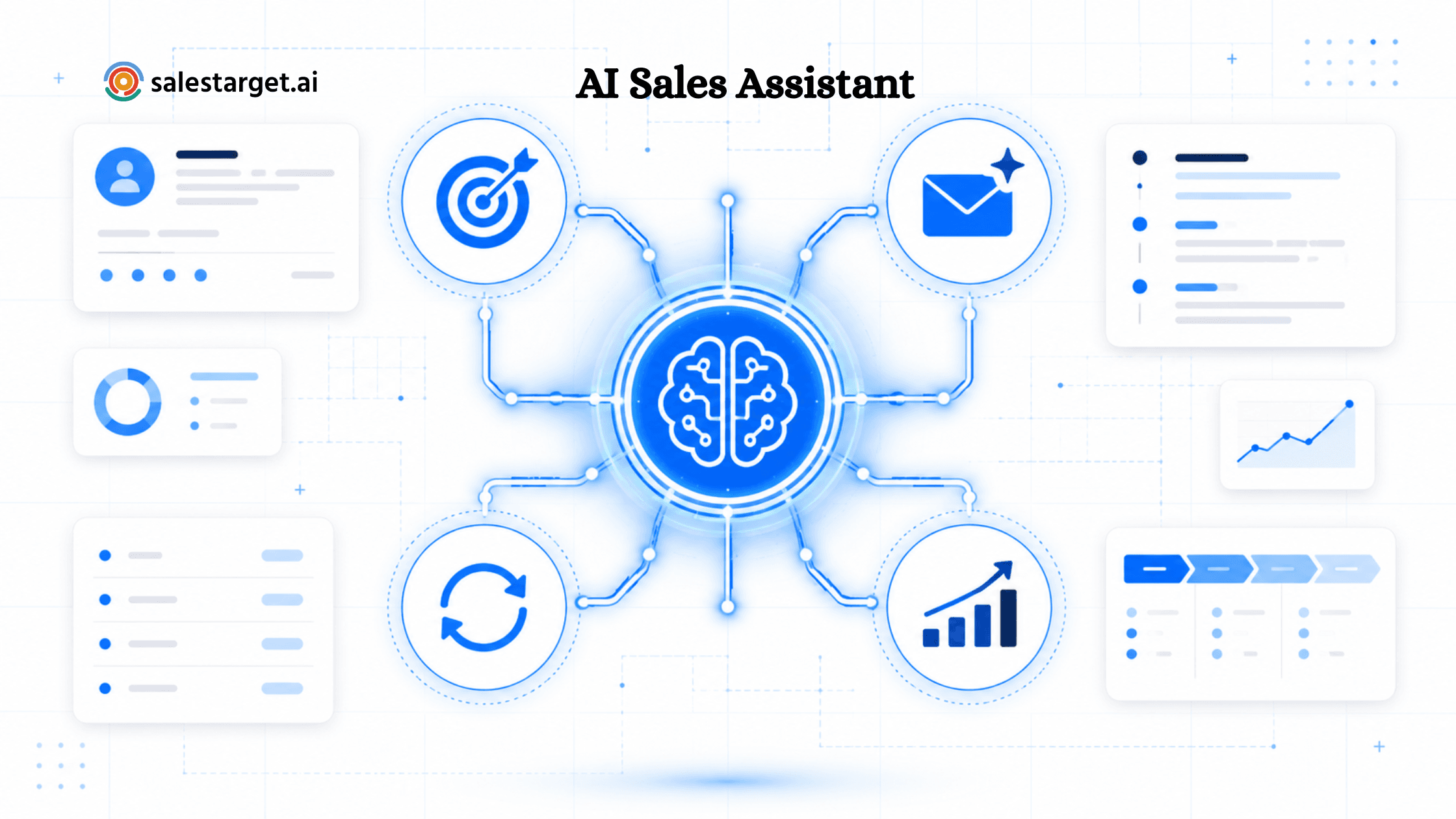
An AI sales assistant is software that uses machine learning, natural language processing, and automation to augment — or in some cases fully execute — key parts of the outbound sales process.
Think of it as an always-on SDR layer that never gets tired, never skips a follow-up, and continuously improves based on what works.
At its core, an AI outbound sales assistant handles three categories of work:
- Research and prospecting — identifying and qualifying leads that match your ICP
- Outreach and engagement — drafting, personalising, and sending messages across channels
- Follow-up and pipeline management — tracking signals, timing responses, and surfacing priority actions
→ Learn how an AI sales copilot transforms your outbound workflows
Key Capabilities of Modern AI Sales Assistants
The most effective AI sales tools in 2025 go well beyond simple email sequencing. Here's what a capable AI SDR assistant brings to the table:
Intelligent Lead Scoring
Not every lead deserves equal attention. AI models trained on your historical conversion data can score inbound and outbound prospects based on fit, intent signals, and behavioural patterns — helping reps focus on accounts most likely to convert.
Automated Prospect Research
Instead of spending 45 minutes building a prospect profile, AI can pull firmographic data, technographic signals, recent company news, job changes, and funding events — and synthesise it into a ready-to-use brief in seconds.
Multi-Channel Outreach Coordination
Modern buyers aren't on just one channel. An AI-powered sales outreach system can orchestrate email, LinkedIn, and phone touchpoints in a sequenced, signal-driven flow — without manual scheduling.
Hyper-Personalised Messaging
Generic 'Hi [FirstName]' sequences no longer cut through. AI can generate personalised opening lines, value propositions, and call-to-action language tailored to each prospect's industry, role, and recent activity.
Conversation Intelligence
AI tools that integrate with calls and emails can analyse tone, objections, buying signals, and sentiment — flagging high-intent conversations for immediate follow-up.
→ Explore how SalesTarget's AI Sales Copilot handles these workflows
How AI Improves Prospecting Accuracy
One of the biggest ROI drivers of AI for sales teams is improved targeting. Traditional prospecting often relies on static lists filtered by job title, company size, and industry. But these filters miss a lot. They don't tell you who's in-market right now, who recently changed tools, or which companies are actively growing their sales headcount.
AI-powered B2B prospecting tools layer in:
- Intent data — signals from content consumption, search behaviour, and third-party platforms
- Technographic data — what tools a company uses, and what they might be replacing
- Trigger events — funding rounds, executive hires, product launches, and expansions
- Lookalike modelling — finding new accounts that mirror your best customers
The result is a tighter, higher-quality prospect list that wastes less time on poor-fit accounts.
AI-Driven Personalisation at Scale
Personalisation is no longer optional in outbound — it's the baseline expectation. The challenge is that true personalisation doesn't scale with human effort alone.
An AI lead generation assistant changes this equation entirely. It can analyse a prospect's LinkedIn activity, company blog posts, recent press coverage, and role-specific pain points — and use that context to generate opening lines that feel genuinely researched.
Done at scale, this capability alone can lift reply rates by 30–50% compared to generic templates, according to industry benchmarks from multiple outbound sales studies.
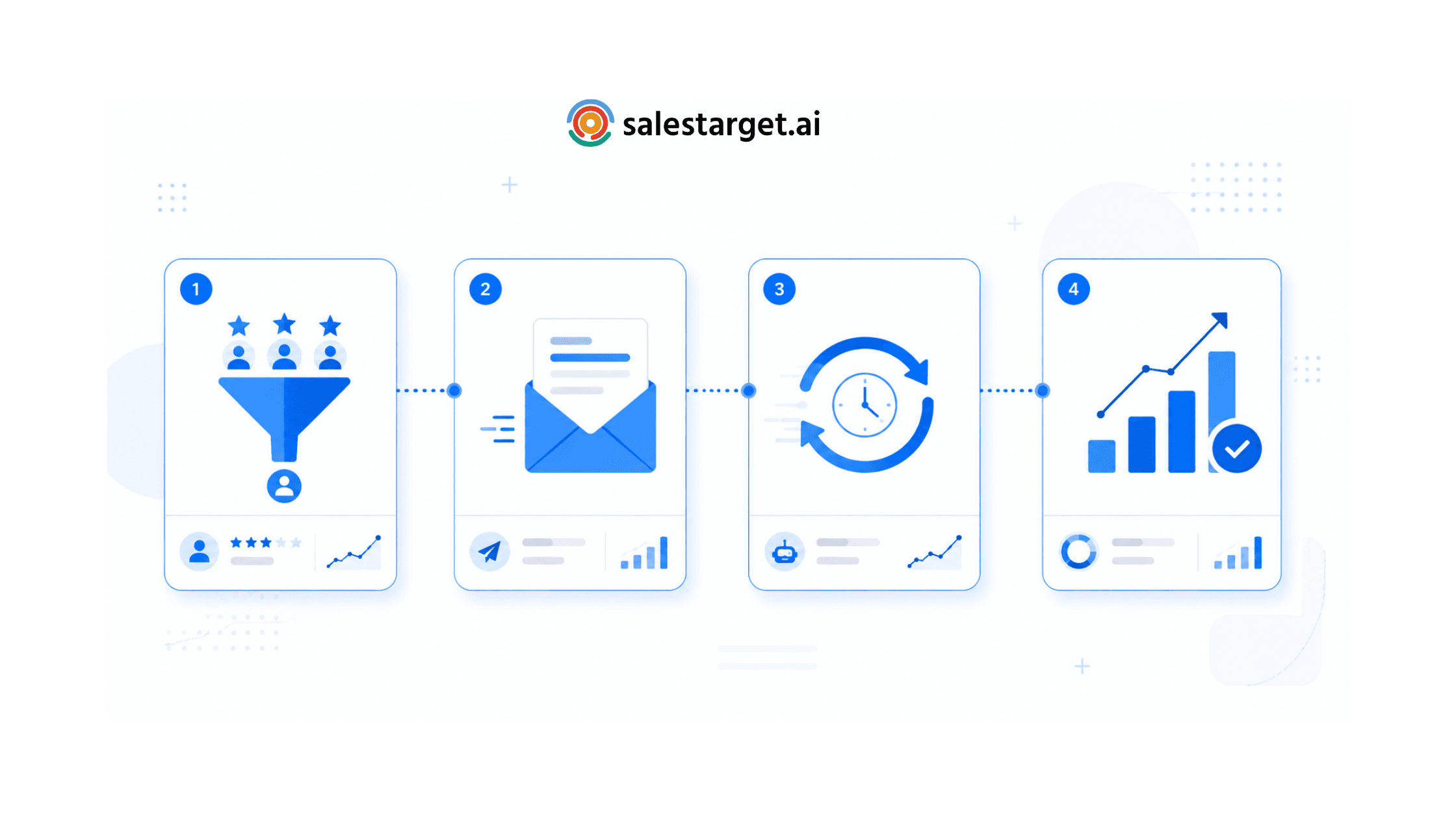
Automated Follow-Up Intelligence
Most deals are lost not because the prospect said no — but because they were never followed up with at the right moment.
The average B2B sales cycle requires 8–12 touchpoints before a meeting is booked. Most reps stop at 2–3.
AI-driven outbound sales workflow automation solves this by:
- Tracking email opens, link clicks, and reply timing
- Automatically adjusting follow-up cadence based on engagement level
- Surfacing 're-engage' triggers when a prospect revisits your website after going quiet
- Suggesting the optimal next touchpoint — email, call, or LinkedIn message
This transforms follow-up from a manual chore into an intelligent, behaviour-driven process.
→ See how AI-powered email outreach works
AI-Powered Pipeline Management
Beyond prospecting and outreach, AI is reshaping how sales managers understand and manage pipeline health. Predictive pipeline analytics allow revenue leaders to:
- Identify deals at risk before they stall
- Forecast close probability with higher accuracy than traditional CRM stage weighting
- Detect patterns in winning versus losing deals
- Prioritise coaching conversations for reps based on specific deal signals
This gives leadership more signal and less noise — replacing gut-feel pipeline reviews with data-driven decision making.
Real-World Use Cases
For SDR Teams
An SDR working a list of 500 accounts can use AI to automatically research each prospect, generate personalised first-line openers, and schedule multi-touch sequences — cutting 3–4 hours of prep work per day.
For Lead Generation Agencies
Agencies managing outbound for multiple clients can use AI sales automation to run parallel campaigns with distinct personalisation for each client's ICP — without scaling headcount proportionally.
For SaaS Sales Teams
AI tools can identify accounts using legacy technology and trigger timely, contextual outreach campaigns with messaging tailored to migration use cases.
For Growth Marketers
Marketers running account-based campaigns can use AI to align sales outreach with content engagement signals — ensuring that prospects who've consumed multiple assets are flagged for immediate SDR follow-up.
Benefits That Go Beyond Efficiency
- Consistency — AI applies your best-performing playbooks uniformly, without the variance of individual rep styles
- Speed — Leads are contacted faster, follow-ups happen on time, and pipeline moves without bottlenecks
- Insight — AI surfaces patterns humans can't see across thousands of interactions
- Scalability — You can expand outbound reach without proportionally increasing headcount
→ Explore the full capabilities of SalesTarget's AI-powered platform
The Best Implementation Techniques
- Define your ICP in detail — the more precise your targeting criteria, the better your AI will perform
- Start with one workflow — prove value in prospecting or follow-up before expanding
- Audit your messaging library — feed your best-performing emails and sequences into AI training
- Set clear KPIs — track reply rate, meeting rate, and pipeline contribution from AI-sourced leads
- Review and refine weekly — use performance data to continuously improve prompt templates and targeting rules
AI's Potential in Outbound Sales
AI will become the operational foundation of every high-achieving sales team, according to the obvious trajectory. Autonomous AI SDRs that can manage complete outreach cycles — from prospect identification to meeting scheduling — with little assistance from humans are already beginning to appear.
The quality of AI-generated outreach will become indistinguishable from the best human-written messages as models grow more multimodal and contextually aware.
The strategic dilemma for sales directors is now how quickly to integrate AI without interfering with current procedures rather than whether to use it. Compared to organizations still using manual procedures, early adopters will gain compounding advantages such as improved data, more sophisticated models, and broader pipeline coverage.