Your team sent 4,000 cold emails last month. Twelve people replied, three booked calls, and one of those was a student with a Gmail address. The CRM says pipeline is up. The bank account disagrees.
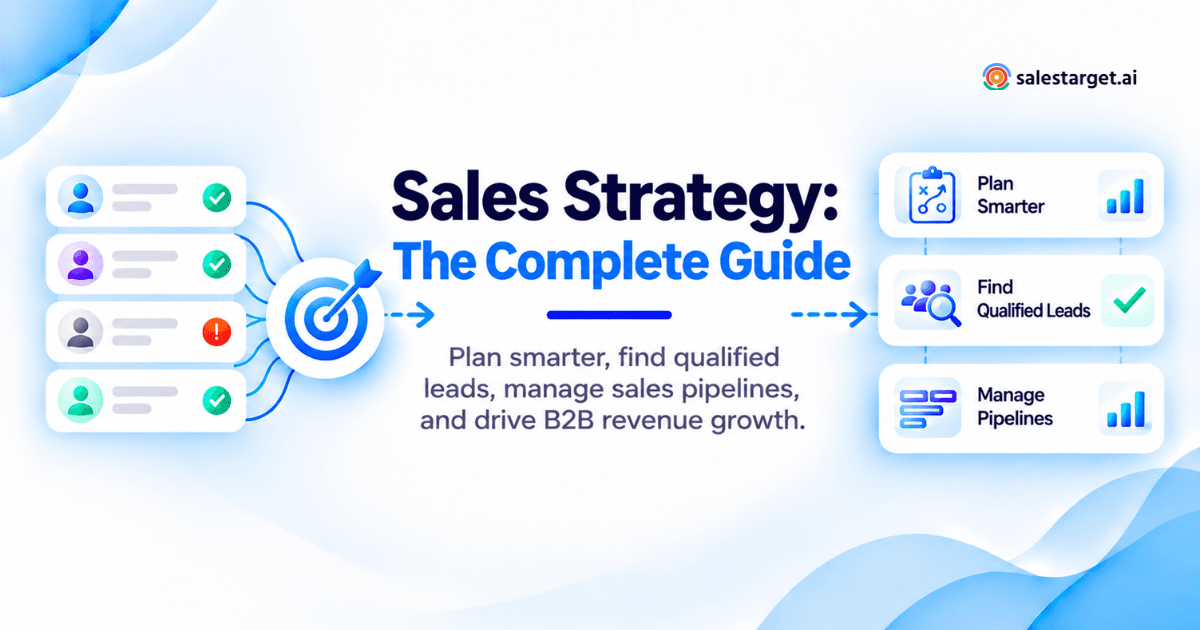
That gap is what a sales strategy closes. A B2B sales strategy is a written plan for who you sell to, how you reach them, how deals move from first contact to signed contract, and which numbers prove it works. It turns scattered activity into a repeatable path to revenue.
This guide covers each piece and shows how Salestarget.ai runs that plan inside one platform instead of five disconnected tools.
The Role of Sales Strategy in Building Predictable B2B Revenue
A sales strategy makes revenue predictable by linking rep activity to qualified pipeline and closed deals.
The Gap Between Sales Activities, Qualified Opportunities, and Revenue Growth
Activity is easy to count and easy to fake. Salesforce's 2026 State of Sales report found reps spend only about 40% of their week selling. Strategy decides which work earns that time.
Connecting Sales Planning, Prospecting, and Pipeline Performance
Planning sets the target, prospecting feeds the pipeline, and reviews show if the plan holds. Split them across tools and nobody sees the break until the quarter is lost.
Sales Strategy vs. Sales Plan vs. Sales Process
Strategy is who and why: markets, ICP, channels. A plan is what and when: quotas, territories, headcount. Process is how: the stages each deal moves through. Revisit them yearly, quarterly, and whenever a stage breaks.
Core Components of a Successful B2B Sales Strategy
Five parts hold up every working B2B sales strategy.
Revenue Goals and Sales Performance Targets
Work backward from the number. A $1.2M new-business target at a $20K average deal and a 20% win rate needs 300 qualified opportunities a year, or 25 a month.
Ideal Customer Profile and B2B Buyer Personas
Your ICP describes the companies that buy fastest and churn least; personas describe the people inside them. Build both from closed-won data.
Lead Generation and Sales Prospecting Channels
Pick channels by where buyers respond. Most outbound teams run email, LinkedIn, and phone together, with inbound feeding the same pipeline.
Sales Pipeline Stages and Buyer Decision Process
Map stages to buyer actions. "Budget owner confirmed" is a stage exit; "proposal sent" is only rep activity.
Sales Team Structure, Resources, and Technology
Decide who prospects, who closes, and who grows accounts, then give them one system. Every extra tool adds a login and a place for data to go stale.
Types of B2B Sales Strategies for Different Business Goals
Most teams combine two or three, based on deal size and buyer behavior.
Inbound Sales Strategy for High-Intent Leads
Inbound works when buyers already search for your category. Speed wins: route demo requests to a rep within minutes.
Outbound Sales Strategy for Targeted Prospecting
Outbound means you choose the accounts. It suits defined ICPs and lives or dies on list quality and deliverability.
Account-Based Sales Strategy for High-Value Accounts
Account-based selling treats a short list of high-value companies as markets of one. Forrester's State of Business Buying 2026 counts 13 internal stakeholders in a typical purchase, so map the committee, not one champion.
Consultative and Value-Based Selling for Complex Deals
For large deals, sell outcomes in the buyer's numbers: hours saved, revenue added, risk removed. End discovery with a quantified problem the buyer agrees with.
Multichannel Sales Strategy for Email, LinkedIn, and Phone Outreach
Multichannel outreach runs email, LinkedIn, and phone as one sequence. Run them in separate tools and a prospect gets a LinkedIn pitch a day after replying to your email.
Customer Expansion and Upselling Strategy for Revenue Growth
The cheapest new revenue sits in current accounts. Treat expansion triggers (new hires, new offices, fresh funding) like new leads, with owners and deadlines.
Key Benefits of a Structured B2B Sales Strategy
Structure pays off in four measurable places.
Improved Lead Quality and Customer Acquisition
A written ICP stops reps from padding lists with accounts that will never buy, which lowers acquisition cost per customer.
Higher Sales Conversion and Win Rates
Shared qualification rules end gut-feel staging. Weak deals exit early instead of clogging late stages, and win rates rise.
Shorter Sales Cycles and Better Resource Allocation
Clear stage exits show where deals wait. Fix the slowest stage and the whole cycle shortens.
Predictable Pipeline Growth and Revenue Forecasting
Consistent stages turn pipeline into math. If stage-two deals close at 18%, today's pipeline forecasts next quarter.
B2B Sales Strategy Framework: From Planning to Execution
A sales strategy framework turns annual goals into weekly actions.
Setting Sales Objectives Based on Revenue Targets
Split the revenue goal by segment and channel. If outbound must deliver 60% of new pipeline, that number sets SDR headcount, sending capacity, and list volume.
Defining Target Markets, Customer Segments, and Buying Committees
Segment by fit and buying motion. A 50-person SaaS firm buys in weeks with two people; a 2,000-person bank buys in quarters with procurement and legal. Each needs its own sequence.
Aligning Sales and Marketing Activities Around Qualified Pipeline
Give sales and marketing one shared number: qualified pipeline created. Define "qualified" in writing and revisit it monthly.
Creating Sales Workflows, Accountability, and Review Cycles
Give every stage and lead source an owner. Review stuck deals weekly and conversion rates monthly, so problems show up with time left to act.
Step-by-Step Process for Building an Effective B2B Sales Strategy
Here is how to create a B2B sales strategy step by step.
Step 1: Analyze Current Sales Performance and Revenue Gaps
Pull 12 months of won and lost deals. Compare win rate, cycle length, and deal size by segment and source. The gap between target and run-rate is your problem statement.
Step 2: Set SMART Sales Goals and Pipeline Targets
Write goals like "Create $900K in qualified fintech pipeline by March 31," then hold pipeline coverage at three to four times quota.
Step 3: Identify High-Value Accounts and Decision-Makers
Score accounts on fit and timing. Fit comes from your ICP; timing comes from funding, hiring, or intent signals. Map three contacts per account: champion, budget owner, and likely blocker.
Step 4: Select Sales Channels and Prospecting Methods
Match channel to persona, then test. Track meetings booked per 100 contacts by channel and shift volume to the winner.
Step 5: Develop Sales Messaging and Outreach Sequences
Write to one problem per persona. A solid sequence runs six to eight touches over three weeks across email and LinkedIn, and every touch adds something new.
Step 6: Define Lead Qualification and Opportunity Management Rules
Pick a framework (BANT, MEDDIC, or your own) and turn it into hard rules: what a lead must confirm to become an opportunity, and what disqualifies it.
Step 7: Establish Sales KPIs and Performance Reviews
Choose five to seven KPIs tied to revenue (meetings, opportunities, stage conversion, win rate, cycle length, coverage) and review them every week.
B2B Sales Prospecting Strategies for Generating Qualified Leads
Qualified leads come from tight targeting, clean data, and relevant outreach, in that order.
Building Targeted B2B Prospect Lists Using ICP Filters
Stack company filters (industry, headcount, revenue, tech stack) with people filters (role, seniority, department). Salestarget.ai's Lead Explorer takes your ICP in plain English or as stacked filters. Curious how many accounts fit your ICP today? Start a free Salestarget.ai trial and run the search.
Using Buyer Intent and Company Signals to Prioritize Accounts
6sense's 2025 Buyer Experience Report found buyers first contact sellers about 61% of the way through their buying process. Signals help you show up sooner. Track signal-to-first-touch time: a funding round worked three weeks late is a missed window.
Improving Lead Quality Through Contact Enrichment and Email Validation
Contact data goes stale as people change jobs. Salestarget.ai verifies contacts at the moment of enrichment, not when the data was first scraped. Run anything older than 30 days through the Email Validator before it enters a sequence.
Personalizing Cold Email and LinkedIn Prospecting Campaigns
Personalize to the account's situation, not the prospect's alma mater. Gartner's May 2025 sales survey found buying-group relevance lifted consensus by 20%; content aimed at one person's priorities hurt it.
Managing Follow-Ups and Lead Qualification Across Sales Channels
Follow-ups need rules, not memory. Stop every sequence the moment a prospect replies on any channel, and route warm replies to an owner the same day.
Sales Pipeline Management Strategies for Higher Conversion Rates
Pipeline management works when stages are honest and stalled deals get attention.
Building a Sales Pipeline With Clear Opportunity Stages
Keep five to seven stages, each with a written exit the buyer confirms. If two reps would stage the same deal differently, rewrite the definition.
Defining Lead-to-Opportunity Qualification Criteria
A lead becomes an opportunity with a confirmed problem, a known decision process, and a booked next meeting. Anything less is still prospecting.
Tracking Deal Progress and Sales Activities With CRM Software
A CRM is only as good as the data reps enter. Salestarget.ai's CRM removes the typing: campaign leads land automatically, emails and calls log to the lead timeline, and replies create follow-up tasks.
Identifying Pipeline Bottlenecks and Stalled Opportunities
Flag deals with no buyer activity in 14 days, or time in stage above 1.5 times your median. Give each one a next step or close it out.
Improving Sales Forecasting and Pipeline Visibility
Weight each deal by its stage's historical close rate, then compare that total to the rep's call every week. The gap shows where optimism hides.
Sales Automation and AI Strategies for B2B Sales Teams
Automate repetitive work; keep people on judgment calls.
Automating Prospect Research and Lead Data Management
Research, enrichment, and list cleanup are the first tasks to automate. In Salestarget.ai, enriched leads go straight to a sequence or the CRM, no CSV needed.
Building Automated Email and LinkedIn Outreach Workflows
Build one sequence that branches on behavior: no reply after two emails, send a LinkedIn request; request accepted, send a short DM; reply anywhere, stop everything.
Managing Sales Follow-Ups and CRM Updates
Each reply should trigger an owner, a task, and a CRM update with no typing. Salestarget.ai's Unibox sorts replies by intent (Interested, Follow-Up, Not a Fit) and syncs deals to the CRM.
Using AI for Campaign Planning, Personalization, and Sales Analysis
Use AI for first drafts and pattern-spotting. Salestarget.ai's AI Copilot builds lead lists from a chat prompt, writes sequences with A/B variations, and flags at-risk deals.
Balancing Sales Automation With Human-Led Engagement
Automate early touches, not late-stage conversations. Once a prospect shows real interest, a person should write every message.
Measuring Sales Strategy Performance and Revenue Growth
Measure the chain from first touch to revenue, not each step alone.
Lead Generation and Prospecting Performance Metrics
Track bounce rate (keep it under 2%), positive reply rate, and meetings booked per 100 prospects. Positive replies matter more than total replies.
Sales Pipeline Conversion Rates and Opportunity Velocity
Track conversion between stages and pipeline velocity: opportunities × win rate × average deal size ÷ cycle length in days. The result is revenue per day.
Sales Cycle Length, Win Rate, and Average Deal Value
Measure cycle length from first touch, not opportunity creation, or you hide weeks of work. Split win rate and deal value by source; inbound and outbound deals behave differently.
Customer Acquisition Cost and Sales Return on Investment
CAC equals sales and marketing spend divided by new customers won. Track payback by channel to see which motion earns its budget.
Sales Forecast Accuracy and Revenue Performance Dashboards
Compare each quarter's forecast to actual revenue and track the gap. One shared dashboard keeps reps and leaders on the same numbers.
B2B Sales Strategy Examples for Different Business Models
The right sales strategy depends on stage, deal size, and team size.
Sales Strategy for Early-Stage B2B SaaS Startups
Founders should sell first and stay narrow: one ICP, one persona, one problem. Run 20 to 30 discovery calls before hiring an SDR, so you know which message books meetings.
Sales Growth Strategy for Small and Mid-Sized B2B Companies
Growing teams win by systemizing what works. Document the best rep's sequence, add signal-based targeting, and consolidate tools before adding headcount.
Account-Based Sales Strategy for Enterprise Sales Teams
Pick 50 to 200 named accounts, map each buying committee, and coordinate email, LinkedIn, and executive outreach. Measure engagement per account, not lead counts.
Outbound Sales Strategy for Lead Generation Agencies
Use separate sending domains per client, warm every inbox before launch, and report on meetings, the number clients renew on.
Common Sales Strategy Mistakes and Ways to Fix Them
Most broken sales strategies fail in one of six places.
Targeting the Wrong Accounts and Buyer Personas
Mistake: an ICP built on who you wish would buy. Fix: rebuild it from your top 20 customers by revenue and retention.
Relying on Outreach Volume Instead of Lead Quality
Mistake: sending more when replies drop. Fix: cut to accounts showing fit and timing; 300 targeted contacts beat 3,000 random ones.
Using Disconnected Sales Tools and Customer Data
Mistake: separate data, email, LinkedIn, and CRM tools joined by CSV exports. Fix: one platform where the lead record follows the prospect from search to signature.
Losing Opportunities Through Poor Follow-Up Management
Mistake: replies sitting unread across ten inboxes. Fix: one unified inbox, an owner per reply, and auto-created tasks after meetings.
Tracking Vanity Metrics Instead of Pipeline Revenue
Mistake: celebrating opens and sends. Apple Mail Privacy Protection preloads emails, so open rates mislead. Fix: report meetings, pipeline created, and revenue.
Scaling Outbound Campaigns Without Managing Deliverability
Mistake: adding volume before protecting the domain. Since February 2024, Gmail and Yahoo require bulk senders to authenticate with SPF, DKIM, and DMARC and keep spam complaints under 0.3%; Microsoft began enforcing similar rules for Outlook.com in May 2025. Fix: warm inboxes, rotate senders, and validate every list.
Choosing the Right Tools to Execute Your B2B Sales Strategy
Judge tools on five capabilities, and on whether they share one data layer.
B2B Contact Database and Lead Enrichment Capabilities
Check database size, verification method, and when verification happens. Data verified the moment you find a lead beats data checked months ago.
Email and LinkedIn Outreach Automation Features
Look for multi-step sequences, conditional branching, LinkedIn safety limits, and one inbox for replies from both channels.
Email Verification and Deliverability Management
Require real-time and bulk verification, automatic warm-up, inbox rotation, and SPF, DKIM, and DMARC checks.
CRM and Sales Pipeline Tracking Capabilities
The CRM should log activity automatically, show a shared pipeline, and create follow-up tasks without manual entry.
AI Sales Assistance, Reporting, and Workflow Integration
AI should work on your own leads, campaigns, and deals, and connect to your calendar, Slack, and any existing CRM.
Why Choose Salestarget.ai for B2B Sales Strategy Execution
Salestarget.ai puts lead data, email and LinkedIn outreach, validation, a CRM, and an AI Copilot in one workspace. Many teams instead pair a data tool like Apollo with a sender like Instantly and a separate CRM, and lose context at every handoff.
Find Target Accounts and Decision-Makers With Lead Explorer
Lead Explorer covers 840M+ verified profiles, 146M+ businesses, 50+ data sources, and 4,000+ intent signals. Its ICP Builder and intent-based lead scoring rank accounts by fit and live buying signals.
Build Accurate Prospect Lists With Contact Enrichment and Email Validation
One click returns verified work email, personal email, phone, and mobile, checked at the point of enrichment. The validator adds MX and SMTP checks, disposable-email detection, and risk scoring across 60+ connected platforms.
Manage Multichannel Prospecting With Email and LinkedIn Outreach
Describe your audience in plain English and Email Outreach builds the sequence. LinkedIn Outreach adds connection requests, DMs, and conditional branches with human-like delays, all in one coordinated flow.
Support Email Deliverability With Inbox Warm-Up and Sending Controls
Connect unlimited inboxes with automatic AI warm-up, intelligent inbox rotation, and SPF, DKIM, and DMARC checks. The AI Spintax Generator varies copy so sends don't look templated.
Organize Leads, Deals, and Sales Activities With the Built-In CRM
Campaign leads land automatically, with a built-in dialer, a shared pipeline, and sync to HubSpot, Salesforce, Zoho, Slack, and Calendly. Salestarget.ai cites 3.2X faster deal cycles and about 6 hours saved per rep each week.
Plan Campaigns and Review Sales Performance With AI Copilot
AI Copilot is built into the platform. Ask which campaigns drove revenue or which deals need attention; its Memory feature pulls your website content for on-brand replies, and workspace data stays private.
Building a 30-Day B2B Sales Strategy Action Plan
Thirty days is enough to launch and test a sales strategy.
Week 1: Define Revenue Goals, ICP, and Target Accounts
Do the pipeline math, rebuild your ICP from closed-won data, and pick 200 to 500 accounts with fit and timing signals. Start inbox warm-up on day one; new inboxes need two to three weeks.
Week 2: Build Prospect Lists and Prepare Outreach Campaigns
Enrich and verify three contacts per account, write one sequence per persona, and set qualification rules in your CRM.
Week 3: Launch Outreach and Manage Qualified Opportunities
Launch at modest daily volume, answer positive replies within hours, and move qualified leads into opportunities with a booked next step.
Week 4: Review Pipeline Results and Refine Sales Activities
Review bounce rate, positive replies, meetings, and opportunities by segment. Cut the weakest segment, rewrite the weakest step, and plan the next 30 days.
Conclusion: Build a Repeatable Sales Strategy for Long-Term B2B Revenue Growth
Go back to those 4,000 emails and three meetings. That result rarely comes from lazy reps. It comes from a fuzzy ICP, stale data, burned inboxes, and replies lost between tools. A repeatable sales strategy fixes each link, and it holds when execution lives in one place.
Salestarget.ai is that place: find buyers showing intent, verify them at enrichment, reach them on email and LinkedIn, and close them in a built-in CRM with AI Copilot watching the pipeline. Start building your sales strategy on Salestarget.ai.