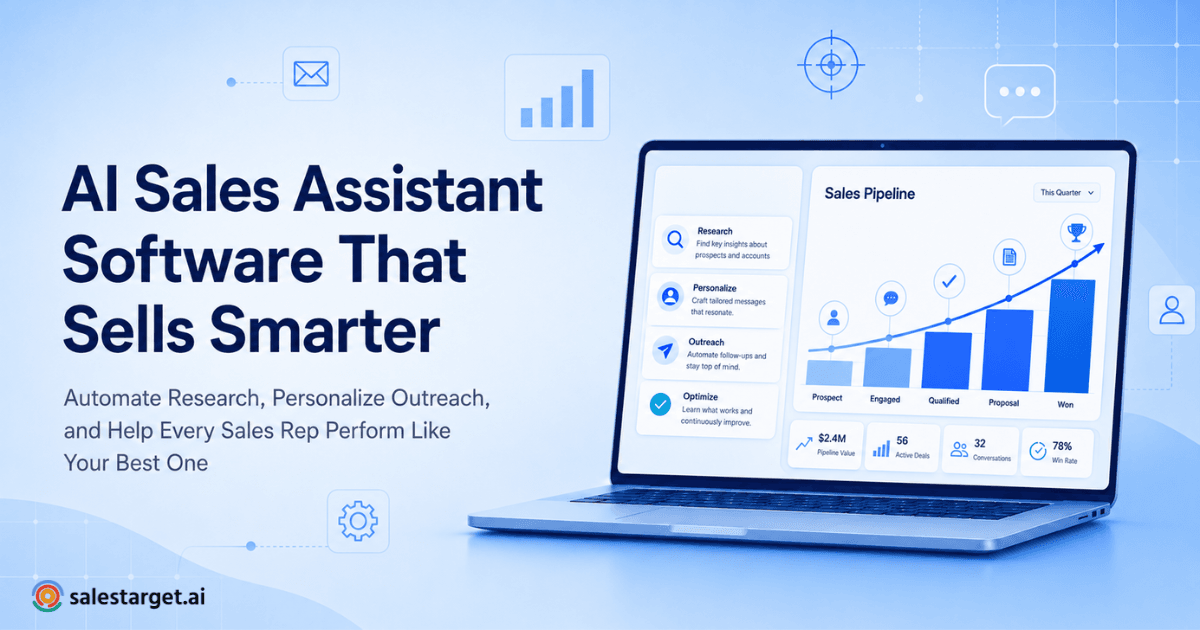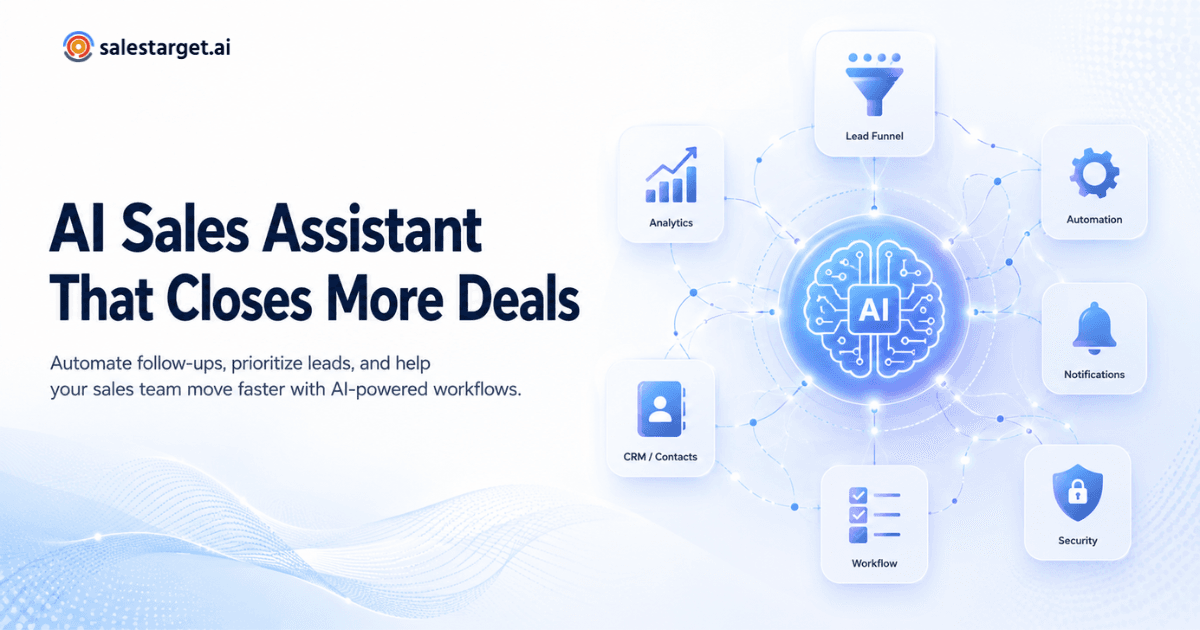
An AI Sales Assistant is software that handles repetitive sales tasks—CRM updates, lead research, email drafting, follow-up scheduling—so sales reps can spend more time on conversations that actually close deals. It doesn't replace human SDRs. It removes the busywork that keeps them from selling. The best results come when AI handles volume and admin while humans own relationships, objections, and strategy.
Every sales leader I talk to is asking the same question right now: should we bring in an AI Sales Assistant, and if we do, what happens to our SDR team?
It's a fair concern. Headlines love the "AI replacing sales reps" narrative because it gets clicks. But the reality on the ground looks nothing like that. Most outbound teams aren't debating whether to fire their SDRs and plug in a bot. They're trying to figure out which parts of the sales process eat up too much human time—and which parts actually need a human touch.
That's what this piece is about. Not hype. Not fear. Just a practical breakdown of where AI fits, where people fit, and how the two work best together. If you lead an outbound team, manage SDRs, or run revenue operations, this should give you a clear framework for making the call.
Why AI Sales Assistants Are Becoming Essential ?
Let's start with the uncomfortable truth: most SDRs spend a shocking amount of their day not selling. They're toggling between tabs, copying data into CRM fields, researching accounts, writing follow-up emails that probably won't get opened, and sitting through internal syncs. A analysis found that reps frequently reclaim 8–12 hours per week once repetitive workflows are offloaded.
In many outbound teams, SDRs spend nearly one-third of their day on administrative tasks rather than customer conversations. An AI Sales Assistant can significantly reduce this operational workload, allowing more time for revenue-generating activities.
That's the real driver behind adoption. It's not about replacing headcount. It's about making each rep dramatically more productive with the hours they already have.
AI vs Human SDR: Understanding the Difference
The AI vs human SDR debate usually gets framed as a competition. That framing is wrong. AI and humans are good at fundamentally different things, and pretending otherwise leads to bad decisions on both sides.
Where AI Wins ?
- Speed at scale—processing thousands of leads, enriching data, flagging intent signals
- Consistency—AI doesn't forget to log a call or skip a follow-up on a Friday afternoon
- Pattern recognition—surfacing which sequences, subject lines, or timing windows convert best
- Always-on availability—working across time zones without burnout
Where Humans Win ?
- Reading a room during a live discovery call
- Building real trust with a VP who's been burned by three previous vendors
- Navigating internal politics at an enterprise account
- Improvising when a prospect goes off-script
The takeaway is simple: AI sales agent capabilities are strongest in structured, repeatable tasks. Human capabilities are strongest when the conversation requires empathy, judgment, or creative problem-solving. Collaboration—not replacement—is the move.
What an AI Sales Assistant Should Automate ?
If you're evaluating AI for sales reps, start here. These are the tasks where automation delivers the biggest return with the least risk.
- CRM hygiene: Automatic logging of calls, emails, and meetings. No more end-of-day data entry marathons.
- Lead research and enrichment: Pulling firmographic, technographic, and intent data so reps open conversations already informed.
- Email drafting and personalization: Generating first drafts based on prospect signals, then letting reps edit before sending.
- Follow-up scheduling: Automated sequences that trigger based on prospect behavior, not calendar reminders.
- Meeting prep and summaries: Pre-call briefs and post-call notes pushed directly into the CRM.
- Pipeline visibility: Real-time dashboards that surface at-risk deals, stalled opportunities, and next-best actions.
- Task reminders: Nudging reps on overdue follow-ups without manager intervention.
According to research, organizations that deploy AI across their commercial functions see measurable revenue uplift, largely because reps reallocate time from admin to customer-facing activity.
If you're looking for an AI Sales Assistant, the key is choosing a platform that integrates into your existing workflow rather than replacing it entirely.
What Humans Should Continue Doing
Here's where I push back on the "automate everything" crowd. Some parts of selling cannot be delegated to software—period.
- Discovery conversations: Asking the right follow-up question in the moment is a skill AI can't replicate.
- Negotiation: Pricing discussions, contract terms, and creative deal structuring require human nuance.
- Objection handling: A prospect saying "we're happy with our current vendor" needs a human ear, not a chatbot response.
- Executive-level conversations: C-suite buyers expect a peer, not a tool.
- Relationship building: Trust is earned through consistent human interaction over time.
- Strategic account planning: Mapping buying committees and navigating multi-threaded deals demands judgment.
Think of it this way: AI handles the prep work so your reps walk into every conversation sharper, more informed, and with more energy for the work that actually moves revenue.
Signs You're Using AI the Wrong Way
Not every team gets this balance right. Here are red flags that suggest your AI implementation is doing more harm than good.
- Your outbound emails feel generic because nobody's reviewing AI-generated drafts before they go out.
- SDRs have been removed from the workflow entirely, and prospects only interact with automated sequences.
- You're relying on AI for complex negotiations or sensitive objection handling.
- Pipeline data looks clean in the CRM, but reps can't explain the context behind any of their deals.
- Response rates have dropped because personalization disappeared when you turned on automation.
AI is a force multiplier, not a replacement for sales craft. If your team can't explain why a deal is in their pipeline without checking a dashboard, you've automated too much.
When to Use an AI Sales Assistant
Timing matters. Here are practical situations where introducing an AI Sales Assistant makes the most sense.
- Startups scaling outbound for the first time: Small teams can't afford to burn rep hours on admin when every conversation counts.
- Growing SDR teams: When you're adding headcount, AI ensures process consistency without doubling your onboarding burden.
- High-volume prospecting environments: If your reps manage 200+ accounts, AI keeps nothing from falling through the cracks.
- Pipeline review preparation: AI-generated deal summaries save managers hours of prep before weekly reviews.
- Account research at scale: When reps are expected to personalize outreach across dozens of verticals, AI handles the data gathering.
The common thread? You should use an AI Sales Assistant when your team's biggest bottleneck is time spent on non-selling activities.
AI Augmented Selling: The Future of Sales Teams
The concept of AI augmented selling isn't theoretical anymore. Teams that integrate AI into their daily workflow—without over-automating—consistently see faster ramp times for new reps, better research quality before calls, more consistent follow-up cadences, and cleaner pipeline data for forecasting.
A study found that high-performing sales teams are significantly more likely to use AI than underperformers. The gap isn't talent—it's leverage.
The emerging sales AI roles we're seeing—AI-assisted pipeline managers, AI-augmented SDRs, AI-coached AEs—all point in the same direction. The future isn't fewer salespeople. It's better-equipped salespeople.
Sales AI Assistant Comparison: AI Alone vs Human Alone vs AI + Human
| Task | Human SDR | AI Sales Assistant | Best Approach |
|---|---|---|---|
| Lead Research | Slow but contextual | Fast and thorough | AI + Human review |
| Prospecting | Relationship-driven | Volume-driven | AI sourcing + Human outreach |
| Email Drafting | Personalized but time-heavy | Fast drafts, needs editing | AI draft + Human edit |
| Discovery Calls | Strong rapport building | Cannot replicate | Human only |
| Negotiation | Nuanced and adaptive | Cannot handle | Human only |
| CRM Updates | Inconsistent | Always accurate | AI only |
| Relationship Building | Essential human skill | Not possible | Human only |
| Forecasting | Gut-driven estimates | Data-driven accuracy | AI analysis + Human judgment |
Explore AI Copilot
SalesTarget AI Copilot sits inside your existing workflow—handling CRM updates, lead research, email drafts, and follow-up scheduling—so your SDRs can focus on the conversations that actually close deals. No rip-and-replace. Just more selling time, less busywork.
The question was never "AI Sales Assistant or human SDR." It was always "which parts of the job should each one own?" AI doesn't replace great salespeople. It removes the friction that keeps them from being great. The teams winning right now aren't choosing between technology and talent. They're combining both—letting AI handle the volume, the admin, and the data, while their reps focus on the human moments that actually move deals forward.
If your SDRs are buried in busywork, the answer isn't more headcount. It's smarter tools that give every rep the bandwidth to sell.