Your reps are spending three hours a day hunting for contacts, personalizing messages, and chasing replies that never come. The prospect list is stale. Half the "decision-makers" haven't replied to anyone's outreach in six months. And your pipeline shows meetings booked, but most of those meetings never convert because the contacts were wrong to begin with.
LinkedIn outreach services exist to fix that. Specifically, they handle the end-to-end process of identifying the right B2B prospects on LinkedIn, reaching out to them with relevant messages, and handing off only qualified conversations to your sales team.
This guide breaks down what LinkedIn outreach services actually cover, how to evaluate delivery models (agency vs. in-house vs. software), how to run a pilot that produces real data, and how platforms like SalesTarget.ai approach LinkedIn prospecting as part of a coordinated multichannel outreach workflow.
LinkedIn Outreach Services: Scope, Process, and Business Value
The Role of LinkedIn Outreach in B2B Lead Generation
LinkedIn outreach services connect B2B sellers with verified, role-specific decision-makers through structured prospecting sequences. The goal is a meeting with a qualified buyer, not a follower count.
At its core, LinkedIn outreach for lead generation covers target account selection, contact discovery, connection request campaigns, follow-up messaging, reply handling, and lead handoff to a sales team or CRM. Most services wrap these activities into a managed workflow so sales teams can focus on calls and demos while the prospecting pipeline runs in the background.
Core Activities Covered by LinkedIn Outreach Services
LinkedIn outreach services typically include:
- ICP (Ideal Customer Profile) development and account targeting
- Contact research and decision-maker identification
- LinkedIn profile optimization for outreach senders
- Connection request campaigns with personalized notes
- Multi-step follow-up message sequences
- Reply management and lead qualification
- Meeting scheduling and CRM entry
The quality difference between services comes down to how well each of these steps is executed and how they connect with each other. A well-built prospect list with weak messaging produces the same result as a strong message sent to the wrong audience: low reply rates and wasted pipeline.
LinkedIn Outreach Services vs. General LinkedIn Marketing
LinkedIn marketing focuses on content, brand visibility, and audience building. LinkedIn outreach services focus on direct, 1:1 prospecting and conversion. These are separate disciplines with different KPIs.
A LinkedIn outreach service is measured on connection acceptance rates, reply rates, qualified meetings booked, and pipeline generated. It is not measured on impressions, follower growth, or engagement on company posts.
From Prospect Connections to Qualified Sales Opportunities
The best LinkedIn outreach services treat the connection as the start of a qualification process, not the finish line. Accepting a connection request means a prospect noticed your message. What happens next (the follow-up sequence, the qualification questions, the meeting ask) is where real pipeline gets built or lost.
This is why reply handling and qualification ownership matter as much as the initial outreach. Services that hand off "interested" responses without any qualification layer create work for your sales team, not pipeline.
The Growing Role of LinkedIn Outreach in B2B Sales
Reaching Decision-Makers Outside Traditional Cold Email
Cold email delivery rates have dropped across almost every B2B vertical. Inbox filters are smarter, domain reputation matters more, and buyers have gotten better at ignoring templated pitches. LinkedIn reaches the same decision-makers on a platform they check multiple times a day for professional reasons, which changes the context of the message.
A VP of Sales scrolling their LinkedIn feed is in a professional mindset. The same person deleting cold emails is in filtering mode. That context difference affects reply rates more than message copy does.
Building Relationships Across Complex B2B Buying Groups
Enterprise B2B deals rarely have a single decision-maker. A typical mid-market software sale involves three to six stakeholders across IT, finance, and the business unit. LinkedIn outreach lets you run parallel outreach to multiple contacts at the same account, building visibility across the buying group before a formal conversation starts.
This is something cold email alone can't replicate without significant risk of looking like spam. LinkedIn's professional context makes multi-stakeholder engagement feel coordinated rather than aggressive.
Supporting Account-Based Sales and Targeted Prospecting
LinkedIn is the primary channel for account-based sales (ABS) programs because it provides direct access to the exact titles and companies on your target account list. You don't need a purchased email list, and you're not dependent on catching someone at the right moment in their email inbox.
For teams running ABM (account-based marketing) alongside ABS, LinkedIn outreach creates the 1:1 touchpoints that content campaigns can't. A prospect who saw your company's thought leadership content and then receives a personalized connection request is more likely to reply than one receiving cold outreach with no prior context.
Connecting LinkedIn Engagement With Pipeline Development
Standalone LinkedIn outreach that doesn't connect to a CRM or a coordinated email sequence leaves revenue on the table. A prospect who accepts your connection, reads your follow-up, but doesn't reply right away isn't lost. They're just not ready. An outreach service that feeds engagement signals into your pipeline lets your team follow up at the right moment instead of guessing.
Types of LinkedIn Outreach Services for B2B Companies
Managed LinkedIn Lead Generation Services
Fully managed services handle everything: prospect research, campaign setup, message writing, reply management, and meeting booking. Your team receives qualified meetings, not a list of contacts to work.
These services are best for companies that want to outsource prospecting entirely and care about meetings delivered, not the process behind them.
LinkedIn Prospect Research and List-Building Services
Some providers specialize only in building LinkedIn prospect lists: verified contacts, current roles, and relevant firmographic data. The outreach itself is handled internally by the client's reps.
List quality is the only thing that matters here. Outdated titles, wrong company stages, and contacts with no decision-making authority make the list worthless regardless of how cheap it was to build.
LinkedIn Appointment Setting and Lead Qualification
Appointment-setting services focus specifically on the back half of the outreach process: responding to replies, qualifying prospects against defined criteria, and booking meetings directly onto sales rep calendars.
These services work best when paired with high-quality prospect lists and strong initial messaging. They are not designed to fix targeting or message problems upstream.
LinkedIn Outreach Automation and Software-Led Prospecting
Software platforms automate connection requests, follow-up sequences, and engagement actions (profile views, post reactions) to trigger responses at scale. The rep or operator writes the messaging and reviews results; the software handles the timing, pacing, and scheduling.
The main risk with automation software is over-sending. LinkedIn's terms of service restrict automation tools, and accounts that send too many requests too fast get flagged or restricted. Platforms built with native rate limits, warm-up logic, and human-like delays are significantly safer than generic automation scripts.
Multichannel Outreach Services Combining LinkedIn and Email
Multichannel services coordinate LinkedIn and cold email so the same prospect receives consistent, sequenced outreach across both channels. A prospect who doesn't reply to a connection request might reply to a follow-up email referencing the LinkedIn message, and vice versa.
This approach produces materially higher engagement than either channel alone. It also requires that LinkedIn and email sequences are managed from a single platform, or contacts get confused, sequences overlap, and reps lose track of who said what where.
LinkedIn Outreach Agency, In-House SDR, or Software: Comparing the Delivery Models
Fully Managed LinkedIn Outreach Agencies
Agencies handle every step of the process under a service retainer. The client defines ICP criteria, approves messaging, and receives qualified meetings. Agencies work best for teams with no internal SDR capacity and a clear ICP.
Watch for agencies that run campaigns from their own LinkedIn accounts (not yours), use generic prospect lists across clients, or report on vanity metrics instead of pipeline contribution.
In-House LinkedIn Prospecting Teams
In-house SDR teams give you full control over messaging, targeting, and qualification standards. The tradeoff is cost: a single SDR fully loaded costs significantly more per year than most software or agency retainers, and ramp time runs three to six months before productivity stabilizes.
In-house teams are the right call when LinkedIn prospecting is a core, ongoing motion and when the sales process is complex enough that outsiders can't qualify leads accurately.
Software-Led LinkedIn Outreach Operations
Software platforms let your existing reps run structured LinkedIn prospecting without manual follow-up tracking. Modern platforms automate sequences, log replies, and surface engaged prospects for human follow-up. The rep's time goes to qualified conversations, not admin.
The economics are favorable at scale. One rep running a LinkedIn automation platform with 200-plus active contacts per month can produce more meetings than three reps doing manual outreach.
Hybrid Outreach Using Internal Reps and Sales Automation
Most high-performing outbound programs combine in-house reps with sales automation platforms. Reps own strategy and qualification. Software handles sequencing, follow-ups, and engagement at scale. This model keeps response quality high while expanding outreach volume beyond what manual effort can support.
Comparing Control, Staffing, Cost Structure, and Campaign Ownership
| Model | Control | Staffing Required | Campaign Ownership |
|---|---|---|---|
| Managed Agency | Low | None | Agency |
| In-House SDR | Full | 1+ FTE | Internal |
| Software-Led | High | Existing reps | Internal |
| Hybrid | Full | Existing reps | Internal + Platform |
The right model depends on your pipeline targets, internal capacity, and how much message quality matters for your deal size.
The LinkedIn Outreach Process: From Target Accounts to Qualified Meetings
ICP Development and Target Account Selection
Before any outreach starts, you need a defined Ideal Customer Profile. This means specific firmographic criteria: industry, company size by headcount or revenue, geography, tech stack, and growth stage. The ICP determines which accounts make the list and which contacts within those accounts are worth reaching.
Weak ICP definitions produce lists full of companies that technically fit the criteria but aren't buyers. The difference between a firmographic match and a real buyer signal is the difference between a 2% reply rate and a 12% reply rate.
B2B Contact Discovery and Decision-Maker Identification
Once target accounts are defined, contact discovery identifies the specific people worth reaching at each account. This means matching job titles and seniority levels to the buying role in your deal: who owns the budget, who influences the decision, and who will use the product.
Contact data quality matters as much as targeting accuracy. Reaching the right title at the wrong company is just as useless as reaching the wrong title at the right company.
Prospect Segmentation Using Firmographic and Intent Signals
Not every contact on your list should receive the same message at the same time. Segmenting prospects by company size, industry, buying stage, and intent signals lets you send messages that match where each prospect is in their decision process.
A company that just raised a funding round has different priorities than one in a steady-state growth phase. A VP of Sales at a 50-person company has different problems than a VP of Sales at a 500-person company. These differences should show up in your outreach, not just your spreadsheet.
LinkedIn Profile Preparation and Message Personalization
The sender's LinkedIn profile is part of the outreach, not background noise. Prospects check it before accepting a connection request. A sparse, unoptimized profile with no clear value proposition reduces acceptance rates before the message is even read.
Message personalization goes beyond inserting a first name and company name. Effective personalization references something specific to the prospect's role, company situation, or recent activity that makes the message feel sent specifically to them, not blasted to a list.
Connection Requests, Follow-Up Sequences, and Prospect Engagement
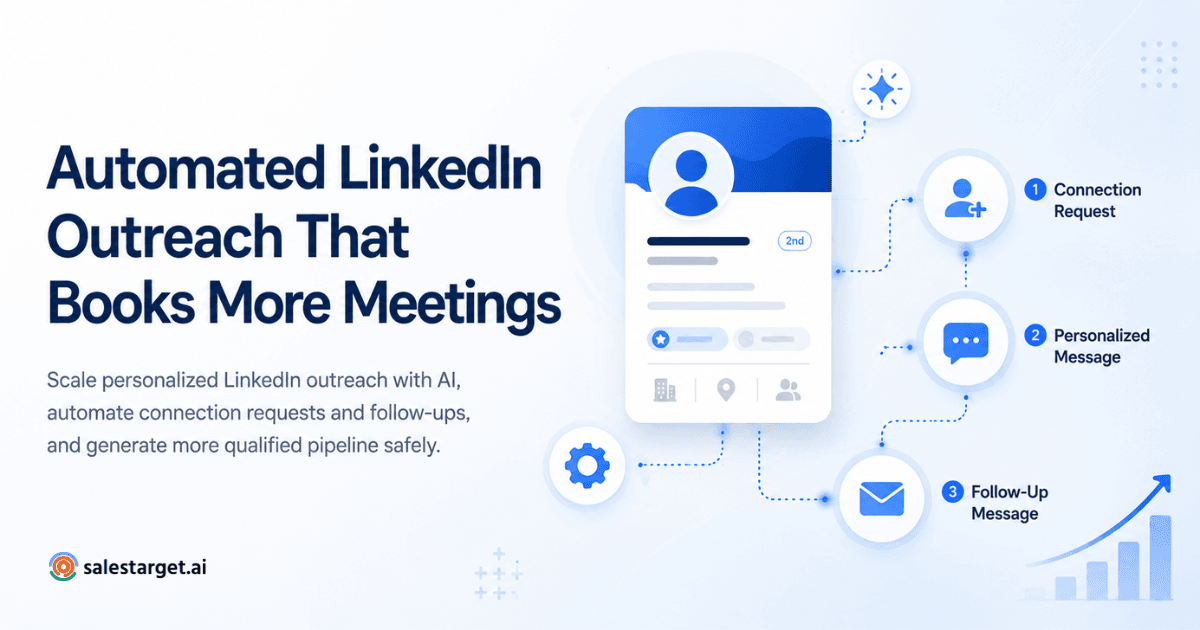
A structured connection request sequence typically runs four to six touchpoints across two to three weeks:
- Connection request with a short, role-relevant note
- First follow-up after acceptance (value-led, no hard pitch)
- Second follow-up referencing a specific pain point or trigger
- Final follow-up or pivot to email channel
Spacing matters as much as content. Following up three times in a week signals automation. Following up once a week with varied angles signals relevance.
Lead Qualification, Meeting Booking, and CRM Handoff
Reply handling is where most LinkedIn outreach falls apart. A prospect who responds with "tell me more" isn't a qualified lead. Qualification means confirming budget authority, relevant pain, and a viable timeline before a meeting gets booked.
Every qualified conversation should enter the CRM immediately, with context: what the prospect said, what objections surfaced, and what was promised in the meeting request. Sales reps flying blind into booked meetings produce lower close rates than reps who know exactly why the prospect agreed to talk.
Building a LinkedIn Outreach Strategy Around Buyer Intent
Identifying Relevant Buying Signals Before Outreach
Buyer intent signals are the difference between outreach that interrupts and outreach that arrives at the right moment. Relevant signals include:
- Recent funding rounds (budget available, growth mode active)
- Leadership changes (new buyers, new priorities)
- Hiring spikes in specific departments (investment in a function you support)
- Technology stack changes (evaluating alternatives, switching modes)
- Topic-level intent (researching problems your product solves)
Outreach that references one of these signals as context lands differently than a generic pitch, because it shows you've done actual research, not just filtered a database.
Matching Outreach Messages to Buyer Roles and Sales Stages
A CFO, a VP of Sales, and an SDR Manager all care about different things, even at the same company. A message built for a VP of Sales that lands in a CFO's inbox reads as tone-deaf. Role-based message variants aren't optional. They're the minimum standard for B2B outreach that produces replies.
Early-stage buyers (aware of a problem, not yet evaluating solutions) respond to insight and relevant questions. Late-stage buyers (actively evaluating vendors) want specifics: outcomes, timelines, and how you're different from the alternatives they're already talking to.
Coordinating LinkedIn and Email Outreach Across the Sales Cycle
LinkedIn and email work better together than either works alone. A common multichannel sequence:
- Day 1: LinkedIn connection request
- Day 3: Cold email (if no LinkedIn connection yet)
- Day 5: LinkedIn follow-up message (after connection accepted)
- Day 8: Email follow-up referencing LinkedIn engagement
- Day 12: Final LinkedIn message or email with a direct meeting ask
Running these in parallel from a single platform keeps the context consistent across both channels. Running them in separate tools creates the risk of duplicate messages, inconsistent tone, and a rep who doesn't know what the prospect has already seen.
Managing Follow-Ups Based on Prospect Engagement
Not every follow-up should be the same. A prospect who viewed your profile but didn't reply to your connection request signals different interest than one who accepted but didn't engage with your first message. Conditional sequences that branch based on actions let you send the relevant next message instead of the next templated step.
Keeping Outreach Relevant Across Multiple Stakeholders
When reaching multiple contacts at the same account, make sure the messages don't contradict each other. A VP of Sales receiving a pitch focused on SDR productivity while the SDR Manager receives a pitch focused on management reporting creates confusion if they compare notes. Coordinate messaging at the account level, not just the contact level.
Key Deliverables and Responsibilities in LinkedIn Outreach Services
Prospect List Quality and Contact Data Verification
The prospect list is the foundation. A list with 15% bad contacts produces 15% fewer potential replies before a single message is sent. Verified contact data includes current job title, correct company, and a working email (for multichannel follow-up) confirmed through real-time checks, not scraped once and stored.
Messaging Strategy, Copy Approval, and Campaign Setup
Messaging strategy should be reviewed and approved by the client before launch. This means seeing actual message copy, not just a framework. Many agencies and platforms send first drafts that sound generic and only revise under pressure. Getting the messaging right before the campaign runs is significantly cheaper than fixing it after 200 connection requests have already gone out.
Reply Management and Lead Qualification Ownership
Who handles replies and who owns qualification criteria should be clearly defined before a campaign starts. If the service handles replies, what qualifies a prospect as "interested"? What disqualifies them? What happens to prospects who say "not now"? These definitions prevent qualified leads from getting dropped and unqualified conversations from eating sales team time.
CRM Updates, Meeting Handoffs, and Sales Team Coordination
Every qualified conversation should arrive in the CRM with context attached. Meeting handoffs that include the prospect's stated pain point, objections raised, and the specific reason they agreed to a call produce better-prepared reps and higher meeting-to-opportunity conversion.
Campaign Reporting, Data Access, and Service Accountability
Reporting should show connection acceptance rate, reply rate, positive reply rate, meetings booked, and cost per meeting (at minimum). Services that report only on "outreach volume" are reporting on activity, not results. If you can't see the underlying data, you can't diagnose what's working.
Evaluating LinkedIn Outreach Service Quality and Campaign Fit
Audience Targeting Accuracy and Prospect Data Coverage
Ask specifically how prospects are identified. Are they using LinkedIn's native search with manual verification? A third-party database? A combination? How current is the data? Prospect lists built from data scraped six months ago have significantly higher stale contact rates than lists built with real-time enrichment.
Message Relevance and Personalization Standards
Request sample messages for your ICP before signing a contract. Generic messages with "Hi [First Name], I noticed you're the [Title] at [Company]" as the only personalization signal weak targeting and weaker copy.
Reply Handling and Qualified Meeting Criteria
Define "qualified" before the campaign starts. A service that hands off anyone who said "yes" to a meeting invite without checking fit is booking unqualified meetings for your team to clean up.
LinkedIn Account Access and Campaign Oversight
Know whether the service runs campaigns from your LinkedIn account or their own. Campaigns run from shared accounts don't build your network, can't leverage your existing connections, and disappear the moment the contract ends. Campaigns run from your account build a real professional network with lasting value.
Reporting Transparency and Pipeline Attribution
Reporting should include which accounts produced replies, which message variants produced the best response rates, and what the pipeline value is of the conversations handed off. Without this, you can't improve, and you can't attribute meetings to the right campaigns.
Service Costs, Internal Workload, and Expected Deliverables
Calculate total cost of ownership, not just the service fee. Managed agencies require internal time for approvals, feedback cycles, and CRM maintenance. Software platforms require a rep's time for setup, monitoring, and reply handling. Neither is free. The question is which cost structure produces the better return at your current scale.
Measuring LinkedIn Outreach Performance and Revenue Impact
Connection Acceptance and Reply Rates
Connection acceptance rates in the 25-40% range indicate strong targeting and an optimized sender profile. Below 20% signals a targeting or profile problem. Reply rates of 5-15% on the initial sequence are realistic for well-targeted campaigns with relevant messaging.
Positive Replies and Sales-Qualified Conversations
A "reply" isn't always a "yes." Track positive replies (interested, wants to learn more, requests a meeting) separately from total replies. The ratio of positive replies to total replies tells you whether your messaging is resonating or just generating polite declines.
Meeting Booking, Attendance, and Qualification Rates
Meeting attendance rates below 60% usually mean the qualification bar was too low. Prospects who booked a meeting without a clear reason to attend don't show up. Attendance rates above 75% indicate the outreach qualified effectively before booking.
Opportunity Creation and Sales Pipeline Contribution
Track how many meetings from LinkedIn outreach convert to open opportunities in the CRM. This connects outreach activity to actual pipeline value, not just calendar activity.
Cost per Qualified Meeting and LinkedIn Outreach ROI
Cost per qualified meeting is the most useful unit economics metric for LinkedIn outreach. It accounts for list cost, messaging time, tool costs, and rep time spent on qualification. Divide that by the number of meetings that actually entered the pipeline, and you have a real cost figure to compare against other prospecting channels.
Tracking Performance by Audience Segment and Outreach Channel
Segment performance reporting by ICP tier, company size, industry, and message variant. Campaigns that look average in aggregate often have one strong segment and two underperforming ones. Finding the strong segment and doubling down produces faster results than optimizing the weak segments.
LinkedIn Outreach Challenges That Affect Lead Quality and Results
Poor ICP Matching and Outdated Prospect Records
The most common cause of low reply rates is a poorly defined ICP translated into a list of contacts that technically match the criteria but aren't real buyers. ICP definitions that haven't been validated against actual closed deals produce lists full of companies at the wrong stage, size, or buying readiness.
Generic Messaging and Weak Outreach Relevance
Prospects receive dozens of LinkedIn connection requests per week. Messages that lead with "I help companies like yours" or "I came across your profile" are immediately categorized as mass outreach and ignored. The first line of every message should make the prospect think you wrote it specifically for them.
Repeated Follow-Ups and Prospect Fatigue
Four follow-ups in four days feels like harassment, not persistence. Spacing follow-ups appropriately (five to seven days between each touch) with different angles each time maintains interest without burning the contact.
Platform Restrictions, Unauthorized Automation, and Account Risk
LinkedIn restricts automation use in its terms of service. Accounts using unauthorized third-party tools that don't respect daily send limits, use unnatural engagement patterns, or lack human-like delays face restrictions or permanent bans. This is a real operational risk, especially for campaigns running at volume.
Platforms built with native LinkedIn safety controls (rate limits, warm-up schedules, auto-pause logic) protect sender accounts. Generic automation scripts do not.
Disconnected LinkedIn and Email Campaigns
Running LinkedIn outreach in one tool and cold email in another without shared contact records produces duplicate outreach, missed follow-ups, and confused prospects. When a contact replies to your email and then receives a LinkedIn message that doesn't acknowledge the email reply, the outreach reads as uncoordinated and damages trust.
Missed Replies, Duplicate Contacts, and Incomplete CRM Records
Manual reply management at scale is error-prone. Replies get missed in notification noise, duplicates get added to the CRM with conflicting data, and meetings get booked without proper context attached. The further a reply handling process is from an automated, unified inbox, the more leads fall through the gaps.
A 30-Day LinkedIn Outreach Pilot for B2B Teams
Week 1: ICP Validation, Prospect Research, and Campaign Preparation
Spend the first week validating your ICP against your last 10 closed deals, not your wishlist. Look at actual company size, industry, and title for deals that closed within a reasonable sales cycle. Build your initial prospect list from those criteria, verify contacts, and prepare two or three message variants for A/B testing.
Week 2: Initial Outreach and Message Quality Review
Launch connection requests to the first segment. By day 10, you'll have enough acceptance data to see whether your sender profile and connection note are working. Review the first replies manually. Are the conversations qualifying naturally, or are reps spending time explaining basic product details that should be in the message?
Week 3: Reply Analysis, Lead Qualification, and Follow-Up Refinement
Review positive reply rates by message variant and audience segment. The variant with the highest positive reply rate gets scaled. The underperforming variants get rewritten or cut. Tighten qualification criteria based on what you're hearing in actual conversations.
Week 4: Pipeline Assessment and Campaign Performance Review
By week four, you have enough data to calculate cost per qualified meeting, connection acceptance rate, and meeting attendance rate. Compare these against your other prospecting channels. The pilot either validates LinkedIn outreach as a scalable motion or surfaces the specific problems (targeting, messaging, qualification) that need fixing before scaling.
Pilot Scorecard: Lead Quality, Engagement, Meetings, and Costs
| Metric | Benchmark | Your Pilot |
|---|---|---|
| Connection Acceptance Rate | 25-40% | |
| Reply Rate | 5-15% | |
| Positive Reply Rate | 30-50% of replies | |
| Meeting Attendance Rate | >70% | |
| Cost per Qualified Meeting | Varies by market |
Why Choose SalesTarget.ai
Discover B2B Prospects Using Lead Explorer and Contact Enrichment
SalesTarget.ai's Lead Explorer gives you access to 840M+ verified professional profiles and 146M+ business entities. Search with plain-English prompts or stack filters by industry, role, seniority, company size, revenue, tech stack, and intent topics. One-click enrichment unlocks verified professional email, personal email, phone, and mobile at the moment you find the lead.
Real-time buying signals via Bombora Intent Topics, plus business events like funding rounds, hiring spikes, and leadership changes on a 30-to-90-day lookback window, let you prioritize prospects who are actually in a buying motion, not just ones who match your ICP on paper.
Coordinate LinkedIn and Email Outreach in One Platform
SalesTarget.ai's LinkedIn Outreach module runs connection requests, DMs, follow-ups, and engagement actions in a coordinated sequence alongside cold email. AI personalization adapts to each profile, role, and industry. Conditional sequences branch on replies, actions, or no response, so the follow-up matches what the prospect actually did, not just where they are in a linear sequence.
Timezone-aware smart scheduling with working-hour limits and human-like delays keeps campaigns running safely. Built-in LinkedIn safety controls (rate limits, warm-up logic, auto-pause safeguards) protect sender accounts from platform restrictions.
Validate Email Contacts Before Multichannel Outreach
The Lead/Email Validator runs MX/SMTP checks, disposable-email detection, and risk scoring before any email goes out. 90% of emails are validated before sending. This keeps bounce rates down, protects domain reputation, and ensures the email half of your multichannel sequence actually reaches inboxes.
Manage Prospect Conversations and Sales Opportunities With Built-In CRM
Campaign leads land automatically in SalesTarget.ai's built-in CRM, with every email and call logged to the lead timeline and follow-up tasks created automatically when a lead replies or a meeting ends. The Unibox unified inbox pulls every reply from LinkedIn and email into one view, sorted by intent (Interested, Follow-Up, Not a Fit), so no reply gets lost in notification noise.
Teams using SalesTarget.ai's CRM report 3.2X faster deal cycles and 91% follow-up completion rates, specifically because the handoff from outreach to pipeline happens inside the same platform, not across a spreadsheet and a separate CRM.
Use AI Copilot for Outreach Planning, Messaging, and Campaign Analysis
SalesTarget.ai's AI Copilot is a conversational sales teammate built into the platform. Search across 840M+ profiles, generate full personalized LinkedIn and email sequences in seconds, query CRM deals and pipeline in plain language, and flag at-risk deals before they go cold. The Copilot generates A/B message variations by role, industry, and company size, which means your message variants are ready to test without a copywriting session.
Track Prospect Engagement From First Contact to Sales Pipeline
Every engagement action (connection accepted, message opened, reply received, meeting booked) feeds into the same platform view as the prospect's CRM record. Sales reps see the full engagement history before their first call. Pipeline reports show which LinkedIn outreach segments are producing meetings and which aren't, so you're optimizing based on data instead of intuition.
Building a More Predictable B2B Pipeline With LinkedIn Outreach
The reps who consistently book meetings from LinkedIn outreach aren't sending more messages. They're sending better-targeted messages to better-qualified prospects, following up with relevant context, and handing off only conversations that are worth a rep's time.
The teams with the best outreach results treat LinkedIn as one channel in a coordinated system, not a standalone tool. Prospect research, sequence management, reply handling, and CRM tracking all run in the same workflow. When they do, the compounding effect is real: better data produces better targeting, better targeting produces better reply rates, and better reply rates produce more pipeline from the same number of contacts.
SalesTarget.ai was built for exactly this workflow: find the right prospects using real-time intent data, reach them across LinkedIn and email in one coordinated sequence, validate contacts before sending, qualify replies in a unified inbox, and track everything from first touch to closed deal in a CRM built for outbound teams. No bolt-on tools. No CSV imports. No switching platforms mid-sequence.
If you want to see what a coordinated LinkedIn outreach program looks like when all the pieces are in one place, start with SalesTarget.ai.