TL;DR
- Sequences plateau around the 90-day mark even on completely fresh lists. That rules out list fatigue — the problem is approach fatigue, not audience reuse.
- Four causes stack: template staleness, angle saturation inside a narrow ICP, positioning drift, and reversion from an inflated early baseline.
- Re-personalizing a stale sequence does nothing. Personalization changes what you mention; a plateau requires changing what you claim.
- Different layers decay at different speeds. Openers go stale in weeks, value claims in a quarter, sequence structure in about six months.
- The fix is a standing challenger on 20–30% of volume, so you find the next angle before the current one dies rather than after.
The sequence worked. Week one, reply rates were the best your team had seen. Week six, still solid. Somewhere around month three, the number started drifting down, and nobody could point to what changed. The leads were fresh. The targeting was the same. The messaging was the same — which turns out to be exactly the problem.
The 90-day plateau pattern
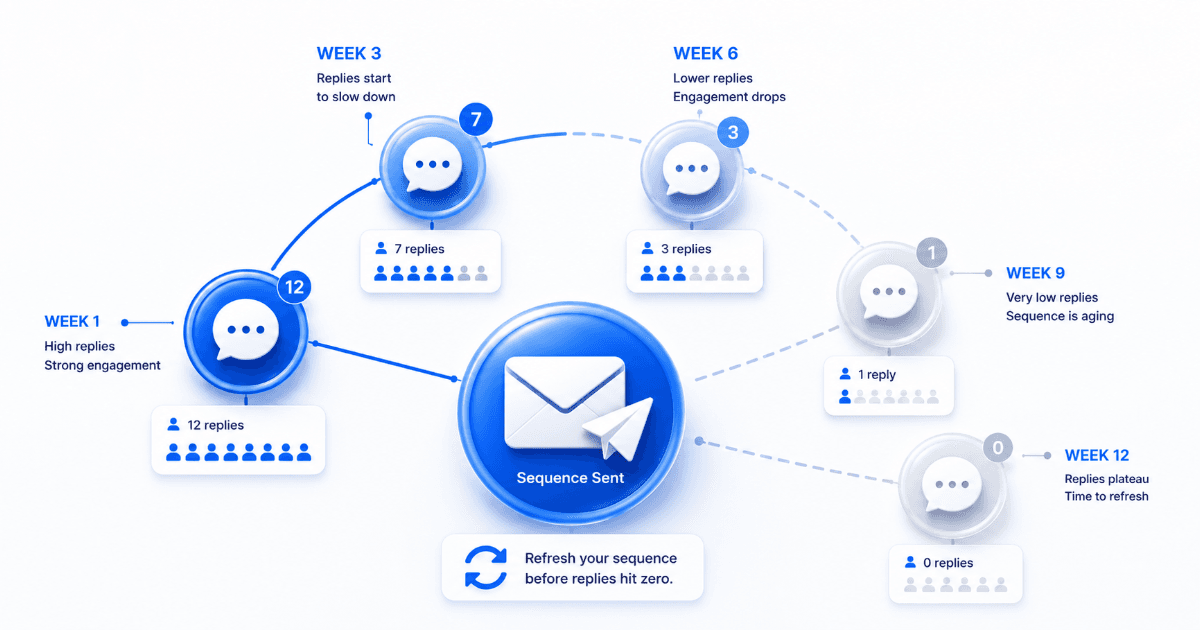
The shape is consistent enough across outbound teams to be worth naming. A new LinkedIn sequence launches strong, holds for four to eight weeks, then enters a slow decline that flattens into a plateau somewhere around the twelve-week mark. Not a crash — a drift. Acceptance rates soften first, then reply rates, then the plateau settles maybe 40 to 60% below the launch numbers and stays there.
What makes this diagnostically confusing is that the obvious explanation is wrong. Most teams reach for list fatigue: we've burned through the good prospects. But the plateau shows up on freshly imported lists too. New companies, new contacts, nobody previously touched, same decline. If the audience is genuinely new and performance still degrades, the audience was never the variable.
Two different problems, often confused
The distinction that changes the fix
List fatigue is about audience reuse — the same people receiving too much from you. The fix is suppression and rest periods. Approach fatigue is about your method going stale — the same message losing power on people who have never heard from you. The fix is a rewrite. Applying the list fatigue remedy to an approach fatigue problem produces the most common outcome in outbound: a bigger list running a dead sequence.
Why sequences go stale even on fresh leads
Four mechanisms drive the plateau. They compound, which is why the decline feels gradual and untraceable rather than attributable to any single cause.
1. Template staleness
Your sequence has a shape: the way the first line opens, where the ask sits, the rhythm of the follow-ups. That shape is a pattern, and patterns become recognizable long before they become famous. A buyer who has received four structurally identical messages this quarter classifies the fifth in about two seconds — not as "bad message" but as "automated outreach," which is a different and more final category.
The important part: the recognition is structural, not verbal. You can change every word in the message and keep the same skeleton, and buyers will still pattern-match it. Which is why wording tweaks reliably fail to move a plateau.
2. Angle saturation inside a narrow ICP
A well-defined ICP is a small world. If you sell to heads of RevOps at Series B SaaS companies, the total population is measured in thousands, and those people talk to each other, follow the same people, and read the same posts.
Over 90 days, your angle diffuses through that population — not just via your own sends, but via competitors converging on the same positioning because the market rewarded it. By month three, "we help RevOps teams cut manual data work" is not your angle. It is the category's angle. The message is no longer wrong; it is simply no longer information.
3. Positioning drift
This one is self-inflicted and the most fixable. Your sequence was written against what you understood about your buyer at a moment in time. Since then your product shipped things, your best deals started coming from a slightly different segment, and your sales team learned which objection actually kills deals. None of that got back into the sequence.
Six months on, the sequence is pitching a version of your company that no longer exists to a buyer profile that is no longer your best one. It still converts a little, which is why nobody catches it — a genuinely broken sequence gets rewritten in a week, a subtly outdated one runs for a year.
4. Reversion from an inflated baseline
Part of every plateau is a measurement artifact, and it is worth separating out honestly. When you launch a sequence you almost always point it at your warmest available segment first — the accounts with the clearest fit, the strongest signals, the names someone already recognized. Those weeks produce your benchmark.
Then you work outward into the rest of the ICP, where fit is looser by construction. Some of the "decline" is your sequence performing consistently against a progressively harder audience. This matters because it changes the response: if week one was a warm-segment number, chasing it with rewrites is chasing a benchmark that was never repeatable. Establish your baseline from weeks four to eight, not week one.
Why re-personalizing doesn't fix a plateau
The standard response to declining reply rates is to add personalization. More variables, deeper research, a reference to a recent post. It rarely moves the plateau, and understanding why tells you what will.
Personalization operates on what you mention. Approach fatigue is a problem with what you claim. A message that references a prospect's recent funding round and then makes the same value argument you have made for 90 days is a personalized stale message. The buyer's objection was never "this doesn't mention me." It was "I have heard this pitch."
Used correctly, AI personalization is a multiplier on a good angle — it makes a fresh argument land harder on more accounts. It cannot substitute for the angle. Multiplying zero stays zero, and a saturated claim is functionally zero.
The refresh cycle: what to rewrite and when
Not everything decays at the same rate, and treating a sequence as one monolithic asset to be replaced is why refreshes feel expensive enough to postpone. Break it into layers with their own intervals.
| Layer | Refresh interval | What a real refresh means |
|---|---|---|
| Opening line | 4–6 weeks | A different entry point, not a reworded version of the same one |
| Core value claim | Quarterly | Re-derived from your last 10 closed-won deals, not the pitch deck |
| Proof point | Quarterly | A newer customer, closer to the segment you're sending to |
| Sequence structure | ~6 months | Touch count, spacing, channel order, where the ask lands |
| Segmentation logic | ~6 months | Split by buyer situation rather than by job title |
| ICP definition | Annually, or on any positioning change | Rebuilt from who actually bought, not who you targeted |
Read the table as a budget rather than a schedule. Most teams over-invest in the top row — endless subject line and opener testing — and never touch the middle rows, which is where a plateau actually lives. If your last three refreshes were all openers, your next one should be the value claim.
Testing new angles before the plateau hits
The structural problem with reacting to plateaus is timing. By the time the decline is unambiguous in your reporting, you have already lost a month of pipeline and you are now writing a replacement sequence under pressure, which is when teams produce their worst work. The alternative is to always have the next angle partly tested.
- Set your baseline from weeks four to eight. Discard week one. It was your warmest segment and it is not a target you can hold. Everything downstream depends on measuring against a real number.
- Run a standing challenger on 20–30% of volume. Not an A/B test you launch when things get bad — a permanent second sequence carrying a genuinely different angle. The cost is a slightly lower blended average. The return is that you always know what your next champion is.
- Change one layer at a time, and make it the angle. A challenger that differs in wording teaches you nothing. Change the problem you lead with, or the outcome you claim, or who you address. If you cannot summarize the difference in one sentence, it is not a different angle.
- Define the promotion trigger in advance. Decide now what result promotes the challenger — for example, beating the champion's trailing four-week reply rate across a set volume of sends. Deciding afterward guarantees you will rationalize keeping the sequence you already wrote.
- Retire winners deliberately. When a challenger is promoted, the old champion goes into the archive rather than staying live at reduced volume. Running four half-dead sequences to avoid the discomfort of retiring one is how teams end up with no clear signal about anything.
- Keep a log of retired angles. Angles recover. A positioning that saturated 18 months ago is often fresh again to a market that has cycled through two hiring waves since. Your archive is a source, not a graveyard.
What to instrument so you see it coming
Aggregate reply rate is the metric that hides plateaus. It blends a declining champion with a fresh challenger and a seasonal dip into one number that moves too slowly to act on. Four views make the decline visible weeks earlier.
📊 The four views that expose approach fatigue
- Reply rate by launch cohort — group sends by the week the sequence started running. A declining trend across cohorts is approach fatigue; a flat trend with a bad recent week is noise.
- Acceptance rate separately from reply rate — acceptance usually softens first, which makes it your earliest warning signal.
- First-touch versus later-touch replies — if only your opener is degrading, refresh the entry point. If every touch is degrading, the value claim is the problem.
- Champion-to-challenger delta — the single number that tells you whether it is time to promote, and the reason the standing challenger is worth its cost.
The practical requirement is that these live in one place. When acceptance sits in the LinkedIn tool, replies in a spreadsheet, and pipeline in the CRM, nobody assembles the cohort view — and a plateau you cannot see is a plateau you address a quarter late. Keeping sequence analytics and CRM visibility together is less about having better charts and more about making the trendline someone's routine glance rather than a monthly reporting project.
Four mistakes that turn a dip into a plateau
Diagnosing it as a list problem
Why it fails
Buying more leads to fix declining replies scales the sequence, not the performance. If the decline persists on fresh, never-touched contacts, the audience was never the cause — and you have just made the real problem more expensive to run.
Tweaking wording instead of changing the angle
Why it fails
Buyers pattern-match structure and claim, not phrasing. A rewritten opener on the same argument reads as the same message. Ten rounds of wording tests can run for a quarter and move nothing, while feeling like diligent optimization.
Waiting for certainty before acting
Why it fails
At realistic LinkedIn volumes, waiting for a statistically airtight verdict on a declining sequence costs more pipeline than acting on a directional signal. Treat two consecutive declining cohorts as sufficient evidence to start writing the challenger.
Rebuilding everything at once
Why it fails
A total rewrite changes structure, claim, proof and segmentation simultaneously, so when the numbers move you cannot tell what worked. You have replaced a plateau with a mystery, and you will face the same decision again in 90 days with no more knowledge than you had before.
Build a motion that expects to go stale
The mental model worth changing is the idea that a sequence is something you get right. Sequences are perishable by design — they work by being unfamiliar, and every send spends a little of that unfamiliarity. A sequence that has been running unchanged for six months is not a proven asset. It is an asset that has been quietly depreciating while your reporting called it stable.
Teams that hold performance over years are not the ones with a better template. They are the ones who assumed the template would expire, kept a challenger running, and made the refresh a scheduled routine rather than an emergency. Running the whole motion — sequences, personalization, and the trendline that tells you when to move — inside a single LinkedIn outreach system is what makes that routine cheap enough to actually sustain.
Your current sequence will plateau. The only real question is whether the next one is already half-written when it does.
See the plateau before it costs you a quarter.
Sequences, personalization and per-sequence performance in one place.
✓ 50 credits ✓ 7-day trial ✓ No credit card required

See It In Action: Book Your Free Demo
Get a personalized walkthrough and see how it works for your team.
Book My Demo →