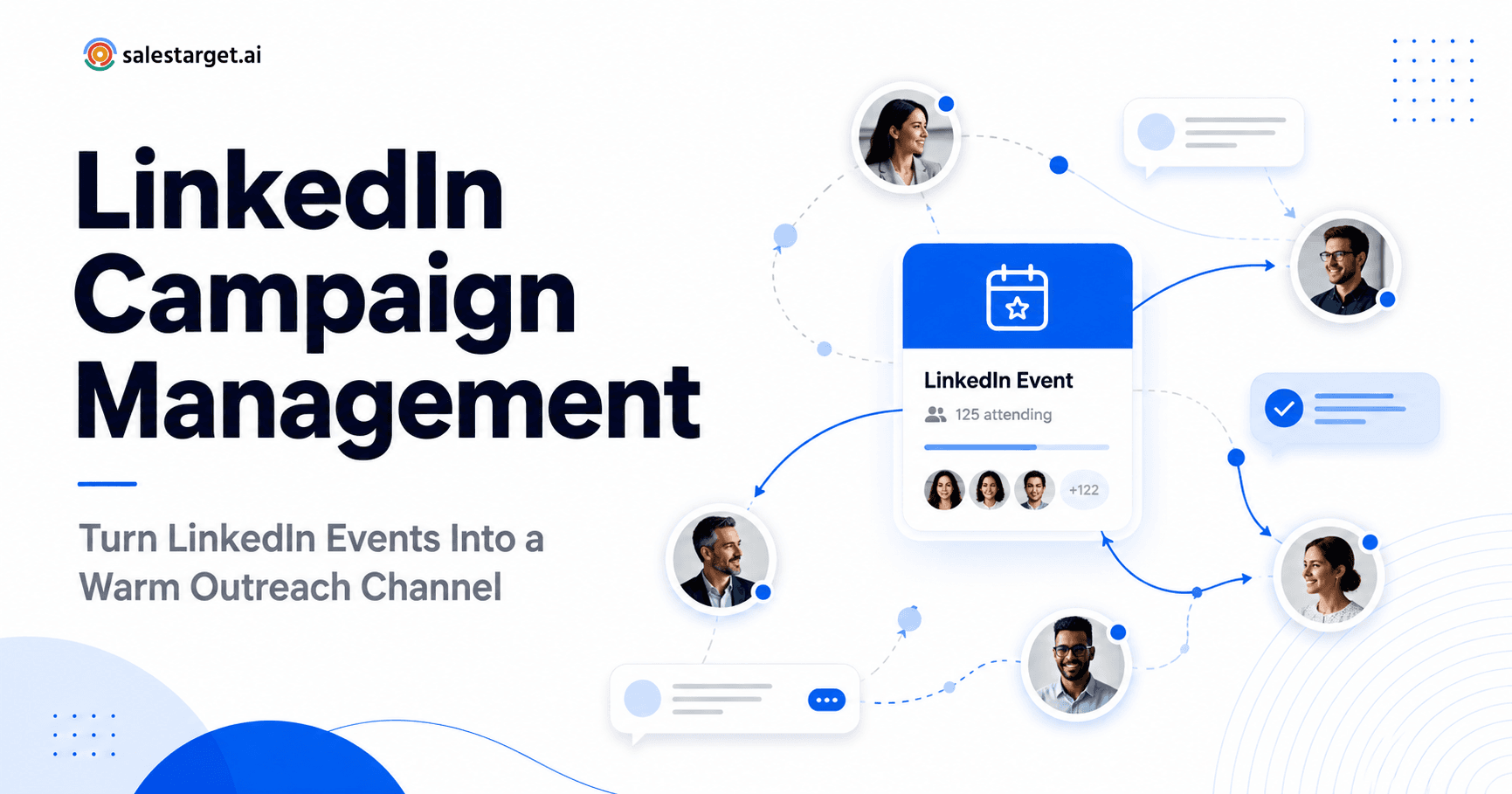
Most LinkedIn outreach fails for one straightforward reason: there's no context. You're messaging a person who has zero frame of reference for who you are or why you're reaching out. That's why LinkedIn Campaign Management built around real intent signals matters more than volume ever will.
Quick Answer: B2B sales teams can use LinkedIn Events as a warm outreach channel by identifying prospects who have already expressed interest in a relevant topic through event attendance. This shared context enables warmer conversations through personalized LinkedIn Outreach, thoughtful follow-ups, and eventually Multi-Channel Outreach - turning passive event engagement into active pipeline.
LinkedIn Events are one of the most overlooked prospecting signals available today. When someone registers for an event about pipeline forecasting or sales enablement, they're actively raising their hand around a specific theme. That behavioral cue is worth far more than a job title filter alone. Yet most sales teams walk right past it.
Why LinkedIn Events Create Warmer Sales Conversations
When a prospect registers for or attends a LinkedIn Event, they're broadcasting something important: this topic matters to them right now. That's a behavioral indicator, not a demographic guess.
Compare this with standard cold prospecting, where your only targeting levers are job title and company size. Event-based outreach adds a critical third dimension - demonstrated topic interest. LinkedIn's official Events documentation confirms that Events are designed to help professionals connect around shared interests, which naturally lowers the barrier to engagement.
Here's why that shifts the outreach equation. You've got shared context—a natural conversation opener. The event theme hands you a direct messaging angle. Attendees self-select around a topic, sharpening your targeting before you send a single connection request. And prospects who see genuine relevance in your message are far more receptive.
Sales teams that build automated LinkedIn outreach workflows around event engagement consistently see stronger response rates than teams running title-based cold lists. Context compounds.
The LinkedIn Event Prospecting Workflow
Turning event signals into pipeline requires a repeatable process. Here's a nine-step workflow:
- Identify relevant LinkedIn Events. Search for upcoming or recent events tied to your buyer's industry or pain points.
- Define your ideal attendee profile. Not every participant is a prospect. Clarify which roles and company sizes matter.
- Identify attendees and decision-makers. Review attendee lists and cross-reference against your ICP.
- Segment by relevance. Group prospects into tiers: high-priority targets, warm leads, and awareness-stage contacts.
- Engage before pitching. Comment on event posts, react to speaker content, or share related insights.
- Send personalized connection requests. Reference the event and topic naturally.
- Start a contextual conversation. Ask a question about the event theme rather than leading with your product.
- Follow up based on engagement. Responders move forward; non-responders enter a nurture cadence.
- Move qualified prospects into broader outreach. LinkedIn Outreach Automation tools help manage follow-up sequences at scale.
The principle: automate the scaffolding - sequencing, timing, tracking - through LinkedIn Automation, and keep the first-touch messages genuinely personal.
5 LinkedIn Event Use Cases Sales Teams Can Actually Run
1. Event Attendee Follow-Up
After an event wraps, attendees are still reflecting on the topics discussed. A relevant message within 48 hours that references a specific session or takeaway starts a conversation that feels organic, not forced.
2. Speaker and Panelist Outreach
Speakers at LinkedIn Events tend to be senior leaders or recognized experts. They're visible and active on the platform. Reaching out with a thoughtful comment about their session beats a cold pitch every time.
3. Topic-Based Prospecting
When an event focuses on revenue operations challenges in mid-market SaaS, you have a curated audience interested in that exact problem. Use it as a prospecting filter alongside standard criteria. Teams already running LinkedIn outreach sequences triggered by job changes and events can layer event signals into existing workflows for sharper targeting.
4. Post-Event Conversation Campaigns
Build a lightweight follow-up sequence around the event. Start with a connection note, continue with a question about their experience, then share a relevant resource. This mirrors how real professional relationships form at in-person conferences.
5. Event + Multi-Channel Outreach
LinkedIn doesn't have to be the only channel. Once a prospect engages, extend the conversation through email or other touchpoints. Multi-Channel Outreach built on event context avoids the "why are you emailing me?" reaction because a relationship foundation already exists. Just be careful to avoid common LinkedIn outreach automation mistakes like sending identical messages across channels or following up too aggressively.
How to Turn Event Signals Into a LinkedIn Campaign Management System
Illustrative benchmark: A practical event-led outreach campaign can be structured around three signal layers—event participation (did they attend?), profile relevance (do they match your ICP?), and conversation engagement (did they respond?). Each layer narrows your focus and increases pipeline quality.
Effective LinkedIn Campaign Management isn't about sending more messages. It's about organizing: audience segments based on event-plus-ICP fit, campaign stages from connection through qualification, personalized messaging with event-specific angles, follow-up cadences that respect timing, response tracking across prospects, clear qualification criteria, and a clean handoff with full context to your closing team.
Think of it as a lightweight CRM layer on top of your LinkedIn activity. Without this structure, event-based outreach quickly degrades into another batch of generic connection requests.
Example LinkedIn Event Outreach Sequence
Here's a five-step sequence you can adapt for any event:
Step 1 - Connection: "Hi [Name], noticed we both attended the [Event] session on [Topic]. Interesting discussion - would be great to connect."
Step 2 - Conversation (Day 2–3): "What stood out to you from the session? The point about [specific topic] really resonated with what I'm seeing across [industry]."
Step 3 - Value (Day 5–7): "Came across this [article/report] that ties into what was discussed at [Event]. Thought you might find it useful."
Step 4 - Qualification (Day 10–12): "Curious -is [event topic challenge] something your team is actively working through? I've been hearing similar priorities from several [role] leaders."
Step 5 - Soft CTA (Day 14–15): "If helpful, happy to share how some teams are approaching [challenge]. No pitch - just a quick comparison of what's working. Worth 15 minutes?"
The progression matters: relevance first, value second, business context third, invitation last. No pitch appears until genuine relevance has been established.
Where LinkedIn Automation Helps - and Where It Doesn't
LinkedIn Automation works well for scheduling connection requests at optimal send times, managing follow-up cadences without manual tracking, segmenting audiences by engagement level, and monitoring response patterns across active campaigns.
Where it falls short—and can actively damage your brand: first-message personalization still requires a human touch. Reading engagement signals (a "not interested" versus a "tell me more") demands judgment, not rules. And sometimes the right decision is to pause outreach entirely rather than escalate it.
LinkedIn's Sales Solutions research consistently shows that personalized outreach referencing shared experiences generates significantly higher acceptance rates than generic requests. The takeaway: automate the operational scaffolding and keep the creative, relationship-building work human.
How SalesTarget.ai Supports LinkedIn Outreach
For teams ready to operationalize this playbook, SalesTarget AI's LinkedIn Outreach product is built for structured, event-informed prospecting. It helps sales teams organize campaigns, manage connection sequences, and track engagement across prospects—without sacrificing the personalization that makes event-led outreach effective.
Rather than replacing human judgment, SalesTarget.ai handles the operational layer: campaign sequencing, follow-up management, audience segmentation, and response tracking. Your team spends less time on logistics and more time on conversations that advance deals.
Turn Event Interest Into Conversations
SalesTarget.ai helps sales teams automate and organize LinkedIn outreach while keeping conversations relevant, personal, and pipeline-focused.
Automate Your LinkedIn Outreach →
LinkedIn Events represent one of the clearest intent signals on the platform. Attendees have already shown interest. Context already exists. The only question is whether your team has a system to act on it.
Thoughtful LinkedIn Campaign Management turns that intent into pipeline—not through mass messaging, but through structured outreach that respects timing, relevance, and how professionals actually prefer to be approached. Combine that with disciplined LinkedIn Automation for the operational lift, and you have a prospecting approach that feels personal at real scale.