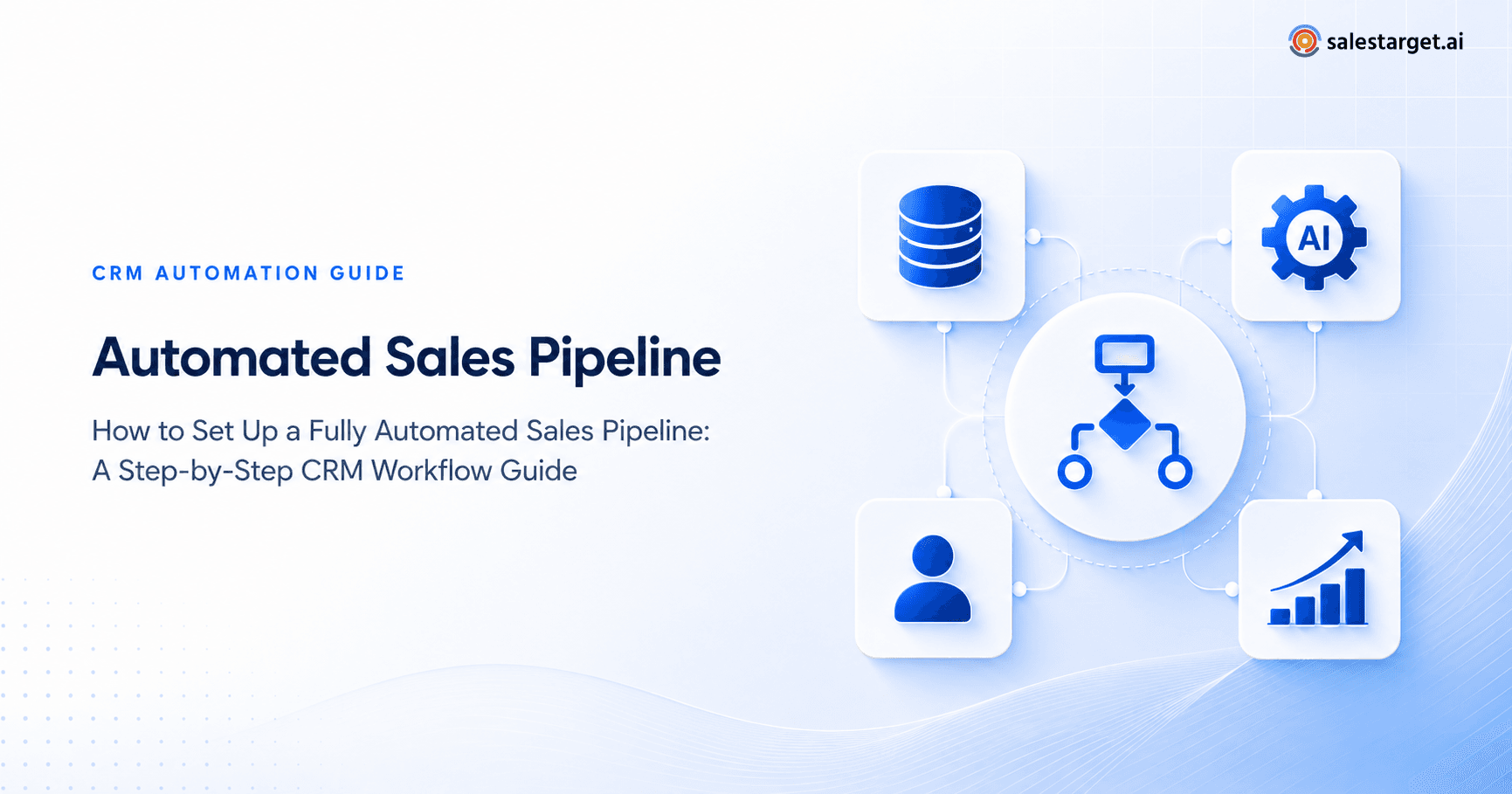
Automated Sales Pipeline
An Automated Sales Pipeline uses CRM workflow automation and pipeline stage automation to automatically capture, qualify, route, nurture, and advance leads through the sales process with minimal manual effort, resulting in faster response times, improved conversion rates, and more predictable revenue.
If your reps are still manually moving deals from stage to stage, logging every call, and chasing down follow-ups in a spreadsheet, your pipeline isn't a pipeline — it's a to-do list with a funnel shape. The future of automated sales pipelines belongs to revenue teams that let their CRM do the heavy lifting, not their reps.
This guide walks you through exactly how to build one.
Why Most Sales Pipelines Break Before Deals Close
Speed and consistency are what separate winning pipelines from leaky ones. Most don't fail because of bad leads or a weak product — they fail because manual processes create gaps.
A rep forgets to follow up. A hot inbound lead sits unassigned for two hours. A deal moves stages without a single task being created. These aren't one-off mistakes; they're structural problems baked into how the pipeline was built.
According to HubSpot's Sales Trends research, salespeople spend only about one-third of their day actually selling. The rest goes to administrative work, data entry, and chasing internal process. That's not a productivity problem — it's an automation gap.
The fix isn't hiring more SDRs. It's removing the manual steps that shouldn't exist in the first place.
The 7-Step Blueprint for Building an Automated Sales Pipeline
Step 1 — Capture Every Lead Automatically
Every untracked lead is lost revenue. The foundation of any automated sales pipeline is a reliable capture layer that feeds your CRM in real time — from web forms, chat, inbound email, LinkedIn, paid campaigns, and partner referrals.
Configure your CRM to create contact records automatically upon form submission or intent signal. No manual import, no data lag. Pair this with deduplication rules so your pipeline stays clean from day one.
Step 2 — Enrich and Qualify Contacts Instantly
Raw leads aren't sales-ready leads. Once a contact enters your CRM, automated enrichment tools pull in firmographic data — company size, industry, job title, tech stack — so your reps never start a cold call cold.
Layer in lead scoring rules tied to ICP criteria and behavioral signals (pages visited, content downloaded, email opened). Contacts that cross a scoring threshold automatically get flagged as Sales Qualified Leads and move to the next stage without anyone touching them.
This is where lead management software best practices matter most — the quality of your qualification logic directly determines pipeline accuracy downstream.
Step 3 — Trigger CRM Workflow Automation Rules
CRM workflow automation is the engine behind every automated action in your pipeline. Think of workflows as if-then logic that runs 24/7: if a lead scores above 80, then assign to an enterprise rep; if a deal goes five days without activity, then create a follow-up task and alert the manager.
Map your core workflows around three triggers:
- Time-based: Days without activity, days since last contact
- Stage-based: When a deal moves into or out of a stage
- Field-based: When key data changes — lead score, deal size, company size
Keep each workflow focused on a single outcome. Stacked automations with ten conditions are brittle and hard to debug.
Step 4 — Design Pipeline Stage Automation Logic
Pipeline stage automation means your CRM should advance or flag deals based on real sales signals — not manual updates from reps. A discovery call logged? Move the deal to "Qualified." A proposal email sent? Advance to "Proposal Sent." Silence for ten days? Flag the deal as at-risk.
This is where most teams underinvest. They build a pipeline with stages but never configure the logic that connects them. The result is a pipeline where stage data reflects when a rep last remembered to click, not where the deal actually stands.
Work closely with your CRM admin to build a sales pipeline that matches your selling process — because automating a pipeline that doesn't reflect reality just speeds up the wrong process.
Step 5 — Automate Follow-Ups and Task Creation
Every deal that advances should generate a next step automatically. A proposal sent? Schedule a follow-up call in three days. A demo completed? Assign an email sequence for objection handling. A trial started? Trigger an onboarding check-in sequence.
SalesTarget's task automation eliminates the cognitive overhead of remembering what to do next — your reps open the CRM and see a clean action list, not a blank screen.
Step 6 — Route Opportunities to the Right Reps
Lead routing is where speed-to-lead lives or dies. Salesforce research shows that buyers expect fast responses — and the longer a lead waits, the lower the conversion probability drops.
Configure routing rules in your CRM based on territory, deal size, product line, or rep capacity. SalesTarget's lead routing engine supports round-robin, weighted, and attribute-based routing — so the right rep gets the right lead at the right time, automatically.
📊 Industry Insight
Based on analysis of automated B2B sales workflows, organizations that automate lead routing and follow-up execution can reduce lead response delays by up to 60% and improve sales productivity by approximately 25%.
Step 7 — Measure, Optimize, and Scale
Automation without visibility is just blind speed. Build reporting dashboards that track pipeline velocity, stage conversion rates, average deal cycle, and follow-up completion rates. SalesTarget's CRM visibility layer surfaces these metrics in real time so revenue leaders can spot bottlenecks before they become missed quarters.
Review your automation rules monthly. Winning pipelines evolve — your logic should too.
Common Automation Mistakes That Create Revenue Leaks
Even well-intentioned automation creates problems when it's configured carelessly:
- Over-automating outreach. Sequences that fire too fast or too generically damage sender reputation and lead trust.
- No fallback for edge cases. Every automation needs a manual override path for deals that don't fit the standard flow.
- Automating a broken process. If your stage definitions are unclear, automating stage transitions just moves confusion faster.
- Neglecting data hygiene. Enrichment and deduplication aren't one-time tasks — they're ongoing maintenance requirements.
- No human review loop. Automation should accelerate decisions, not replace them entirely. High-value deals still need human judgment.
The Automated Sales Pipeline Checklist for Revenue Teams
Use this before going live with any pipeline automation:
- ☐ All lead sources feeding CRM automatically with no manual import
- ☐ Lead scoring model built and validated against historical win rates
- ☐ Enrichment rules running on all new contacts
- ☐ Workflow automation rules documented with clear trigger logic
- ☐ Pipeline stages defined with entry and exit criteria
- ☐ Stage advancement tied to CRM activity data, not manual rep updates
- ☐ Follow-up sequences assigned per stage transition
- ☐ Lead routing rules configured and tested
- ☐ At-risk deal alerts enabled for manager visibility
- ☐ Reporting dashboards built for pipeline velocity and conversion rates
- ☐ Monthly automation review scheduled
Ready to Build Your Automated Pipeline?
SalesTarget CRM gives revenue teams the workflow automation, lead routing, pipeline automation, and reporting tools to build a pipeline that runs itself.
An automated sales pipeline isn't a luxury for enterprise teams — it's the operational baseline for any B2B revenue org that wants to scale without scaling headcount at the same rate. The seven steps above give you a practical blueprint, but the execution is where most teams either win or stall.
Start with lead capture and routing. Get those two right and you'll see ROI in the first thirty days. Then layer in stage automation, follow-up sequences, and reporting. Automation compounds — every workflow you add makes the next one more powerful.
The pipeline that closes deals isn't the one managed hardest. It's the one built smartest.