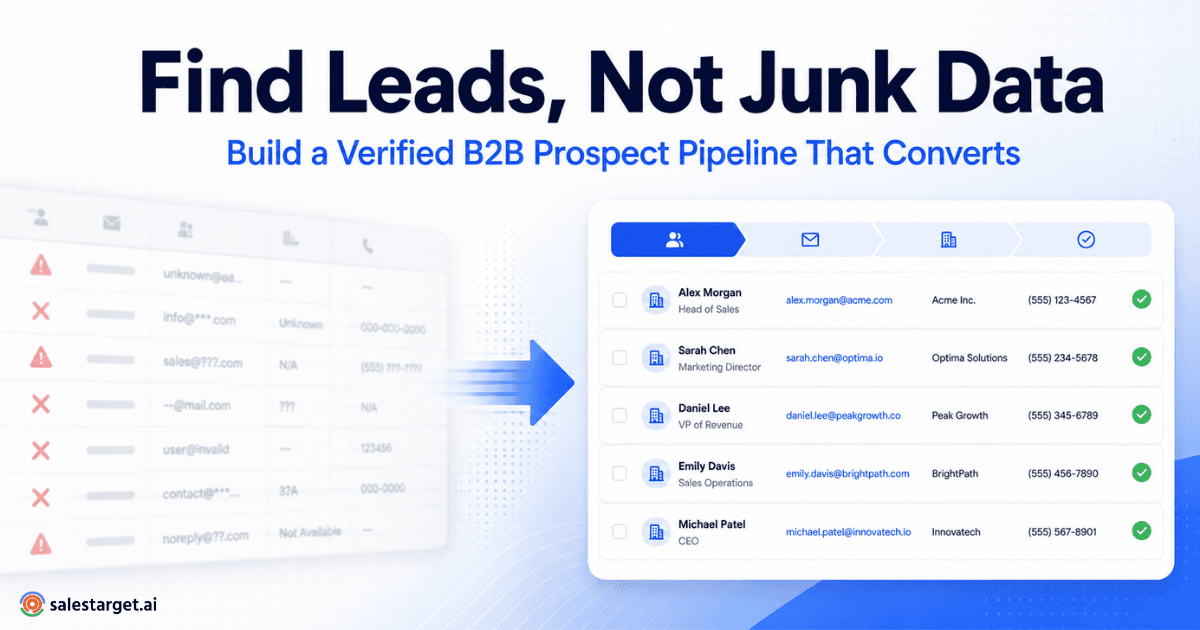
Most purchased lead lists start decaying the moment they're compiled. Job titles go stale, people change companies, emails bounce, and generic inboxes bury your message. If you've ever loaded a "verified" list into your CRM only to watch bounce rates climb past 8%, you already know the frustration.
The real question isn't where to buy contacts - it's how to find B2B leads that are accurate, relevant, and worth your team's outreach effort. That starts well before you ever draft a cold email.
Quality B2B lead sourcing begins with defining your Ideal Customer Profile, then identifying accounts that match it. From there, find the right decision-makers inside those accounts, verify their contact data, enrich any missing fields, and validate prospect fit- all before launching outreach. This ICP-driven approach replaces the guesswork of bulk-purchased lists with a pipeline built on accuracy and relevance.
1. Start With an ICP, Not a Contact List
The single biggest mistake in B2B lead generation is skipping the ICP definition and jumping straight to contact acquisition. An Ideal Customer Profile isn't a rough sketch- it's a detailed filter that prevents wasted outreach.
Your ICP should specify industry vertical, company size (headcount and revenue range), geography, technology stack, business model, and the pain points your product solves. Layer in buyer role: what title does the person who signs the contract hold? Who champions the purchase internally?
Without these criteria locked down, every lead sourcing method you use will pull in noise. You'll spend cycles contacting companies that will never buy and people who can't authorize a deal. ICP-driven lead sourcing saves time on the back end by investing it on the front end.
2. Build a Target Account List
Once your ICP is defined, the next step is identifying companies that match it. This is where many teams default to buying a massive database. Resist that urge.
Effective B2B lead sourcing methods for account identification include:
- Industry and technology directories that map companies by vertical, stack, or market segment.
- Hiring signals - a company hiring three SDRs is probably investing in outbound, which tells you something about their growth stage.
- Funding or expansion announcements that signal budget availability and strategic priorities.
- Professional networks and community engagement where prospects reveal interests and pain points organically.
For deeper account intelligence- especially when you need to understand board composition and executive leadership—tools that surface board-level and leadership data through enrichment can sharpen your account prioritization considerably.
Aim for a focused list of 200–500 accounts rather than 5,000 loosely matched companies. Tight targeting almost always outperforms broad coverage in outbound prospecting.
3. Find the Right Decision-Makers
Having the right company on your list means nothing if you're reaching the wrong person inside it. Finding decision makers is arguably the hardest part of B2B prospecting—and the part most often shortcut.
Think beyond job titles. "Head of Marketing" at a 40-person startup and "Head of Marketing" at a 4,000-person enterprise are entirely different roles with different buying authority. You need to identify:
- The economic buyer who controls the budget.
- The champion who will advocate internally for your solution.
- The influencer who shapes the decision without signing the contract.
Contacting the wrong stakeholder doesn't just waste an email—it can poison the account. A confused employee forwarding your pitch with a sarcastic note is worse than no outreach at all.
4. Use Prospect Research Techniques Before Outreach
Research sits between identification and action, and it's where personalization earns its return. Good prospect research techniques don't require spending 30 minutes per contact. They require knowing what to look for.
Before adding someone to a sequence, confirm:
- They still hold the role listed in your data.
- Their company is still a fit (no recent acquisition, layoffs, or pivot).
- There's a relevant trigger—a new hire, product launch, or public statement—that gives your outreach a reason to exist.
According to LinkedIn's own B2B sales research, personalized outreach based on prospect context significantly outperforms generic batch messages. That finding aligns with what any experienced SDR already knows: relevance beats volume.
5. Verify and Enrich Before You Send
This is where most sourcing workflows break down. A team does solid ICP work, builds a reasonable account list, identifies contacts—then loads everything into an email tool without verification. The result: bounces, spam complaints, and a damaged sender domain.
Before any outreach sequence goes live, every contact should pass through:
- Email verification to remove invalid, catch-all, and generic addresses.
- Contact enrichment to fill in missing phone numbers, titles, LinkedIn profiles, and company data.
- Duplicate detection to prevent sending the same prospect multiple conflicting emails.
Job changes are one of the biggest sources of data rot. Someone who was VP of Sales six months ago may now be an advisor or at a different company entirely. Tracking job-change alerts in your contact database prevents you from pitching ghosts.
Practical benchmark: Before launching any outbound campaign, aim to verify at least 85% of contacts on your working list. Campaigns built on unverified purchased records routinely see bounce rates above 6–8%, which accelerates domain reputation damage.
Stop Building Outreach Lists on Guesswork
Find, enrich, and verify the B2B contacts that actually fit your ICP - before you spend another email on the wrong prospect.
6. Build a Qualification Layer Before Email Outreach
Not every verified contact deserves the same outreach effort. Before sequencing, score each prospect across a simple framework:
Lead Quality Score = ICP Fit + Contact Fit + Data Freshness + Buying Relevance
- ICP Fit: Does the company match your defined profile?
- Contact Fit: Is this the right person in the buying process?
- Data Freshness: Was the contact verified in the last 30–60 days?
- Buying Relevance: Is there a trigger or signal suggesting active need?
A list of 300 qualified, verified prospects will outperform 3,000 unqualified names every time. Smaller, sharper lists mean better personalization, stronger open rates, and fewer spam complaints—which directly protects your email deliverability.
7. Turn Lead Sourcing Into a Repeatable Workflow
Ad hoc sourcing creates inconsistent pipeline. The teams that succeed with outbound prospecting treat sourcing as a process, not a one-time project.
Repeatable workflow: Define ICP → Identify target accounts → Find decision-makers → Research prospects → Enrich data → Verify contacts → Score and prioritize → Launch outreach → Monitor and iterate
Each stage feeds the next. When one source runs thin, layer in additional providers. A prospecting waterfall approach that combines multiple B2B data providers prevents over-reliance on a single database and improves coverage across your target market.
Run this cycle weekly or bi-weekly. Treat sourcing like pipeline hygiene, not a quarterly project.
8. Common Lead-Sourcing Mistakes to Avoid
- Buying the largest list available and assuming size equals opportunity.
- Skipping ICP definition and treating every company in a vertical as a prospect.
- Trusting job titles at face value without confirming current employment.
- Sending outreach before verifying emails, then wondering why deliverability tanks.
- Treating every contact equally instead of prioritizing based on fit and signal.
- Over-researching low-priority accounts at the expense of reaching high-priority ones quickly.
9. The Better Alternative to Buying Bad Lists
The sourcing philosophy behind this playbook is straightforward:
Quality over volume. Fit over database size. Verification over assumptions. Research over generic personalization. Fresh data over old lists.
Every step-from ICP definition to enrichment to qualification—exists to ensure that when you finally press send, the message reaches a real person at a real company who has a real reason to care.
That's what separates effective B2B lead generation methods from expensive busywork. Build the process once, refine it continuously, and your outbound pipeline will compound rather than collapse.
Ready to build cleaner prospect lists?
Explore SalesTarget's built-in lead enrichment to find the right contacts, fill in missing data, and verify before your next campaign.