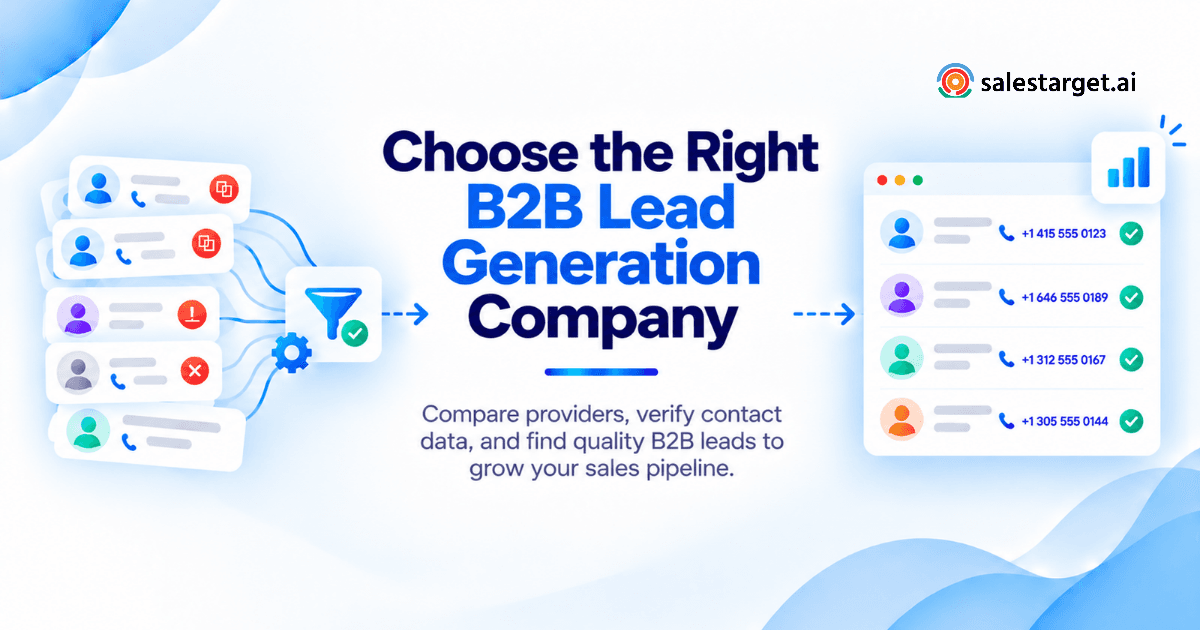
Your SDR spent three days pulling contacts from a lead generation company's database, loaded them into a sequence, and hit send. Bounce rate: 28%. Decision-maker reach rate: below 10%. That's not a bad campaign. That's bad data costing you real pipeline.
Choosing the right lead generation company for B2B contacts comes down to one non-negotiable: verified B2B contact data that matches your actual target market. Not database size. Not a flashy interface. Verified contacts, current job titles, deliverable emails, and working phone numbers for the buyers you need to reach.
This guide gives you a practical framework to evaluate B2B lead generation companies on data accuracy, compliance, features, and fit, so you stop paying for contacts you cannot use.
Why Choosing the Wrong Lead Generation Company Costs More Than Bad Contact Data
Bad contact data is not just a nuisance for your reps. It is a compounding problem that hits your entire revenue engine.
The Difference Between High Lead Volume and Qualified Sales Opportunities
A database with 10 million contacts sounds impressive until your SDR finds that only 8% match your ICP, and half of those have wrong job titles or stale emails. Volume without relevance is noise. Qualified sales opportunities come from contacts who match your buyer profile and can actually be reached. Those are two separate filters, and most B2B lead generation companies only solve for the first one.
How Invalid Emails, Outdated Phone Numbers, and Incorrect Job Titles Affect Outbound Sales
Invalid emails push your sender domain toward spam filters, which affects every campaign you run, not just the current one. Outdated phone numbers burn rep time on calls that never connect. Incorrect job titles mean your personalization fails at the first sentence, and your message goes to the wrong person inside the account. Each bad record costs more than the record itself.
Why Database Size Alone Cannot Determine B2B Lead Quality
Providers with the largest databases often achieve that scale by aggregating contacts without verifying them. A database of 500 million records with 60% accuracy is less useful than a database of 100 million records with 95% accuracy if you are targeting a specific vertical, role, and geography. What matters is relevant coverage, not raw volume.
The Connection Between Verified Contact Data and Sales Pipeline Performance
When your contact data is accurate, reps spend more time selling and less time researching or cleaning lists. Reply rates increase. Meeting booking rates improve. And your pipeline reflects real demand rather than inflated activity metrics. Research consistently shows that sales teams lose 27% of their time to manual data tasks that verified contact databases eliminate.
Lead Generation Companies vs. B2B Data Platforms
Not every provider calling itself a lead generation company does the same thing. Buying from the wrong category for your needs is one of the most common and expensive mistakes sales teams make.
| Provider Type | What They Do | Best For | Key Trade-off |
|---|---|---|---|
| B2B Lead Generation Agencies | Full managed service: research, outreach, appointment setting | Teams without in-house SDRs | High cost, limited control |
| Self-Service Contact Databases | Search and export contact lists | Teams with existing outreach tools | Data freshness varies widely |
| AI-Based Prospecting Platforms | Find, enrich, and engage leads in one workflow | SDR and BDR teams running outbound | Quality depends on data sources |
| Custom Data Research Firms | Manual research and bespoke list building | Niche or hard-to-find segments | Slow and expensive at scale |
| Contact Enrichment Providers | Append missing fields to existing records | Teams cleaning CRM data | Not a full prospecting solution |
B2B Lead Generation Agencies and Managed Prospecting Services
Agencies take over the prospecting and outreach process entirely. They research contacts, write sequences, run campaigns, and deliver qualified meetings. The trade-off: you pay a premium for managed services, have less control over targeting, and are dependent on their data sources, which may not match your ICP standards.
Self-Service B2B Contact Databases and Sales Intelligence Platforms
These give your team direct access to a searchable database of business contacts. You apply filters, export records, and run your own outreach. Quality varies significantly across providers. Some verify contacts in real time; others rely on data scraped months or years ago.
AI-Based Prospecting and Automated Lead Generation Tools
AI prospecting platforms combine contact discovery, enrichment, and outreach automation in a single workflow. Instead of exporting a list and loading it into a separate tool, reps find a lead and push it straight into a sequence. This is where platforms like SalesTarget.ai's Lead Explorer operate: AI-driven search across 840M+ verified profiles, with enrichment and outreach built into the same workspace.
Custom Data Research and B2B Contact Enrichment Providers
For hard-to-reach segments, such as niche industries, international markets, or specialized roles, custom research firms build lists manually. The quality ceiling is high, but the cost per contact is too, and the turnaround is slow. Contact enrichment providers focus on filling gaps in your existing CRM data rather than generating net-new leads.
Choosing Between Outsourced Lead Generation and In-House Prospecting Software
Outsourcing works if you lack headcount or need fast market entry. In-house software wins when you need control, speed, and the ability to iterate your targeting in real time. For most SDR-driven outbound teams, a self-service AI prospecting platform offers the best combination of data quality, targeting precision, and speed.
What Makes a B2B Lead Generation Company Reliable
Reliability is not a claim on a pricing page. It is a set of verifiable practices you can inspect before you commit.
Transparent Contact Data Collection and Verification Methods
Ask any provider: where does your data come from, and how is it verified? Reliable providers answer this specifically. They identify their data sources (public business directories, professional networks, company websites, third-party data partners) and describe their verification process (MX record checks, SMTP pings, phone line verification). Vague answers like "multiple sources" and "proprietary algorithms" are red flags, not differentiators.
Accurate Decision-Maker Profiles and Current Company Information
A contact record is only useful if the person is still in that role at that company. Decision-maker profiles should include current employer, current title, seniority level, department, and direct contact details. Profiles that rely on self-reported data without cross-referencing against real-time employment signals go stale fast, especially at the director and VP level where job change rates are high.
Reliable Business Email Addresses and Direct Dial Phone Numbers
Business email accuracy and phone number reliability are the two most important contact fields for outbound sales. Look for providers who verify both at the point of enrichment, not at the time of initial data collection. A business email that was valid six months ago may be invalid today if the person changed jobs.
Consistent Data Updates and Contact Freshness Standards
Ask how often records are reverified. A database that updates contacts annually is not sufficient for fast-moving roles in SaaS, finance, or tech, where job tenure averages 18 to 24 months. Leading providers reverify business emails on a 30 to 90 day cycle and use employment change signals to flag stale records proactively.
Independent Accuracy Testing and Clear Data Quality Reporting
Any provider making accuracy claims ("95% deliverable emails", "90% connect rate on mobile numbers") should be able to show data that supports those numbers, ideally from third-party audits or publicly available test results. Claims without supporting evidence are not a selling point.
Contact Replacement Policies and Data Quality Commitments
What happens when a contact bounces or a phone number is disconnected? Providers with confidence in their data offer credit-based replacement policies or free reverification for invalid records. If a provider does not offer any form of remediation for bad data, that tells you what they think of their own accuracy.
Define Your B2B Prospecting Requirements Before Comparing Companies
The single biggest reason sales teams pick the wrong provider: they start evaluating vendors before they know exactly what they need. Fix that first.
Build an Ideal Customer Profile Based on Your Target Market
Your ICP defines which companies are worth pursuing. This means naming the industries, sub-verticals, company sizes, revenue ranges, and geographies where your product actually delivers value. Without a documented ICP, you are evaluating contact coverage in the abstract, which tells you nothing about whether a database can fill your specific pipeline.
Identify Decision-Makers, Buying Committees, and Job Seniority Levels
For most B2B sales, you are not targeting a single role. A typical SaaS deal involves 6 to 10 stakeholders. Before choosing a provider, document the exact titles, seniority levels, and departments you need access to. A database that is strong on C-suite contacts but thin on VP and Director-level decision-makers may not match your sales motion.
Set Industry, Revenue, Employee Size, and Geographic Targeting Criteria
Granularity matters. "Mid-market tech companies in North America" is not specific enough to evaluate a database. "Series B to Series D SaaS companies with 50 to 500 employees, based in the US and UK, using Salesforce" is. The more precise your targeting criteria, the more accurately you can test a provider's actual coverage for your market.
Define Required Contact Fields and Minimum Data Accuracy Standards
Do you need verified business email only, or also direct dial and mobile? Do you need tech stack data to qualify accounts? Set minimum accuracy thresholds before you test: for example, 85% email deliverability and 70% phone connect rate as baseline requirements.
Match Lead Volume Requirements with Your Sales Team's Outreach Capacity
A team of three SDRs running 50-touch sequences across 200 prospects per rep per month needs very different data volume than a 20-person SDR team targeting 5,000 accounts per quarter. Overpaying for data volume you cannot work is as wasteful as buying low-quality data at scale.
How to Evaluate the Accuracy of Verified B2B Contact Data
Do not take a provider's accuracy claims at face value. Run your own evaluation against the specific markets you target.
Business Email Validity, Mailbox Status, and Deliverability Checks
A valid-looking email address is not the same as a deliverable one. Valid business emails pass MX record checks, confirm an active mailbox via SMTP ping, and are not flagged as disposable or catch-all addresses. Catch-all domains accept all incoming emails regardless of whether the address exists, which inflates apparent deliverability.
Direct Dial, Mobile Number, and Company Phone Verification
Phone verification should confirm that a number is connected and rings to a live line, not just that the digits are formatted correctly. Direct dials that reach a personal voicemail or mobile line are significantly more valuable for outbound than general company switchboards.
Job Title Accuracy, Employment Status, and Decision-Maker Relevance
Job title data decays fast. An SDR Director who joined a new company three months ago is unreachable at their old address and irrelevant at their old employer. Cross-referencing job titles against active employment signals (LinkedIn updates, company HR data, email deliverability) dramatically improves title accuracy.
Contact Data Completeness, Consistency, and Duplicate Detection
Partial records create partial outreach. A contact with a name and company but no email or phone requires manual research before it is usable. Evaluate what percentage of a provider's records are complete (all required fields populated) versus partial. Also check for duplicate detection, especially if you are enriching existing CRM records.
Data Freshness, Last-Verified Dates, and Record Update Frequency
Ask for the average age of records in your target segment. A record last verified 18 months ago in a high-turnover industry is likely stale. Top providers surface last-verified dates at the contact level, not just at the database level.
Measuring Contact Accuracy Across Industries and Geographic Markets
Accuracy is not uniform across industries or geographies. A provider may have excellent coverage for US-based SaaS companies but weak data for European enterprise accounts or APAC markets. Test accuracy within your specific target segments, not across the provider's database as a whole.
Data Compliance, Verification Methods, and Contact Freshness
Compliance is not a legal formality. It is a prerequisite for sustainable outbound. Non-compliant contact data exposes your business to regulatory penalties and reputational risk.
GDPR, CCPA, and Regional B2B Contact Data Requirements
GDPR applies to any outreach targeting individuals in EU/EEA countries, including B2B contacts. Under GDPR, processing business contact data for direct marketing requires either consent or a legitimate interests basis, which must be documented. CCPA applies to California-based contacts. If you are selling into Europe or the US, your lead data provider must be able to explain how their data collection practices comply with both frameworks.
First-Party, Third-Party, and Public Business Data Sources
First-party data comes from direct relationships (event registrants, form fills). Third-party data is purchased from data aggregators who collect it indirectly. Public business data is sourced from company websites, press releases, and regulatory filings. Each source carries different compliance profiles. The cleanest providers use a mix of all three and can tell you which source applies to each record.
Email Verification, Data Enrichment, and Contact Validation Processes
Verification is the process of confirming that contact information is current and accurate. Enrichment appends additional fields to an existing record. Validation checks that a record meets your specific quality criteria. These are three separate activities. Providers who conflate them often mean that they verify at collection time only, not at the point of delivery.
Handling Outdated Contact Records, Job Changes, and Invalid Information
Job change frequency at the director and VP level means that even a 90-day-old record has a measurable risk of being stale. Providers should have automated detection for employment changes, domain shutdowns, and email bounces, and should flag or remove affected records proactively rather than waiting for your campaigns to surface the problem.
Consent, Lawful Data Use, Opt-Out Requests, and Suppression Lists
Any provider operating in regulated markets should maintain suppression lists of opted-out contacts and honor removal requests within legally required timelines. Ask for the provider's process for handling opt-out requests and how quickly suppression propagates across their database.
Data Retention, Security, and Contact Information Ownership
Clarify who owns the contact data after export. Can you retain it indefinitely, or does your license require you to delete it at contract end? What security standards govern how contact data is stored and transmitted? These details belong in the contract, not the marketing materials.
Key Features to Look for in B2B Lead Generation Providers
Features are only valuable when they serve the specific outbound workflow your team actually runs.
Advanced Company and Contact Search Filters
You need more than keyword search. Look for providers with firmographic filters (industry, employee size, revenue, HQ location), people filters (title, seniority, department, function), and technology filters (tech stack, software used). The ability to combine these filters with AND/OR logic and exclude specific accounts matters as your ICP gets more specific.
Verified Business Emails and Direct Dial Contact Information
Business email deliverability and direct dial accuracy are the two most operationally critical data fields. Providers should verify both before surfacing them, not after export. This is the difference between a list that goes straight into a sequence and one that needs a cleaning pass first.
Firmographic, Technographic, and Buyer Intent Data
Firmographic data tells you what the company looks like. Technographic data tells you what tools they use, which is highly predictive of fit for SaaS products. Buyer intent data tells you what they are actively researching, which identifies the right moment to reach out. Providers who offer all three, like SalesTarget.ai's Lead Explorer with its 4,000+ intent signals across 50+ data sources, give sales teams a meaningful timing advantage.
Contact Enrichment and Automated Database Updates
Enrichment should happen at the point of prospecting, not as a separate workflow. When a rep identifies a target contact, the enriched data (verified email, phone, LinkedIn, company details) should be available in the same click, not after a manual export and re-import cycle.
CRM Integration and Bulk Contact Export Capabilities
Contacts that do not move cleanly into your CRM create data hygiene problems. Look for native integrations with your CRM (Salesforce, HubSpot, Zoho), not just CSV export. Direct push to CRM, duplicate detection on import, and field mapping customization are features that save significant operational time.
Email Outreach, LinkedIn Prospecting, and Follow-Up Automation
The most effective outbound uses email and LinkedIn in a coordinated sequence. Providers who offer both in one platform eliminate the tool-switching and context loss that happens when reps run separate email and LinkedIn campaigns. SalesTarget.ai's Email Outreach and LinkedIn Outreach modules run in one coordinated flow, with context carrying across both channels.
Lead Scoring, Prospect Segmentation, and Sales Activity Tracking
Lead scoring based on fit and intent helps reps prioritize the highest-value prospects rather than working every record with equal urgency. Segmentation by buyer persona, industry, or purchase intent enables personalized outreach at scale.
Reporting Tools for Contact Quality and Pipeline Performance
The metrics that matter: email deliverability rate, reply rate by segment, contact-to-meeting conversion, and pipeline generated per data source. Providers who surface these metrics give sales leaders the visibility to optimize data spend and targeting criteria over time.
How to Test B2B Contact Data Before Choosing a Provider
Every serious vendor evaluation includes a data test. Here is the exact methodology.
Build a Representative Sample of 100 B2B Contacts
Request or export exactly 100 contacts that match your ICP: specific industry, specific employee size range, specific decision-maker titles, and your target geographies. 100 contacts is large enough to be statistically meaningful and small enough to test quickly. If a provider will not give you a sample that matches your ICP, that alone tells you something.
Test Business Email Validity with Independent Verification Tools
Run the 100 emails through an independent email verification tool, not the provider's own. Tools like NeverBounce, ZeroBounce, or SalesTarget.ai's Email Validator classify emails as valid, invalid, catch-all, or risky. Calculate your valid rate. Anything below 80% valid is a problem. Below 70% means the provider's email data does not meet industry standards.
Assess Phone Number Reliability and Decision-Maker Reachability
For direct dial numbers, call a random subset of 25 to 30 records and track: connected (reached a live person or voicemail at the right company), wrong number, disconnected, or general switchboard. A connect rate below 60% for direct dials signals poor phone data quality.
Cross-Check Company Information, Job Titles, and Employment Status
For 20 to 25 records, manually verify the contact's current employer and job title on LinkedIn. Calculate what percentage of records reflect the person's actual current employment. In high-turnover verticals, even a 90-day-old database may show 10 to 15% employment change rates.
Calculate Valid Contact Rate and Ideal Customer Profile Match Rate
Valid contact rate: (valid emails + working phone numbers) / 100. ICP match rate: (contacts matching your documented ICP criteria) / 100. The combination of these two metrics gives you a usable lead rate, the percentage of contacts you can actually work.
Compare Provider Results Using Consistent Data Quality Metrics
Use the same methodology across every provider you test. Running different tests for different providers makes comparison impossible. Document your results in a standardized scorecard so you can rank providers objectively.
Document Invalid Records and Review Replacement Policies
Keep a log of every invalid email, disconnected number, and wrong-titled contact. Bring this to the provider conversation. Ask how their replacement policy works and whether they will replace records that fail your independent test. How a provider responds to documented invalid data tells you more about their confidence in their product than any sales conversation will.
Comparing B2B Lead Generation Companies by Data Coverage and Lead Quality
Data coverage and lead quality are different metrics. A provider can have broad coverage with poor quality, or narrow but highly accurate coverage. You need both to be aligned with your ICP.
Contact Database Size vs. Relevant Market Coverage
The question is not how many total contacts a provider has. The question is how many contacts they have that match your specific ICP. A provider with 200 million records but only 50,000 that match your vertical and role requirements is less useful than one with 50 million records and 200,000 ICP matches.
Industry-Specific Data Availability and Decision-Maker Coverage
Some providers are strong in finance and enterprise but thin on SaaS startups. Others have excellent healthcare coverage but poor data on manufacturing. Before choosing, run sample searches within your specific target industries and count the decision-maker contacts available at your target company size range.
Regional Contact Accuracy Across the US, UK, Europe, and APAC
US contact data is generally the strongest across most providers, with European data a step behind and APAC data quality varying significantly by country. If you are running international outbound, test regional coverage explicitly. Do not assume that a strong US database translates to comparable European or APAC accuracy.
Verified Lead Quality for SMB, Mid-Market, and Enterprise Prospecting
Contact data quality also varies by company size. SMB contacts often have higher job change rates and less consistent firmographic data. Enterprise contacts may have more complete profiles but are harder to reach directly. Match your provider choice to the market segment you actually sell into.
Contact Freshness and Verification Frequency Across Providers
Ask each provider: what percentage of your records were verified in the last 30 days? In the last 90 days? This single question reveals more about data quality than any accuracy claim on a website. Providers who cannot answer it specifically either do not track it or do not want you to know.
Lead Generation Agencies vs. Database Providers: Comparison Matrix
| Dimension | Lead Gen Agency | Database / Platform |
|---|---|---|
| Data Control | Low (agency manages) | High (you control) |
| Targeting Flexibility | Moderate | High |
| Speed to First Contact | Slow (onboarding) | Fast (same day) |
| Cost Structure | Retainer / per meeting | Subscription / per credit |
| Outreach Ownership | Agency owns | Your team owns |
| Scalability | Limited by headcount | Scales with platform |
| ICP Iteration Speed | Slow (brief agency) | Fast (filter in real time) |
Lead Qualification Beyond Verified Contact Information
A verified email address does not make a contact a qualified sales lead. These are two different filters, and conflating them is one of the most common mistakes in B2B outbound.
Contact Verification vs. Ideal Customer Profile Qualification
Verification confirms that a contact is reachable. ICP qualification confirms that they are worth reaching. A VP of Finance at a company with 15 employees outside your target industry is a verified contact but a zero-fit lead. Your prospecting process needs both filters applied before a contact enters a sequence.
Using Firmographic and Technographic Data to Identify Suitable Accounts
The best account targeting combines firmographics (what the company looks like: industry, size, revenue, HQ) with technographics (what tools they use: CRM, MAP, tech stack). Technographic targeting is particularly powerful for SaaS companies selling to specific tool ecosystems. If your product integrates with Salesforce, targeting companies actively using Salesforce is a qualifying filter that dramatically improves relevance.
Buyer Intent Signals, Hiring Activity, and Company Growth Indicators
Buyer intent data identifies accounts that are actively researching topics related to your category. Hiring activity in specific departments signals company growth and budget. Funding rounds, leadership changes, and product launches signal organizational change, which is a known trigger for vendor evaluation. These signals are available in platforms like SalesTarget.ai through real-time signal discovery with a 30 to 90 day lookback.
Identifying Buying Committees and Multiple Stakeholders per Account
In enterprise and mid-market B2B sales, no single person buys alone. The economic buyer, technical evaluator, and end-user champion are often different people. Prospecting platforms that let you build contact lists at the account level, pulling multiple stakeholders per target company, are significantly more aligned with how modern B2B deals are actually structured.
Aligning Marketing-Qualified and Sales-Qualified Lead Criteria
If marketing and sales are using different criteria to define a qualified lead, your pipeline metrics are misleading and your handoff process is broken. Document the shared definition before you select a provider, so you can evaluate whether the platform supports your qualification logic.
Prioritizing High-Fit Accounts for Personalized Outreach
Not all ICP-fit accounts deserve the same level of outreach effort. High-fit accounts showing intent signals and hiring activity warrant personalized, multi-touch sequences. Lower-fit accounts can receive lighter-touch outreach. Platforms that surface intent scores and account signals alongside contact data help reps allocate effort correctly without manual research.
Lead Generation Company Pricing and the Real Cost of Verified B2B Leads
The sticker price of a lead generation service is almost never the actual cost. The real number is cost per usable, ICP-matched contact that converts to a meeting.
Subscription-Based, Credit-Based, and Pay-Per-Lead Pricing Models
Subscription pricing gives you access to the database for a flat monthly or annual fee, often with limits on contact exports. Credit-based pricing charges per contact enriched or exported. Pay-per-lead pricing bills based on number of leads delivered, typically used by agencies. Each model creates different incentives: credit models penalize exploration; subscription models reward heavy use.
Lead Generation Agency Retainers and Appointment-Based Fees
Agencies typically charge a monthly retainer plus a per-meeting fee. Retainers range from $3,000 to $15,000 per month depending on scope and market. Per-meeting fees add $300 to $800 per qualified appointment. For teams with limited outbound headcount, this can be cost-effective, but it creates dependency on an external party for pipeline.
Hidden Costs of Data Enrichment, Verification, and Contact Exports
Watch for providers who charge separately for enrichment (unlocking contact details), verification (confirming email validity), and export (downloading contacts). A provider whose base price covers only firmographic data but charges extra to unlock emails and phones is more expensive than their headline number suggests.
Cost per Contact vs. Cost per Valid, ICP-Matched Lead
The formula that matters:
Cost per Usable Lead = (Total Spend) / (Total Contacts × Valid Rate × ICP Match Rate)
If you spend $500 for 500 contacts, but only 70% have valid emails (350 contacts) and only 60% match your ICP (210 contacts), your real cost per usable lead is $500 / 210 = $2.38, not $1.00.
Measuring Cost per Qualified Meeting and Sales Opportunity
Take the cost per usable lead and divide by your outreach-to-meeting conversion rate. If you book one meeting for every 40 usable contacts, and your cost per usable lead is $2.38, your cost per meeting is $95.20. Compare this across providers to find actual efficiency, not just headline price.
Calculating B2B Lead Generation ROI from Pipeline Outcomes
ROI calculation: (Pipeline Value Generated from Provider Data) / (Total Spend on Provider + Outreach Costs). Include SDR time, tool costs, and sequence creation in the denominator. Track this over a 90-day period, long enough for deals to enter but short enough to catch data decay.
A Practical Vendor Scorecard for Comparing Lead Generation Companies
Use this weighted scorecard to evaluate B2B lead generation providers objectively. Score each dimension from 0 to 100 and multiply by the weight to get a weighted score.
Contact Accuracy and Verification Quality
Weight: 25 points. Test email validity and phone accuracy with your own sample. Score providers on measured valid rate, not claimed accuracy. A provider scoring 90%+ email validity earns full marks. Below 75% earns zero.
Database Coverage and Ideal Customer Profile Match
Weight: 20 points. Run searches within your specific ICP and count available decision-maker contacts. Providers with 1,000+ ICP-matched contacts per target segment earn full marks. Less than 200 means poor coverage for your market.
Data Freshness and Contact Update Processes
Weight: 15 points. Ask for the percentage of records verified in the last 90 days. Providers who reverify actively and flag employment changes earn high scores. Providers with annual or undisclosed update cycles score low.
Prospecting Features, CRM Compatibility, and Automation
Weight: 15 points. Evaluate search filter depth, outreach automation capability, CRM integration quality, and LinkedIn prospecting support. Platforms that handle enrichment, outreach, and CRM in one workflow score highest.
Compliance Standards and Data Source Transparency
Weight: 10 points. Can the provider explain their data sources and compliance approach clearly? Can they demonstrate GDPR-compliant processing? Vague answers reduce the score.
Pricing, Support, and Invalid Contact Replacement Terms
Weight: 10 points. Evaluate total cost of ownership (including enrichment, export, and integration fees), support responsiveness, and whether they offer replacement for invalid contacts documented in testing.
Creating a Weighted 100-Point Vendor Evaluation Scorecard
| Dimension | Weight | Provider A Score | Provider B Score | Provider C Score |
|---|---|---|---|---|
| Contact Accuracy | 25 | |||
| ICP Coverage | 20 | |||
| Data Freshness | 15 | |||
| Platform Features | 15 | |||
| Compliance | 10 | |||
| Pricing & Support | 10 | |||
| Pilot Results | 5 | |||
| Total | 100 |
Fill this scorecard with data from your 100-contact pilot test and your vendor evaluations. The provider with the highest weighted score against your actual requirements wins, not the one with the most impressive website.
Selecting B2B Lead Generation Services for Different Sales Teams
The right provider depends heavily on team structure, sales motion, and stage of growth.
Lead Generation Companies for Startups and Founder-Led Sales
Founders running outbound themselves need fast setup, low friction, and tight ICP targeting rather than enterprise data contracts. Self-service AI prospecting platforms with monthly billing, plain-English search, and built-in outreach automation match this need. Spending three weeks onboarding an enterprise data platform when you have 50 target accounts is wasted time.
Verified B2B Contact Providers for SDR and BDR Teams
SDR teams need high daily contact volume, fast enrichment, and direct CRM integration. They need providers where a rep can search, enrich, and push a contact to a sequence in under two minutes. They also need accurate direct dials, because cold calling is still part of the SDR workflow.
B2B Prospecting Platforms for SaaS and Technology Companies
SaaS sellers often target by tech stack, making technographic data a core requirement. They also need intent data to identify accounts in active buying cycles. Platforms combining verified contact data, technographics, and buyer intent signals in one interface give SaaS SDRs a significant prospecting advantage.
Lead Generation Solutions for Marketing and Demand Generation Teams
Marketing teams building ABM campaigns need account lists and contact data that align with their campaign targeting. They care less about direct dial accuracy and more about email deliverability, firmographic precision, and the ability to push contacts into their MAP for nurture sequences.
Multi-Client Prospecting Platforms for Sales and Marketing Agencies
Agencies running outbound for multiple clients need platforms with workspace separation, client-level reporting, and the ability to manage multiple email domains and LinkedIn accounts without cross-contamination.
Enterprise Data Providers for Account-Based Sales Programs
Enterprise ABM programs need deep account intelligence, multi-stakeholder coverage per account, and integration with complex CRM and sales engagement tool stacks. Data quality and integration reliability matter more than self-service ease at this scale.
Integrating Verified B2B Lead Data into Your Sales Workflow
Buying good data is step one. Turning it into pipeline requires a workflow that connects prospecting, outreach, and CRM without manual handoffs that introduce errors and delays.
Importing Verified Contacts into CRM and Prospecting Systems
The best integrations push contacts directly from the prospecting platform into your CRM with field mapping, deduplication, and sequence enrollment in one step. The worst require CSV export, manual field mapping, re-import, and manual sequence enrollment, with errors at each handoff. Map this workflow before you buy.
Cleaning Duplicate Records and Updating Existing Customer Data
New contact imports often create duplicates against existing CRM records. Set up deduplication rules based on email domain and contact name before any bulk import. Verify that enrichment from your new provider does not overwrite existing CRM data with outdated fields.
Segmenting Contacts by Buyer Persona, Industry, and Purchase Intent
Before pushing contacts into outreach, segment them. Contacts going into the same sequence should share enough characteristics (industry, title, company size, intent signal) that the messaging is genuinely relevant to all of them. Generic sequences to mixed audiences perform significantly worse than segmented, persona-matched sequences.
Connecting Lead Lists with Personalized Email Outreach
Personalization at scale requires both accurate contact data and a platform that uses it. Using SalesTarget.ai's Email Outreach, verified contact fields (title, company, industry, tech stack) feed directly into AI-generated sequence copy, so personalization is built into the outreach rather than added manually per contact.
Coordinating Email and LinkedIn Prospecting Campaigns
Multichannel outreach outperforms single-channel, but only when the two channels are coordinated. A LinkedIn connection request that arrives before an email increases email open rates. An email that references a LinkedIn interaction increases reply rates. Running both from the same platform ensures timing and context are aligned.
Tracking Replies, Qualified Meetings, and Sales Pipeline Results
Track results at the contact level, not just the campaign level. Which contacts replied? Which booked meetings? Which converted to deals? This contact-level data feeds back into your ICP criteria and helps you refine targeting for the next prospecting cycle.
Monitoring Data Decay and Refreshing Contact Records
B2B contact data decays at roughly 30% annually. Set a quarterly review of your most active prospect lists: run email validation on contacts that have not engaged, check for employment changes on key accounts, and remove or update stale records before they hurt your sender reputation.
Why Choose SalesTarget.ai
SalesTarget.ai is built for outbound teams who are tired of stitching together five tools to do what should happen in one workflow: find a qualified lead, verify their contact details, reach out across email and LinkedIn, and track the deal in a CRM.
Find Relevant B2B Decision-Makers with Lead Explorer
Lead Explorer gives you AI-powered search across 840M+ verified professional profiles and 146M+ business entities. Search in plain English or use 50+ firmographic and people filters to pinpoint the exact decision-makers you need. Four thousand intent signals across 50+ data sources surface accounts actively in a buying motion, not just ones that match your target profile.
Build Targeted Prospect Lists Using Company and Contact Filters
Stack filters by industry, employee size, revenue, job title, seniority, department, tech stack, location, and buying intent to build precisely targeted prospect lists. SalesTarget.ai's ICP Builder makes this a structured process rather than an ad-hoc filter session, so your targeting criteria are documented and repeatable.
Validate Business Email Addresses Before Launching Campaigns
SalesTarget.ai's Email Validator runs MX and SMTP checks, disposable email detection, and risk scoring before any contact enters a sequence. The result: 99% verified contact data and 90% of emails validated before sending, which protects your sender domain and improves deliverability across every campaign you run.
Manage Email and LinkedIn Outreach from a Connected Sales Platform
Email and LinkedIn outreach run as a coordinated multichannel sequence from a single platform. AI-generated sequences with automatic warm-up, inbox rotation, and SPF/DKIM/DMARC checks protect sender reputation. LinkedIn automation handles connection requests, DMs, and follow-ups with human-like timing and rate limits built in.
Track Leads, Follow-Ups, and Deals with Built-In CRM
SalesTarget.ai's CRM is built for outbound, not enterprise overhead. Campaign leads land automatically, every email and call is logged to the lead timeline, and follow-up tasks are created when a lead replies. Teams using it report 3.2X faster deal cycles, 91% follow-up completion, and roughly 6 hours saved per rep per week.
Use AI Copilot for Prospecting, Campaign Planning, and Sales Activities
AI Copilot works as a conversational sales assistant inside the platform. Ask it to find leads, generate personalized sequences, query your pipeline, or flag at-risk deals. It handles the operational work so reps spend more time on relationships and less time on admin.
Reduce Disconnected Sales Workflows with an All-in-One B2B Sales Platform
The compounding cost of managing separate tools for data, enrichment, email outreach, LinkedIn, and CRM is real: data handoff errors, duplicate records, inconsistent tracking, and subscription overhead. SalesTarget.ai consolidates the entire outbound stack on one platform with one dataset, so your pipeline data is always consistent and your reps are always working from the same source of truth. Start a free trial today.
Common Mistakes When Choosing B2B Lead Generation Companies
Most of these mistakes are avoidable. Most teams make them anyway.
Selecting Providers Based Only on Database Size or Contact Volume
Database size is the single most-marketed metric in the B2B data industry and the least useful for predicting performance in your specific market. A database of 800 million contacts with 60% accuracy in your target segment delivers worse results than a database of 100 million with 90% accuracy and deep coverage for your ICP.
Trusting Contact Accuracy Claims Without Independent Testing
Every provider claims high accuracy. The number they quote is often a blended average across their full database, not measured against your specific market. Run the 100-contact test described in this guide before committing to any provider.
Ignoring Data Freshness and Decision-Maker Employment Changes
A contact who changed jobs three months ago is not reachable at their old email and irrelevant to their old employer. Data freshness is not a nice-to-have; it directly determines how many of your contacts are actually workable on any given day.
Confusing Verified Contact Records with Qualified Sales Leads
A contact with a valid email, current job title, and direct dial is a verified record. It is not a qualified sales lead until it also matches your ICP, fits your target segment, and has some signal of fit or intent. Do not let providers sell you on contact verification as if it were lead qualification.
Overlooking CRM Integration, Data Ownership, and Export Restrictions
Some providers restrict how many contacts you can export per month, require deletion of contacts at contract end, or charge extra for direct CRM integration. These terms significantly affect the total cost and operational flexibility of your data investment. Read the contract.
Buying Contact Lists Without Reviewing Compliance Requirements
Purchasing a list and emailing it without reviewing GDPR or CCPA requirements is not a technicality. It exposes your business to regulatory penalties and reputational risk with both prospects and email infrastructure providers.
Comparing Subscription Prices Instead of Cost per Usable Lead
A cheaper subscription that delivers fewer usable contacts at lower accuracy is not a better deal. Always compare on cost per valid, ICP-matched contact, not on subscription price.
Warning Signs of Low-Quality Lead Generation Providers
Recognize these patterns before you sign a contract.
Missing Data Sources and Unclear Verification Processes
If a provider cannot explain where their data comes from or how they verify it, assume the worst. Legitimate providers can name their data sources and describe their verification methodology in plain terms. Vague answers about "proprietary technology" and "multiple sources" are evasions, not differentiators.
Claims of Perfect Contact Accuracy Without Supporting Evidence
No database has 100% accuracy. Any provider claiming this is not being honest about how contact data works. Ask for third-party validation, audit reports, or independent accuracy studies. If they cannot produce any supporting evidence, the claim is marketing, not a measurement.
Limited Sample Data or Restrictions on Independent Testing
Providers who will not let you export a representative sample for independent testing are aware that independent testing would reveal problems. Any serious provider will give you a sample that matches your ICP for testing before you commit. Restrictions on this are a hard stop.
High Invalid Contact Rates and Unclear Replacement Policies
If your sample test returns 25%+ invalid emails, the database has a quality problem. If the provider does not have a clear, documented replacement policy for invalid contacts, they have no accountability for accuracy. Walk away from both.
Hidden Export Charges and Restrictive Subscription Contracts
Watch for platforms where the headline price does not include contact export, where you are charged per enrichment, or where cancellation requires data deletion. Read the pricing page and the contract carefully. The total cost is often meaningfully higher than the advertised subscription.
Poor Geographic Coverage and Recycled Contact Records
Some providers appear to have broad geographic coverage on paper but actually recycle records purchased from other data vendors without reverification. Test regional coverage explicitly. Contacts in underserved markets like Southeast Asia, Eastern Europe, or Latin America often reveal data quality issues that US-focused databases hide.
Checklist for Choosing the Right B2B Lead Generation Company
Work through this checklist before making a final decision.
Confirm Target Industry, Company Size, and Decision-Maker Coverage
- Run sample searches for your specific ICP within the provider's platform
- Count available decision-maker contacts within your target industry and company size range
- Confirm coverage in all target geographies
Review Contact Verification Methods and Freshness Standards
- Ask for the specific verification process (MX check, SMTP ping, phone verification)
- Ask what percentage of records were verified in the last 90 days
- Ask how employment changes are detected and how quickly stale records are flagged
Request Sample Data and Complete Independent Accuracy Tests
- Request 100 ICP-matched contacts for independent testing
- Run business emails through an independent verification tool
- Call a subset of direct dial numbers and track connect rate
- Cross-check 20+ contacts against current employment on LinkedIn
Compare Contact Quality, Pricing, and Data Replacement Policies
- Calculate valid contact rate and ICP match rate from your sample
- Calculate cost per usable lead across providers
- Review replacement or credit policy for invalid contacts
Check Compliance Requirements and CRM Compatibility
- Confirm GDPR/CCPA compliance approach and data source documentation
- Test CRM integration with your existing stack
- Review data ownership and export terms in the contract
Evaluate Vendor Scores Against Your Sales Team's Requirements
- Complete the weighted vendor scorecard for each finalist
- Rank finalists by weighted score, not by price or database size claims
Run a Limited Prospecting Campaign Before Scaling
- Use the sample data to run a 2-week outreach pilot
- Measure email open rate, reply rate, and meeting book rate from the pilot
- Compare pilot results across providers before committing to a full subscription
Final Selection: Choose Lead Generation Companies Based on Verified Data and Sales Results
The SDR who launched that campaign with a 28% bounce rate did not make a bad decision. They made a decision without enough information. This guide gives you the information.
The right B2B lead generation company is the one that delivers verified contacts matching your exact ICP, in the geographies you target, at the job levels you need, with the data freshness your outbound motion requires. Not the one with the largest database. Not the cheapest subscription. The one that moves your pipeline.
If you want to stop stitching together separate tools for data, enrichment, outreach, and CRM, and start running your entire outbound workflow from one platform with 99% verified contact data, SalesTarget.ai is built for exactly that.
Your target decision-makers are already in the database. The question is whether you find them before your competitors do.