Your reps spend three hours building a list, send fifty emails, and hear nothing back. Half the contacts bounced. The ones who did open the email weren't close to buying anything. This is what happens when outreach runs on guesswork instead of signal.
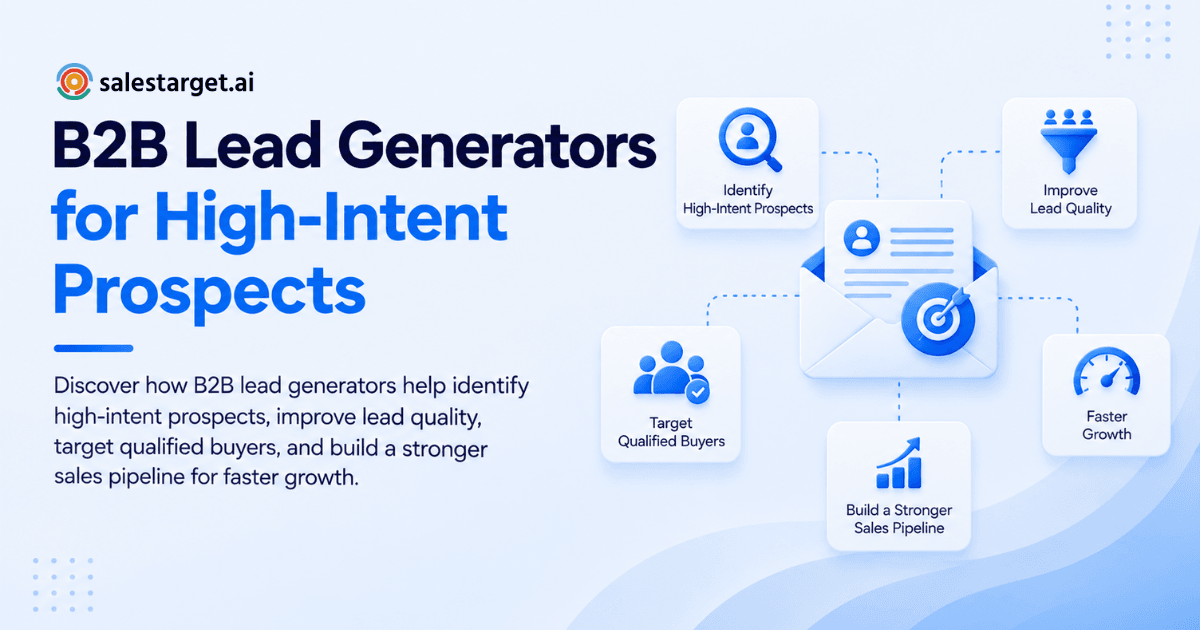
B2B lead generators fix this by pulling from firmographic data, buyer intent signals, and verified contact records to point sales teams at accounts that are actually in the market right now, not accounts that merely fit a rough profile. They combine company and contact data with behavior signals such as content research, hiring changes, and funding events, then rank prospects by how close they are to buying. Reps stop cold-calling every name on a list and start working the fraction of accounts showing real buying activity. That shift alone changes reply rates, meeting rates, and how a pipeline fills.
How B2B Lead Generators Help Sales Teams Find the Right Prospects
A B2B lead generator works by matching a defined buyer profile against a live database of companies and contacts, then layering signals on top that show which of those accounts are actively researching a purchase. Instead of a static list pulled once a quarter, the tool refreshes as new signals appear: a company adopts a competing tool, a VP of Sales gets hired, a business raises funding.
Sales teams get two things from this process that a manual list never delivers. First, coverage: databases with hundreds of millions of contacts surface accounts a rep would never find through networking or referrals alone. Second, timing: intent data tells a rep which of those accounts to call this week rather than next quarter. Both matter, and neither works well without the other.
Why High-Intent Prospects Matter for B2B Sales
Higher-Quality Leads for Sales Teams
A high-intent prospect has already shown a real reason to buy: researching a category, comparing vendors, or dealing with a trigger event like a leadership change. That single distinction separates a lead worth a rep's time from a name on a spreadsheet. Gartner research finds that 73% of B2B buyers actively avoid vendors who send outreach that has nothing to do with their situation, which makes fit and timing the price of entry for a reply, not a bonus.
Better Sales Prioritization and Productivity
When every lead looks the same, reps default to working the top of the list or the easiest names to find, not the accounts most likely to close. Intent scoring gives a rep a reason to call company A before company B. That single change removes the guesswork from a rep's daily queue and puts the highest-probability accounts first.
Shorter Path From Prospect to Opportunity
A prospect who is already researching a solution needs less education than one who has never thought about the problem. Sales cycles compress when reps skip the awareness stage and open with something specific to the buyer's situation: a recent hire, a tech stack change, a funding round. Gartner's own research puts direct vendor contact at only 17% of a typical B2B purchase process, so a rep who shows up during that narrow window, with a relevant reason to be there, has a real edge over one who calls cold.
Key Ways B2B Lead Generators Find High-Intent Prospects
Using Ideal Customer Profile and Firmographic Data
Every search starts with a filter: industry, company size, revenue band, department, seniority, location, and tech stack. This narrows a database of tens of millions of companies down to the few thousand that match a real buyer profile, before a single intent signal gets applied.
Using Buyer Intent Data and Buying Signals
Intent data tracks what accounts are researching across the web: which topics they're reading about, which competitor pages they visit, which keywords keep showing up in their search activity. Business signals add another layer: funding rounds, hiring spikes, leadership changes, new office openings, industry awards. Together they tell a rep which accounts are moving, not just which accounts fit.
Enriching Prospect and Company Information
A name and a company aren't enough to start a conversation. Enrichment fills in the missing pieces: verified email, direct phone, LinkedIn profile, company size, revenue, tech stack, and recent news. A rep working an enriched record can open with something specific instead of a generic pitch.
Qualifying Leads Based on Fit and Intent
Fit tells you if an account matches the buyer profile. Intent tells you if that account is in the market right now. A lead generator that scores both lets a team set a threshold: only accounts above a certain fit-and-intent score move into active outreach, which keeps low-probability names out of a rep's queue entirely.
Verifying Contact Data Before Outreach
None of the above matters if the email bounces. B2B contact data decays fast, and a list built six months ago is already carrying dead records. Verification at the point of contact, not months after a database was first built, keeps bounce rates down and sender reputation intact.
How to Build a High-Intent B2B Lead Generation Process
Define Your Target Accounts and Buyer Profiles
Start with the accounts that already convert well: their size, industry, tech stack, and the roles that typically buy. This becomes the filter every future search runs against, and it keeps a team from chasing companies that were never a fit to begin with.
Build Targeted Prospect Lists
Search a live B2B database against that profile instead of buying a static list from a broker. Fresh, filterable data beats a purchased CSV that's already stale by the time it lands in a rep's inbox. Teams that lean on active prospecting tools for lead generation tend to keep their pipeline full without relying on inbound alone.
Apply Intent and Lead Qualification Signals
Layer buyer intent topics and business events on top of the list, then rank accounts by how many signals they show. An account with three active signals deserves a call before one showing zero.
Enrich and Verify B2B Sales Leads
Pull verified contact details and company context for the accounts that clear the qualification bar. Skip enrichment on the rest, since there's no reason to spend credits or time on accounts that don't fit or aren't moving.
Prioritize Leads for Sales Outreach
Rank the qualified, enriched list by intent score and fit score combined, then route the top accounts to reps first. A round-robin distribution that ignores score wastes the advantage the earlier steps built.
Track Lead Engagement and Conversion
Log every open, reply, and meeting against the original intent score so a team can see which signals actually predict a closed deal. Over a few quarters, this turns a hunch about "good signals" into a data-backed model a team can repeat.
Features to Look for in B2B Lead Generation Tools
Accurate B2B Contact and Company Data
A large database means nothing if the records are stale. Look for a provider that refreshes contact and firmographic data on a rolling basis rather than a one-time import.
Lead Enrichment and Buyer Intent Signals
Enrichment and intent should live in the same workflow as prospecting, not in a separate tool that requires exporting and re-importing a CSV between steps. Every export is a chance for data to go stale or for a rep to skip the step entirely.
Lead Qualification and Filtering
The tool should let a team set fit and intent thresholds directly in the platform, so unqualified accounts never make it into a rep's queue.
Email Verification and Data Quality
Verification should happen when a contact is found, not on a separate schedule weeks later. A record that was accurate at export time can already be dead by the time a rep sends the first email.
Email and LinkedIn Outreach Automation
Once a lead clears qualification, it should move into a sequence without a manual handoff. Multichannel sequencing across email and LinkedIn, coordinated so both channels carry the same context, tends to outperform either channel run alone.
CRM and Sales Pipeline Management
Replies, meetings, and deal stages need a home that isn't a separate tool reps have to update by hand. A built-in CRM keeps the full history, from first search to closed deal, on one lead record.
Why Choose SalesTarget.ai
Most teams end up stitching together a data provider, a cold email tool, a LinkedIn automation tool, a verification service, and a CRM, then hoping the handoffs between them don't drop data along the way. SalesTarget.ai keeps the whole workflow, from finding a high-intent account to closing the deal, on one platform and one bill.
Find and Enrich Prospects With Lead Explorer
Lead Explorer searches 840M+ verified professional profiles and 146M+ business entities using plain-English queries or stacked filters across industry, role, seniority, and tech stack. Enrichment happens the moment a lead is found, not on a separate export, and real-time buying signals from Bombora Intent Topics and business events (funding, hiring spikes, leadership changes) run on a 30 to 90 day lookback so a rep sees who's active right now.
Connect With Prospects Through Email and LinkedIn Outreach
Email Outreach builds multi-step sequences from a plain-English audience description and runs SPF, DKIM, and DMARC checks automatically to protect sender reputation. LinkedIn Outreach runs connection requests, DMs, and follow-ups in the same coordinated flow, with rate limits and warm-up logic built in so accounts stay protected. SalesTarget.ai customers see 35% faster campaign creation using this workflow.
Verify Contacts With Email Validator
Email Validator checks MX and SMTP records and flags disposable addresses before a single email goes out, and 90% of emails sent through SalesTarget.ai are validated before sending. Bulk list cleaning is available for existing databases that need a refresh.
Manage Leads in the Built-In CRM
The CRM pulls campaign leads in automatically, logs every email and call to the lead timeline, and creates follow-up tasks the moment a lead replies. Teams running deals through it report 3.2X faster deal cycles and 91% follow-up completion.
Use AI Copilot for Sales Prospecting
AI Copilot lets a rep search across the full database, draft a personalized sequence, and check campaign performance in one chat window. Reps save close to 6 hours a week on tasks that used to mean switching between four separate tools.
Common B2B Lead Generation Mistakes That Lower Lead Quality
Targeting Too Broad an Audience
A list built with loose filters (any company, any size, any role) produces a high volume of leads that mostly go nowhere. Tighter firmographic filters produce fewer leads and a much higher reply rate.
Ignoring Buyer Intent Signals
Skipping intent data means treating every account in a target profile the same, whether they're actively evaluating a purchase or haven't thought about the category in a year. That's the difference between a call that lands and one that gets ignored.
Using Outdated or Unverified Contact Data
A list pulled six months ago and never re-verified is already leaking. Bounces damage sender reputation and can get a domain flagged, which hurts every future campaign, not just the current one.
Sending Outreach Without Lead Qualification
Pushing every enriched contact straight into a sequence, with no fit or intent filter applied, buries reps in low-probability accounts and drowns out the leads that were actually worth working.
Failing to Measure Lead-to-Opportunity Conversion
Teams that track opens and replies but never connect a lead back to a closed deal end up optimizing for the wrong metric. A high reply rate on leads that never convert isn't a signal of a healthy pipeline.
How to Measure the Performance of B2B Lead Generators
Lead Quality and Qualification Rate
Track what percentage of sourced leads actually clear your fit and intent thresholds. A tool sourcing thousands of leads that mostly fail qualification isn't saving a team any real time.
Meeting and Reply Rates
Reply rate shows whether outreach is landing. Meeting rate shows whether a reply is turning into a real conversation. A B2B lead generation tool worth keeping should move both numbers over a full quarter, not just a single campaign.
Lead-to-Opportunity Conversion
This is the number that ties lead generation back to revenue: what share of qualified leads turn into a real sales opportunity. A flat conversion number paired with rising lead volume means the extra leads aren't adding value.
Pipeline and Revenue Generated
The final check is dollars: how much pipeline and closed revenue can be traced back to leads sourced through the tool. Everything upstream (fit, intent, qualification, enrichment) exists to move this one number.
Conclusion: Turning High-Intent Prospects Into Sales Opportunities
Bad lead data and guesswork targeting cost reps hours every week and fill a pipeline with names that were never going to buy. B2B lead generators solve that by combining firmographic filtering, live intent signals, enrichment, and verification into a single workflow that points a team at accounts that are actually ready. SalesTarget.ai runs that entire process on one platform: find high-intent accounts in Lead Explorer, reach them through coordinated email and LinkedIn sequences, verify every contact before it's sent, and manage the whole deal cycle in a built-in CRM. Start free with SalesTarget.ai and put your next batch of prospects in front of the reps who can close them.