Here is a stat that should make every outbound team pause: the average cold email reply rate in 2026 sits at roughly 3–5%, according to aggregated outbound platform data. That means for every hundred emails your SDRs fire off, ninety-five or more disappear into the void. Yet top-performing teams routinely break 10% and above. The gap is not talent. It is tooling.
Modern cold email software has changed the economics of outbound. What used to require a full-time ops person — rotating inboxes, warming domains, personalizing first lines, staggering sequences — now runs in the background while you focus on closing. This guide breaks down exactly how that works, what features matter, and where most teams trip up. Whether you run a lead-gen agency juggling thirty client campaigns, a Series A startup where the founder is still the top seller, or a scaled revenue team pushing for pipeline coverage, this is the playbook.
Why Cold Email Still Works ?
Every year, someone publishes a think piece declaring outbound dead. And every year, the data says otherwise. Email remains 40 times more effective at acquiring new customers than social media, according to McKinsey. Litmus reports that email marketing delivers an average return of $36 for every $1 spent — a ratio no other digital channel touches consistently.
The real shift is not whether cold email works. It is how it works. Volume-first spray-and-pray died somewhere around 2022, when Google and Microsoft began aggressively filtering bulk sends. What replaced it is a precision game: smaller lists, richer personalization, bulletproof deliverability infrastructure, and intelligent follow-up sequences. If you are building or refreshing your outreach strategy, this cold email outreach 101 guide covers the foundational framework.
What Is Cold Email Software?
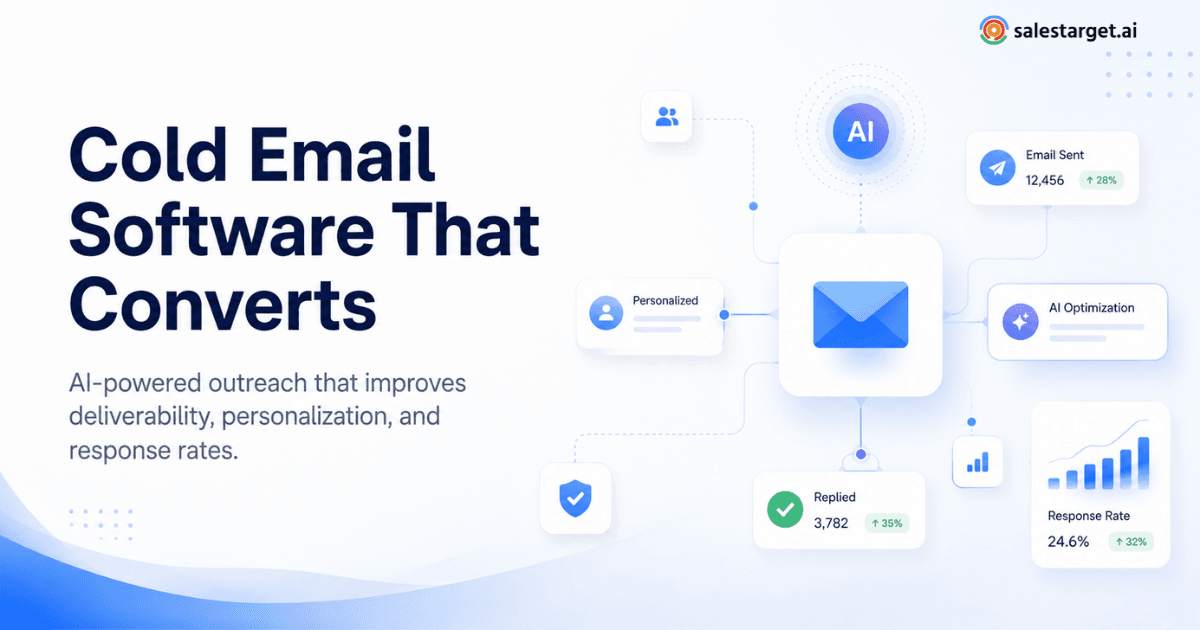
Cold email software is a category of sales technology designed to automate and optimize outbound email campaigns to prospects who have no prior relationship with the sender. Unlike traditional email marketing platforms (Mailchimp, Klaviyo) built for newsletters and subscriber lists, cold email outreach software is purpose-built for one-to-one sales conversations at scale.
The core functions typically include:
- Automated multi-step sequences with conditional logic
- Email warm-up to build and protect sender reputation
- Inbox rotation across multiple sending accounts
- AI-generated personalization at the first-line level
- Deliverability monitoring with real-time analytics
- CRM integrations to keep pipeline data clean
Think of it as the operating system for outbound. It sits between your lead data and your prospects' inboxes, handling the complex infrastructure that makes or breaks reply rates.
Why Businesses Need Cold Email Software ?
Sending cold emails through Gmail or Outlook manually is fine when you are reaching ten people a week. The moment you cross fifty, the cracks show: inconsistent follow-ups, domain reputation damage, and zero visibility into what is working. According to HubSpot, the average sales rep spends 21% of their day writing emails. That is nearly a quarter of their working hours on an activity that cold email automation software can handle in minutes.
Beyond time savings, the business case comes down to three pillars:
- Deliverability at scale. Without warm-up, rotation, and throttling, your domain gets flagged. Software handles the technical plumbing.
- Personalization without the bottleneck. AI cold email software can generate unique opening lines for hundreds of prospects in seconds, referencing their company, role, or recent activity.
- Measurable pipeline impact. Every open, click, and reply feeds into analytics that tie directly back to meetings booked and revenue generated.
Key Features to Look For
Not all email outreach software is created equal. When evaluating platforms, prioritize these capabilities:
| Feature | Why It Matters | Business Impact |
|---|---|---|
| Email Warm-Up | Builds sender reputation gradually before launching campaigns | Reduces spam folder placement by up to 80% |
| Inbox Rotation | Distributes sends across multiple accounts automatically | Prevents single-domain burnout and deliverability drops |
| AI Personalization | Generates unique first lines, CTAs, and subject lines per prospect | Personalized emails see 26% higher open rates (Adobe) |
| Multi-Step Sequences | Automates follow-ups with conditional triggers | 55% of replies come from follow-ups, not the initial send (Woodpecker) |
| Bounce Detection | Identifies invalid addresses before they damage reputation | Keeps bounce rates under 2%, protecting future campaigns |
| Campaign Analytics | Tracks opens, replies, clicks, and meetings booked | Enables A/B testing and data-driven optimization |
| CRM Sync | Pushes engagement data into your pipeline automatically | Eliminates manual data entry and keeps records current |
Platforms like SalesTarget.ai bundle these features into a single workspace, so teams do not have to duct-tape five different tools together. The result is a streamlined stack where warm-up, personalization, rotation, and analytics all talk to each other.
AI in Modern Cold Email Software
A 2026 Gartner survey of 227 chief sales officers found that organizations providing sellers with AI-enabled next best actions are 2.6 times more likely to achieve commercial growth. That finding extends directly to outbound email. AI cold email software is not just a convenience layer — it is a competitive differentiator.
Here is what AI actually does inside modern cold email platforms:
- Dynamic first-line generation. The system scans a prospect's LinkedIn activity, company news, or job postings, then writes an opening line that references something specific. No more "I noticed your company is growing."
- Subject line optimization. AI tests and scores subject lines against historical performance data. If you want to see what high-performing subject lines actually look like, this AI-tested collection of 50 high-converting subject lines is worth bookmarking.
- Send-time intelligence. Rather than blasting at 9 AM in your timezone, AI schedules each email for the window most likely to land when the recipient is actively checking their inbox.
- Reply sentiment analysis. Not all replies are created equal. AI categorizes responses as interested, objection, not now, or unsubscribe — so your team focuses on the right conversations.
Common Mistakes That Hurt Deliverability
Deliverability is the silent killer of outbound campaigns. You can write a masterful email, but if it lands in spam, it may as well not exist. Industry data shows the average bounce rate across cold senders is roughly 5.1% — but top-performing teams keep theirs under 1.5%.
Here are the mistakes that separate the top performers from everyone else:
- Skipping warm-up entirely. New domains and mailboxes need two to four weeks of gradual volume increase before running campaigns. Jumping straight in triggers spam filters immediately.
- Sending from a single domain. One domain getting flagged takes your entire outbound operation offline. Use secondary sending domains and rotate inboxes.
- Ignoring authentication protocols. SPF, DKIM, and DMARC records are non-negotiable. Google and Microsoft both tightened enforcement in 2024 and 2025, and unauthenticated senders face significantly higher filtering.
- Massive daily volumes. Sending 500 emails from a single mailbox in a day is a sure way to tank your domain score. Best practice is 30–50 sends per mailbox per day, spread across multiple accounts.
- Using unverified lists. Verified email lists generate roughly double the reply rate of unverified ones and nearly three times the meetings booked, according to aggregated platform benchmarks.
Cold Email Workflow Example
Here is a practical five-step workflow that high-performing outbound teams follow:
- Build and verify the list. Pull ICPs from LinkedIn Sales Navigator, Apollo, or your CRM. Run every address through a verification tool. Target a bounce rate under 2%.
- Set up sending infrastructure. Create 3–5 secondary domains (e.g., tryacme.com, acmehq.com). Provision 2–3 mailboxes per domain. Set SPF, DKIM, and DMARC. Begin warm-up.
- Write and personalize sequences. Create a 4–6 step email sequence. Use AI-generated first lines. Keep body copy under 125 words — recent benchmarks show that 50–125 words achieves the highest reply rates.
- Launch with throttled sending. Start at 20 emails per mailbox per day. Gradually increase to 40–50 over two weeks. Stagger send times between 9:30 AM and 11:30 AM in the recipient's local timezone.
- Monitor, iterate, repeat. Track reply rates by variant. Kill underperforming sequences after 200 sends. Double down on messaging that works. Feed positive replies into your CRM automatically.
💡 Pro Tip: SalesTarget.ai automates steps 2 through 5 of this workflow, handling infrastructure setup, AI-powered personalization, inbox rotation, and real-time campaign analytics from a single dashboard. Start Free Trial to see how it works with your sending setup.
How Agencies Scale Outreach
Lead generation agencies live and die by their ability to manage multiple client campaigns without cross-contamination. An agency running thirty accounts cannot afford to manually track which domain belongs to which client, or risk one client's aggressive sending schedule damaging another's reputation.
The agency playbook typically looks like this:
- Dedicated workspace per client. Each client gets isolated domains, mailboxes, and analytics. No shared infrastructure.
- Templated sequences with AI customization. Agencies build proven sequence frameworks, then let AI personalize the first line and CTA for each client's ICP.
- Centralized reporting. A unified dashboard shows open rates, reply rates, and meetings booked across every client — making it easy to spot which campaigns need attention.
- White-label capability. Clients see polished reports under the agency's brand, without logging into the tool themselves.
Cold email automation software built for agencies — like SalesTarget.ai — reduces the operational overhead that typically eats into margins, letting teams scale from five clients to fifty without proportional headcount increases.
How Founders Use Cold Email Efficiently
For early-stage founders, cold email is often the highest-leverage sales activity available. You do not have a brand. You do not have inbound traffic. You have a list of people who might have the problem you solve, and you need conversations.
The founder-led outbound approach works best with these principles:
- Hyper-targeted lists over volume. Fifty perfect-fit prospects beat five hundred lukewarm ones. Target by specific pain point, not just job title.
- Personal tone, automated delivery. Write the emails in your own voice. Let the software handle scheduling, follow-ups, and rotation. Recipients should feel like they are getting a personal note, not a mass blast.
- Feedback loops that inform the product. Objections in cold email replies are market research. Track them systematically. If three out of ten replies mention the same hesitation, that is a positioning insight.
The efficiency gain is real. Founders using AI-powered email outreach software can run meaningful outbound campaigns in under 30 minutes a day — leaving the rest of their time for product and customer calls.
ROI of Using Cold Email Software
Let us run the numbers. Assume a B2B company sends 1,000 cold emails per month using a proper cold email platform:
- Reply rate: 5% (achievable with verified lists and AI personalization) = 50 replies
- Meeting conversion: 40% of positive replies = 20 meetings
- Close rate: 25% of meetings = 5 new customers
- Average deal size: $5,000 = $25,000 in new revenue per month
Against a software cost of $100–$300 per month, that is an 80x–250x return. Even if you cut these numbers in half, cold email remains one of the most cost-effective customer acquisition channels available — especially when Litmus data confirms email delivers $36 for every $1 spent on average across all email activities.
The compounding effect is where it gets interesting. As your cold email software accumulates performance data across campaigns, AI personalization improves, send-time optimization sharpens, and your reply rates climb quarter over quarter. Gartner's research reinforces this: organizations that prioritize AI upskilling in sales are 2.4 times more likely to achieve strong revenue growth.
Cold email is not a dying channel. It is an evolving one. The teams winning in 2026 are not sending more emails — they are sending smarter ones, backed by infrastructure that protects deliverability and AI that makes personalization effortless.
The right cold email software does not just save your team time. It fundamentally changes the economics of outbound — turning a channel with a 3% average reply rate into one that consistently drives qualified meetings and real revenue. Whether you are an agency managing dozens of client campaigns, a founder running lean outbound, or an ops leader scaling a team of SDRs, the tooling decision matters more than ever.
If you are ready to see how AI-powered outreach, built-in warm-up, inbox rotation, and smart analytics work together in practice, start a free trial of SalesTarget.ai and run your first campaign this week.