TL;DR
- 100 customers is a system problem, not a volume problem — most startups fail at cold email because they copy enterprise playbooks that require brand recognition they don't have yet.
- Before sending a single email: set up a dedicated sending domain, run 14–21 days of warmup, and define your ICP to 300–500 contacts per campaign.
- Startup cold email copy must lead with the prospect's problem, not your product — especially when no one knows your name yet.
- Start at 20–30 emails per day after warmup. Scaling to 100+/day before your domain is ready burns deliverability before the first reply arrives.
- The sequence is four touches over 14 days. Most startups never send touch three — that is where most meetings are booked. See how SalesTarget runs it.
Most startups that try cold email quit inside three weeks. Not because the channel doesn't work — because they built the wrong system for the wrong stage. Research from McKinsey shows email is 40 times more effective than social media for customer acquisition. The problem is most founders copy enterprise playbooks that require brand recognition, warmed audiences, and SDR teams they simply don't have yet. Getting to 100 customers with cold email is not a volume problem. It is a system problem. And the system has a very specific order of operations.
Why Most Startup Cold Email Fails Before the First Reply
The failure pattern is almost always the same. A founder registers a domain, writes three templates, loads a list of 2,000 contacts, and sends 150 emails on day one. By day five, the domain is flagged. By day ten, everything lands in spam. The experiment is declared a failure and the channel gets written off.
None of that is a copy problem. None of it is a targeting problem. It is an infrastructure problem — specifically, a domain that was never warmed up being used at enterprise volume before it had any sending reputation. The emails never had a chance to land, regardless of how good the message was.
The second failure pattern is strategic. Founders write cold emails the way they have seen them written — leading with company intro, product features, and a calendar link. That structure works when your brand does some of the persuasion for you. When no one knows your name, it reads as noise. The prospect has no context for why this company matters or why this email should get a reply today.
Both problems are fixable. But they require a startup-specific playbook, not a scaled-down version of what a 50-person sales team runs.
Before You Send a Single Email: The 3-Day Setup
The biggest mistake early-stage founders make is treating setup as optional. It is not. These three days determine whether your outreach lands in the inbox or disappears. Do not skip any of it.
📋 The 3-Day Pre-Launch Checklist
- Day 1 — Sending domain: Register a dedicated sending domain separate from your main website domain. Example: if your company is acme.com, register outreach.acme.com or tryacme.com for sending. Configure SPF, DKIM, and DMARC records. This protects your main domain's reputation entirely.
- Day 2 — Warmup begins: Connect the sending domain to SalesTarget's email warmup tool and start the warmup process. Do not send any real outreach during warmup. Minimum warmup period: 14 days. 21 days is better for a brand-new domain. This is non-negotiable.
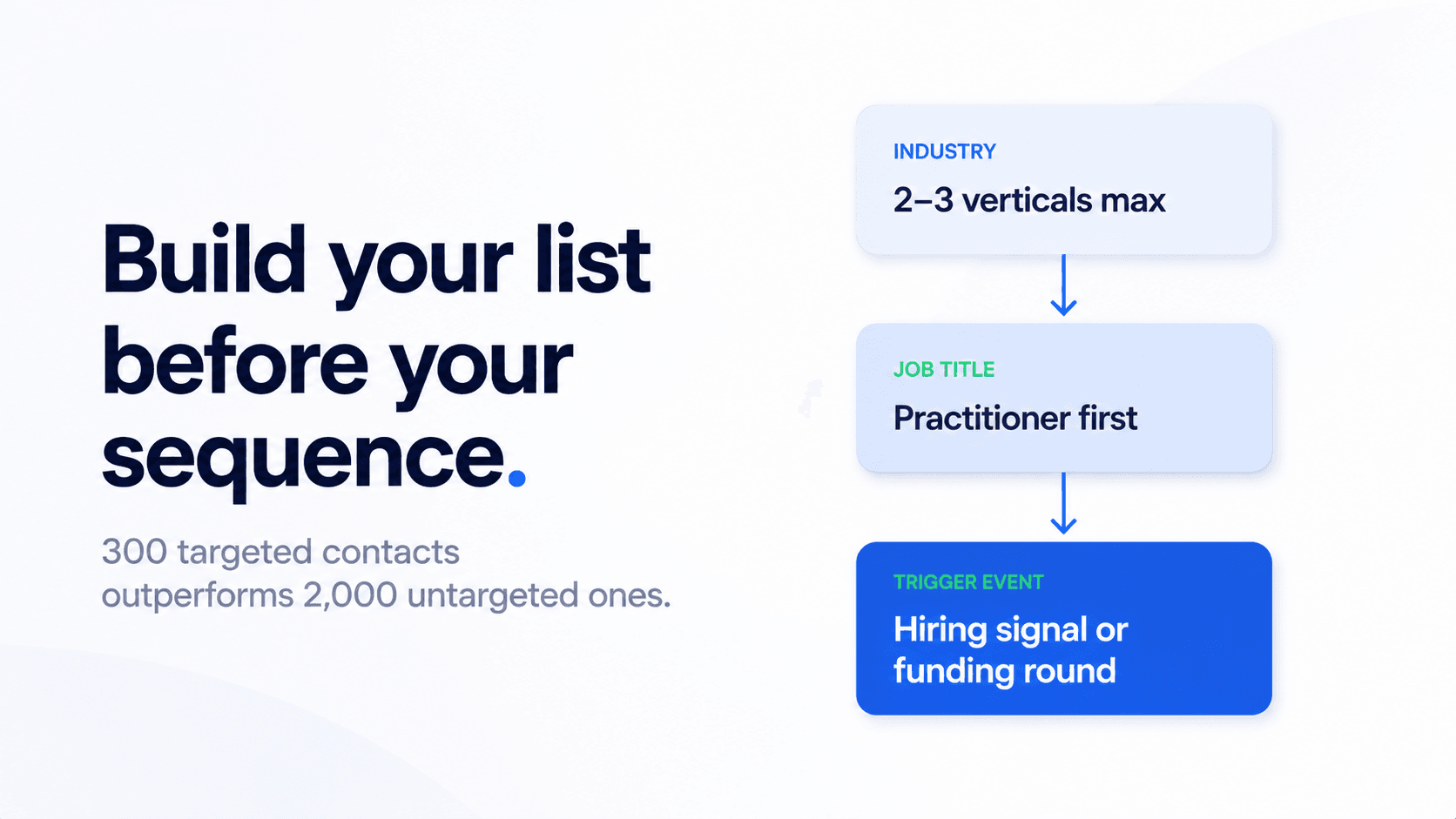
- Day 3 — ICP definition: Write down exactly who you are targeting. Three filters only: industry, job title, and one trigger event (company raised funding, hiring in a specific role, recently launched a product). This becomes the sourcing brief for your first list. Without this, every list you build is a spray-and-pray list.
- Days 4–17 — Warmup running, list building: While warmup runs, build your first contact list. Target 300–500 contacts for campaign one. Not 2,000. Not 10,000. The precision of 300 targeted contacts outperforms the noise of 2,000 untargeted ones at this stage every time.
For a full technical walkthrough of domain and email warmup best practices, the SalesTarget guide to domain warmup covers every step in detail.
Building Your First List When You Have No Existing Customers
Most list-building advice assumes you already know what your best customer looks like. At early stage, you're often working with a hypothesis. That's fine — but it means your first list is a validation exercise as much as a sales exercise. Build it tight, not wide.
| Filter | What to define | Startup-specific note |
|---|---|---|
| Industry | 2–3 verticals maximum for campaign one | More than 3 verticals means your copy has to be too generic to work |
| Job title | The person who feels the problem, not just approves the budget | At early stage, target the practitioner first — they pull the budget conversation upward |
| Company size | The band where your offer fits the budget | 10–200 employees is the sweet spot for most early-stage B2B tools — fast decisions, real budgets |
| Trigger event | One signal that this company has the problem right now | Recent funding, a new hire in a relevant role, or a job posting that implies the pain you solve |
Where to find contacts without paying for a data provider: LinkedIn is the most reliable free starting point. Industry Slack communities, event attendee lists, and company job boards are underused sources that often surface the exact person experiencing the problem. For verified email data at scale once you're ready to move past manual sourcing, SalesTarget's Lead Explorer combines ICP filtering with verified contact data in one step.
Writing Cold Emails When No One Knows Your Name
The biggest copywriting advantage a startup founder has is also the one most founders ignore: you can tell the truth about why you built this. No corporate voice, no committee-approved messaging, no positioning framework — just a direct statement of the problem you saw and the thing you built to fix it. That honesty is genuinely rare in a cold inbox, and it earns replies that polished templates never do.
Here is the framework that works for early-stage cold email:
| Line | What it does | Write this, not that |
|---|---|---|
| Line 1 — The hook | Names the specific problem the prospect has right now | ✓ "Most [job title] at [company size] companies spend 3 hours a week doing X manually." ✗ "I wanted to reach out about our platform." |
| Line 2 — The credibility hook | Explains why you — specifically — can help with it | ✓ "We built [product] after experiencing this problem firsthand at [previous context]." ✗ "We are a leading provider of solutions for..." |
| Line 3 — The ask | One low-friction ask. Not a demo. Not a 30-minute call. | ✓ "Worth a 10-minute call to see if it's relevant for [Company]?" ✗ "Book a demo via the link below." |
💡 The subject line rule for startups
Avoid subject lines that try to sound like a warm introduction you haven't earned. The best startup subject lines are specific and slightly unexpected: "[Company] + the X problem" or "quick question about [specific thing they do]". If your subject line could have been written about any company on your list, rewrite it.
How Many Emails Should a Startup Send Per Day?
Volume is the variable that most damages early-stage outbound. Sending too many emails too fast on a new domain is the single most common cause of deliverability failure — not bad copy, not wrong targeting. For a detailed breakdown of safe sending volumes by domain age and warmup stage, the cold email volume limits guide covers this in full. As a startup-specific starting point:
| Stage | Timeline | Safe daily volume | Focus |
|---|---|---|---|
| Warmup | Days 1–21 | 0 real sends | Domain reputation building only |
| Early sends | Weeks 3–4 | 20–30 / day | Message validation — are people replying? |
| Ramp up | Month 2 | 50–80 / day | Iterate on copy, add follow-up touches |
| Scale | Month 3+ | 100–200+ / day | Add inbox rotation, expand ICP verticals |
The Sequence from First Send to First 100 Customers
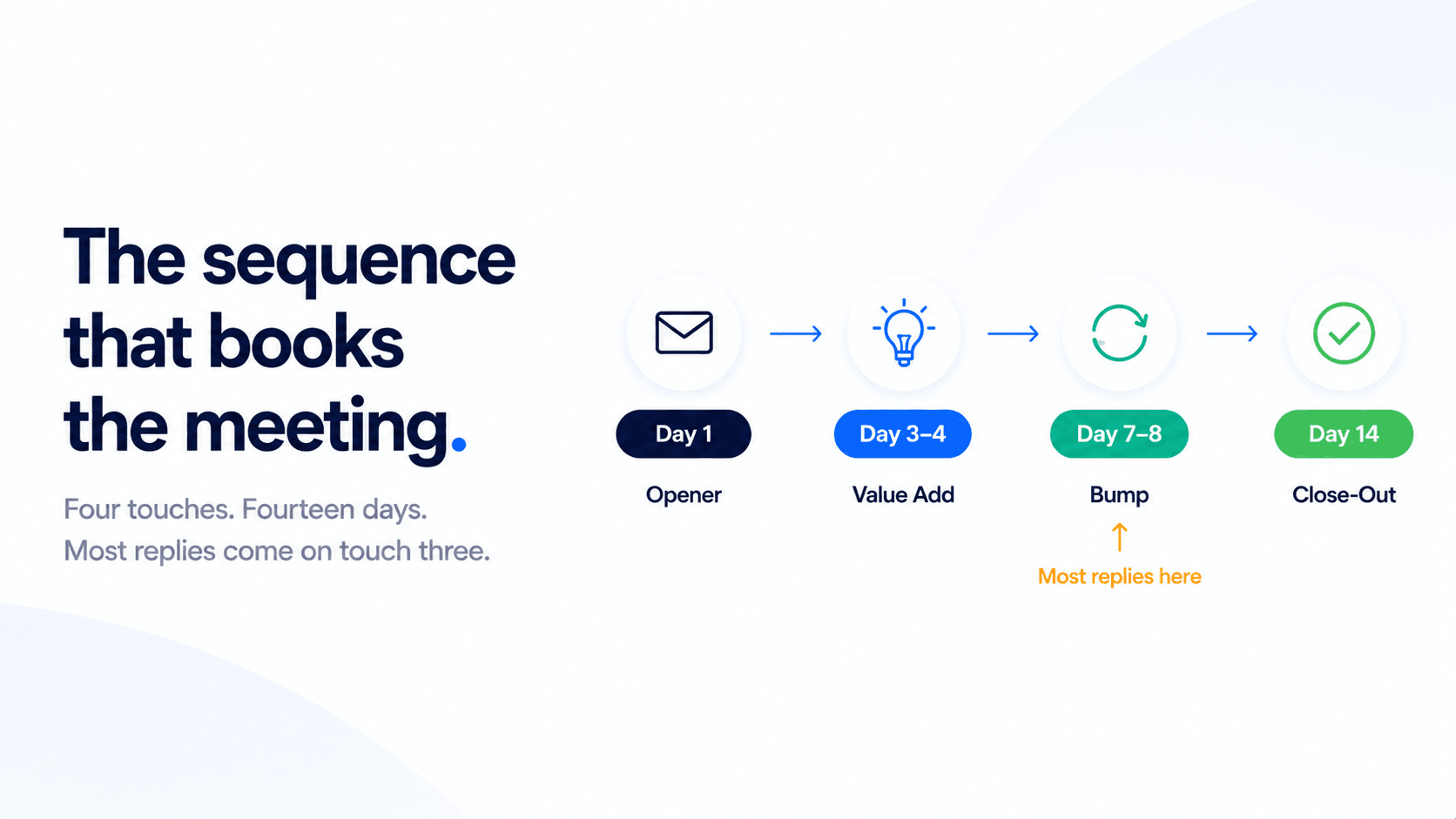
A cold email sequence is not a set of templates — it is a structured conversation with someone who does not know you yet. Each touch serves a different purpose. Most startups send email one, get no reply, and move on. The data tells a different story: most positive replies at the early stage come on touches two and three, not touch one.
| Touch | Timing | Purpose | Format |
|---|---|---|---|
| Email 1 | Day 1 | Name the problem. Establish credibility. One ask. | 3 lines max. No links. Plain text. |
| Email 2 | Day 3–4 | Add value without re-pitching. Give them a reason to reply that isn't a sales call. | A relevant data point, a short insight, or a question about their current approach. |
| Email 3 | Day 7–8 | The bump. Re-surface without repeating. Most replies at early stage come here. | "Wanted to make sure this didn't get buried — [one sentence reframe of the problem]." |
| Email 4 | Day 14 | The close-out. Low pressure, leaves the door open. Often generates replies from people who were interested but busy. | "Last note from me — happy to close the loop or reconnect when the timing is better." |
This four-touch, 14-day structure is the core sequence. Every reply that comes in goes into your CRM — every meeting booked gets tracked against the campaign that generated it. That is how you build a repeatable system, not just a pipeline spike. SalesTarget's AI sequence builder automates the timing, personalisation, and follow-up logic so founders can run this across hundreds of contacts without managing it manually.
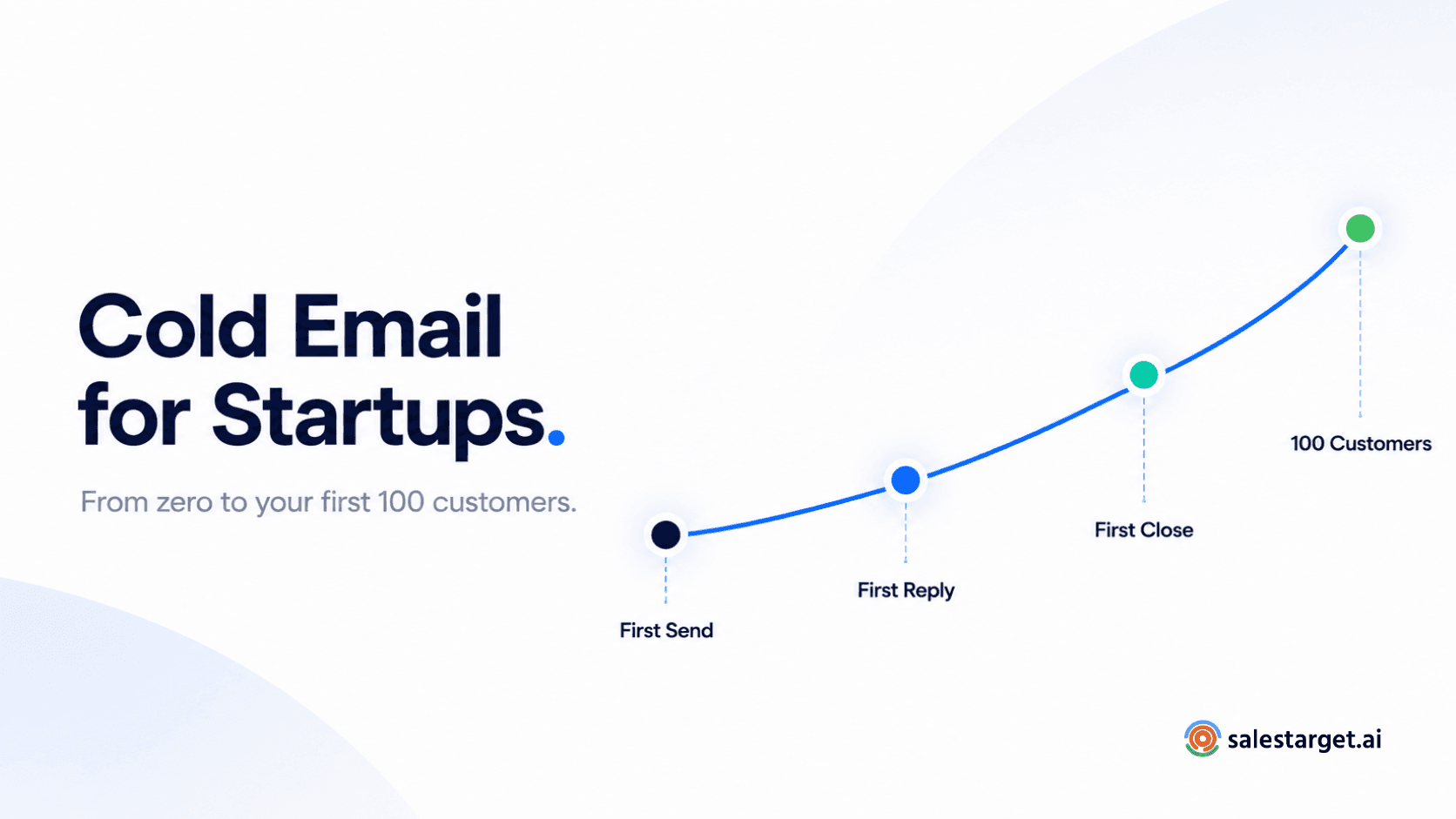
The milestone trajectory from first send to 100 customers looks like this for a typical early-stage B2B startup: weeks 1–3 are infrastructure and list building; month 2 delivers first positive replies and first meetings from 20–30 daily sends; month 3 delivers first closes as messaging is refined; months 4–6 scale toward 100 customers as daily volume increases and more ICP verticals are added. The timeline compresses significantly if your ICP definition is tight and your copy leads with a specific, felt problem.
Three Mistakes That Stall Early-Stage Outbound
Mistake 1: Sending from your main company domain
If your cold email programme damages your domain reputation, it damages your main website, your transactional emails, and every future outreach you ever send from that domain. Always use a dedicated sending domain from day one. Set it up before warmup, use it exclusively for outbound, and protect your primary domain entirely. This is not optional at any stage — it is especially critical before your domain has any history.
Mistake 2: Writing about your product instead of their problem
The instinct when you have just built something is to describe it. Features, benefits, differentiators — everything that makes it worth the price. The reader has no context for any of that, and without context, none of it means anything. The cold email that gets a reply at early stage names a specific problem the prospect recognises, demonstrates that you understand it better than they expected, and asks one question. Save the product explanation for the call you are trying to book.
Mistake 3: Treating no-reply as rejection
Most no-replies are not rejections. They are timing mismatches, inbox clutter, or emails that landed on a busy day. A structured four-touch sequence accounts for this by creating multiple low-friction re-entry points over 14 days. Founders who send one email, see no reply, and conclude "cold email doesn't work" have not tested cold email — they have tested a single untargeted send with no follow-up. The system only works when all four touches are in place.
You don't need 10,000 contacts to get your first 100 customers.
SalesTarget gives early-stage teams the warmup, sequences, and inbox tools to run a professional outbound programme from day one — no enterprise budget required.
✓ 50 credits ✓ 7-day trial ✓ No credit card required
Frequently Asked Questions

See It In Action: Book Your Free Demo
Get a personalized walkthrough and see how it works for your team.
Book My Demo →