Most sales teams do not have a prospecting problem. They have a workflow problem. The B2B prospecting tool is installed, the database has millions of contacts, and the SDRs have quota targets. Yet pipeline reviews still surface the same complaints: too many unqualified meetings, inconsistent outreach volume, and a pipeline that looks full on paper but stalls at every stage.
The issue is rarely the tool itself. It is the absence of a structured, repeatable workflow that connects each step - from defining who to target, through enriching and verifying contacts, to launching outreach and measuring what actually converts. Without that operational framework, even the best B2B prospecting tool becomes an expensive contact database that reps open when they feel like it.
This guide provides a complete workflow framework that sales teams can implement immediately. Each section covers one operational stage, explains what to do and why it matters, and shows where a prospecting tool fits into the process.
➤ Explore SalesTarget.ai
SalesTarget.ai combines prospect discovery, contact enrichment, email and LinkedIn outreach, and CRM in one platform — built for the workflow described in this guide.
Why Most B2B Prospecting Breaks Down Before It Starts
Before building a workflow, it helps to understand where the common breakdowns happen. In most B2B sales teams, prospecting fails at one of three points.
First, the targeting is too broad. SDRs search by job title alone and end up with a list that includes companies outside their ideal revenue range, industries where the product has no traction, and contacts who left their roles months ago. Volume looks healthy, but conversion rates tell a different story.
Second, there is no consistent cadence. Reps prospect heavily at the start of the month, go quiet while working active deals mid-month, and scramble again in the last week. This feast-and-famine cycle creates gaps in the pipeline that show up one or two quarters later.
Third, the data degrades silently. Contact records go stale at a rate that surprises most teams. People change jobs, companies restructure, and email addresses stop working. Without a built-in verification step, a prospecting list that looked solid on Monday can generate a double-digit bounce rate by Thursday.
A B2B prospecting tool addresses each of these problems, but only when it is embedded in a structured process. The workflow framework below provides that structure.
The Six-Stage B2B Prospecting Workflow Framework
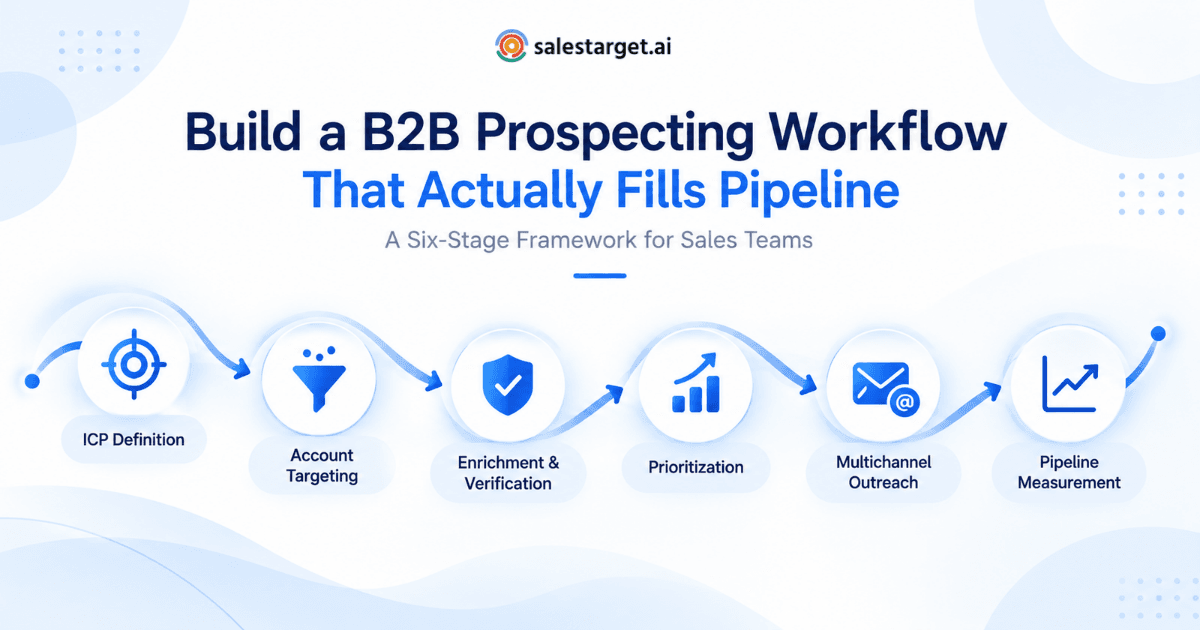
A repeatable prospecting workflow has six connected stages. Each stage feeds the next, and skipping any one of them introduces the kind of friction that slows pipeline creation.
Stage 1: Define Your Ideal Customer Profile With Specificity
An ideal customer profile is not a persona document that sits in a shared drive. It is a set of measurable criteria that your B2B prospecting tool can use to filter accounts programmatically.
Start with your best existing customers. Identify the firmographic attributes they share: industry vertical, company headcount range, annual revenue band, geographic region, and technology stack. Then add behavioral patterns: what triggered their initial interest, how long their sales cycle lasted, and which deal sizes closed fastest.
Translate these observations into filter settings inside your prospecting tool. For example, if your strongest customer segment is mid-market SaaS companies with 50 to 500 employees in North America that use Salesforce, those filters become the starting parameters for every prospecting session.
The goal is precision, not restriction. A tightly defined ICP does not limit your addressable market; it concentrates your team's effort on the accounts that are statistically most likely to convert. Adjustments happen quarterly as new win-loss data comes in.
Stage 2: Build Targeted Account Lists Using Layered Filters
With the ICP defined, the next step is building account lists inside your B2B prospecting tool. The effectiveness of this stage depends on how many filters you can stack together.
Single-filter searches (e.g., "Marketing Directors in the United States") return broad, low-quality lists. Layered searches combine firmographic, technographic, and role-based criteria to narrow results to accounts that closely match your ICP.
A practical approach is to build three to five micro-lists per week, each targeting a specific segment within the ICP. For example, one list might focus on Series B fintech companies with 100 to 300 employees, while another targets enterprise healthcare organizations that recently adopted a specific technology platform. Micro-lists keep outreach relevant and make it easier to track which segments produce the best conversion rates.
SalesTarget.ai's Lead Explorer searches over 840 million verified professional profiles using stacked filters across industry, role, seniority, headcount, revenue, tech stack, and more. For a deeper explanation of how these filtering capabilities improve lead qualification , the linked guide covers the qualification side of the process in detail.
Stage 3: Enrich and Verify Every Contact Before It Enters a Sequence
This is the stage where most prospecting workflows quietly fail. A contact record with a name, title, and company is not a complete record. Without a verified email address, a confirmed phone number, and current employment status, that record is a liability rather than an asset.
Contact enrichment fills in the missing data fields: professional email, personal email, direct phone number, department, seniority level, and social profiles. Verification then confirms that the email address is deliverable and the phone number is active.
The enrichment and verification steps should happen at the point of discovery, not as a separate batch process days later. Every hour between discovery and verification is an hour where a contact could change roles, a company could be acquired, or an email domain could go offline.
In SalesTarget.ai, enrichment happens in one click as prospects are added from Lead Explorer. The built-in Email Validator runs MX and SMTP checks along with disposable-email detection before any contact enters an outreach sequence. This approach eliminates the common workflow of exporting a list, uploading it to a third-party verification service, waiting for results, and re-importing the cleaned list.
Stage 4: Prioritize Prospects Using Intent and Fit Signals
Not every ICP-matching account deserves the same level of effort on the same day. Prioritization is what separates a flat contact list from a ranked prospecting queue.
The most useful prioritization model combines two dimensions: ICP fit and buying intent. ICP fit measures how closely an account matches the firmographic and technographic profile of your best customers. Buying intent measures whether that account is actively researching a solution or showing signs of organizational change that create purchasing urgency.
Intent signals to monitor include recent funding announcements, executive hiring in relevant departments, technology adoption changes, topic research spikes detected through intent data providers, and job postings that indicate expansion or strategic shifts.
A prospect that scores high on both fit and intent goes into the priority tier and gets outreach within 24 to 48 hours. A high-fit, low-intent account enters a longer-cycle nurture sequence. A low-fit account, regardless of intent, stays out of the active workflow entirely.
SalesTarget.ai surfaces buyer intent signals and company-level events alongside contact data in Lead Explorer, making it possible to rank and segment prospects without exporting data into a separate analysis tool.
Stage 5: Launch Coordinated Outreach Across Email and LinkedIn
With a prioritized, enriched, and verified list in hand, the workflow moves into outreach execution. The critical principle here is coordination: email and LinkedIn touchpoints should work as a single sequence, not as two disconnected campaigns running in parallel.
A well-structured multichannel outreach sequence might follow this pattern: a personalized LinkedIn connection request on day one, followed by a value-driven cold email on day three, a LinkedIn follow-up message on day five, a second email with a different angle on day eight, and a final touchpoint on day twelve. The exact cadence and channel mix depend on the buyer persona and industry norms, but the principle of coordinated timing remains constant.
Personalization at this stage draws directly from the enrichment data collected in Stage 3. Job title, department, company size, technology stack, and recent company events all provide hooks for relevant messaging. Generic "I noticed your company is growing" openers perform poorly compared to specific references that demonstrate genuine research.
SalesTarget.ai supports multichannel sequences that combine email and LinkedIn outreach steps in one coordinated flow. AI-assisted message generation helps teams personalize at scale without sacrificing relevance, while inbox rotation and warm-up controls protect sender reputation as outreach volume increases.
Stage 6: Track Results and Feed Learnings Back Into the Workflow
The final stage is measurement, and it closes the loop back to Stage 1. Without tracking which ICP segments, intent signals, and outreach cadences produce the best results, the workflow cannot improve over time.
Track these metrics at a minimum: reply rate by ICP segment, meeting-booked rate by outreach channel, bounce rate by data source, pipeline value generated per micro-list, and average time from first touchpoint to qualified meeting.
Review these numbers weekly. If a specific industry segment consistently produces low reply rates, adjust the ICP parameters or test different messaging. If LinkedIn outreach outperforms email in a particular persona, shift the channel mix. If bounce rates creep above two percent, tighten the verification criteria.
SalesTarget.ai's built-in CRM logs every email, call, and LinkedIn interaction to the lead timeline automatically. Campaign analytics show open rates, reply rates, and click-through rates in real time, while the pipeline view connects outreach activity to deal progression. This single-platform approach eliminates the common problem of trying to stitch together reporting from three or four disconnected tools.
A Practical Weekly Prospecting Cadence
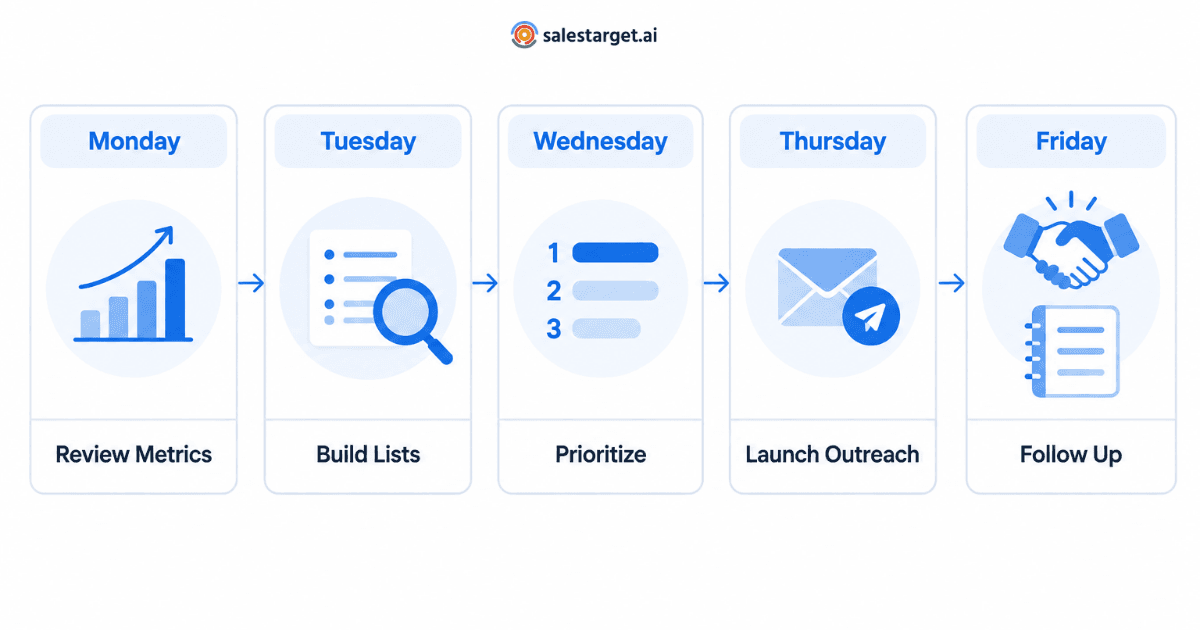
The six-stage framework becomes actionable when it runs on a consistent weekly schedule. Here is a practical cadence that an SDR or BDR team can follow:
| Day | Activity | Workflow Stage |
|---|---|---|
| Monday | Review previous week's metrics; refine ICP filters based on results | Stage 6 → Stage 1 |
| Tuesday | Build 3–5 targeted micro-lists; enrich and verify contacts | Stage 2 + Stage 3 |
| Wednesday | Prioritize accounts by fit and intent; assign to outreach tiers | Stage 4 |
| Thursday | Launch new outreach sequences; personalize first touches | Stage 5 |
| Friday | Follow up on active sequences; log replies and outcomes in CRM | Stage 5 + Stage 6 |
This cadence is a starting point, not a rigid schedule. Teams should adjust the timing based on their sales cycle length, territory size, and outreach volume targets. The important thing is that every stage runs every week, creating a consistent flow of qualified prospects into the pipeline.
Five Workflow Mistakes That Undermine B2B Prospecting Results
1. Treating the tool as the workflow
Purchasing a B2B prospecting tool is not the same as having a prospecting workflow. The tool provides data, automation, and tracking capabilities. The workflow provides the structure that determines when, how, and why those capabilities get used. Teams that skip the workflow design step end up with powerful software and no consistent process.
2. Skipping enrichment and jumping straight to outreach
The pressure to hit activity metrics drives some reps to export raw lists and start emailing immediately. This shortcut produces higher bounce rates, lower reply rates, and gradually damages sender reputation. Enrichment and verification take minutes; repairing a blacklisted domain takes weeks.
3. Running email and LinkedIn as separate silos
When email sequences and LinkedIn outreach run independently, prospects receive disjointed messaging with no awareness of what the other channel has already communicated. Coordinated multichannel sequences perform better because each touchpoint builds on the previous one.
4. Ignoring intent data in prioritization
A list sorted alphabetically or by company size alone misses the timing dimension of prospecting. Accounts showing active buying intent deserve faster outreach than dormant ICP matches. Without intent signals in the prioritization model, high-potential accounts often get contacted too late.
5. Measuring activity instead of outcomes
Tracking emails sent and calls made tells you how busy the team is, not how effective the workflow is. Outcome metrics — reply rate, meeting-booked rate, and pipeline value per micro-list — reveal which parts of the workflow are working and which need adjustment.
How SalesTarget.ai Supports Each Stage of This Workflow
SalesTarget.ai was built around the principle that prospecting, enrichment, outreach, and pipeline management should live in one platform rather than across four disconnected tools. Here is how the platform maps to each workflow stage:
| Workflow Stage | SalesTarget.ai Capability | Key Benefit |
|---|---|---|
| ICP Definition | Lead Explorer with firmographic, technographic, and role-based filters | Translates ICP criteria directly into searchable parameters |
| Account List Building | 840M+ verified profiles; stacked multi-criteria search | Builds targeted micro-lists in minutes, not hours |
| Enrichment & Verification | One-click enrichment; built-in Email Validator with MX/SMTP checks | Eliminates the export-verify-reimport cycle |
| Prioritization | Buyer intent signals and company events surfaced alongside contact data | Ranks accounts by fit and timing, not just title match |
| Outreach Execution | Coordinated email and LinkedIn sequences; AI-assisted personalization | Multichannel outreach runs from one workflow, not separate tools |
| Measurement | Built-in CRM with automatic activity logging and campaign analytics | Connects outreach data to deal progression without manual tracking |
The AI Copilot adds another layer of efficiency. Reps can use natural-language queries to find prospects, generate outreach sequences, and check deal status without navigating between multiple screens. This reduces the administrative overhead that often eats into active selling time.
From Tool to Workflow: Where Consistent Pipeline Starts
A B2B prospecting tool provides the data, automation, and tracking capabilities that modern sales teams need. But the tool alone does not produce pipeline. The workflow — the structured, repeatable process that determines how data gets sourced, enriched, prioritized, activated, and measured — is what turns capabilities into results.
The six-stage framework in this guide gives sales teams a clear operational model: define the ICP with measurable criteria, build targeted micro-lists, enrich and verify every contact before outreach, prioritize by fit and intent, launch coordinated multichannel sequences, and track outcomes to improve the next cycle.
Salestarget.ai is built for exactly this kind of workflow. Prospect discovery, enrichment, verification, email and LinkedIn outreach, and CRM all live in one platform, which means the workflow runs end-to-end without the friction of exporting, importing, and reconciling data across separate tools.
➤ Start Building Your Prospecting Workflow with SalesTarget.ai