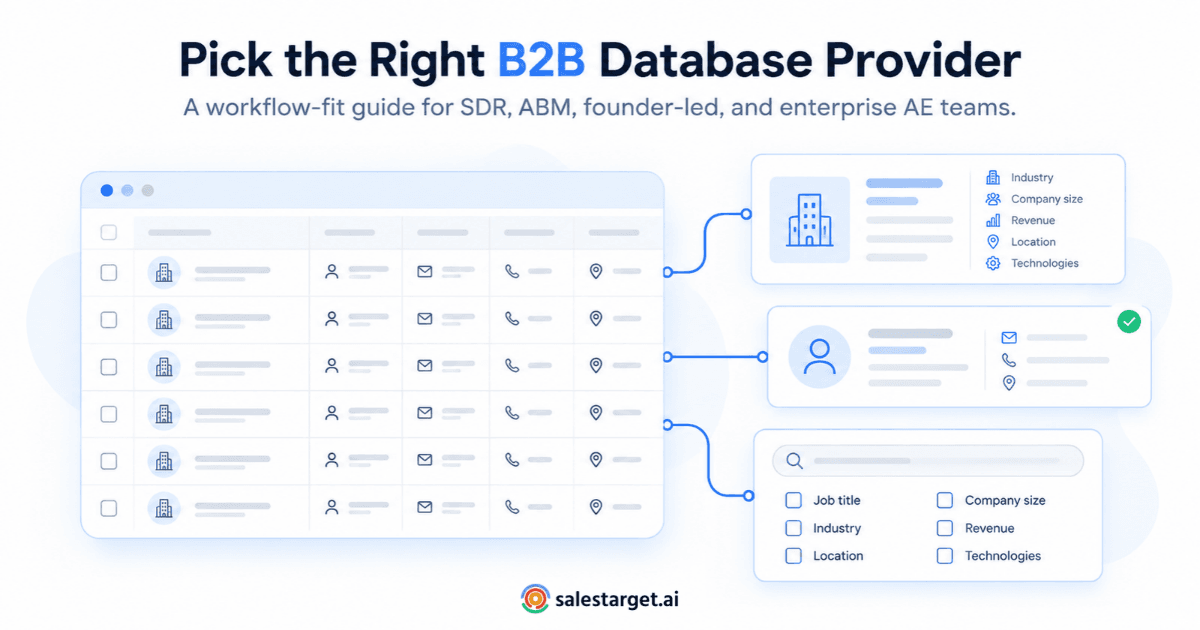
Every sales team eventually asks the same question: which B2B database provider should we actually buy? The answer rarely comes down to a universal 'best' platform. It depends on how your team sells. A founder running early-stage outbound needs something different than a 40-person SDR team layered under an enterprise AE org, and both are different from an ABM team working a 200-account target list.
This guide reframes the decision. Instead of ranking providers one through ten, it maps the main provider categories to the sales motions they actually serve well, so you can shortlist with intent rather than by brand familiarity.
See a workflow-integrated database in action
SalesTarget.ai Lead Explorer gives new accounts 50 free credits and a 7-day trial, with no credit card required, so you can run a focused quality test against your ICP in under an hour.
Why most B2B database provider lists lead teams astray
Generic 'top providers' lists assume every sales team buys data for the same reason. In practice, teams use database providers to solve very different problems: list-building for cold outbound, enriching leads already in a CRM, surfacing in-market accounts, or verifying contact details before a campaign goes live.
A provider that excels at bulk contact export may be the wrong choice for an ABM team that needs account-level depth and signal intelligence. A provider built for enrichment APIs may be overkill for a two-person startup that still exports CSVs. If you shortlist on feature breadth alone, you often end up paying for coverage you do not use and missing the one capability that would actually move pipeline.
The better starting question is simpler: what motion does our team run, and which provider type is built to support it?
The four B2B database provider categories (and what each is built for)
Most B2B data providers fall into one of four functional categories. Knowing the category simplifies the shortlist and avoids apples-to-oranges comparisons.
Broad-coverage data platforms
These are the household names in B2B data. They aim for large contact and company coverage across industries and regions, deep firmographic filters, and a self-serve search interface. They work well when your team needs volume, broad market exploration, or the ability to build many different lists across segments. The trade-off: coverage breadth can come at the cost of refresh frequency in less common geographies or industries, so verification at the point of use matters more than headline record counts.
Workflow-integrated prospecting platforms
These providers combine a database with the downstream sales workflow - enrichment, outreach, CRM, signal discovery - in one platform. Instead of exporting a list and stitching it into separate tools, SDRs search, enrich, and launch sequences from the same place. SalesTarget.ai's Lead Explorer sits in this category, offering a B2B prospecting database alongside connected outreach and a built-in CRM. This category fits teams that would otherwise maintain three or four overlapping subscriptions and want a tighter prospect-to-pipeline loop.
Enrichment-first data layers
These providers are built primarily as an API or integration layer that enriches records already in your CRM or marketing stack. They do not necessarily offer a strong search UI. Instead, they focus on filling in missing fields: job titles, firmographics, tech stack, direct dials. They are the right fit when the issue is CRM data quality or inbound lead enrichment, not list-building.
Signal and intent data specialists
These providers focus on buying signals: funding events, hiring surges, leadership changes, intent topic consumption, and technology installations. Their value is timing, not coverage. Pair them with another database for contacts, and they help you prioritize which accounts to work this week rather than next quarter.
Match your sales motion to the right provider type
With the categories in mind, the next question is which motion your team actually runs. Most teams fit one of five patterns.
Outbound SDR/BDR teams running high-volume prospecting
Teams sending high weekly volumes across email and LinkedIn need two things: a deep searchable database to keep lists fresh, and a verification layer so bounce rates stay low. A workflow-integrated platform usually wins here because switching between a database tool, an enrichment tool, and an outreach tool creates data loss and manual overhead. A broad-coverage database can also work if your team already has disciplined outreach and verification infrastructure in place.
Account-based (ABM) motions
ABM teams work from a fixed account list, often 100 to 500 accounts. The priority is depth per account: full buying committees, tech stack visibility, and signal data that tells you when an account becomes active. Providers strong in firmographic depth and intent signals fit better than those optimized for contact volume. A signal specialist layered over a workflow-integrated platform is a common combination.
Founder-led and startup sales
Founders selling before hiring their first SDR need a database they can learn in a day and that does not require a separate enrichment contract to be useful. Workflow-integrated platforms with transparent credit models and a free tier are usually the fastest to value here. A broad-coverage platform built for 30-seat teams can feel heavy for one or two users.
Enterprise account executive teams
AEs typically do not run their own lead generation at scale. They work accounts, map committees, and nurture multi-threaded conversations. Their data needs are account intelligence, relationship mapping, and signal data to time outreach. An enrichment layer that keeps CRM records fresh plus a signal specialist is often more valuable than a search UI they will rarely open.
Lead-generation agencies and outsourced SDR firms
Agencies run campaigns across many ICPs and clients. They need flexible filters, a large underlying database, bulk list operations, and clean export workflows. Both broad-coverage platforms and workflow-integrated platforms serve this well. The deciding factor is often per-seat economics and the ability to isolate client workspaces.
A workflow-first evaluation framework
Once your category is clear, evaluate shortlisted providers against the criteria that matter for your motion. The following six questions cut through marketing copy quickly.
- Does the database actually cover your ICP? Run a saved search against your current best accounts. If the provider misses 30 percent of them or returns outdated titles, coverage is the wrong fit, regardless of total record counts.
- Where is verification applied - at collection or at use? Databases that verify emails and phone numbers at the point of enrichment produce fewer bounces than those relying on stale verification from when the record was first scraped.
- How deep is decision-maker coverage? Count how many relevant titles the provider returns per account for your target company size. Thin coverage above director level is a red flag for ABM motions.
- What signals are included, and how fresh are they? Confirm the signal types (funding, hiring, leadership change, intent) and the lookback window. A 30- to 90-day lookback is standard; longer windows mean you are often reaching accounts after the window closed.
- How much workflow friction does it introduce? Count the number of steps and tools between search and sent outreach. Fewer steps mean fewer dropped leads.
- What does compliance and data sourcing look like? GDPR, CCPA, and other regimes affect which contacts you can process. Verified sourcing documentation matters at procurement review.
Testing data quality before you commit
Marketing claims about data accuracy rarely survive contact with your actual ICP. Before a longer commitment, run a small, controlled test.
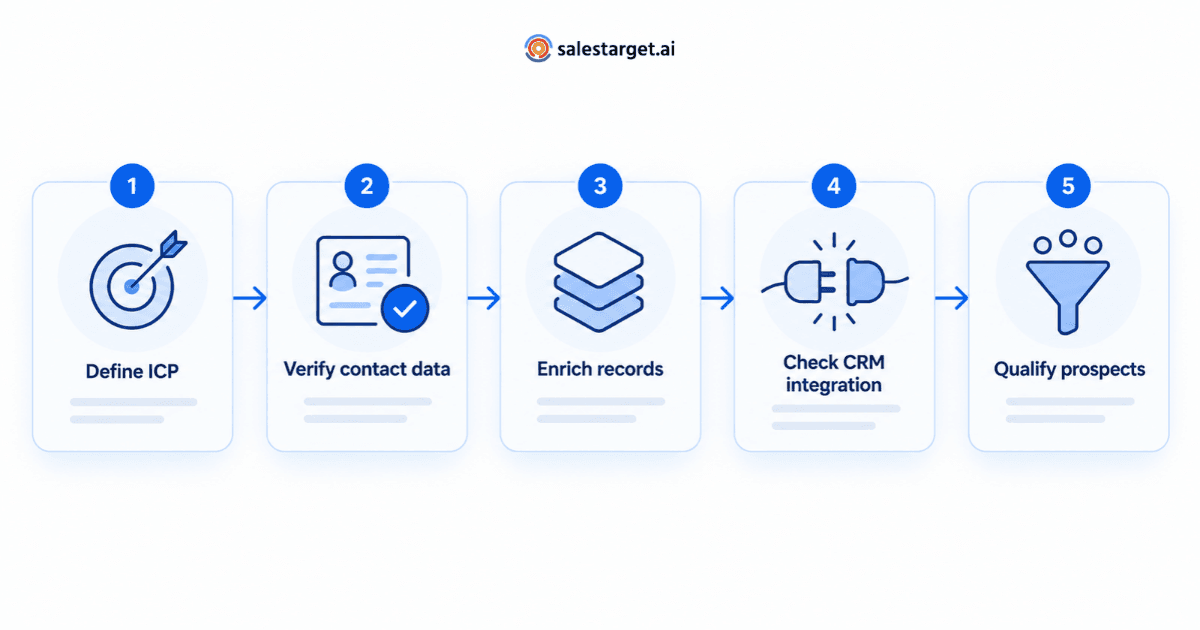
Pull 100 to 200 records matching your ICP. Verify a sample manually against LinkedIn and company sites. Send a controlled test campaign to measure bounce and reply rates against your baseline. If the provider offers a free tier or trial credits, use it for this test rather than for live pipeline work. SalesTarget.ai's Lead Explorer, for example, provides 50 free credits on signup, which is enough to run a focused quality check across one segment.
Common selection mistakes to avoid
- Buying on raw contact counts without checking coverage for your specific ICP.
- Underweighting workflow fit. A great database stitched into a bad workflow still loses leads at every handoff.
- Treating signal data as a bonus instead of a core input. For ABM and enterprise motions, signals are the primary driver of timing, not an add-on.
- Ignoring CRM integration quality. Native, field-mapped integrations save hours per week compared with CSV workflows.
- Overlooking the compliance review until procurement blocks the renewal.
Where SalesTarget.ai Lead Explorer fits
SalesTarget.ai Lead Explorer sits in the workflow-integrated category. According to the product page, it offers search across 840M+ professional profiles and 96M+ business entities, with AI-powered prospect search alongside firmographic and technographic filters. Verification is applied at the point of enrichment rather than at collection, which supports lower bounce rates in cold outreach. Buying signal filters cover funding rounds, hiring spikes, leadership changes, and intent topics with a 30- to 90-day lookback window.
For sales teams, the differentiator is the end-to-end flow: search, enrichment, outreach sequences, and CRM sync happen in the same platform, with native integrations for HubSpot, Salesforce, Pipedrive, and Zoho, plus a built-in advanced CRM. That makes it a fit for outbound SDR teams, founder-led motions, and agencies that want to consolidate overlapping subscriptions, and a reasonable option for ABM teams when paired with disciplined account prioritization. For a deeper look, explore SalesTarget.ai Lead Explorer.
Quick-reference provider-fit table
| Sales motion | Best-fit provider category | What to prioritize |
|---|---|---|
| High-volume outbound SDR | Workflow-integrated or broad-coverage | Verification and outreach integration |
| Account-based (ABM) | Signal specialist + workflow platform | Decision-maker depth, intent signals |
| Founder-led / startup | Workflow-integrated with free tier | Time to first value, no stitched stack |
| Enterprise AE | Enrichment-first + signals | CRM freshness, timing signals |
| Lead-gen agency | Workflow-integrated or broad-coverage | Bulk operations, client workspaces |
A short decision checklist
Before signing, confirm:
- The provider covers your actual ICP with sufficient depth.
- Verification happens at the point of use, not at collection.
- Signal data types and lookback window match your motion.
- CRM integrations are native, not CSV.
- Compliance documentation is available in writing.
- Workflow friction is measurably lower than your current stack.
The 'best' B2B database provider is the one that fits your motion, not the one with the most impressive dashboard. Start with how your team sells, pick the category that matches, test with real data, then commit. If a workflow-integrated platform fits your motion, consider AI-powered B2B lead database options as part of your shortlist. The free credit tier is designed for exactly this kind of focused test.