TL;DR
- Lead enrichment is the process of adding verified contact data to a prospect record from external sources — email, phone, job title, firmographics, tech stack
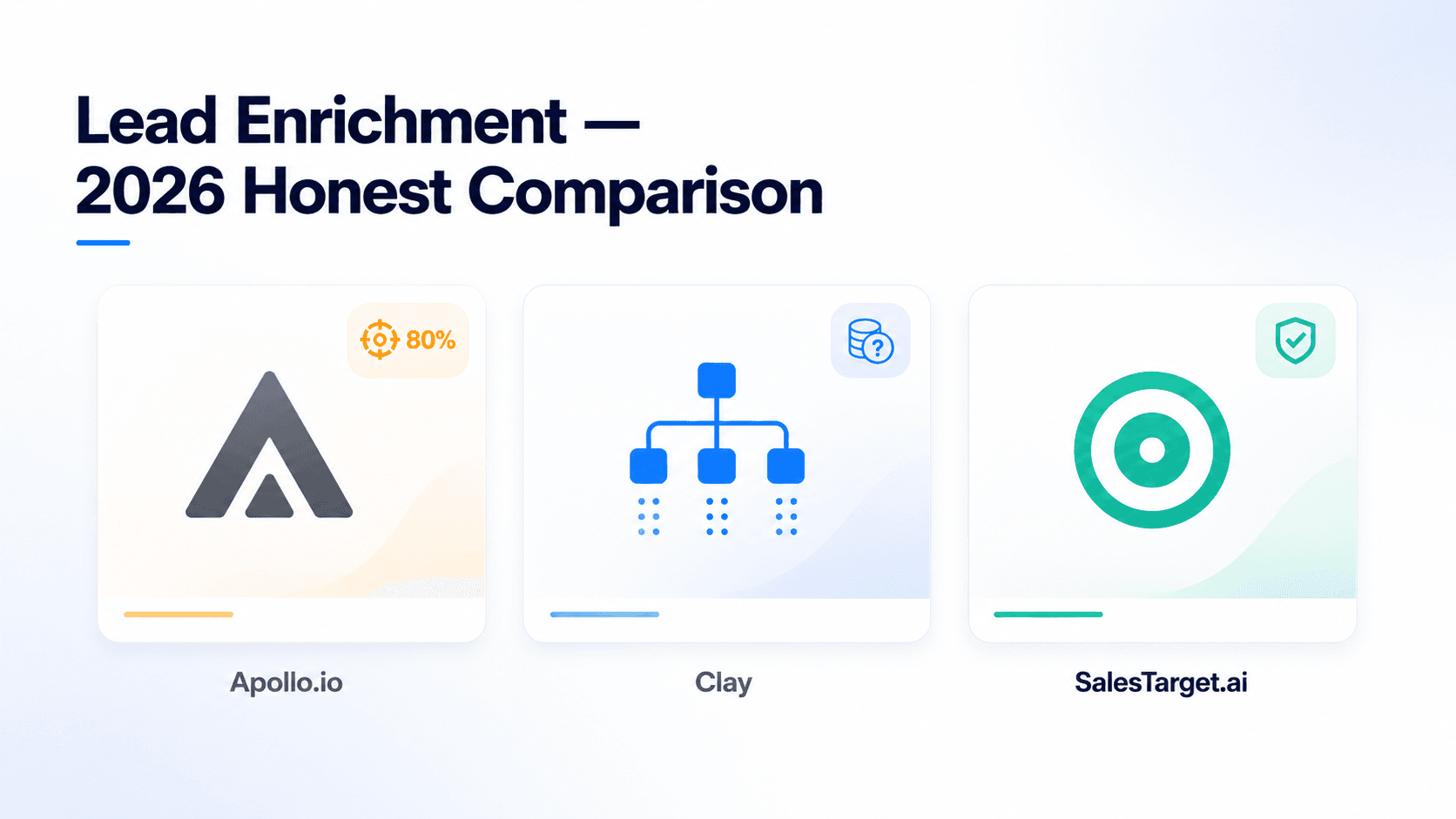
- Apollo's email accuracy sits at 80% in Cleanlist's 2026 independent benchmark (1,000 contacts tested) — 1 in 5 emails bounces before delivery
- Clay's waterfall achieves 78% email coverage across 150+ providers — better than Apollo's 42% match rate standalone — but costs $185–$495/mo, requires RevOps expertise, and charges credits for failed lookups
- SalesTarget.ai uses point-of-discovery enrichment — contacts verified live at the moment of unlock, targeting under 5% bounce rates vs 15–27% from historical verification
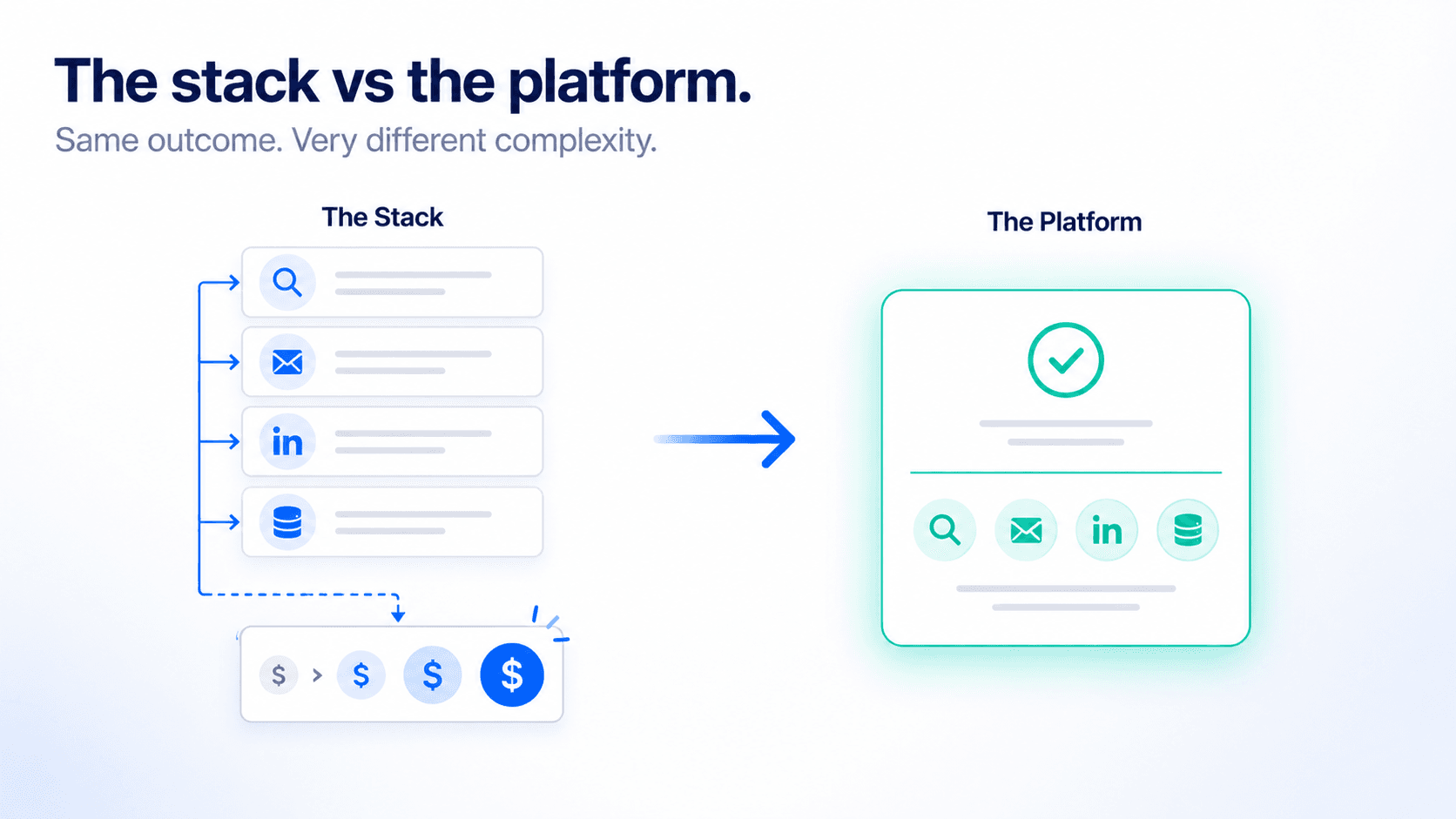
- Apollo and Clay both require separate outreach tools. SalesTarget.ai includes enrichment, email outreach, LinkedIn automation, and CRM in one platform
- Honest recommendation: Apollo for first-time outbound teams; Clay for technical RevOps with existing outreach stack; SalesTarget.ai for outbound teams wanting everything in one workflow
Why Enrichment Accuracy Matters More Than Database Size
Lead enrichment is the process of adding verified contact and company information to a prospect record from external data sources at the moment of use. It is the infrastructure that makes cold outreach work at any scale. Without accurate enrichment, sequences bounce, domain reputation deteriorates, and SDR time disappears into contacts that no longer exist at the addresses being targeted.
The market has conditioned buyers to compare enrichment tools by database size. 275 million contacts. 840 million profiles. These numbers are real — but they are not the right primary metric. The right metric is accuracy: what percentage of the emails returned actually deliver?
Cleanlist's 2026 independent benchmark — run on 1,000 real contacts across 15 providers — answers that question directly. Results for the tools most commonly recommended for outbound teams:
📊 Cleanlist 2026 independent benchmark — 1,000 contacts tested
- Apollo.io: 80% email accuracy — 1 in 5 emails returned will bounce (Cleanlist, February 2026)
- ZoomInfo: 85% email accuracy — 1 in 6–7 emails bouncing
- Cognism: 90% email accuracy — strongest single-database provider tested
- Clay (waterfall, 5+ providers): 78% email coverage match rate — higher match rate than Apollo standalone (42%), different metric from accuracy
- SalesTarget.ai (point-of-discovery): targets under 5% bounce — contacts verified live at moment of enrichment
A 20% bounce rate (Apollo's 80% accuracy) on a 1,000-contact sequence means 200 hard bounces — more than four times Gmail's 5% domain reputation threshold. One campaign at this accuracy rate can suppress deliverability for weeks across every sequence the team sends from that domain.
Apollo.io for Lead Enrichment: Strong Database, Structural Accuracy Limitation
Apollo.io is the dominant outbound platform for SMB and mid-market sales teams. 275M+ contacts, built-in email sequences, a dialer, and a feature set that covers most of the outbound workflow at a price point significantly below enterprise alternatives. For teams starting outbound, it is a rational starting point.
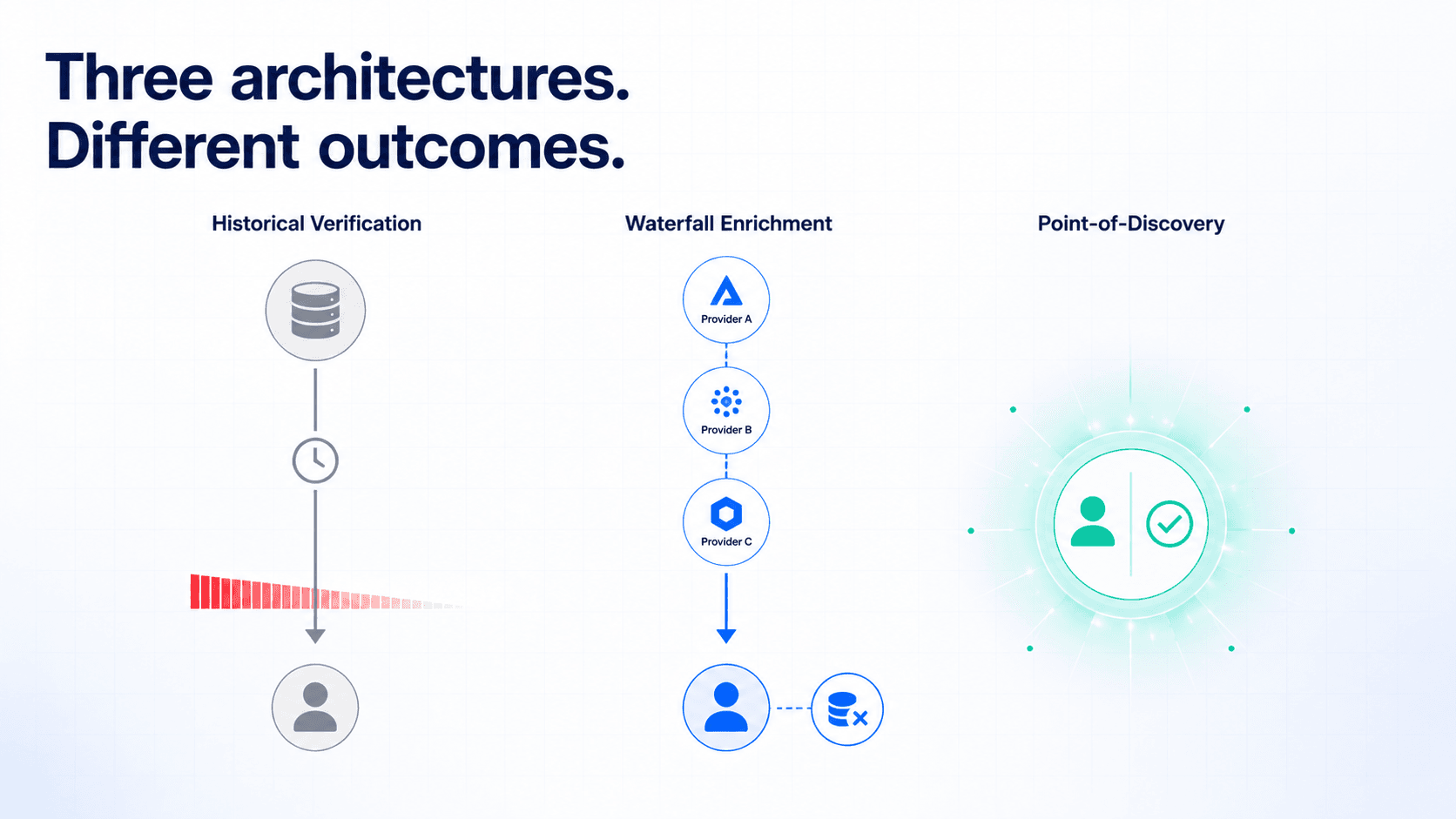
But Apollo's enrichment architecture is a single-database, historical verification model. Contacts are verified when added to Apollo's database — not when you pull them. B2B contact data decays at 22.5% annually. Apollo's 80% accuracy in Cleanlist's independent test is a direct consequence of this architecture — not a data quality failure, but a timing failure.
Apollo.io — Enrichment Verdict
Verdict: Strong starting point for outbound teams. Accuracy bottleneck at 80% becomes a deliverability liability at volume.
✓ Strengths: 275M+ contact database; built-in email sequences + dialer; competitive pricing ($49/user/mo annual); large integration ecosystem
✗ Weaknesses: 80% email accuracy — 1 in 5 emails bounces; historical verification model; email match rate of ~42% in comparative waterfall tests
Best for: Teams starting outbound for the first time; small teams not yet hitting volume where 20% bounce rates trigger domain reputation damage
Clay for Lead Enrichment: Best-in-Class Coverage, Significant Complexity and Cost
Clay is the most technically sophisticated enrichment tool on the market. Its waterfall architecture — cascading through 150+ data providers sequentially — achieves 78% email coverage in independent testing vs Apollo's 42% standalone match rate. For technical RevOps teams building custom enrichment workflows, Clay's coverage advantage is real.
But Clay is not a prospecting platform. It is an enrichment engine. You still need a separate outreach tool to send campaigns. CRM sync requires the Growth plan at $495/month. And the credit system — dual-currency Data Credits plus Actions — produces costs that are genuinely difficult to predict.
Clay — Enrichment Verdict
Verdict: Maximum enrichment coverage for technical teams. Not suitable for lean outbound teams without a dedicated RevOps operator.
✓ Strengths: 78% email coverage (waterfall across 150+ providers); Claygent AI for unstructured research; unlimited seats on all plans
✗ Weaknesses: 4–6 week learning curve; failed lookups consume credits; waterfall of 5 providers = 5x credits; no native email outreach; CRM sync locked to Growth at $495/mo; Trustpilot 2.2/5
Best for: Technical RevOps or GTM engineering teams that need maximum enrichment flexibility and already have an outreach platform
⚠️ The Clay credit trap
A waterfall of 5 providers does not cost 1 credit — it costs 5 separate lookups worth of credits. On the Launch plan (2,500 credits/month), a single contact enriched through a five-provider waterfall at 3 credits per lookup consumes 15 credits — giving you roughly 167 fully enriched contacts per month. Failed lookups are charged regardless of whether data is returned. Top-up credits carry a 30–50% markup. Source: Cleanlist Clay review, Amplemarket pricing analysis, April–June 2026.
SalesTarget.ai for Lead Enrichment: Point-of-Discovery, No Tool-Switching
SalesTarget.ai's enrichment architecture is fundamentally different from both Apollo and Clay. It is not a single-database historical verification model. It is not a waterfall enrichment layer requiring a separate outreach tool. It is point-of-discovery enrichment built into the same platform as prospecting, outreach, LinkedIn automation, and CRM.
Point-of-discovery means the contact's email is verified live at the exact moment you unlock it — not when it was added to the database, not on a scheduled refresh cycle. B2B data decays at 22.5% annually. Historical verification checks the data at collection time. By the time your SDR enriches that contact, it may be weeks out of date. Point-of-discovery eliminates this gap entirely.
SalesTarget.ai — Enrichment Verdict
Verdict: Best fit for outbound teams that want enrichment, outreach, LinkedIn, and CRM in one platform — without RevOps complexity or tool-stacking cost.
✓ Strengths: Point-of-discovery verification (targets under 5% bounce); 840M+ profiles; Has Email/Phone toggles pre-filter availability; email + LinkedIn + CRM all built in; self-serve from day one
✗ Weaknesses: Newer platform vs Apollo's category dominance; no waterfall across 150+ external providers; less suited for highly customised enrichment workflows
Best for: Outbound SDR teams, founders running outbound, SMB and mid-market teams wanting enrichment + outreach in one place without RevOps overhead
Head-to-Head Comparison
| Apollo.io | Clay | SalesTarget.ai | |
|---|---|---|---|
| Enrichment model | Single DB, historical | Waterfall, 150+ providers | Point-of-discovery |
| Email accuracy (tested) | 80% (Cleanlist 2026) | 78% coverage match rate | Targets under 5% bounce |
| Failed lookups billed? | No | Yes — credits consumed | No — Has Email toggle prevents |
| Outreach built in? | Yes | No — separate tool required | Yes — email + LinkedIn |
| CRM built in? | No (integrations only) | Growth plan only ($495/mo) | Yes — included |
| RevOps needed? | No | Yes — 4–6 week setup | No — self-serve day one |
| Entry price | $49/user/mo (annual) | $185/mo (2,500 credits) | $49/mo (2,000 credits, all features) |
| Full stack cost | $49 + CRM tool cost | $185–$495 + outreach $37–$137/user/mo | $49–$149/mo — everything included |
Who Should Use Which: Honest Recommendations
Choose Apollo if: you are starting outbound for the first time; your team is small enough that 20% bounce rates don't yet generate domain-damaging volume; or you prioritise database breadth and already have deliverability infrastructure to compensate.
Choose Clay if: you have a dedicated RevOps or GTM engineer; maximum contact coverage is your primary concern; you already have an outreach platform; and your team prospects at volume with proper credit governance.
Choose SalesTarget.ai if: you want enrichment, email outreach, LinkedIn automation, and CRM in one platform without building a multi-tool stack; deliverability is a priority; you don't have RevOps and need a tool that works from day one; or you are currently paying for Apollo + a separate outreach tool + a separate LinkedIn tool + a CRM and want to consolidate.
Conclusion: The Stack vs the Platform
Every roundup recommending Apollo + Clay + ZoomInfo as the optimal enrichment stack is recommending three separate tools, three billing relationships, and three separate data quality architectures — each producing slightly different results that need to be reconciled across your sequences.
Apollo at 80% accuracy requires deliverability infrastructure to compensate. Clay at $185–$495/month requires RevOps expertise to build and maintain. SalesTarget.ai is a different category of answer: one platform, point-of-discovery verification, and every outbound tool a lean sales team needs built in.
The stack works if you have the RevOps resources to run it. The platform works if you don't.
See how SalesTarget.ai compares — try free.
Point-of-discovery enrichment. 840M+ profiles. Outreach built in. No RevOps required.
50 credits · 7-day free trial · No credit card required