TL;DR
- AI memory in outbound means what a prospect said in touch one is available and used in touch four — not just stored somewhere, but shaping what gets written next.
- Without it, every touch is written as if the sequence just started — even the fifth message ignoring an objection raised in the second.
- The clearest failure mode is contradiction: asking a question the prospect already answered, or pushing a feature they already said doesn't apply to them.
- Memory has to be scoped deliberately — remembering everything is as unusable as remembering nothing, just noisier.
- The practical test: read touch four in isolation. If it reads like it's never met this prospect, memory isn't doing its job.
A prospect replies to your second touch: "Not the right time, we just cut budget for this quarter." Touch three arrives two weeks later asking if they'd like to see pricing. That single moment — a sequence contradicting what the prospect just told it — is the entire argument for AI memory in outbound, condensed into one bad email.
Quick recap: what AI memory means
If you need the concept first
This piece assumes you already know roughly what AI memory is. If you want the concept explained from the ground up, start with what AI memory in sales means and why it matters. What follows here is the practical layer: what memory actually changes inside a running sequence, touch by touch.
The practical impact: how memory changes touch four based on touch one
Strip away the architecture talk and the practical question is simple: does the system writing touch four know what happened in touch one? Not "is it logged somewhere retrievable." Does it change what gets written.
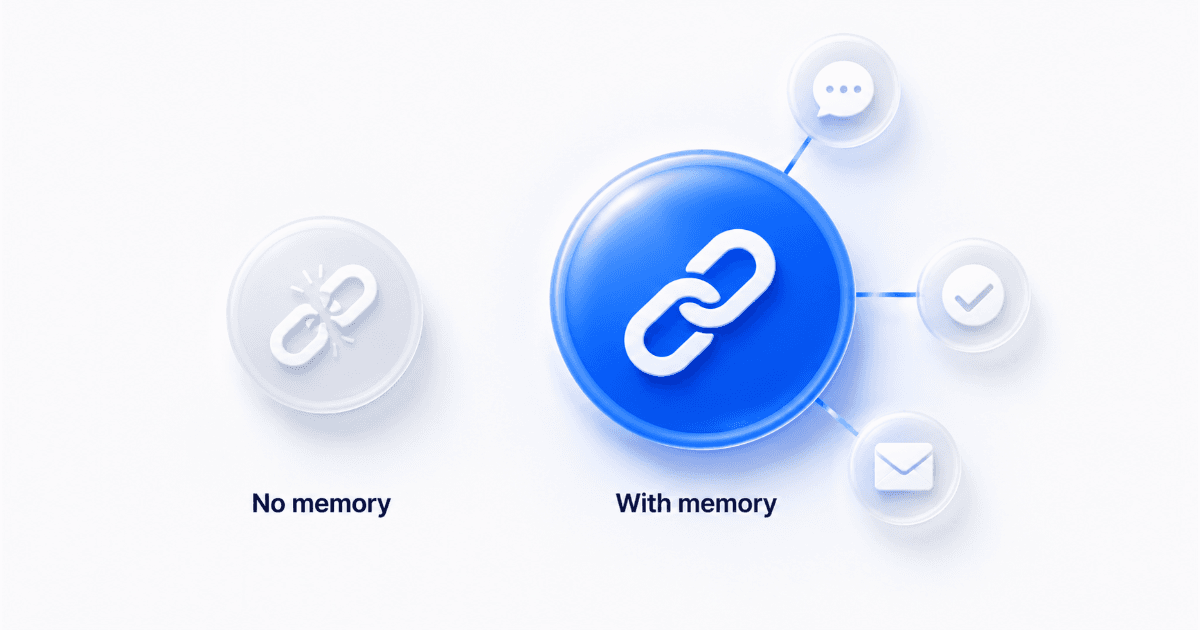
Without memory, a four-touch sequence is four independent messages that happen to arrive in order. Each one is generated, or written, against the same static brief — the prospect's title, company, and whatever was true when the sequence was built. Touch four knows exactly as much about this specific prospect as touch one did, which is to say, nothing that happened since.
With memory, touch four is generated against an updated picture: what the prospect said, what they didn't respond to, what they clicked, what they explicitly ruled out. The difference is not tone or personalization depth. It is whether the sequence is having one conversation or sending four unrelated messages that share a subject line convention.
Example: objection handling across a sequence
Walk through the same four-touch sequence twice — once with no memory, once with it — to see where the divergence actually happens.
| Touch | Without memory | With memory |
|---|---|---|
| Touch 1 | Opens with a generic pitch on efficiency gains | Same opener — nothing to remember yet |
| Prospect reply | "Not the right time, budget's been cut this quarter." | Same reply — the moment that should change everything downstream |
| Touch 2 | Asks if they'd like to see a pricing breakdown | Shifts to a lightweight, no-cost resource and asks when budget resets |
| Touch 3 | Pushes a feature the prospect never asked about | References the stated budget timeline and re-engages near that date |
| Touch 4 | Repeats the original pitch, word for word in spirit | Opens by acknowledging the earlier constraint directly |
The no-memory column isn't a strawman — it's what generating each touch independently produces by default, because there's nothing wrong with any single message in isolation. The problem only exists across the sequence, which is exactly why it's easy to ship and hard to catch in a one-touch review.
The risk of no memory: repetitive, contradictory follow-ups
Three failure patterns show up repeatedly in sequences that lack persistence, and each one costs more credibility than a generic message ever would — because a generic message reads as impersonal, while a contradictory one reads as inattentive.
📊 Three patterns memory prevents
- Re-asking a question already answered — asking about team size, current tools, or timeline when the prospect volunteered it three touches ago. It signals nobody, human or otherwise, actually read the reply.
- Contradicting a stated fact — offering a discount after the prospect said budget is fixed, or proposing a call time after they said they're out until next month.
- Restarting the pitch from zero — treating touch four as a fresh cold open instead of a continuation, which reads as a company too disorganized to track its own conversation.
The pattern underneath all three is the same: the prospect experiences the sequence as one conversation with your company, whether or not the tooling was built to treat it that way. Every gap between what they told you and what the next message assumes is a gap they notice, even when they don't reply to point it out. Most damaged relationships from this never generate a complaint. They just generate silence.
Why more memory isn't automatically better
It's tempting to treat memory as a dial to turn up — remember everything, always, forever. That produces a different failure, not an improvement.
A prospect who mentioned in passing that they used to work at a competitor two years ago doesn't need that surfaced in a message today — it reads as surveillance rather than attentiveness. Useful memory is scoped to what's relevant to the current conversation and recent enough to still be true: stated objections, explicit preferences, unanswered questions, and anything the prospect would reasonably expect you to have retained from the conversation you're already having with them. Anything older or more tangential than that adds noise, and noisy recall is functionally indistinguishable from no recall — the signal a prospect actually needs gets buried under details they never asked you to track.
The practical boundary: memory should cover this conversation's history, not the prospect's entire digital footprint. That distinction is what keeps context persistence feeling like attentiveness instead of something closer to a dossier.
A quick test for your own sequences
You don't need to understand the underlying architecture to audit for this. A five-minute manual check surfaces most of the problem.
- Pull a real reply thread with at least one substantive prospect response. Something with an actual objection, preference, or fact in it — not a one-line "not interested."
- Read only the next scheduled touch, in isolation. Cover up everything before it. Does it reference or account for what the prospect said, or does it read like it was written without seeing the reply at all?
- Check for direct contradiction, not just tone mismatch. A slightly off-tone follow-up is a minor issue. A follow-up that asks something already answered or offers something already ruled out is the failure mode that costs replies.
- Repeat across a handful of threads, not one. A single miss could be an edge case. A pattern across five threads means the sequence isn't carrying context forward at all.
- If you find gaps, fix the workflow before the wording. The problem usually isn't that the message is badly written — it's that whoever or whatever wrote it never saw the reply. That's a process fix, not a copy fix.
Where an AI copilot fits into this
This is the category requirement worth holding any tool to: an AI assistant helping run a sequence should have the reply thread in view when it drafts the next touch, not just the original campaign brief. SalesTarget's Copilot is built to work from the conversation as it stands, so drafting the next message starts from what's actually been said rather than from a template that predates the reply.
Whatever tool you use, the test in the section above is the one that matters more than any feature list: pull a real thread, read the next touch in isolation, and check whether it sounds like it heard the reply.
What good practice looks like going forward
Treat every reply as information that must reach the next touch, whether a human or an assistant is drafting it. That's a workflow discipline as much as a tooling feature — a rep who reads a reply and manually adjusts the next step is doing the same job memory is meant to automate. The tooling question is whether that discipline holds at scale, across hundreds of threads, without a human re-reading every prior message before writing the next one.
For deeper technique on writing the individual touches themselves once memory is handling continuity, our AI prompt recipes for cold email and prospecting covers the message-level craft this piece assumes as a given.
Let your next touch remember the last one.
Copilot drafts from the actual conversation, not a static template.
✓ 50 credits ✓ 7-day trial ✓ No credit card required