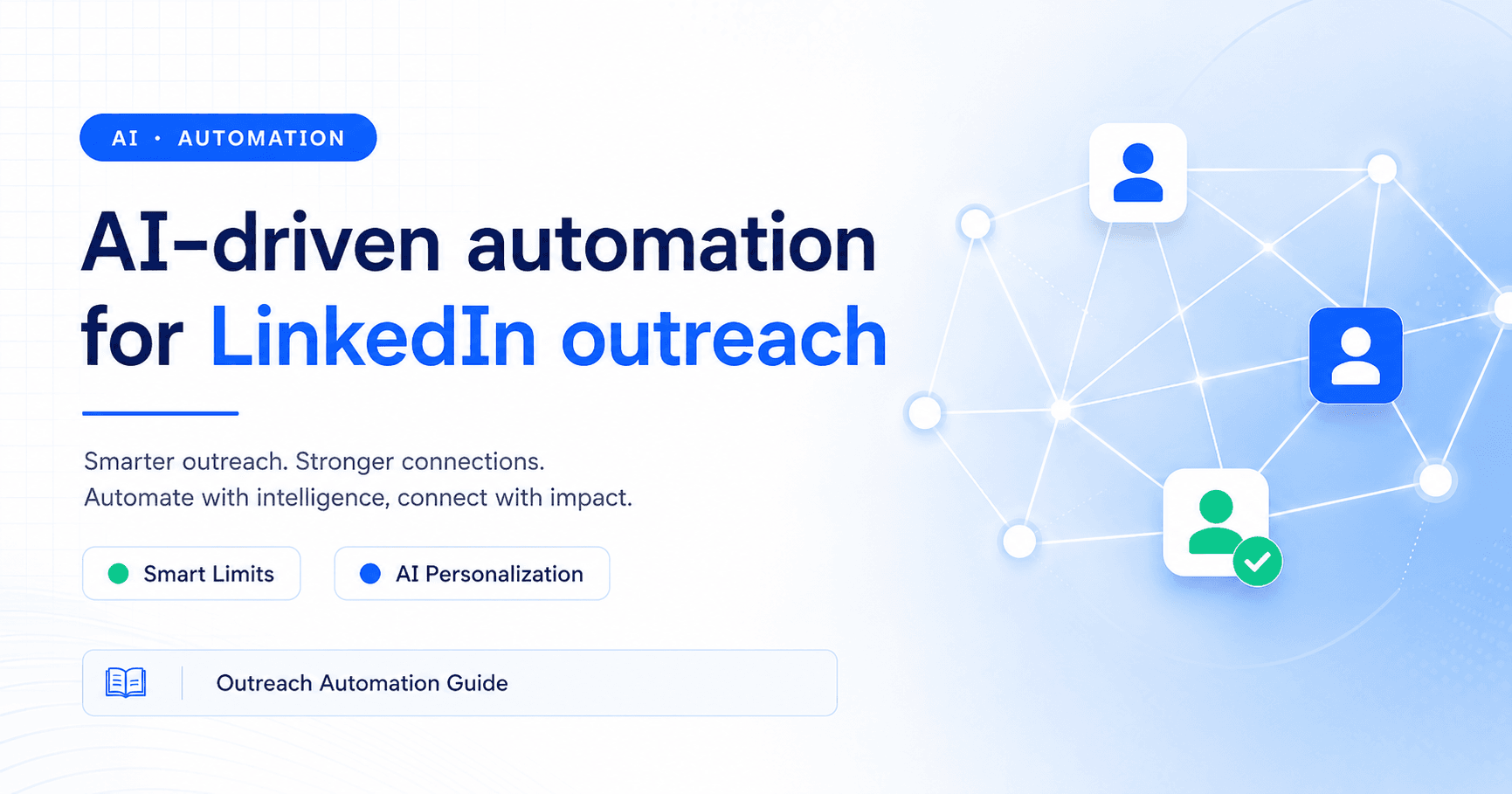
Scaling outreach on LinkedIn used to mean choosing between two bad options: send fewer messages and miss pipeline, or blast everyone and risk a restricted account. Modern sales teams want a third path. A modern LinkedIn Automation Tool gives them that path by combining safe sending limits, sequence logic that mimics human behaviour, and AI personalization that lifts reply rates without burning the seat behind it.
This guide walks SDRs, founders, and growth marketers through how these systems actually work, what to look for, and how to measure results.
What is a LinkedIn Automation Tool?
A LinkedIn Automation Tool is software that automates connection requests, follow-ups, profile visits, and messaging on LinkedIn while respecting platform limits. It lets sales teams run multi-step outreach sequences with AI-generated personalization, behaviour delays, and analytics — replacing the manual prospecting workflow without triggering safety flags on the user's account.
What Is a LinkedIn Automation Tool?
A LinkedIn Automation Tool is a software layer that performs prospecting actions — visiting profiles, sending invites, following up, liking posts — on behalf of a user account. The best platforms run through a dedicated cloud session per user, throttle activity to mirror real human patterns, and plug into a CRM so every reply is tracked.
Sales teams use these tools for two reasons: speed and consistency. LinkedIn outreach automation removes the copy-paste fatigue that kills SDR productivity, while automated LinkedIn messaging keeps follow-ups firing on schedule even when reps are on calls, asleep, or onboarding. The result is a steady drumbeat of touches instead of bursty manual effort.
Why Traditional LinkedIn Outreach Doesn't Scale
Manual prospecting hits a ceiling fast. A focused SDR can realistically send 30–40 thoughtful invites and follow-ups per day before quality drops. Multiply that by personalization, research, and CRM logging, and most reps spend more time preparing outreach than doing it.
Three bottlenecks repeat across teams:
- Time tax. Researching every prospect adds minutes that compound into hours.
- Personalization drift. By message 50, openers start sounding identical.
- Inconsistent follow-up. Reps forget step three of a five-step sequence, and pipeline leaks.
Pipeline targets keep climbing, but the human capacity to manually personalize doesn't. That gap is exactly where automation earns its place.
The Three Pillars of Safe LinkedIn Automation
LinkedIn's Professional Community Policies make it clear: any tool that scrapes or floods the platform puts the underlying account at risk. Safe automation is built on three pillars.
Smart Activity Limits
Volume is the easiest way to get flagged. Mature platforms cap daily activity well below LinkedIn's invisible thresholds — typically 15–25 connection requests, 40–60 messages, and a few dozen profile visits per day, with gradual ramp-up for new accounts. Limits should scale with account age, premium tier, and warmth signals, not a flat number for every user.
Human-Like Engagement Patterns
Bots get caught because they behave like bots. Real users don't send 30 invites at 9:00:00 AM sharp. Good tools introduce randomized delays between actions, restrict sending to working hours in the user's timezone, and pause when the account is logged in from elsewhere. Behavior simulation, not raw speed, is the trust signal.
Compliance and Safety Controls
Account health monitoring should be a first-class feature. That means warning alerts when reply rates dip, automatic pauses when LinkedIn returns soft errors, and audit logs reviewed weekly. For a deeper checklist on protecting seats, see the LinkedIn automation safety best practices playbook covering 2026 guardrails.
Building High-Converting LinkedIn Outreach Sequences
A great sequence respects the medium. LinkedIn is not email; it's a social graph where every touch is visible on a profile. Strong sequences usually follow this rhythm:
- Connection request (Day 0) — A short note tied to a shared signal: a mutual group, a recent post, a customer they cited. No pitch.
- Welcome message (Day 1, post-accept) — A single line of value. Why you reached out, what problem you usually help with. No calendar link yet.
- Insight follow-up (Day 4) — A relevant case study, benchmark, or one-line takeaway from a similar buyer.
- Soft ask (Day 8) — A specific, low-commitment question. "Worth a 15-minute look?" beats "Do you have time this week?"
- Polite breakup (Day 14) — Closes the loop. Surprisingly, breakup messages convert.
The art is matching tone to ICP. A CFO won't engage with the same opener that delights a founder. Templates are a starting point, not the finish line — which is where AI changes the math.
How AI Personalization Changes Outreach Performance
Old-school "{{first_name}}" mail-merge is dead. AI personalization reads a prospect's profile, recent activity, company news, and role context, then drafts an opener that references something specific — a post they shared, a hiring trend at their company, a recent funding round. At scale, that level of relevance was impossible for human reps. Now it ships in seconds.
Based on aggregated outreach campaign analysis conducted by SalesTarget.ai across 4,200+ B2B sequences between Q3 2025 and Q1 2026, campaigns combining AI-generated first-touch personalization with paced 15–20 connections per day saw an average acceptance rate of 38% — compared to 19% for unpersonalized, high-volume sequences. Reply rates more than doubled in the same dataset.
This is the lift the AI-powered LinkedIn outreach platform from SalesTarget.ai is built to deliver: prospect research, dynamic message generation, and sequence orchestration in one workspace.
READY TO SEE IT ON YOUR OWN ICP?
Spin up a sequence, let AI write the openers, and watch acceptance rates climb — without touching your sending limits.
Key Features to Look for in a Modern LinkedIn Automation Tool
Not all platforms are equal. When evaluating options, pressure-test the shortlist on:
- AI personalization at the message and subject-line level, not just variables.
- Multi-step sequence automation with branching logic for accepted, replied, and ignored states.
- CRM integrations with HubSpot, Salesforce, and Pipedrive — bi-directional, not just push.
- Analytics dashboards showing acceptance, reply, and meeting rates per step and per sender.
- Safety controls including cloud IP isolation, working-hour scheduling, and automatic throttling.
- Campaign reporting that ties LinkedIn activity to sourced pipeline.
For a fuller side-by-side, the best LinkedIn automation tools breakdown compares leading 2026 platforms across these dimensions.
Common Mistakes Teams Make with LinkedIn Automation
Most failures aren't tooling problems — they're discipline problems.
- Over-automation. Treating LinkedIn like cold email. Every message should still feel one-to-one.
- Generic messaging. "I'd love to connect to grow my network" deserves the silence it gets.
- Poor targeting. A perfect sequence to the wrong ICP loses every time.
- Ignoring limits. Pushing volume to test the ceiling almost always finds it.
- No A/B testing. Teams that don't test openers leave 20–30% of reply rate on the table, as HubSpot's prospecting research consistently confirms.
How to Measure LinkedIn Automation Success
Vanity metrics like "invites sent" mean nothing. Track the funnel:
- Acceptance rate — Health of your targeting and first message. Aim for 30%+.
- Reply rate — Quality of your follow-ups. Aim for 10–15%.
- Meeting booked rate — The only metric that matters to revenue. 2–5% of total touched is strong.
- Pipeline contribution — Sourced opportunity value per seat per month.
- Revenue impact — Closed-won attributable to LinkedIn-sourced meetings.
Review weekly, iterate on the lowest-converting step, and protect what works. For a deeper framework, the complete LinkedIn automation guide walks through benchmarks by industry.
Safe scale on LinkedIn is no longer a tradeoff. The right LinkedIn Automation Tool lets revenue teams pair smart activity limits with human-like engagement patterns and AI personalization that actually sounds human. Get the three pillars right — limits, behavior, compliance — wrap them in tested sequences, and measure what converts to pipeline. That's how modern teams turn LinkedIn from a manual grind into a predictable, compounding channel.