Your reps are spending half their day in spreadsheets, pulling names from LinkedIn, cross-checking company websites, guessing at email formats, and sending cold messages that bounce or get ignored. By the time they find one contact worth calling, the data is already three months stale. That's not a process problem. That's a data problem.
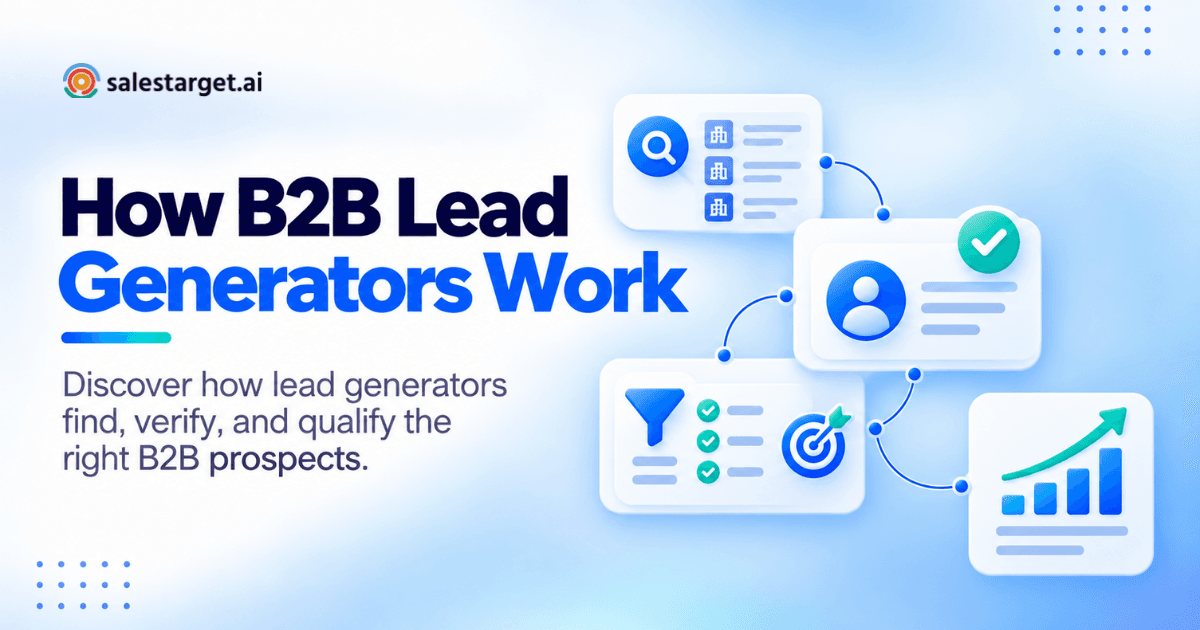
B2B lead generators solve this by automating the work between "who should we be talking to?" and "here's a verified contact ready for outreach." At their core, they pull prospect data from large databases, filter it against your ideal customer profile (ICP), enrich each record with contact details, verify that the information is current, and surface a signal on who's most likely to buy right now.
This guide breaks down exactly how that works, what to look for in a lead generator, and how to build a prospecting workflow that produces pipeline, not just lists.
What B2B Lead Generators Do
Find Companies That Match Your Ideal Customer Profile
Lead generators start at the account level. You define the type of company you sell to: industry, headcount, revenue range, location, tech stack. The platform searches a database of business entities and returns accounts that match those parameters. This replaces hours of manual research with a filtered, actionable list.
Identify Decision-Makers Inside Target Accounts
Once you have target accounts, the tool surfaces the people inside them worth reaching. You filter by job title, department, and seniority level. Every contact comes attached to the account context you already built, so nothing arrives without company-level framing.
Enrich Prospect Records With Sales Data
Raw contact records are thin. Good lead generators fill the gaps: verified business email, direct phone, LinkedIn URL, company funding status, headcount growth, and tech stack. Enrichment turns a name into a workable prospect record.
Verify Contact Information Before Outreach
A list is useless if the emails bounce. Verification runs MX record checks, SMTP validation, and disposable-address detection to confirm a contact is reachable before it goes into a sequence. According to Salesforce's State of Sales report, sales reps spend only 28% of their time actually selling. Verified data protects that time from being consumed by failed outreach.
Prioritize Prospects Using Fit and Intent Signals
Not every matching account is ready to buy. Lead generators that incorporate buyer intent data flag which accounts are actively researching topics related to your product. That layered signal (fit plus intent) separates a cold list from a prioritized one.
How B2B Lead Generators Find Sales Prospects
Building Prospect Searches From ICP Criteria
The search starts with your ICP: the firmographic and technographic attributes of your best closed customers. You input those criteria, and the platform returns accounts matching across multiple dimensions simultaneously.
Filtering Accounts by Industry, Size, Location, and Revenue
Filters narrow the universe. Industry keeps you in your lane. Headcount and revenue indicate budget and buying complexity. Location matters for territory-based teams and compliance-sensitive markets. Stacking filters tightens list quality before a single contact is added.
Finding Contacts by Role, Department, and Seniority
After accounts, the search moves to people. Filtering by role and department finds the right function. Seniority filtering gets you to the level that actually signs off on purchases. A VP of Sales at a 200-person SaaS company is a different conversation than a sales ops coordinator at the same company.
Using Sales Intelligence to Add Context to Prospect Data
Static firmographic data tells you who a company is. Sales intelligence tells you what's happening there right now: funding rounds, hiring spikes, leadership changes, and technology additions signal that a company's needs are shifting. That context changes how, and whether, you should reach out.
Creating Focused Prospect Lists for Outbound Campaigns
A focused list of 200 high-fit accounts beats a 2,000-name export where 80% are irrelevant. Learn how B2B lead generators help outbound teams build lists that move to outreach, not just to storage.
From Prospect Discovery to Qualified B2B Sales Leads
Start With the Right Target Accounts
Qualification starts at the account level, not the contact level. If the company doesn't fit your ICP on firmographics, no contact inside it is worth pursuing.
Find the People Involved in the Buying Process
B2B purchases rarely come down to one person. Gartner research shows a typical B2B buying group includes six to ten stakeholders. Your prospect list needs to reflect the buying committee, not just the top executive.
Enrich Missing Contact and Company Data
Most databases have gaps. Enrichment fills them: direct dials where only main numbers exist, personal emails where business addresses are unavailable, and company details that aren't public. The fuller the record, the more effective the outreach.
Verify Business Emails and Contact Details
Unverified lists push bounce rates above 5%, which damages sender domain reputation and reduces inbox placement for every address on the same domain.
Score Prospects Based on ICP Fit
Scoring assigns a relative rank to each prospect based on how closely they match your ICP. A prospect matching on five attributes ranks higher than one matching on two. That ranking tells reps where to spend time first.
Use Buyer Intent Signals to Prioritize Outreach
An account already researching your solution category is warmer than one that isn't. Reaching them first, when the need is active, is the difference between a reply and an ignore.
The Role of Lead Qualification in B2B Prospecting
Account Fit vs Contact Fit
Account fit means the company matches your ICP. Contact fit means the person inside it has buying authority or influence. Both matter. An influencer at a perfect-fit account is worth pursuing. A decision-maker at a poor-fit account usually isn't.
Matching Prospects Against Your ICP
ICP matching is a scoring exercise. Define the attributes of your best customers, then measure each prospect against them. The closer the match, the higher the qualification confidence.
Identifying Buying Roles and Decision-Makers
Most enterprise deals involve a champion, a technical evaluator, a business owner, and a budget holder. Mapping those roles inside a target account before outreach begins means you're building real pipeline, not just sending messages into the dark.
Using Lead Scoring to Rank Prospect Quality
Lead scoring applies numerical weight to each qualification attribute. A company in your target vertical scores points. A company at the right headcount scores more. A VP-level contact adds additional weight. The total tells you what to prioritize.
Separating High-Priority Prospects From Low-Fit Leads
Low-fit leads waste rep time and inflate activity metrics without generating pipeline. Filtering them out before outreach keeps the team focused on accounts that can close.
How Buyer Intent Signals Improve Prospect Prioritization
Signals That Indicate Account Interest
Intent signals are behavioral indicators: an account consuming content on your category, visiting competitor pages, or searching for solution-specific terms. These signals don't guarantee purchase, but they indicate active exploration.
Combining Intent Data With ICP Fit
A high-intent account that doesn't fit your ICP is still a low-quality lead. A high-fit account with active intent is where you focus. The combination filters out noise and surfaces accounts where timing and fit overlap.
Identifying Accounts Worth Contacting First
Accounts showing both ICP fit and live intent signals go to the top of the outreach queue. Reaching them while the signal is active increases the probability of a real reply.
Turning Intent Signals Into Timely Sales Outreach
Intent data has a shelf life. A signal that was active 60 days ago may no longer reflect current buying behavior. A platform that surfaces intent in near-real-time, then connects directly to outreach sequences, closes that gap.
Building a Qualified B2B Prospect List
Define Clear ICP Filters Before Searching
Before opening any lead generation tool, document the attributes of your best closed deals: industry, headcount range, revenue range, geography, and tech stack. These become your search filters. Without this step, your list is a guess.
Build a Target Account List Before Adding Contacts
Contacts should follow accounts. Build the account list first, confirm each fits your ICP, then pull contacts from those accounts. Reversing this order is how you end up with contacts at companies that will never buy.
Add the Right Decision-Makers From Each Account
For each account, identify two to four contacts: the primary decision-maker, a likely champion, and relevant influencers. Covering the buying committee from the start reduces the risk of losing a deal because you reached the wrong person.
Verify Prospect Data Before Starting Outreach
Run every email address through a verification step before adding it to a sequence. This is the most commonly skipped step in manual prospecting, and the most costly in terms of deliverability damage.
Segment Leads by Fit, Intent, and Priority
Split your list into tiers. Tier one: high ICP fit, active intent signals. Tier two: high ICP fit, no current intent. Tier three: partial ICP fit. Each tier gets a different cadence and messaging approach.
Move Qualified Prospects Into Outreach Sequences
Once verified and segmented, push prospects directly into your outreach workflow. Manual transfers introduce delays and data errors. A platform that connects list-building to sequence enrollment removes that friction. See how B2B lead generators for sales teams reduce time from prospect to first touch.
What to Look for in a B2B Lead Generator
Accurate B2B Contact and Company Data
The database is the foundation. A platform with 100 million verified, current contacts beats one with 500 million stale records. Ask vendors how often data is refreshed and what their verified contact accuracy rate is.
Advanced Prospect and Account Filters
You should be able to filter by industry, sub-industry, headcount, revenue, geography, department, seniority, tech stack, and recent business events. The more filter dimensions available, the tighter the list.
Contact Enrichment and Data Verification
Enrichment should happen at the moment of search, not days later as a separate export step. Verification should be built in, not bolted on. If the platform requires a third-party validator, you're adding friction and introducing lag.
Buyer Intent and Account Signals
Look for platforms that surface intent signals from multiple sources: content consumption, search behavior, competitor engagement, and business events. Single-source intent data is too narrow to rely on.
Lead Scoring and Qualification Options
Configurable scoring that reflects your specific ICP definition removes a manual ranking step that most teams skip or do inconsistently.
Email and LinkedIn Outreach Connections
The best lead generators connect directly to outreach. No CSV export, no re-import, no data loss between discovery and contact. Native email and LinkedIn automation in the same platform is the benchmark.
CRM and Pipeline Management
Where do qualified leads go after discovery? If the answer involves exporting to a separate CRM, tracking breaks. A built-in CRM or a tight two-way sync with your existing one keeps the pipeline connected to the prospecting workflow.
Data Freshness and Contact Accuracy
Ask vendors how frequently they re-verify data on a rolling basis. Contacts change jobs, companies get acquired, and emails become invalid within months. A platform that re-verifies continuously is more reliable than one working from data scraped 18 months ago.
B2B Lead Generators vs Manual Sales Prospecting
| Capability | B2B Lead Generator | Manual Prospecting |
|---|---|---|
| Prospect Research and List-Building Time | Minutes with filters and database search | Hours of LinkedIn, company sites, and manual data entry |
| Contact Data Accuracy | Verified at enrichment, typically 95%+ | Prone to errors, outdated fields, and gaps |
| Speed of Lead Qualification | Automated scoring against ICP criteria | Manual review: slow and inconsistent across reps |
| Ability to Prioritize High-Intent Accounts | Real-time intent signals flag active accounts | No visibility into intent; outreach is timing-blind |
| Moving From Prospecting to Outreach | Direct push into sequences with no export step | Manual transfer introduces lag and data errors |
Connecting B2B Lead Generation With Sales Outreach
Moving Verified Leads Into Email Campaigns
Once a prospect clears verification, it should flow directly into an email sequence. Every manual step between verification and first send is a point where leads get delayed, duplicated, or dropped.
Reaching Prospects Through LinkedIn
Email alone reaches fewer than half of B2B buyers. Adding LinkedIn connection requests, DMs, and profile engagement alongside email increases visibility and reply rates without requiring a separate tool or workflow.
Coordinating Email and LinkedIn Follow-Ups
Multichannel outreach works when both channels share context. A LinkedIn message referencing an earlier email feels coordinated. A LinkedIn DM that contradicts the email thread creates confusion. Both sequences need to run from the same system.
Tracking Prospect Activity Across Channels
Reply tracking, open signals, and engagement actions from both email and LinkedIn should land in one unified view. Jumping between inboxes to track a single prospect is how deals get missed.
Moving Engaged Leads Into the Sales Pipeline
When a prospect replies or books a meeting, they move from "outreach" to "opportunity." That handoff should be automatic: the reply triggers a pipeline entry, a deal is created, and the rep gets a task. No one should be manually moving contacts between systems after a positive reply.
Why Choose SalesTarget.ai
SalesTarget.ai combines every step described above into one platform. You don't need a separate data tool, a separate cold email sender, a separate LinkedIn automation tool, and a separate CRM. It's all connected, running from a single workspace.
Find and Enrich B2B Prospects With Lead Explorer
Lead Explorer gives you access to 840M+ verified professional profiles and 146M+ business entities. Search in plain English or use stacked filters across industry, role, seniority, company size, revenue, location, and tech stack. One click enriches each record with verified professional email, direct phone, and mobile number. No export, no waiting.
Search 840M+ Profiles and Use 4,000+ Intent Signals
SalesTarget.ai surfaces buyer intent through Bombora Intent Topics and real-time business events: funding rounds, hiring spikes, leadership changes, and awards. The lookback window is 30 to 90 days, so signals reflect current buying behavior, not last quarter's activity.
Verify Prospect Emails Before Outreach
The built-in Email Validator runs MX record checks, SMTP validation, and disposable-email detection before any contact enters a sequence. SalesTarget.ai validates 90% of emails before sending, protecting sender reputation and keeping bounce rates low.
Run Email and LinkedIn Sequences in One Workflow
Email Outreach and LinkedIn Outreach run as one coordinated multichannel sequence. AI builds the sequence from a plain-English audience description. Unlimited inboxes with automatic warm-up and inbox rotation protect deliverability. LinkedIn automation handles connection requests, DMs, and follow-ups within safe rate limits, with human-like delays and timezone-aware scheduling.
Manage Leads and Deals in the Built-In CRM
The SalesTarget.ai CRM was built for outbound teams, not enterprise admin overhead. Campaign leads land automatically, every email and call logs to the lead timeline without manual entry, and follow-up tasks are created automatically when a lead replies or a meeting ends. Teams using it report 3.2X faster deal cycles and 91% follow-up completion rates.
Use AI Copilot to Support Prospecting and Sales Tasks
AI Copilot works as a conversational sales assistant inside the platform. Ask it to find leads, generate a personalized email sequence, flag at-risk deals, or pull a status update on your pipeline. It handles the administrative work so reps stay focused on conversations and closing.
Common Mistakes That Reduce B2B Lead Quality
Building Large Lists Without a Clear ICP
A list of 5,000 contacts with no ICP filter is five thousand guesses. Volume without criteria is noise, not pipeline.
Targeting Contacts Based Only on Job Titles
"VP of Sales" at a two-person startup and "VP of Sales" at a 500-person SaaS company are not the same prospect. Job title is a starting point, not a qualification criterion.
Sending Outreach to Unverified Email Addresses
HubSpot data shows email bounce rates above 2% begin to damage sender reputation. Skipping verification is one of the fastest ways to get your domain flagged and your emails filtered.
Treating Every Database Contact as a Qualified Lead
A contact in a database is a record. It becomes a lead when it matches your ICP, passes verification, and enters a structured outreach sequence. Everything before that is research.
Ignoring Buyer Intent and Account Signals
Outreach sent to accounts with no active intent gets treated like unsolicited noise because, from the buyer's perspective, that's what it is. Intent signals let you reach people when the topic is already on their radar.
Sending Leads to Sales Before Qualification
Passing unqualified leads to your sales team erodes trust between SDRs and AEs faster than almost any other mistake. It also skews pipeline data and makes forecast accuracy impossible.
Measuring Lead Volume Instead of Pipeline Quality
A quota on leads generated incentivizes list inflation. The right metric is qualified prospects who advance through pipeline stages. Volume without quality is activity theater, not revenue production.
Metrics That Show Whether Your B2B Lead Generation Is Working
Verified Contact Rate
What percentage of contacts in your list pass email verification? Below 80% is a warning sign that your data source needs to change.
ICP Match Rate
Of all contacts generated, what percentage meet every core ICP criterion? A low ICP match rate means your search filters are too broad or your ICP definition isn't specific enough.
Lead Qualification Rate
What percentage of generated leads move from "list" to "qualified prospect" status? If this is low, the problem is usually upstream in the ICP definition or the data source.
Email Bounce Rate
Track hard and soft bounces separately. Hard bounces above 2% indicate a verification gap. Repeated soft bounces from the same domain point to a deliverability issue, not a data issue.
Positive Reply Rate
Replies that express interest, ask a question, or request a meeting signal that your list, messaging, and timing are working together. A low positive reply rate usually points to a fit problem, not a copy problem.
Meetings Booked From Generated Leads
How many qualified leads turn into booked conversations? If this is low while reply rate is acceptable, the issue is in the qualification step or the meeting booking process itself.
Pipeline Created From Qualified Prospects
This is the metric that connects prospecting activity to business outcomes. How much revenue opportunity did your lead generation workflow produce? This number justifies investment in better tools and better process.
Build a Better B2B Prospecting Workflow
Most B2B sales teams are losing time and pipeline to the same problems: stale contact data, lists built without a clear ICP, verification skipped because it's a manual step, and outreach running across disconnected tools with no unified view.
The fix isn't a better spreadsheet or a longer cold email. It's a workflow where finding, enriching, verifying, and reaching prospects all happen in one connected system, with intent signals telling your team who to prioritize before the first message goes out.
SalesTarget.ai is built for exactly that workflow. From Lead Explorer's 840M+ database with real-time intent signals, through verified multichannel outreach on email and LinkedIn, to a CRM that tracks every deal without manual logging, the platform removes the gaps where qualified leads get lost between tools.
If your current prospecting workflow produces lists your reps don't trust, or pipeline numbers that don't reflect the activity your team puts in, the problem is structural. Start with SalesTarget.ai and build a process where every prospect your team contacts is verified, ICP-matched, and ready for a real conversation.