Your sales reps are spending hours crafting cold emails to executives, and most of those emails get deleted before they're even opened. The C-suite is the hardest audience in B2B sales because it is low volume, high stakes, and has zero tolerance for irrelevant messaging. One generic email to a CFO or CRO and you've burned that lead for months.
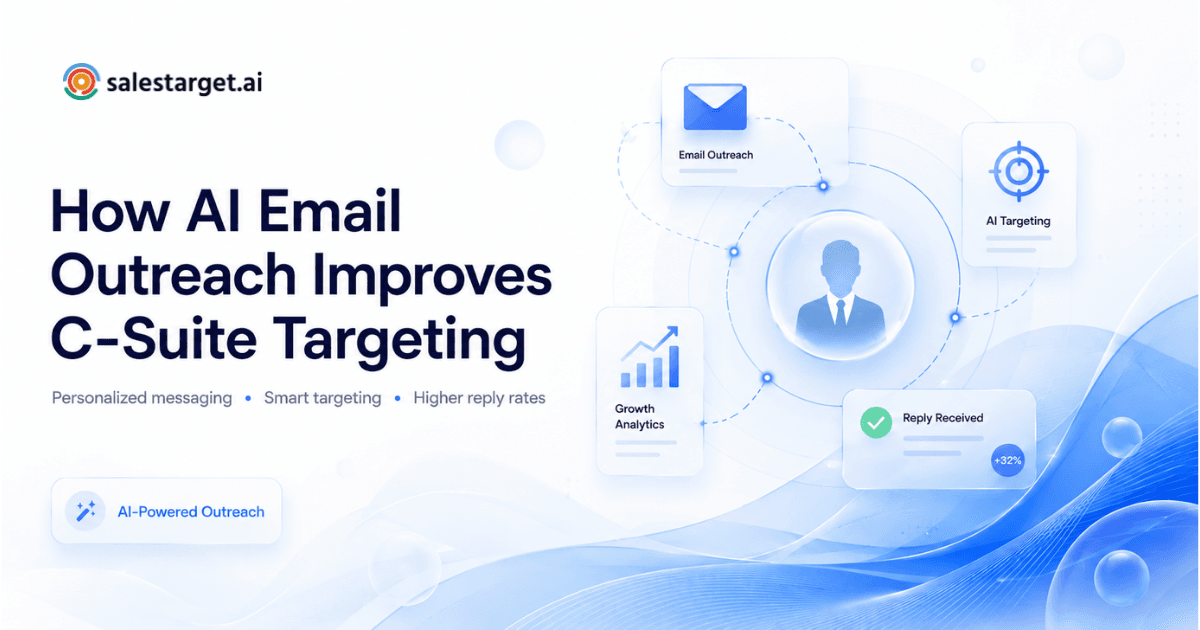
AI email outreach solves this challenge by analyzing executive-level signals, aligning messages with business priorities, and delivering personalized communication at scale without increasing headcount. The result is more replies, more booked meetings, and shorter paths to revenue from the contacts that matter most.
This blog breaks down exactly how AI email outreach works for C-suite targeting, what separates it from basic automation, and how sales teams are using it to move executives from cold to conversation faster.
What Is AI Email Outreach?
AI email outreach is the use of artificial intelligence to find, personalize, send, and optimize cold email campaigns automatically. It goes beyond scheduled sequences or mail merges. AI reads prospect data, company context, and behavioral signals to write emails that feel individually crafted, then adjusts timing, follow-up cadence, and messaging based on what actually gets responses.
Where traditional automation handles repetitive tasks, AI goes further by drafting emails, researching prospects, testing subject lines, and determining the best time to follow up.
Why Traditional Email Outreach Struggles to Reach C-Suite Executives?
Generic Messaging Gets Ignored
C-suite executives receive dozens of cold emails every day. The ones that use first name personalization, a product pitch in the first sentence, and a generic "would love to connect" close get filtered out immediately, either by spam algorithms or by the executive's own pattern recognition. Generic messaging signals that the sender didn't do the work, and executives have no reason to reward that.
Executives Have Limited Time and Crowded Inboxes
A VP of Sales or CFO is not reading email looking for new vendors. They're looking for relevant intelligence that helps them hit a number or solve an urgent problem. An email that doesn't prove relevance in the subject line and first sentence loses immediately. Attention spans at this level are measured in seconds, not minutes.
Manual Personalization Does Not Scale
Researching a single executive properly, their current priorities, recent company news, known pain points, and the right framing, takes 20 to 30 minutes per contact. Across a target list of 200 C-suite prospects, that's 70+ hours of research before a single email is written. SDR teams simply don't have that capacity, so personalization gets cut, and response rates stay flat.
Why Response Rates Remain Low With Traditional Outreach
It's not volume. Sending more emails doesn't fix the core problem: the message isn't relevant to the specific executive receiving it. Studies consistently show that B2B cold email response rates hover around 1 to 5% for generic outreach. The gap between a 2% and a 15% response rate almost always comes down to relevance and timing, not send volume (Backlinko, 2024).
The Difference Between Automation and AI Email Outreach
| Capability | Traditional Email Automation | AI Email Outreach |
|---|---|---|
| Personalization | Merge tags (first name, company) | Role, intent signals, company events, business context |
| Content creation | Pre-written templates | AI-generated, varied copy per prospect |
| Targeting | Static lists | Real-time signal-based segmentation |
| Follow-up logic | Fixed schedule | Adaptive based on engagement behavior |
| Deliverability | Manual SPF/DKIM setup | Auto inbox warm-up, rotation, and deliverability monitoring |
| Data enrichment | Separate tool required | Built into the prospecting workflow |
| Performance optimization | Manual A/B testing | Continuous AI-driven refinement |
The fundamental shift is from campaign-level logic to contact-level intelligence. Automation sends the same playbook to everyone faster. AI adapts the playbook per contact before it sends.
How AI Email Outreach Improves C-Suite Targeting?
Identifying the Right Executive Decision-Makers
Reaching the C-suite starts with finding the right executives at the right companies. Salestarget.ai's Lead Explorer searches across 840M+ verified profiles using plain-English queries and advanced filters, including seniority, department, company size, revenue range, industry, and tech stack. You're not manually scrolling LinkedIn lists. You're pulling a precise slice of executives who match your ICP in seconds.
Segmenting Executives by Role and Business Priorities
A CEO at a 50-person Series A company and a CFO at a 500-person enterprise have entirely different buying triggers. Role-level segmentation means your outreach reflects that. Salestarget.ai's Advanced Targeting Filters let you separate C-suite segments by title, seniority, company stage, and even tech stack, so you're building separate lists for separate messages rather than dropping everyone into one sequence.
Using Intent Signals to Prioritize Outreach
Not every executive is in-market right now. Intent data tells you which ones are. Salestarget.ai's Lead Explorer integrates Bombora Intent Topics plus real-time business events: funding rounds, hiring spikes, leadership changes, and awards, with a 30 to 90 day lookback. An executive whose company just closed a funding round and is actively researching your category is worth five times the outreach effort of one who shows no signal. Prioritizing by intent stops your team from burning time on cold-cold contacts.
Matching Messaging to Executive-Level Challenges
This is where most teams fail. They focus on product features, while executives are primarily concerned with business outcomes such as revenue growth, cost reduction, operational efficiency, and competitive advantage. AI email outreach maps your value proposition to executive-level challenges based on their role, company context, and current signals. The message a CTO receives about security and integration complexity is different from the one a VP of Sales receives about pipeline coverage and rep productivity. Salestarget.ai's AI Content Generator produces role-differentiated messaging from a plain-English brief, removing the need to manually write six variations of the same email.
How AI Personalization Increases Executive Engagement?
Creating Role-Specific Email Messaging
Generic personalization is first name plus company name. Real personalization is knowing that a CFO in a mid-market SaaS company is three months away from a board review and likely focused on cost efficiency and revenue predictability. AI pulls role context, seniority level, and company stage to write emails that speak directly to what that executive is accountable for, not a general pitch that could fit anyone.
Using Company Insights to Make Emails Relevant
Salestarget.ai surfaces company-level events alongside contact data. If a company just hired a new VP of Sales, announced an expansion into a new market, or raised a round, your outreach can open with that context. Executives respond to emails that prove the sender did their homework. Starting with a company-relevant hook instead of a product statement immediately increases the email's perceived value and relevance.
Writing Subject Lines That Attract Executive Attention
Most executive-targeted subject lines fail for one of two reasons: they're too vague ("Quick question") or too salesy ("Increase your revenue by 40%"). The highest-performing subject lines for C-suite prospects reference a specific business outcome, a shared context, or a direct question tied to a known priority. Salestarget.ai's AI Spintax Generator creates multiple subject line variants per campaign so you can test what resonates with different executive segments without writing each variation manually.
Delivering Personalized Outreach at Scale
Personalization at scale sounds contradictory until AI handles the content generation. Salestarget.ai's Email Outreach module auto-builds multi-step sequences from an audience description. Describe the segment, the business context, and the goal, and the AI generates the first touch, follow-ups, and pacing. Unlimited inboxes with AI warm-up and intelligent inbox rotation keep deliverability intact as you scale across hundreds of executive contacts without volume spikes that trigger spam filters.
According to research from McKinsey, personalization at scale can reduce customer acquisition costs by up to 50% and lift revenues by 5 to 15%. For C-suite outreach, where each contact represents significant deal value, that math compounds fast (McKinsey, 2021).
Key AI Email Outreach Features That Drive Executive Responses
AI-Generated Email Content
Salestarget.ai's AI Content Generator writes email copy tuned to the target executive's role, company context, and the current business signal that triggered outreach. This isn't template filling. The AI produces varied, human-sounding copy that avoids the repetition patterns spam filters flag and readers recognize as automated.
Prospect Data Enrichment
One-click enrichment in Salestarget.ai's Lead Explorer unlocks verified professional email, personal email, phone, and mobile at the moment you find the lead. Data comes from 50+ sources and covers 840M+ profiles. Enrichment at the point of discovery means the contact data reflects current reality, not a list scraped six months ago.
Automated Follow-Up Sequences
Most executive replies don't come from the first touch. They come from the second or third email, sent at the right interval, with a slightly different angle. Salestarget.ai auto-sequences follow-ups based on engagement signals, not arbitrary timers. Unibox, the unified inbox, sorts replies by intent (Interested, Follow-Up, Not a Fit), so reps can prioritize response time on the contacts most likely to convert.
Engagement Tracking and Optimization
Every open, click, and reply feeds back into the campaign. Salestarget.ai tracks which subject lines, first sentences, and calls to action get the best responses from which executive segments, giving sales teams real data to improve campaigns continuously rather than guessing what's working.
Email Deliverability Monitoring
Reaching the C-suite requires getting into the inbox first. Salestarget.ai runs automatic SPF / DKIM / DMARC checks, domain health monitoring, and AI inbox warm-up to protect sender reputation. The Email Validator verifies executive emails using MX / SMTP checks and risk scoring before a single send, cutting bounce rates and keeping domains off blacklists. Salestarget.ai reports that 90% of emails are validated before sending across active campaigns.
Best Practices for AI Email Outreach to C-Suite Prospects
Focus on Business Outcomes Instead of Product Features
Executives buy results. They don't buy features. Your email to a CRO should open on pipeline coverage or rep ramp time, not on your platform's dashboard or integrations list. Features are proof points. Lead with the outcome, then back it with one specific capability.
Keep Executive Emails Short and Direct
Under 150 words is a good ceiling for cold executive outreach. Every sentence needs to earn its place. Long emails signal that the sender didn't respect the executive's time. Short emails that nail the relevant pain and make one clear ask outperform longer ones consistently.
Personalize Beyond Basic Contact Details
First name and company name are table stakes. Effective executive personalization focuses on the recipient's current business context, such as recent company milestones, market changes affecting their role, or challenges commonly faced by organizations at their stage of growth. Salestarget.ai's signal layer, pulling from business events and Bombora intent data, gives you that context automatically at the time of enrichment.
Use Data-Driven Follow-Up Timing
There's no magic follow-up window. The right moment depends on who you're contacting, how they engage with email, and where the conversation stands. Salestarget.ai's engagement tracking identifies when individual prospects are most active and adjusts follow-up timing accordingly rather than defaulting to a fixed cadence that ignores actual behavior.
Test and Refine Messaging Continuously
One version of an email is not a campaign. It's a hypothesis. Running two to three subject line variants, testing different opening lines, and tracking which angles resonate with specific C-suite segments builds institutional knowledge about what works for your specific market. Salestarget.ai's AI Copilot generates A/B variants and tracks which drives replies and meetings, so testing becomes a built-in habit rather than a quarterly project.
Common AI Email Outreach Mistakes When Targeting Executives
Sending the Same Message to Every Executive
A CEO, CFO, and CTO at the same company have different priorities and different buying criteria. Sending a single message to all three is like giving one pitch to an entire buying committee and hoping it sticks. Segment by role and customize the angle for each title.
Overusing AI-Generated Content Without Review
AI writes fast. That speed can introduce risk, as teams may send emails without proper review, resulting in messaging that misses the mark on tone, context, or accuracy. AI-generated drafts should be reviewed before deploying to senior contacts where a misstep carries real cost. Use AI for scale, use human judgment for quality.
Ignoring Executive Priorities and Business Context
Sending an email that reads like a cold pitch to an executive who just went through a restructuring, a major product launch, or a leadership change without acknowledging that context signals a lack of situational awareness. Salestarget.ai's real-time business event signals exist specifically to avoid this: you know what's happening at the company before you write the email.
Sending Too Many Follow-Up Emails
Three to four follow-ups is a reasonable ceiling for executive outreach. Sending six, seven, or eight emails to a VP who has not responded is not persistence. It's noise. It also increases unsubscribe rates and damages sender reputation over time.
Failing to Monitor Email Deliverability
High-quality executive contact lists mean nothing if emails land in spam. Deliverability is not a one-time setup. Domain health, inbox warm-up, and bounce management need ongoing attention. Sales teams that ignore deliverability metrics eventually find their response rates declining for reasons that have nothing to do with messaging quality.
Why Choose Salestarget.ai for AI Email Outreach?
Find Verified Executive Contact Data
Salestarget.ai's Lead Explorer gives access to 840M+ verified profiles with 99% contact data accuracy. Filter by seniority, role, company size, revenue, industry, and intent signals to build precise executive target lists, not broad lists that need manual cleanup.
Build Personalized AI Email Campaigns Faster
Salestarget.ai's Email Outreach module creates full multi-step sequences from a plain-English brief, including first touch, follow-ups, and pacing. Teams report 35% faster campaign creation compared to building sequences manually across disconnected tools.
Validate Emails Before Sending
The built-in Email Validator runs MX / SMTP checks, disposable-email detection, and risk scoring on every contact before the first send. Bad data doesn't reach your sequences. Your domain stays clean and your sender reputation stays intact.
Manage Outreach and Follow-Ups From One Platform
Salestarget.ai's CRM receives campaign leads automatically, logs every email and call to the lead timeline, and creates follow-up tasks when a lead replies. Your prospect data moves automatically, so you spend less time managing systems and more time moving deals forward. Teams using Salestarget.ai's CRM report 3.2X faster deal cycles and 91% follow-up completion rates.
Use AI Copilot to Improve Executive Targeting
AI Copilot works as a conversational sales teammate inside the platform. Ask it to find executives matching a specific ICP, generate a personalized sequence for a CFO segment, or surface which campaigns are converting to meetings. It generates A/B email variants, flags at-risk deals, and recommends next steps based on your CRM data. You get the analytical lift without adding an analyst.
Start building executive outreach with Salestarget.ai today!.
Conclusion: Use AI Email Outreach to Connect With More Executive Decision-Makers
The problem isn't that C-suite executives don't respond to cold emails. The problem is that most cold emails to executives aren't worth responding to. Generic messaging, poor timing, and zero business context produce predictably low results regardless of how many emails you send.
AI email outreach changes the inputs. It gives sales teams accurate executive data, role-specific messaging, real-time business signals, and deliverability infrastructure that keeps emails in the inbox rather than spam. The output is higher reply rates, more booked meetings, and shorter cycles to closed deals with the contacts who actually control the budget.
Salestarget.ai brings every piece of this into one platform: find the executive, enrich and verify the contact, build the AI-personalized sequence, send with full deliverability protection, and track results in a built-in CRM. No stitching together five tools. No manual data cleanup between steps.
If your team is ready to move from generic blasts to precision executive outreach, Salestarget.ai is built for exactly that.