TL;DR
- A buying signal is a real-world event at a prospect company that indicates they are entering a purchase decision — before they fill out a single form or raise their hand
- Signal-based outreach achieves a 37% win rate vs. 19% for cold outreach (Champify 2025). The first seller to reach out after a trigger event is 5x more likely to win the deal
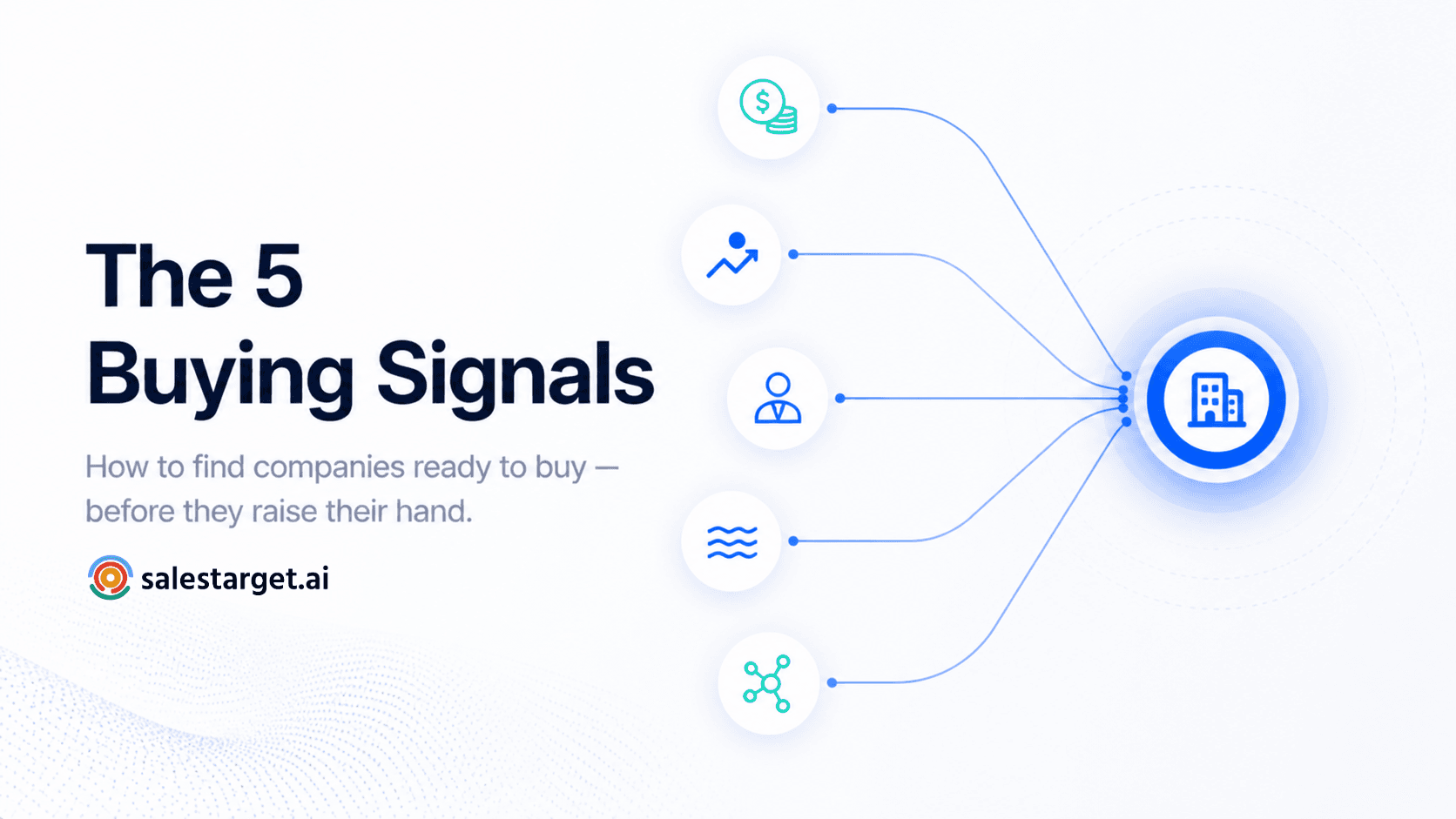
- The 5 highest-value signals: funding round, hiring spike, leadership change, website / content change, and tech stack fit
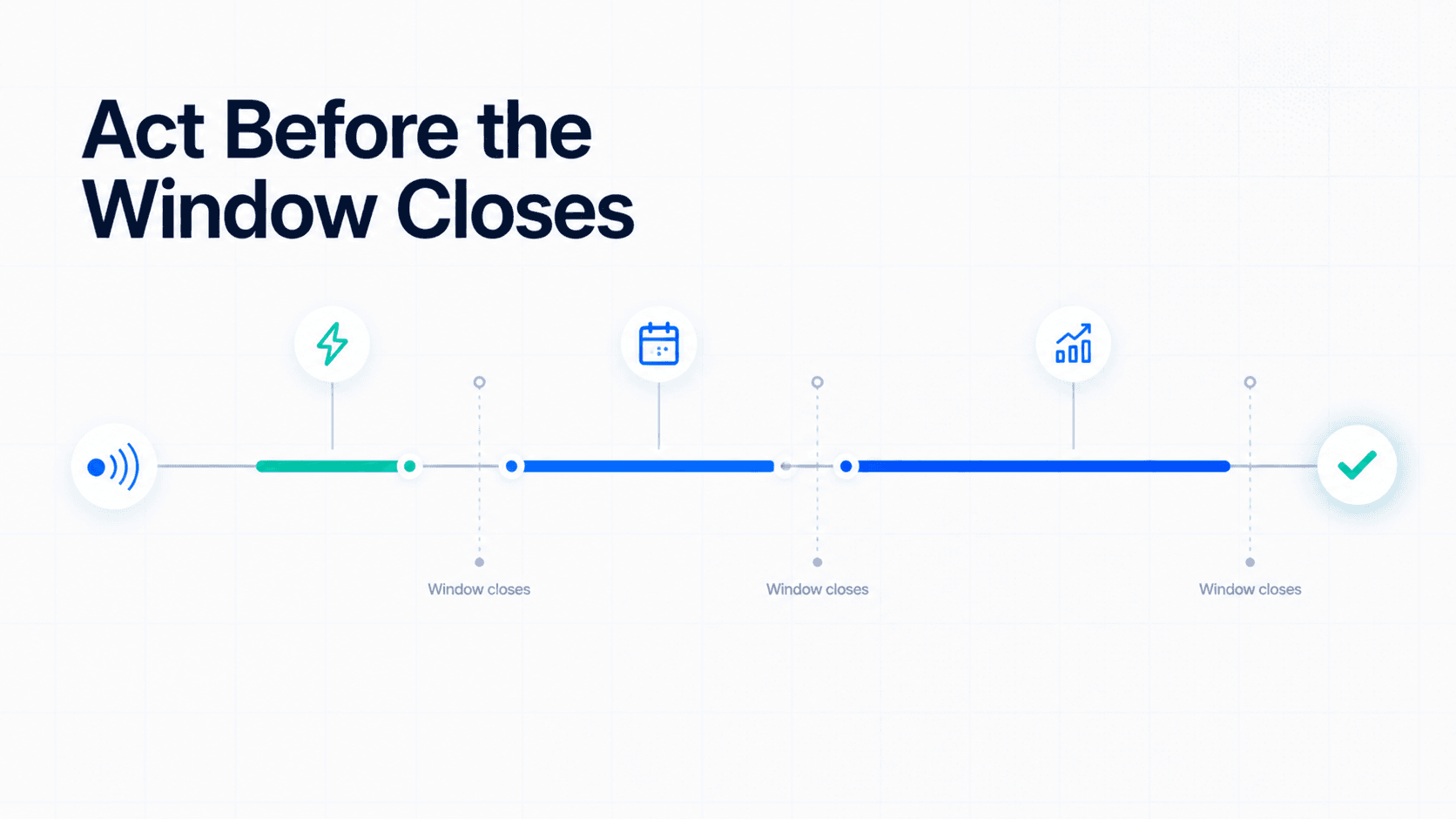
- Each signal has a window — act on a funding round within 48 hours for 4x higher conversion. A new VP evaluates their stack within 90 days. Windows close fast
- Stacking two or more signals on the same account converts at 5–10x the rate of cold outreach — ICP fit + signal = your highest-priority accounts
- SalesTarget.ai's signal discovery surfaces all 5 signal types inside Lead Explorer — funding data, workforce trends, leadership data, website content changes, and tech stack filters
Why Timing Is the Most Underrated Variable in B2B Outbound
85% of B2B purchases go to a vendor already on the buyer's shortlist on day one of their search (Corporate Visions research). Your team is not losing deals because of bad proposals or weak demos. You are losing them because you entered the conversation after the decision was already forming — after the shortlist was already built.
Signal-based prospecting solves this. Instead of working down a static list of contacts who may or may not be in a buying cycle, you identify the companies where something has changed — a funding event, a new leader, a hiring surge, a website update — that indicates a purchase decision is forming right now.
The data on signal-based outreach is unambiguous: signal-personalised outreach hits an 18% reply rate versus 3.4% for generic outreach (Prospeo / Backlinko 2026 analysis). Signal-qualified leads drive 47% better conversion rates, 43% larger deal sizes, and 38% more closed deals.
📊 The signal-based selling advantage
- Signal-based reply rate: 18% vs. 3.4% for generic outreach — Prospeo / Backlinko 2026
- Win rate with buying triggers: 37% vs. 19% for cold outreach — Champify 2025
- 75% of B2B sales engagements in 2025 originated from signal-based triggers — Cognism 2025
- Multi-signal stacked outreach: 5–10x higher response rates than generic cold outreach — Autobound / Salesmotion 2026
What Is a B2B Buying Signal?
A B2B buying signal is a real-world event at a prospect company that indicates they are entering a purchase decision cycle — before they fill out a single form, request a demo, or make first contact with any vendor. Buying signals are the outward, detectable signs that a company's situation has changed in a way that creates budget, urgency, or a clear operational need for a solution like yours.
The key distinction: buying signals are external and observable, not inferred from website behaviour. You do not need them to visit your site. You need them to exist in the world — and you need a way to find them before your competitors do.
| Signal type | What it tells you | Time-sensitivity |
|---|---|---|
| Funding round | New budget to deploy, growth targets to hit, stack to build | Very high — act within 48 hours for 4x higher conversion |
| Hiring spike | Active investment in a department you sell into — budget allocated right now | High — act within 1–2 weeks of posting surge |
| Leadership change | New exec will re-evaluate existing tools within 90 days | High — window opens at hire, closes at 90 days |
| Website / content change | Partnership, expansion, or strategic pivot just announced | Medium-high — relevant for 2–4 weeks post-announcement |
| Tech stack fit | Current tools reveal outreach angle and conversion likelihood | Medium — use as qualifier, layer with intent for timing |
The 5 Buying Signals — With the Exact Outreach Play for Each
The format for each signal is consistent: what the signal is → why it creates a buying window → the exact outreach play → how to find it in SalesTarget.ai.
💰 Signal 1: Funding Round
Why it matters
A funding event creates three things simultaneously: new budget to deploy, growth targets the team did not have before, and a mandate to build the infrastructure to hit them. Funded companies are 3–5x more likely to purchase new software within 12 months of their raise (Origami 2026). Series A companies are building their first serious sales stack. Series B-C companies are upgrading existing tools to handle scale.
The outreach play
Do not congratulate them on the funding — everyone else is. Reference the operational implication instead: "Most Series B teams we work with rethink their prospecting infrastructure in the first 60 days post-raise — is that on your radar at [Company]?" Match your product's complexity to the funding stage: Seed/Series A need lighter tools; Series B-C are buying platforms.
How to find it in SalesTarget.ai
Signal Discovery inside Lead Explorer surfaces funding data including last funding round date, round type, round value, number of rounds, and investors — for public and private companies. Filter by funding stage and recency, combined with your ICP parameters.
📈 Signal 2: Hiring Spike
Why it matters
A company posting 10+ roles in a department you sell into is allocating budget right now — not planning to someday. Job postings are public, real-time, and updated daily. The signal is not a single post (that could be a backfill). The signal is a surge: multiple roles in the same department in the same window, at an ICP-fit company. That pattern means they are building something, not maintaining it.
The outreach play
Reference the hiring category, not the specific job post: "I noticed [Company] is scaling its SDR team — teams building outbound at this pace typically surface prospecting data quality issues within the first 30 days. Is that something you're working through?" Focus on the operational implication of the hire, not the fact that you spotted the posting.
How to find it in SalesTarget.ai
SalesTarget.ai's workforce trends and hiring signals data surfaces companies with active hiring patterns. Combine with ICP filters to find companies hiring in the departments most relevant to your product, then enrich to find the right decision-maker contact.
👤 Signal 3: Leadership Change
Why it matters
A new VP of Sales, CRO, or Head of RevOps will re-evaluate their existing tech stack within 90 days as standard practice. New leaders arrive with mandates to improve performance, preferences from previous roles, and a mandate to build a stack that reflects their approach. The evaluation window opens at the hire announcement and closes at 90 days — with conversion rates dropping significantly after that.
The outreach play
Do not reference that you saw their hire announcement. Reference the operational reality of a new role: "Most new VPs of Sales re-evaluate their prospecting and outreach stack in the first 60 days — even when they're broadly happy with what's there, they want to know if there's something better. Is that a conversation worth having?"
How to find it in SalesTarget.ai
SalesTarget.ai surfaces professional profile data including job title history, seniority level, and experience — enabling you to identify recent leadership hires within target companies. Filter by role seniority and combine with ICP firmographic filters to find new leaders at companies that match your profile.
🔗 Signal 4: Website / Content Change
Why it matters
A company that just announced a major partnership, geographic expansion, product launch, or strategic initiative has created new operational needs that did not exist before. These events are public, observable, and carry specific contextual angles that make outreach significantly more relevant than a generic pitch. The key is connecting the announcement to a specific operational implication.
The outreach play
Reference the business implication, not the announcement: "The [Company]/[Partner] partnership suggests a [market] GTM push — is building the outbound infrastructure to support that on your radar?" 'Congratulations on the partnership' is what everyone else is sending. Connect the event to a specific operational challenge instead.
How to find it in SalesTarget.ai
SalesTarget.ai tracks company website content changes — including change description, change implication, and date — and company social media activity. These signals surface partnership announcements, market expansions, and strategic pivots as they are published. Combine with ICP and funding filters for highest-confidence accounts.
⚙️ Signal 5: Tech Stack Fit
Why it matters
A company's current technology stack tells you whether they are a realistic buyer, an integration opportunity, or a competitive displacement target — before you spend a single enrichment credit on their contact details. Tech stack data is a qualification signal: it tells you the outreach angle and likelihood of conversion. Three patterns matter: integration fit (you extend what they have), competitive fit (they run a direct competitor), and gap-in-stack (they have tool A but need tool B — your product).
The outreach play
Match your angle to the pattern. Integration fit: "Your team is already running HubSpot — most of our HubSpot customers find the gap is in [specific area]. Is that something you're working around?" Gap-in-stack: "Most companies running [adjacent tool] without [your product] hit [specific problem] within [timeframe]. How are you handling that?"
How to find it in SalesTarget.ai
SalesTarget.ai's Tech Stack filter inside Lead Explorer lets you search by specific tool (e.g. 'Salesforce', 'HubSpot') or technology category (e.g. 'CRM', 'marketing automation') — applied before the search runs, so every result already matches your technographic criteria. Use exclusion filters to remove companies running a competitor, or inclusion filters to find the exact integration stack that makes your product a natural fit.
How to Stack Signals for Maximum Conversion
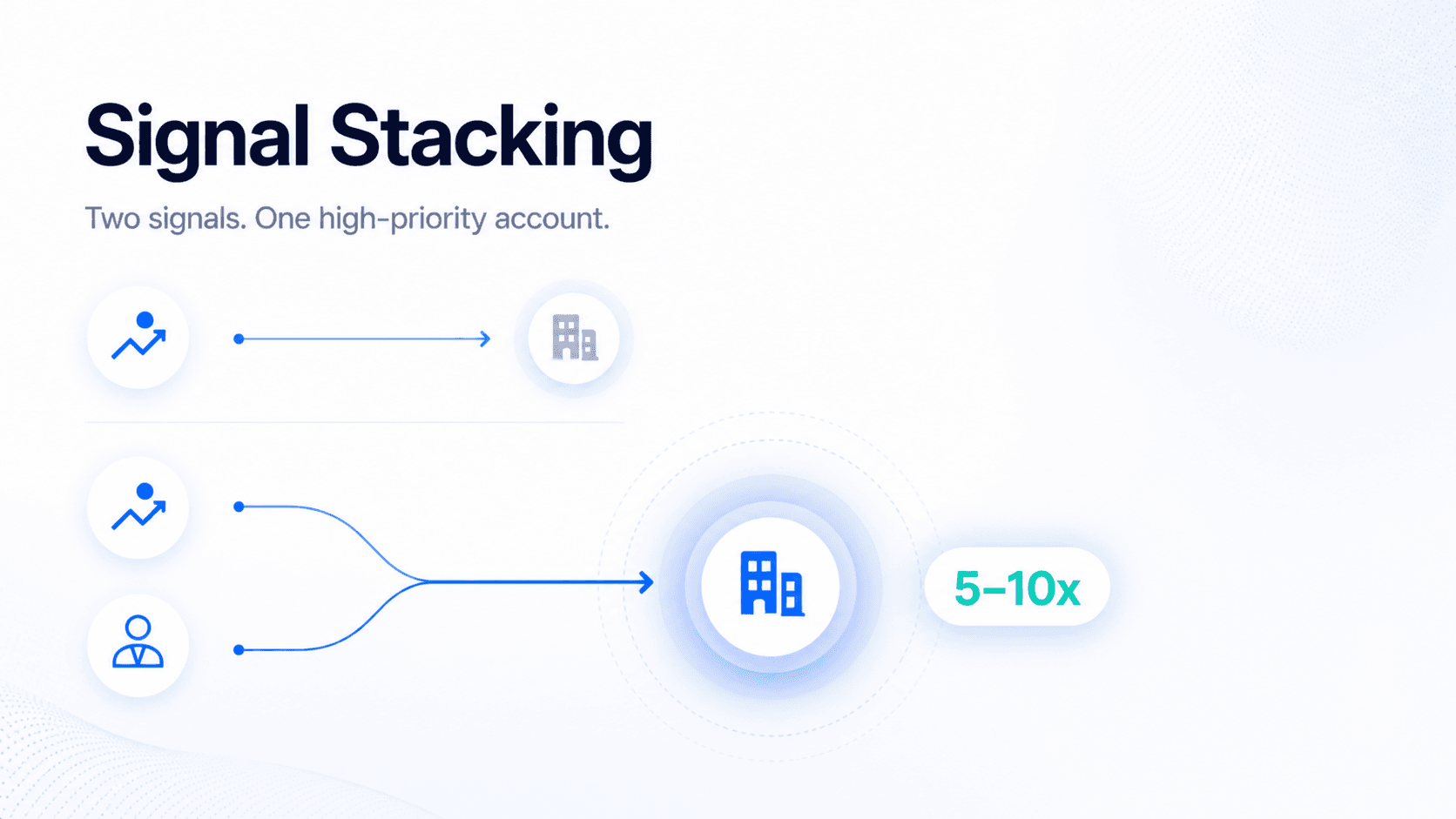
Multi-signal accounts — companies showing two or more buying signals simultaneously — convert at 5–10x the rate of cold outreach (Autobound / Salesmotion 2026). A single signal is a prompt to pay attention. Two or more signals converging on the same ICP-fit account is a Tier 1 priority.
| Signal stack | What it means | Priority |
|---|---|---|
| Funding round + Hiring spike + Tech stack gap | New budget, active scaling, and a clear operational hole your product fills | Tier 1 — contact same day |
| New VP of Sales + Hiring SDRs + Bombora intent surge | Mandate to rebuild revenue infrastructure, active team spend, actively researching solutions | Tier 1 — contact same day |
| Website content change + Hiring spike | New market entry with active team building — infrastructure need is immediate | Tier 1 — within 48 hours |
| Funding round + Tech stack fit | New budget and existing stack compatibility — straightforward sales motion | Tier 2 — within 1 week |
| Leadership change + Bombora intent surge | New exec actively researching alternatives during their evaluation window | Tier 2 — within 1 week |
💡 The ICP-first rule
A buying signal at the wrong company is still the wrong company. Always apply ICP filters — industry, company size, revenue range, geography — before layering signal filters. A Series B funding round at a company that will never be your customer is not a lead. A Series B funding round at a company in your exact target vertical is your next call. ICP first. Signal second.
Common Mistakes When Acting on Buying Signals
- Referencing the signal explicitly in your opener. "Congratulations on the funding!" is the message 50 other reps are sending. Reference the operational implication of the signal instead of the signal itself. Your prospect should feel the relevance, not see the trigger.
- Acting too slowly. The first seller to reach out after a trigger event is 5x more likely to win the deal. The funding window tightens significantly after 48 hours. The leadership change window closes at 90 days. Speed matters more than perfection.
- Using a single signal without ICP validation. A buying signal at a company that doesn't fit your ICP is not a lead — it is noise. Always filter on ICP first, then layer signals on top.
- Treating tech stack data as a timing signal. Tech stack shows fit and angle — it does not tell you they are in a buying cycle right now. Layer tech stack data with a triggering event or Bombora intent signal to convert it from a qualifier into a priority account.
- Not stacking signals. One signal tells you to pay attention. Two signals converging on the same ICP-fit account tells you to act immediately. Flag accounts showing multiple signals simultaneously — these are your highest-value outreach targets.
- Contacting the wrong person after the signal fires. A funding round is addressed to whoever controls the budget or the most affected team. A leadership change is the new leader. A hiring spike in Sales is the VP of Sales or Head of RevOps. The signal tells you it's time. Enrichment data tells you who.
Conclusion: The Window Is the Strategy
Most B2B outreach fails not because the messaging was bad but because the timing was wrong. A cold email to the right company at the wrong moment is still a cold email. The same message — with the same copy, the same personalisation, the same CTA — sent at the moment a buying signal fires converts at a fundamentally different rate.
The five signals in this playbook — funding rounds, hiring spikes, leadership changes, website content changes, and tech stack fit — are all detectable before a prospect ever raises their hand. SalesTarget.ai's signal discovery surfaces all five inside Lead Explorer, combined with ICP filters and point-of-discovery contact enrichment, so the signal fires and you act — while the window is still open.
Stop prospecting to the list. Start prospecting to the signal.
Find the companies showing buying signals — right now.
Lead Explorer surfaces funding rounds, hiring spikes, leadership changes, and tech stack data — all in one search.
50 credits · 7-day free trial · No credit card required