Using Spintax to Create Unique Cold Emails for Every Lead: Best Practices
Cold email has always been a relevance problem disguised as a scale problem.
Most teams believe their biggest challenges are volume, tools, or deliverability. In reality, the hardest part of cold email outreach has always been avoiding repetition while still sounding intentional. Writing one good cold email is not difficult. Writing the same good cold email hundreds of times without sounding copied is where most outreach systems break down.
This is why inboxes are filled with messages that feel familiar even when they come from different senders. The structure looks the same. The phrases repeat. The intent becomes obvious. Over time, response rates drop not because cold email stopped working, but because messages stopped sounding new.
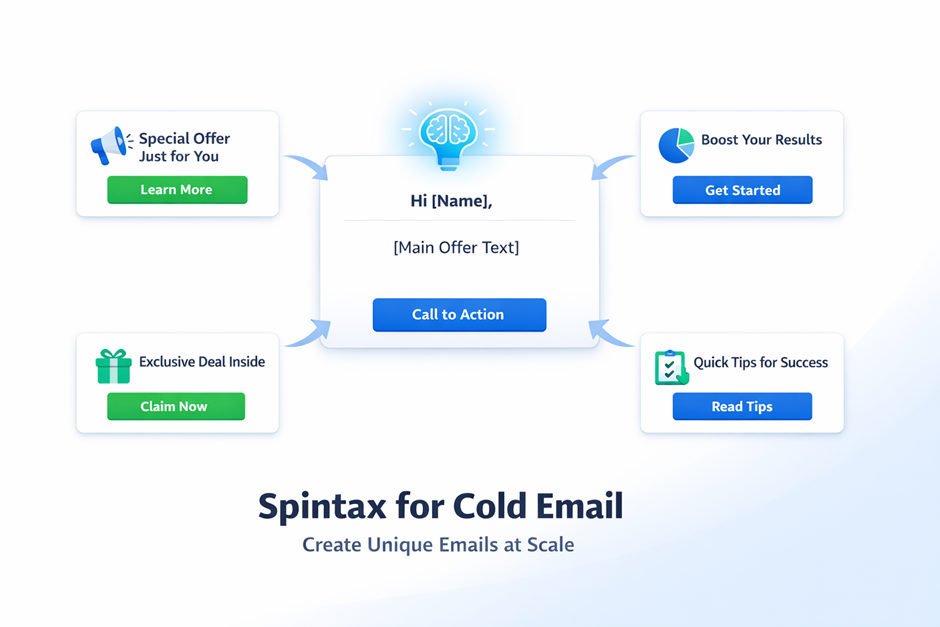
Spintax changes this dynamic. It does not make cold email magical. It makes variation practical. Instead of relying on one rigid template, teams can now build flexible message structures that produce unique-looking emails while preserving the same strategy underneath.
Cold email is no longer just about sending messages faster.
It is about keeping messages from becoming predictable.
What Spintax Really Means for Cold Email Outreach
Spintax is a method of writing that allows multiple versions of the same sentence to exist inside one structure. Instead of committing to one phrasing, the sender defines a group of interchangeable options. Each email is generated by selecting different combinations from those options.
Every message communicates the same idea.
But no two messages look exactly the same.
This matters because cold emails fail when they feel mass-produced. Messages are not ignored because they are poorly written. They are ignored because they feel copied. A spintax generator helps close this gap by shaping language around variation rather than forcing one version onto every lead.
In practice, this means a line written for a SaaS founder does not have to appear in the same wording for every SaaS founder. The meaning stays stable. The expression changes. That is where uniqueness begins to appear.
Why Cold Email Outreach Breaks Down at Scale
Cold email outreach has scaled technically much faster than it has scaled creatively. Tools can now send thousands of emails, automate follow-ups, and rotate inboxes safely. But the logic behind those emails often stays fixed.
Sales teams are expected to prospect, personalize, follow up, and close deals at the same time. Writing thoughtful messages for every segment becomes unrealistic. So they default to templates.
At first, those templates perform. Over time, they become predictable. Prospects recognize the structure. They have seen the same phrasing from different senders. Engagement slowly drops.
This pattern repeats across teams. A campaign launches strong and then fades. The list is blamed. The market is blamed. The channel is blamed.
In reality, the message stopped evolving.
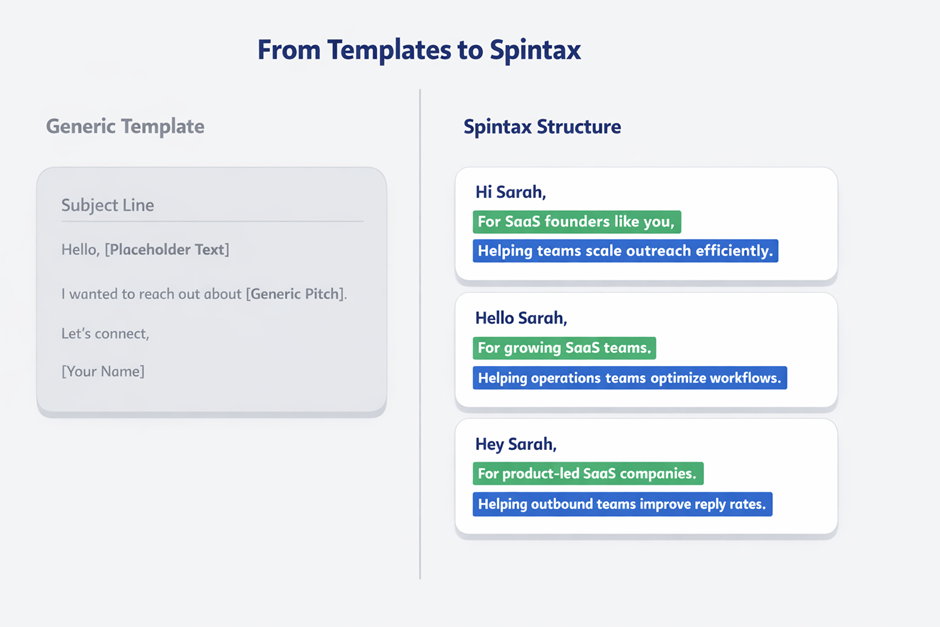
Spintax exists to solve this specific problem. It reduces dependence on manual rewriting and makes variation inexpensive. Instead of protecting one "perfect" email, teams can generate many strong versions and let performance guide refinement.
Cold email does not fail because it is cold.
It fails because it becomes repetitive.
How Spintax Changes the Outreach Process
A spintax-driven outreach system works by separating meaning from phrasing. When you define your audience, your offer, and your goal, the core idea of the email stays the same. What changes is how that idea is expressed.
For example, a message aimed at a founder may emphasize outcomes. A message aimed at an operations leader may emphasize process. With spintax, these shifts can happen naturally inside one structure rather than through separate templates. This approach aligns closely with segmentation-based outreach, where language shifts based on role, industry, and intent.
Instead of relying on one opening line, you can test several. Instead of committing to one subject line, you can explore different tones. Outreach becomes measurable rather than static.
A simple way to see this difference is in testing. A human may write one email and wait for results. A spintax-based system can generate multiple variations and allow real engagement to determine which phrasing performs better.
This does not make spintax more creative than people.
It makes it faster at exploring language.
Template vs Spintax (Where Variation Actually Comes From)
| Approach | How Messages Are Written | What Prospects See | Long-Term Effect |
|---|---|---|---|
| Static Template | One fixed version reused | Same structure repeatedly | Pattern fatigue |
| Manual Personalization | New copy per segment | Relevant but slow | Low scalability |
| Spintax Generator | One structure, many variations | Different phrasing each send | Sustainable freshness |
This is why spintax sits between templates and manual writing.
It preserves consistency without creating monotony.
Why Automation Is About Stability, Not Randomness
Most teams adopt automation to move faster. Manual outreach takes time and effort. Automation removes friction.
But the real advantage of structured variation is stability.
Instead of one SDR writing careful emails and another sending rushed ones, the system enforces consistent intent. Instead of guessing which subject line to use, the system cycles through tested options. Instead of repeating one phrase endlessly, it introduces controlled diversity.
Spintax removes randomness from repetition.
And repetition is what destroys cold email at scale.
Personalization Without Rewriting Everything
Personalization used to mean inserting a name or a company field. That kind of personalization looks personal, but it rarely feels personal.
Modern personalization is contextual. It is about making the message match the role, the industry, and the likely problem of the reader.
Spintax supports this by allowing the same idea to be framed in multiple ways. AI can determine who the prospect is and what likely matters to them. Spintax determines how that idea is expressed.
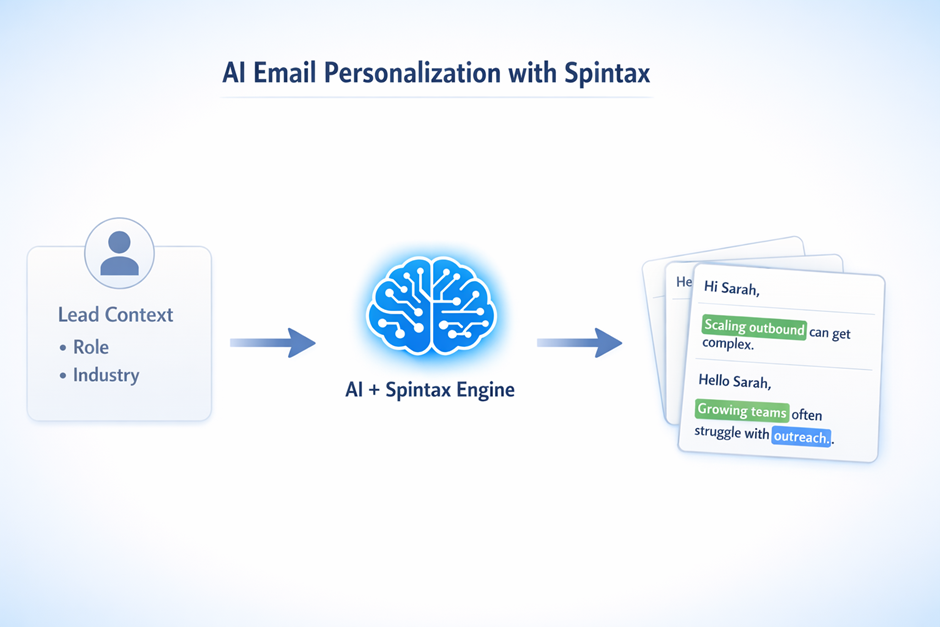
This is how AI email personalization scales without sounding robotic.
Not by inventing new ideas for every lead,
but by expressing the same idea in different human ways.
Where Spintax Adds the Most Value
Spintax is most effective where repetition is most obvious.
Opening lines are one of those places.
Follow-ups are another.
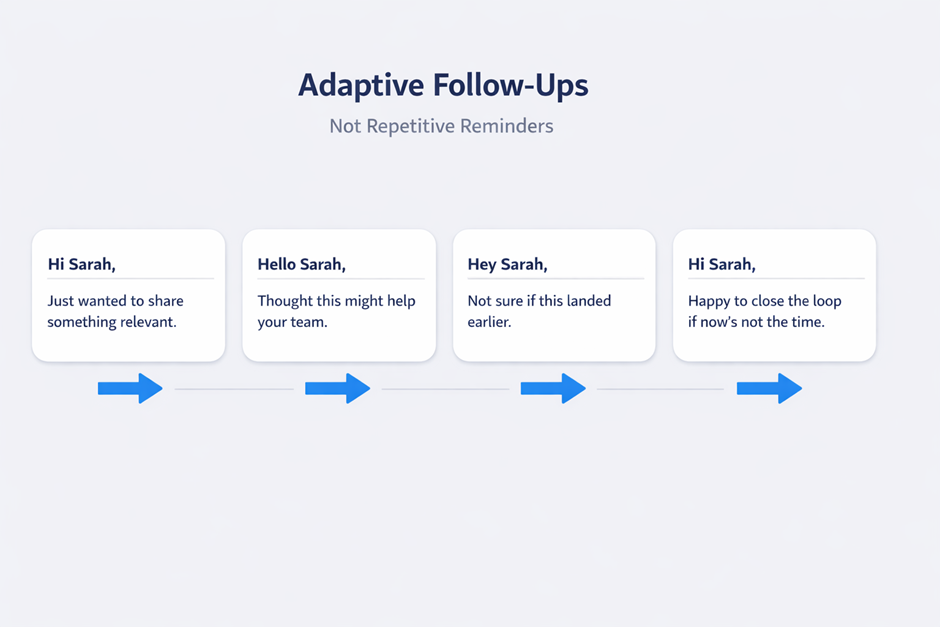
A first line that always starts the same way quickly becomes invisible. A follow-up that always says "just checking in" quickly becomes ignorable. Spintax allows those moments to change slightly while keeping the same meaning.
Instead of repeating, the system reframes.
Instead of pushing, it clarifies.
This is how cold email begins to feel like conversation rather than broadcast.
Why Spintax Feels More Human Than Templates
Humans do not repeat themselves perfectly.
If you explain the same idea twice, you change the wording. You change the order. You change the tone slightly.
Templates remove that natural variation.
Spintax restores it.
This is why spintax improves engagement. Not because it is clever, but because it behaves like speech. A cold email should not feel engineered. It should feel intentional.
High-performing cold emails succeed because they sound intentional rather than mechanically generated. Spintax helps preserve that feeling even when outreach runs at scale.
Examples of Spintax in Action
The impact of spintax becomes clearer when tied to real behavior.
Across B2B sales teams, the biggest improvements from spintax-based outreach tend to appear in reply rates, campaign longevity, and message freshness.
Teams that use spintax to refine subject lines, opening lines, and follow-ups consistently see stronger engagement across their cold email outreach. Variation works because prospects respond differently to language that feels new and relevant instead of recycled.
Industry benchmarks show that campaigns using structured variation outperform static templates because they reduce pattern recognition. The improvement does not come from sounding more creative. It comes from sounding less repeated.
SaaS Startup Example
One SaaS startup replaced its single cold email template with a spintax-based structure that varied its opening line and value framing. Founders received outcome-driven phrasing. Operations leaders received process-driven phrasing. Within weeks, the team saw a measurable lift in replies without increasing send volume.
Lead Generation Agency Example
A lead generation agency replaced its fixed follow-up messages with spintax-based follow-ups that changed tone across steps. Instead of repeating the same reminder, each follow-up reframed the message slightly. The result was not a dramatic spike in opens, but a steady increase in booked calls over time.
These examples show the real value of spintax.
It does not create miracles.
It protects freshness.
And freshness is what keeps cold email alive.
Where Teams Go Wrong
One common mistake is treating spintax as a word spinner. Random variation without logic still feels generic. Spintax should preserve meaning while changing expression.
Another mistake is overloading variation. Too many options make messages unstable. Too few make them predictable. The goal is controlled flexibility.
There is also the risk of ignoring deliverability. Excessive symbols, unnatural phrasing, or aggressive language can trigger spam filters.
Inbox providers evaluate sender behavior continuously, which is why unnatural phrasing and repetition can affect placement. Spintax must work alongside deliverability best practices, not against them.
Spintax is not a shortcut.
It is a structure.
How SalesTarget Uses Spintax for Personalized Outreach
SalesTarget integrates spintax directly into the cold email workflow. Instead of writing static sequences, users can build flexible message structures that adapt across leads.
AI determines the context, such as role or industry. Spintax ensures the phrasing never appears identical twice.
This allows teams to move from lead selection to message creation without constantly rewriting emails for every segment. Instead of spending time drafting repetitive messages, they can focus on strategy, segmentation, and performance analysis.
Instead of writing static sequences, users can build flexible message structures that adapt across leads inside a modern outreach system.
The Future of Spintax in AI Email Personalization
The next phase of spintax will be driven by behavior rather than randomness. Instead of cycling through options blindly, systems will favor phrasing that produces replies and suppress versions that get ignored.
Variation will become adaptive.
Research on generative AI shows that automation works best when it removes repetitive writing and allows teams to focus on higher-value decisions.
Not accidental.
Cold email will feel less like broadcasting and more like guided conversation. Messages will still be structured, but they will not feel templated.
The result will not be more emails.
It will be more relevant emails.
Conclusion and Call to Action
Cold email outreach is no longer just about sending messages.
It is about preserving relevance at scale.
Spintax makes this possible by removing the slowest part of outbound: rewriting the same idea endlessly. It helps teams generate unique-looking messages while keeping intent stable.
When combined with AI email personalization, spintax allows cold email to remain human even when volume increases.
AI decides who to talk to and what to say.
Spintax ensures it never sounds exactly the same twice.
That balance is what keeps cold email working in modern outreach.
If you want to see how this works in practice, explore how SalesTarget helps teams create, personalize, and scale cold email campaigns in one system:
👉 https://salestarget.ai/email-outreach
You can also learn how AI improves email performance in real campaigns here:
👉 https://salestarget.ai/blogs/how-to-increase-your-email-conversion-rates-with-ai
Cold email is not disappearing.
It is becoming more intentional.
And the teams that protect freshness instead of relying on templates will be the ones that keep booking meetings.
References
- Deliverability (Google): https://support.google.com/mail/answer/81126
- AI Productivity (McKinsey): https://www.mckinsey.com/capabilities/mckinsey-digital/our-insights/the-economic-potential-of-generative-ai-the-next-productivity-frontier