Cold email is not failing because buyers have stopped reading email. It fails when teams contact the wrong people, rely on stale data, send generic messages, or scale faster than their sender reputation can support.
That is why modern outbound teams are moving beyond basic email sequencers. The best AI email tools now combine prospect research, contact verification, message personalization, deliverability controls, multichannel follow-ups, reply handling, and pipeline visibility.
This guide explains how AI email software works, what inbox providers evaluate, how to build a safer outbound workflow, and which platform is best suited to different B2B sales requirements.
Choose an AI email tool based on the complete workflow you need, not the number of AI features in its marketing. Evaluate data quality, verification, mailbox protection, personalization, channel coverage, reply management, CRM handoff, and reporting together.
Why B2B Email Outreach Has Changed
The old outbound playbook was simple: collect a large list, create one template, schedule several follow-ups, and increase volume until replies appeared. That approach now creates unnecessary risk.
Inbox providers assess much more than the wording of a message. They examine authentication, sending consistency, domain and IP reputation, spam complaints, bounces, infrastructure changes, and recipient behavior. A strong email can still be filtered when the surrounding sending pattern looks unreliable.
Outbound performance therefore depends on four connected systems:
- Reliable prospect data — accurate contacts reduce bounces and wasted outreach
- Relevant personalization — messages should reflect the prospect's role, company, priorities, or recent signals
- Controlled sending — volume should increase gradually and remain consistent across healthy mailboxes
- Fast follow-up — interested replies need context, ownership, and a clear path into the sales pipeline
AI Email Tools Explained
AI email tools are platforms that use artificial intelligence to support or automate tasks across prospecting and email communication. Depending on the product, AI may help identify suitable leads, enrich contact records, draft personalized messages, build sequences, classify replies, recommend next steps, or optimize campaign workflows.
AI alone does not guarantee inbox placement or positive replies. The technology is most useful when it works alongside verified data, properly authenticated domains, controlled sending limits, human review, and clear sales processes.
A capable AI email outreach platform may include:
- B2B lead discovery and ICP filtering
- Contact enrichment and email verification
- AI-assisted email writing and contextual personalization
- Automated sequences and follow-up rules
- Mailbox warm-up, rotation, and deliverability monitoring
- LinkedIn, phone, SMS, or other coordinated outreach channels
- Unified reply management and intent classification
- CRM synchronization, task creation, and pipeline tracking
Traditional Email Tools vs AI Email Tools
The practical difference is not that one category sends email and the other does not. It is how much context the platform can use before, during, and after each send.
| Area | Traditional Email Tool | AI Email Tool |
|---|---|---|
| Lead selection | Imported lists and manual filters | ICP matching, enrichment, intent signals, and automated prioritization |
| Personalization | Merge tags and reusable templates | Messages generated from prospect, company, and campaign context |
| Sequences | Fixed schedules and manually written steps | AI-assisted creation, branching, and recommendations based on outcomes |
| Deliverability | Separate setup or reactive troubleshooting | Warm-up, rotation, verification, monitoring, and adaptive controls |
| Reply handling | Replies reviewed inbox by inbox | Unified inbox, intent tagging, suggested replies, and automated routing |
| Sales handoff | Manual CRM updates | Automatic contact, activity, task, and opportunity synchronization |
How Inbox Providers Evaluate Senders
Deliverability is shaped by a sender's identity, infrastructure, behavior, and recipient feedback. According to Google's email sender guidelines, all senders should use SPF or DKIM, while bulk senders need SPF, DKIM, and DMARC. Google also recommends consistent sending, gradual volume increases, and ongoing reputation monitoring.
- Authentication — SPF, DKIM, and DMARC help receiving systems verify who sent a message and whether its domain aligns correctly
- Sending consistency — sudden bursts or major infrastructure changes can trigger rate limits and reputation problems
- Spam complaints — Google recommends keeping the Postmaster Tools spam rate below 0.10% and avoiding 0.30% or higher
- Bounces and deferrals — rising SMTP errors are a signal to reduce volume, inspect the list, and correct the underlying issue
- Domain and IP reputation — reputation can be affected by past behavior, shared infrastructure, blocklists, and recipient feedback
- Unsubscribe handling — recipients need a simple, reliable way to stop future messages
Open rate should not be treated as a direct measurement of deliverability. Google states that it does not track opens and cannot verify open-rate data reported by third parties. Replies, complaints, bounce responses, and actual pipeline outcomes are more useful when evaluating campaign quality.
A Practical AI Email Outreach Workflow
The best results come from connecting each stage of outbound sales rather than optimizing email copy in isolation.
Step 1: Define the ICP Before Building the List
Document the industries, company characteristics, locations, roles, seniority levels, technologies, and buying situations that make an account relevant. A clear ICP gives both search filters and AI models better instructions.
Step 2: Discover and Prioritize Suitable Prospects
Use Lead Explorer to search by company and people attributes, then use firmographic, technographic, and intent context to narrow the list. Smaller, better-defined segments usually support more relevant messaging than one broad list.
Step 3: Enrich and Verify Before Sending
Enrich selected contacts when they are needed and validate email addresses before adding them to a campaign. This reduces avoidable bounces and gives the personalization engine more reliable context.
Step 4: Generate a Sequence and Review Every Claim
Use the AI Outreach Suite to draft initial emails, follow-ups, and variations. Human review remains essential: remove invented details, vague compliments, exaggerated claims, and language that does not match the sender's voice.
Step 5: Launch With Controlled Volume
Prepare sending accounts, confirm authentication, and increase volume gradually. Use inbox warm-up and inbox rotation to distribute activity across healthy mailboxes without sudden spikes.
Step 6: Coordinate Email and LinkedIn Touches
Add LinkedIn outreach steps where they support the campaign. Profile visits, relevant engagement, connection requests, and follow-up messages can build recognition before or after an email without repeating the same message on every channel.
Step 7: Centralize Replies and Pipeline Activity
Bring conversations into Unibox, assign ownership, and move qualified prospects into the CRM. The goal is not simply to generate replies. It is to turn relevant replies into consistent follow-up and measurable opportunities.
Best AI Email Tools for B2B Outreach
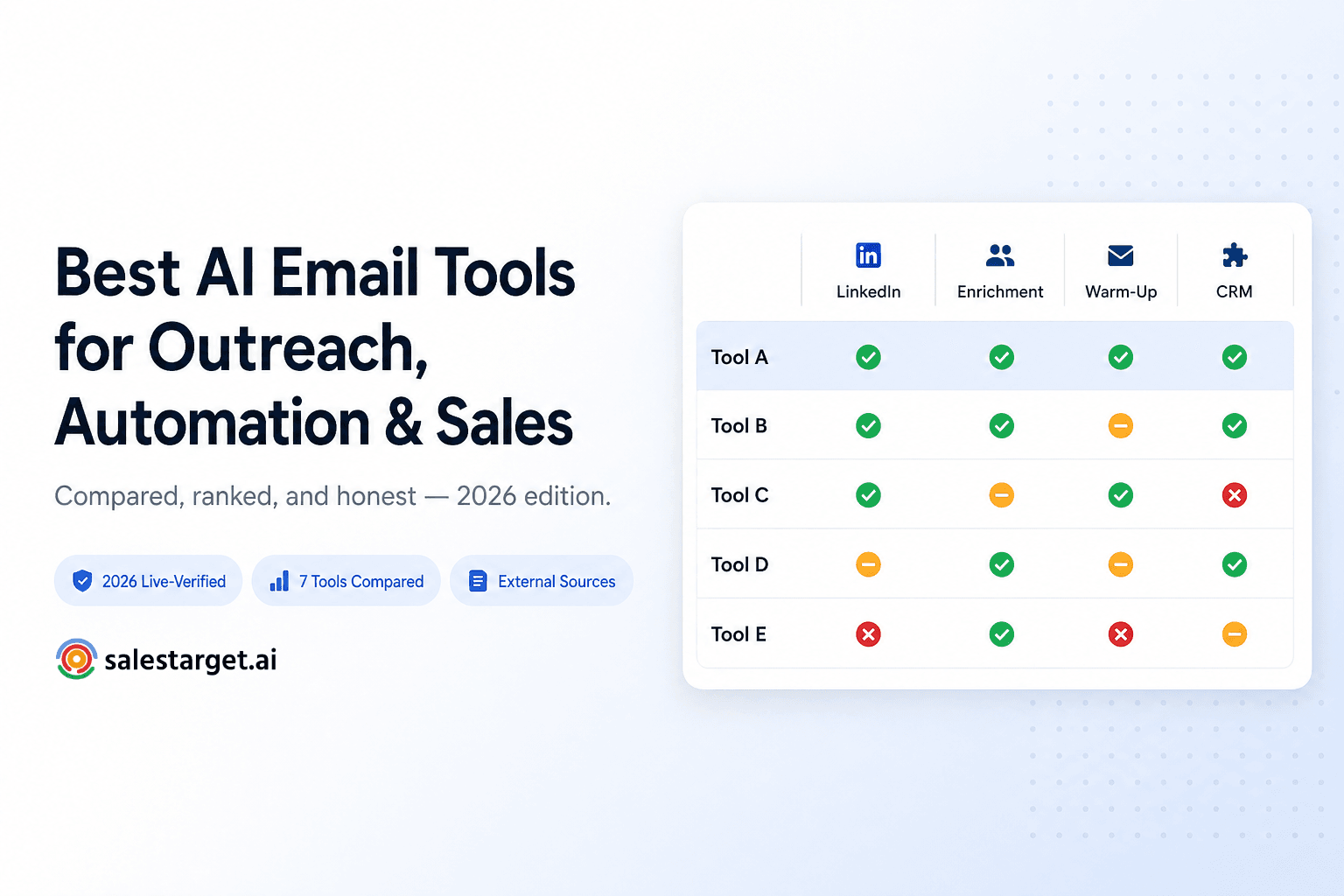
The platforms below overlap, but they are not interchangeable. Some are strongest in email infrastructure, others in prospect data, multichannel engagement, AI-agent automation, or lifecycle marketing. The comparison is based on publicly presented product capabilities and focuses on practical workflow fit.
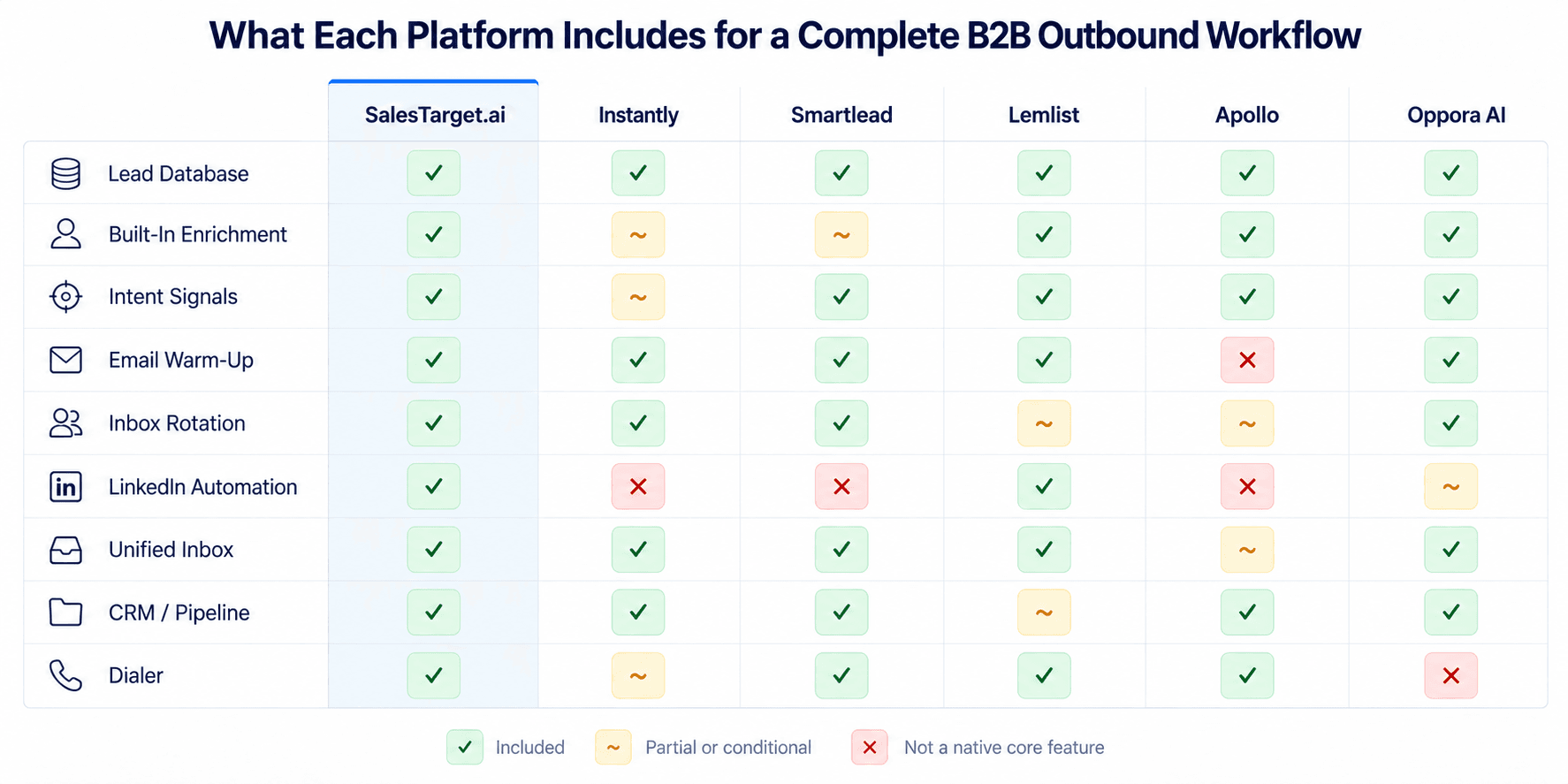
| Platform | Primary Strength | Lead Data | Channels | Pipeline Management |
|---|---|---|---|---|
| SalesTarget.ai | Connected B2B outbound workflow | Lead Explorer, live enrichment, intent signals, and verification | Email, LinkedIn, and phone | Built-in CRM and Dialer |
| Instantly.ai | Email-first automation and deliverability | Lead database, finder agents, and verification | Primarily email | CRM, opportunities, and revenue tracking |
| Smartlead.ai | Scalable sending infrastructure | SmartProspect, verified leads, and intent signals | Email and phone | Integrated CRM and Master Inbox |
| Lemlist | Creative multichannel personalization | Lead database, finder tools, and enrichment agents | Email, LinkedIn, calls, WhatsApp, and SMS | Unified Inbox and CRM integrations |
| Apollo.io | Database-led sales intelligence | B2B database, enrichment, filters, and buyer intent | Email and phone; browser extension for prospecting | Deal management and CRM synchronization |
| Oppora AI | AI-agent workflow automation | Company and lead finders, enrichment, and verification | Email and extension-led LinkedIn outreach | Sales CRM and external CRM synchronization |
| Mailshake | Accessible sales engagement | Data Finder and list cleaning | Email, phone, and social outreach | Lead Catcher and CRM integrations |
| Encharge | Behavior-based lifecycle email | Forms, user profiles, segments, and verification | Email, transactional messages, and integrated SMS | Customer profiles and CRM integrations |
1. SalesTarget.ai — Best Overall for Connected B2B Outbound
What it does well: SalesTarget.ai connects lead discovery, real-time enrichment, email validation, AI-assisted sequences, inbox warm-up, mailbox rotation, LinkedIn automation, reply management, CRM, and calling. Lead Explorer provides access to 840M+ professional profiles and 4,000+ buyer signals drawn from more than 50 sources. Enriched prospects can move directly into outreach without repeated exports or manual record rebuilding.
AI Copilot supports list creation, campaign setup, personalization, analysis, and follow-up tasks. Unibox centralizes email responses, while the CRM preserves the context from first touch through opportunity management.
Considerations: Its broadest value appears when a team wants to consolidate prospecting, outreach, and pipeline work. Organizations seeking only a lightweight email writer or a standalone sequencer may not need the complete workflow.
Verdict: Best suited to B2B teams that want verified prospect data, AI email outreach, LinkedIn automation, deliverability controls, CRM, and calling within one coordinated sales platform.
Explore: SalesTarget.ai | Lead Explorer | Book a demo | G2 reviews
2. Instantly.ai — Best for Email-First Outreach at Scale
What it does well: Instantly.ai combines cold email campaigns, mailbox management, deliverability tools, lead data, verification, AI agents, automations, and CRM functionality. Its AI Sales Agent and Reply Agent can support campaign creation, response handling, and lead routing. Opportunities, pipeline, conversions, and revenue reporting give teams a clearer connection between sending activity and business outcomes.
Considerations: Instantly remains an email-first platform and does not present native LinkedIn outreach as a core campaign channel. Teams that need coordinated email and LinkedIn steps will require another solution for that part of the workflow.
Verdict: A strong choice for teams whose main priority is operating and optimizing AI-assisted cold email campaigns across many mailboxes.
3. Smartlead.ai — Best for Agencies and Scalable Email Infrastructure
What it does well: Smartlead.ai is built around scalable cold email infrastructure. It supports unlimited mailbox connections, automated warm-up, sender rotation, dedicated infrastructure options, reputation monitoring, and a centralized Master Inbox. SmartAgents can research leads, write personalized messages, classify responses, update CRM records, and assist with deliverability.
Its current product suite also includes SmartProspect for verified lead discovery and intent signals, SmartDialer for calling, and an integrated CRM with a synchronized Kanban pipeline.
Considerations: Smartlead does not currently position native LinkedIn automation as a core channel. Teams building email-and-LinkedIn sequences will still need to connect another platform for LinkedIn activity.
Verdict: Best suited to agencies and outbound teams that prioritize mailbox scale, infrastructure control, centralized reply management, and email deliverability.
4. Lemlist — Best for Creative Multichannel Personalization
What it does well: Lemlist combines a large lead database, email and phone finders, enrichment agents, intent-signal agents, creative personalization, and multichannel sequences. Campaigns can include email, LinkedIn, calls, WhatsApp, and SMS, with conversations brought together in a Unified Inbox. Its Deliverability Hub and lemwarm support sender preparation and ongoing mailbox monitoring.
Considerations: Lemlist's enrichment uses multiple external data providers, so coverage can vary by source and market. It integrates deeply with CRMs, but its core experience is outbound engagement rather than a complete native CRM for managing every post-reply sales process.
Verdict: A strong option for teams that want creative personalization and a wide selection of outreach channels inside the same campaign.
5. Apollo.io — Best for Database-Led Sales Intelligence
What it does well: Apollo.io combines B2B contact and company data with advanced filters, enrichment, buyer intent, email sequences, workflow automation, calling, meeting scheduling, conversation intelligence, deal management, and CRM synchronization. Its Chrome extension also helps users access contact data while working in other sales tools.
Considerations: Apollo supports prospecting through its extension but does not offer fully automated LinkedIn connection and messaging sequences as a native outreach channel. Teams that rely on mailbox warm-up should also confirm whether the available deliverability features cover their full sender-preparation process.
Verdict: Best suited to data-first GTM teams that need detailed prospecting, enrichment, email engagement, calling, and sales intelligence in a broad platform.
6. Oppora AI — Best for Autonomous AI-Agent Workflows
What it does well: Oppora AI coordinates specialized agents for company discovery, contact finding, enrichment, email verification, lead scoring, campaign execution, and reply handling. Its drag-and-drop workflow builder is designed to keep these agents running as a connected process rather than requiring a separate prompt for every task.
Oppora presents access to 60M+ companies, more than one billion lead records, 22 buying signals, and 120M+ verified emails through waterfall sources. It also supports AI-personalized email, mailbox rotation, warm-up, LinkedIn invitations and follow-ups, automated reply classification, calendar links, a shared inbox, Sales CRM, external CRM synchronization, REST API access, and MCP connectivity.
Considerations: Email discovery depends partly on waterfall providers or a connected data-provider API, so results may differ by source. Mailbox rotation is limited to 50 accounts, and Oppora states that warm-up is unavailable for Gmail API-connected accounts. LinkedIn activity is closely connected to its browser extension, and the public product suite does not currently present a native sales dialer.
Verdict: A compelling option for founders, agencies, and lean sales teams that want AI agents to coordinate prospect discovery, campaign execution, reply handling, and CRM updates.
7. Mailshake — Best for Accessible Multichannel Sales Engagement
What it does well: Mailshake emphasizes fast adoption and straightforward campaign management. It supports personalized cold email, automated follow-ups, phone and social touches, Lead Catcher, pipeline-focused analytics, Data Finder, list cleaning, an AI email writer, SMTP warm-up, mailbox setup, and a dialer. Its sequences are approachable for teams that want useful automation without a highly technical configuration process.
Considerations: Data Finder is less extensive than a dedicated sales-intelligence database with deep firmographic, technographic, and intent filtering. Mailshake connects with CRM platforms rather than replacing a full sales CRM, and its AI capabilities focus more on writing and campaign assistance than autonomous multi-agent execution.
Verdict: A practical choice for sales teams that value a short learning curve and want email, phone, and social outreach in a clear sequence-building experience.
8. Encharge — Best for Lifecycle and Behavior-Based Email
What it does well: Encharge is designed for marketing automation, user onboarding, trial conversion, lead nurturing, and customer retention. Its visual flow builder uses product events, website activity, email engagement, customer attributes, and connected-app data to trigger targeted communication. It also offers segmentation, forms, lead scoring, email verification, transactional email, company profiles, custom objects, and CRM integrations.
Considerations: Encharge is not a cold outbound platform. It does not provide the mailbox rotation, cold email warm-up, prospect discovery, or multichannel sales sequences required for high-volume outreach to unfamiliar recipients.
Verdict: Best suited to SaaS and digital businesses that need behavior-based journeys for known leads, trial users, and customers rather than cold sales outreach.
Where SalesTarget.ai Stands Out
Several platforms in this comparison now cover more of the sales workflow than traditional email sequencers. SalesTarget.ai stands out through the way its core modules connect data discovery with multichannel execution and post-reply pipeline management.
Lead Data Moves Directly Into Action
Lead Explorer combines large-scale prospect search with instant enrichment, verification, firmographic details, technology context, and buyer signals. Selected records can move directly into campaigns, reducing the delays and context loss created by repeated exports.
Email and LinkedIn Work as One Sequence
SalesTarget.ai can coordinate automated email follow-ups with LinkedIn connections, messages, profile actions, and conditional steps. This gives teams a consistent multichannel cadence instead of two unrelated campaigns running in separate tools.
Deliverability Is Connected to Campaign Execution
Email validation, warm-up controls, mailbox rotation, campaign analytics, and Unibox are part of the same workflow. Teams can prepare senders, limit avoidable bounces, distribute volume, and manage replies without moving between separate deliverability and engagement platforms.
The Workflow Continues After a Reply
Qualified conversations can be converted into CRM records, deals, tasks, follow-ups, and calls. AI Copilot helps teams work across these stages while preserving the context gathered during prospecting and outreach.
How to Choose the Right AI Email Tool
Start with the part of your workflow that creates the most friction, then check whether solving it introduces another disconnected system.
| Primary Requirement | Platform to Evaluate | Reason |
|---|---|---|
| Lead data, email, LinkedIn, validation, CRM, and calling in one workflow | SalesTarget.ai | Broad native workflow with shared prospect and activity context |
| Email-first outreach with AI agents and deliverability controls | Instantly.ai | Strong campaign, mailbox, reply-agent, and performance workflow |
| Agency-scale mailbox management and infrastructure control | Smartlead.ai | Unlimited mailboxes, warm-up, sender rotation, Master Inbox, and infrastructure tools |
| Creative personalization across many outreach channels | Lemlist | Email, LinkedIn, calls, WhatsApp, SMS, enrichment, and visual personalization |
| Large-scale prospect data and sales intelligence | Apollo.io | Detailed database, enrichment, filters, intent, email engagement, and calling |
| Autonomous prospecting, campaign, and reply workflows | Oppora AI | Specialized agents connected through a reusable visual workflow |
| A straightforward path into email, phone, and social outreach | Mailshake | Accessible campaign setup, deliverability utilities, Data Finder, and Dialer |
| Onboarding, trial conversion, and lifecycle communication | Encharge | Behavior-based flows for known leads, users, and customers |
AI Email Tool Evaluation Checklist
Before selecting a platform, test the workflow with real data and real team roles. A feature list alone will not reveal where manual work remains.
- Data coverage: Does the database cover your regions, industries, company sizes, and buyer roles?
- Data freshness: When are email addresses and employment details verified?
- Deliverability controls: Can you validate contacts, prepare mailboxes, rotate senders, monitor reputation, and react to bounces?
- Personalization quality: Can AI use real prospect context without inventing facts or producing repetitive messages?
- Channel coverage: Are email, LinkedIn, phone, and other required touches coordinated or separated?
- Reply workflow: Can the team classify, assign, answer, and track replies without checking many inboxes?
- CRM continuity: Do qualified conversations create the right records, tasks, activities, and opportunities?
- Automation controls: Can users review AI output, set limits, pause actions, and prevent unwanted responses?
- Reporting: Can the platform connect activity to positive replies, meetings, opportunities, and revenue?
- Data portability: Can you export your contacts, campaign history, and activity data when needed?
The Direction of AI Email Software
AI email tools are moving from isolated writing assistance toward coordinated revenue workflows. The most important developments are likely to include:
- Agent orchestration — specialized agents handling research, enrichment, writing, replies, and CRM updates together
- Signal-based prioritization — using hiring, technology, company, engagement, and intent changes to decide who should be contacted
- Adaptive multichannel sequences — changing the next step based on email replies, LinkedIn activity, calls, and CRM stage
- Stronger deliverability safeguards — connecting sender reputation, verification, volume, and campaign decisions in real time
- Human approval controls — allowing teams to decide which AI actions can run automatically and which require review
- Outcome-focused reporting — measuring qualified conversations and pipeline movement instead of relying on opens alone
Final Thoughts
The best AI email tool is not necessarily the platform with the longest feature list. It is the one that supports your actual path from prospect selection to qualified conversation without creating unnecessary gaps, duplicate records, or deliverability risk.
Instantly and Smartlead remain strong for email-first operations. Lemlist offers broad multichannel personalization. Apollo is well suited to data-led prospecting. Oppora introduces a compelling agent-orchestration model. Mailshake emphasizes accessible sales engagement, while Encharge serves lifecycle marketing rather than cold outbound.
For teams that want lead discovery, enrichment, verification, email, LinkedIn, AI assistance, reply management, CRM, and calling in one connected environment, SalesTarget.ai provides the most complete workflow in this comparison.
Build your complete outbound workflow in one platform.
Find verified prospects, coordinate email and LinkedIn outreach, manage replies, and move opportunities through your CRM.