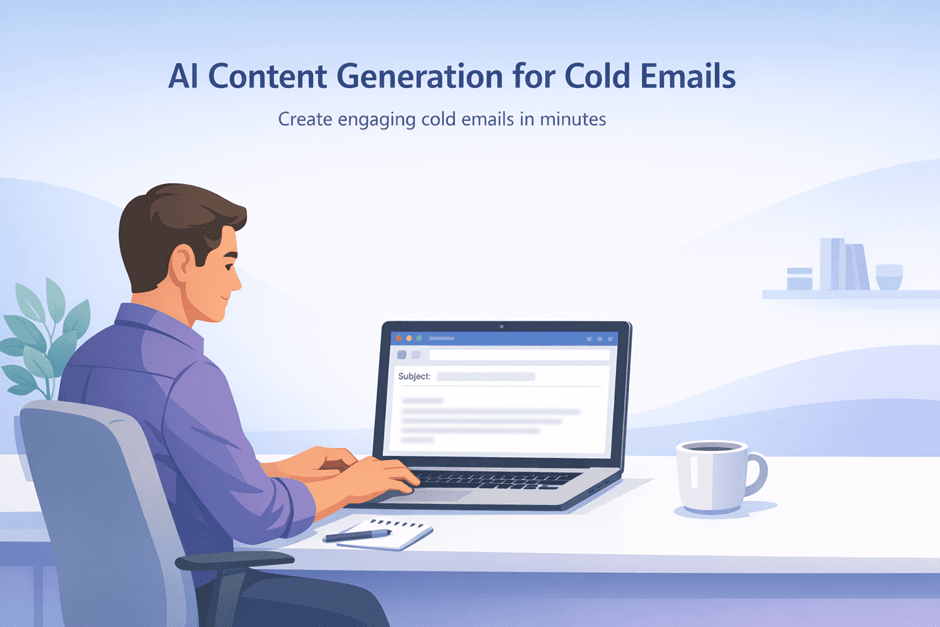
The Power of AI Content Generation: Creating Engaging Cold Emails in Minutes
Cold email has always been a copy problem disguised as a sending problem.
Most teams think their biggest challenge is volume, tools, or deliverability. In reality, the hardest part of cold email outreach has always been writing messages that feel relevant at scale. Writing one good email is easy. Writing hundreds of good emails every day, for different roles and industries, is where things break down.
This is why inboxes are full of emails that sound the same. Teams reuse templates. They change a few words. They hope for replies. Over time, response rates drop, not because cold email stopped working, but because content stopped evolving.
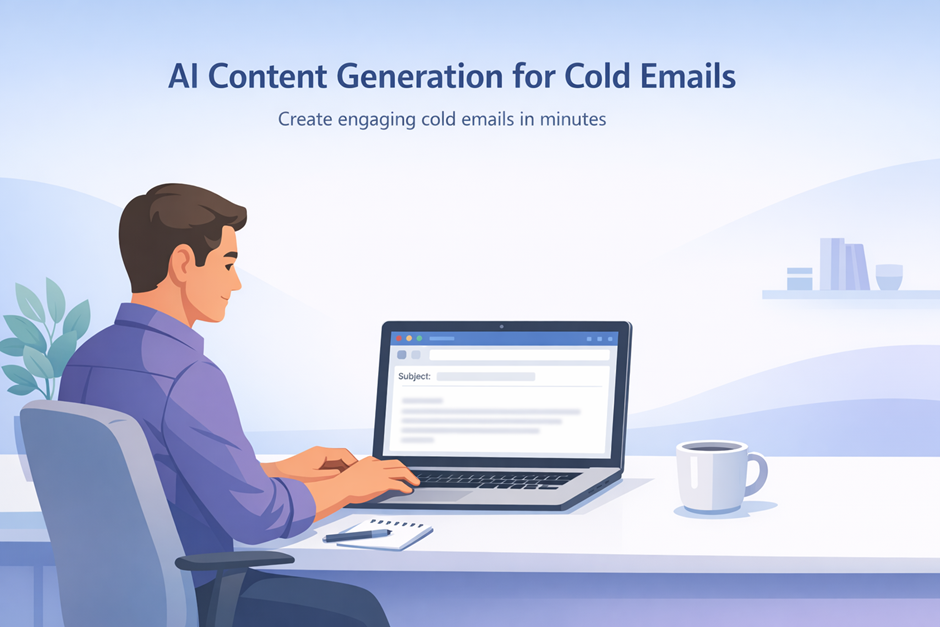
AI content generation changes this dynamic. It does not make cold email magical. It makes it practical. Instead of starting from a blank screen, teams can now generate structured, relevant email drafts in minutes and focus their energy on strategy, targeting, and testing rather than repetitive writing.
Cold email outreach is no longer just about sending faster. It is about writing smarter, at scale.
What AI Content Generation Really Means for Cold Emails
AI content generation is the use of artificial intelligence to produce written content based on context. In cold email outreach, this means generating subject lines, opening lines, body copy, and follow-ups based on who the prospect is and what the sender is trying to achieve.
An AI content generator does not store pre-written templates in the traditional sense. It learns from patterns in language and structure. It understands how business emails are usually written, how value is presented, and how calls to action are framed. When you give it information about the audience and the offer, it creates a message that fits that situation.
This is important because cold emails fail when they feel disconnected from the person reading them. Generic messages do not get ignored because they are bad. They get ignored because they do not feel intentional. AI content generation helps reduce that gap by shaping content around context instead of forcing one message onto everyone.
In practical terms, this means a message written for a marketing manager does not sound like one written for a sales director. A note sent to a SaaS founder does not read like one sent to an enterprise operations lead. The structure may be similar, but the language changes. That is where relevance starts to appear.
Why Cold Email Outreach Struggles With Content at Scale
Cold email outreach has scaled technically much faster than it has scaled creatively. Tools can now send thousands of emails safely, rotate inboxes, and automate follow-ups. But writing still depends on human time and attention.
Sales teams are expected to prospect, personalize, follow up, and close deals. Writing thoughtful emails for every segment becomes unrealistic. So they default to one or two templates and reuse them across campaigns. At first, those templates work. Over time, they become noise.
This is why many teams experience the same pattern. A new campaign starts strong, then slowly declines. The list is not the only problem. The copy becomes predictable. Prospects have seen the same structure, the same phrases, and the same pitches from different senders.
AI content generation exists to solve this specific problem. It removes the bottleneck of manual drafting and makes variation cheap. Instead of protecting one "perfect" email, teams can test multiple good versions and let performance decide.
Cold email does not fail because it is cold. It fails because it becomes repetitive.
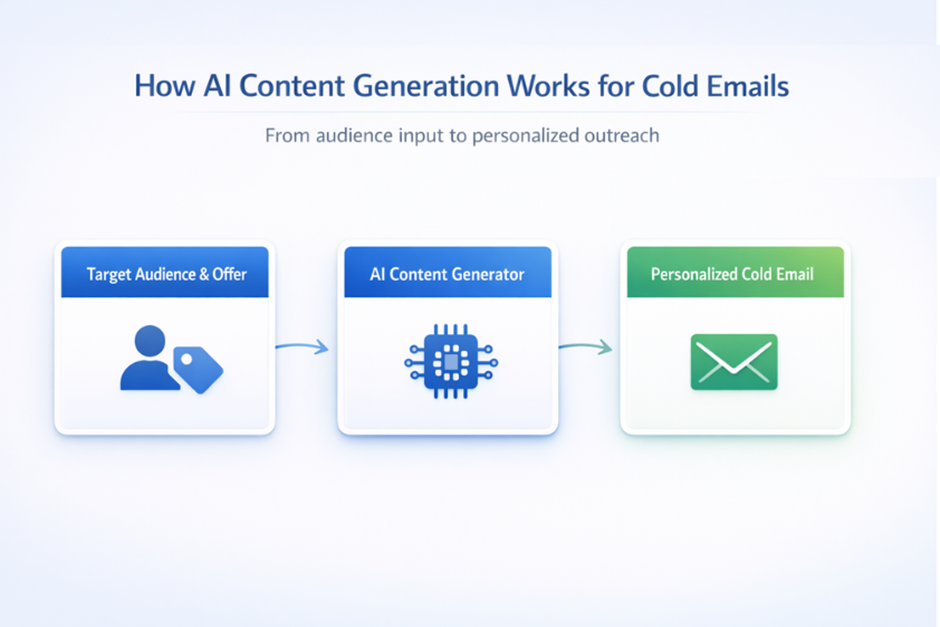
How AI Content Generators Write Cold Emails
An AI email generator works by predicting language based on intent and context. When you define the audience, the product, and the goal of the email, the system selects words and structures that match that scenario.
For example, a message aimed at a founder will usually be shorter, more direct, and more outcome-focused. A message aimed at a department head may include more operational language. These differences are not rules written by a human. They are learned from patterns in how people write to different roles.
This allows AI to produce multiple variations of the same idea. Instead of one opening line, you can generate several. Instead of one subject line, you can test different tones. This shifts cold email from a creative guessing game into a measurable process.
A simple way to see this difference is in testing. A human may write one email and hope it performs. An AI system can generate five versions of the same message, each slightly different in tone or structure, and let real data determine which one works better.
This does not make the AI more creative than a human. It makes it faster at exploring options.
What Makes an AI-Generated Cold Email Engaging
Engagement comes from relevance and clarity. A cold email becomes engaging when it feels like it was written for the person reading it and when it communicates one clear idea.
AI email personalization helps with this by shaping the message around role, industry, or business context. Instead of starting with a vague introduction, the email can reference a situation the prospect likely recognizes. This does not require deep research for every lead. It requires enough context to make the opening line feel specific.
Structure also plays a role. Engaging cold emails are usually short and focused. They avoid long explanations and feature lists. They aim to start a conversation rather than close a deal.
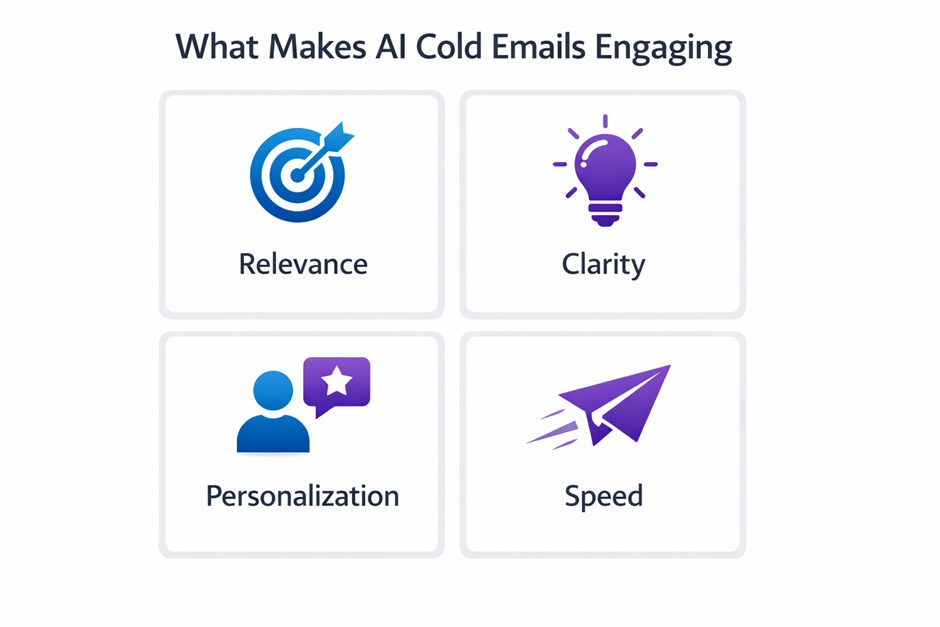
AI content generators are trained on this pattern and tend to produce messages that follow it naturally.
Tone matters as well. Emails that sound promotional are often ignored. Emails that sound conversational tend to get more attention. AI models can help maintain a neutral, professional tone that feels informational rather than pushy, especially when combined with light human editing.
The result is not perfect copy. It is usable copy that can be improved and tested quickly.
Human Writing vs AI Writing in Cold Email Outreach
This is not a question of replacement. It is a question of division of labor.
Humans are good at understanding strategy, audience psychology, and business nuance. AI is good at producing drafts, variations, and consistent structure. When humans try to do everything manually, they become the bottleneck. When AI works without direction, it becomes generic.
The strongest results come from combining both. AI generates the first version. Humans refine the message and decide what to test. Performance data then guides the next iteration. Over time, this creates a system where writing improves continuously instead of staying static.
Human-only writing does not scale well. AI-only writing does not adapt well. Together, they create a process that can handle volume without losing meaning.
Common Pitfalls When Using AI Content Generators
One common mistake is treating AI output as finished copy. Without review, messages can sound unnatural or vague. AI should be seen as a draft engine, not a final author.
Another issue is unclear input. When the instructions are broad, the output is broad. Specific guidance produces more useful content. This includes defining the audience, the problem being addressed, and the desired action.
Over-automation is also risky. If every email follows the same structure and tone, prospects will notice. Variation is still required, even when using AI.
There is also the risk of ignoring deliverability. Certain phrases, excessive links, or overly promotional language can affect inbox placement. AI content generation must work alongside deliverability best practices, not independently of them.
Best Practices for Using AI Content Generation in Cold Email Outreach
The most effective approach starts with segmentation. Before generating content, it is important to know who the message is for and what problem it addresses. This helps the AI produce more focused output.
Emails should remain short. AI can generate long explanations, but cold email performs better when the message is concise and easy to scan. Editing for clarity and length improves results.
Testing should be continuous. Generating multiple versions of an email allows teams to compare performance and refine their approach. This turns copywriting into an optimization loop rather than a one-time task.
A small human touch also goes a long way. Adjusting an opening line or softening a call to action can make an email feel less automated and more intentional.
AI works best when it supports judgement instead of replacing it.
How SalesTarget.ai Uses AI Content Generation for Cold Email Outreach
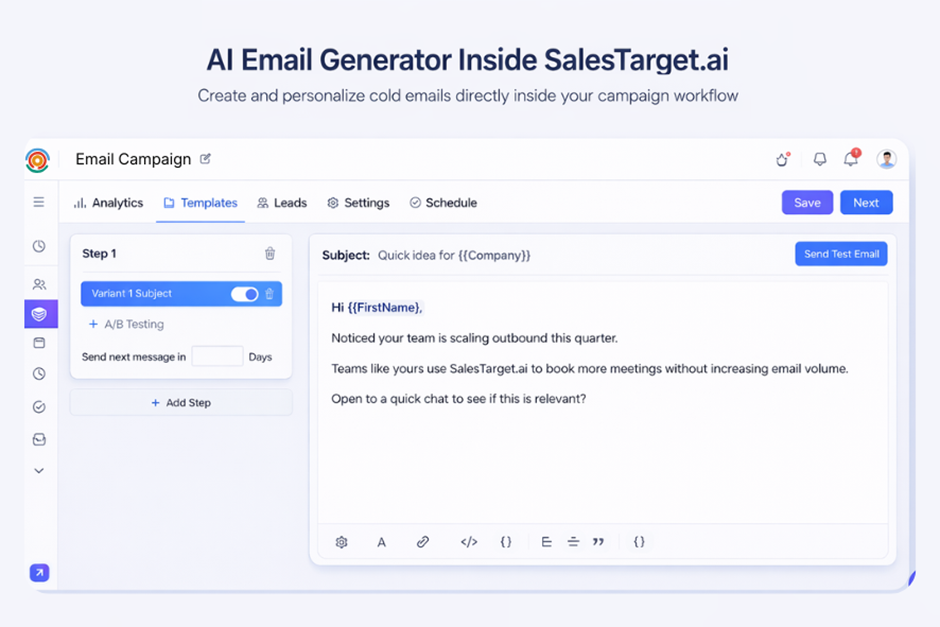
SalesTarget.ai integrates AI content generation directly into the cold email outreach workflow. Instead of writing emails in one tool and sending them from another, users can generate email content inside the platform based on their target audience and campaign goal.
The AI email generator helps create subject lines, email bodies, and follow-up messages that match the campaign context. It also supports AI email personalization by adapting tone and structure for different segments.
This allows users to move from lead selection to message creation without switching tools. Instead of spending time drafting repetitive emails, they can focus on strategy, segmentation, and testing.
The Future of AI Content Generation in Cold Email Outreach
The next phase of AI content generation will be driven by behavior rather than static input. Instead of writing based only on who the prospect is, future systems will adapt based on how the prospect interacts with previous messages.
This means follow-ups may change tone when engagement drops or shift focus when interest appears. Cold email will feel less like broadcasting and more like guided conversation.
AI will also become better at understanding industry language and buyer context. This will allow messages to sound more natural and less templated, even at scale.
The result will not be more emails. It will be more relevant emails.
Conclusion
Cold email outreach is no longer just about sending messages. It is about creating content that earns attention. AI content generation makes this possible at scale by removing the slowest part of the process: starting from scratch.
By using an AI content generator responsibly, teams can create engaging cold emails in minutes while still maintaining a human tone. The balance matters. AI handles repetition and variation. Humans provide direction and meaning.
When those two work together, cold email becomes less about volume and more about relevance. That is what makes modern outreach sustainable, and that is why AI content generation is becoming a foundation of how cold email works today.
Reference Links
1. How spam filters work
https://support.google.com/mail/answer/81126
2. generative AI productivity →
https://www.mckinsey.com/capabilities/mckinsey-digital/our-insights/the-economic-
potential-of-generative-ai-the-next-productivity-frontier