
Shared IP vs Dedicated IP for Cold Email: Is It Really Worth the Investment for SMBs?

Cold email advice online has a problem.
Everything is framed as a binary choice:
- • Shared IP = risky
- • Dedicated IP = professional
And if your emails aren't landing in inboxes, the conclusion is almost always:
"You need better infrastructure."
But here's the uncomfortable truth most blogs won't tell you:
SMB stands for small and medium-sized business.
In the context of cold outreach, SMBs are usually teams sending hundreds of emails per day, not millions, and operating without specialized deliverability staff.
They need reliable inbox placement without heavy infrastructure management.
That's why decisions like shared IP vs dedicated IP affect SMBs very differently from large enterprises.
For 80–90% of SMB cold outreach teams, a shared IP is absolutely fine — and often safer — than a dedicated IP.
This article explains why, when a dedicated IP actually makes sense, and what really moves deliverability for SMBs doing cold email.
First, Let's Kill the Biggest Myth
❌ Myth: "If I switch to a dedicated IP, my deliverability will improve."
This is not how inbox providers work - here's how Inbox Providers Actually Evaluate Senders
Gmail, Outlook, and Yahoo don't reward:
- ❌ Ownership
- ❌ Exclusivity
- ❌ Higher spend
They reward behavior over time.
A badly run cold email program on a dedicated IP will perform worse than a disciplined, relevant outreach setup on a shared IP.
Infrastructure doesn't fix strategy.
This is why cold email deliverability fundamentals matter more than infrastructure choices.
What an IP Address Actually Does (In Plain English)
Every email is sent from an IP address. Inbox providers use that IP to evaluate:
- Sending consistency
- Complaint rates
- Bounce rates
- Engagement patterns
Over time, this builds an IP reputation.
The difference between shared and dedicated IPs is how that reputation is formed and controlled — not whether one is "better."
With that myth out of the way, let’s look at what shared and dedicated IPs actually mean in practice for SMB cold outreach.
Dedicated IP: Control, But With Strings Attached
A dedicated IP means only you send from it. Sounds great — until reality kicks in.
What People Don't Tell You About Dedicated IPs
1. You Start With Zero Trust
Inbox providers don't know you. Everything must be earned.
2. Warm-Up Is Mandatory, Not Optional
Mess it up, and recovery is painful.
3. Low Volume = Weak Signals
If you don't send consistently, reputation stagnates or decays.
4. One Bad Campaign Can Wreck Everything
There's no buffer. It's all on you.
Dedicated IPs are high responsibility, not magic.
Default Recommendation (Clear & Unambiguous)
Let's remove all doubt:
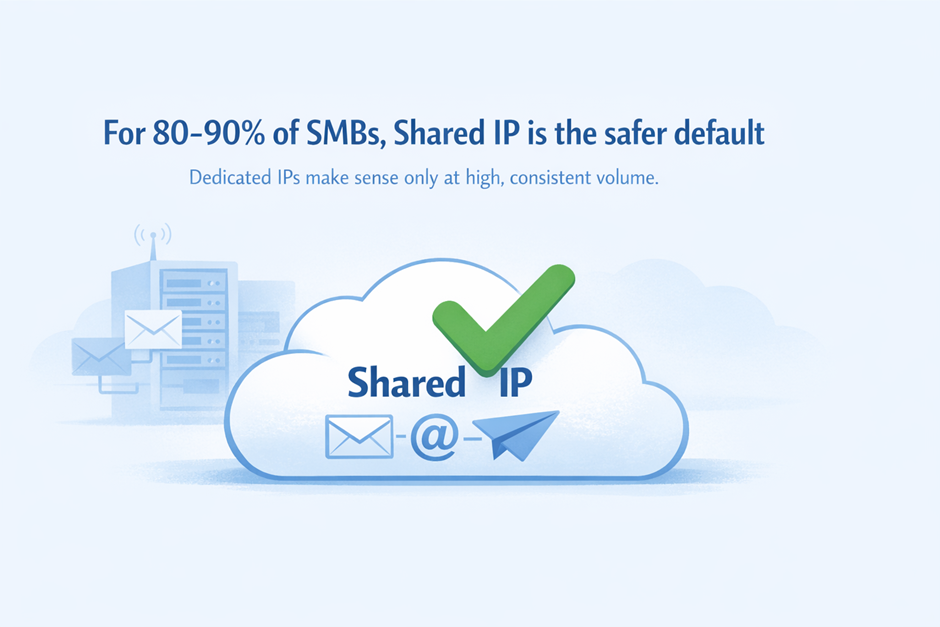
For 80–90% of SMB cold outreach teams, a shared IP is the better default choice.
safer • cheaper • more forgiving • easier to manage
A dedicated IP should be a deliberate upgrade, not a starting point.
If you're unsure which one you need, that uncertainty alone is usually a sign that shared IP is the right place to start.
Quick Takeaway for SMBs
→ Sending under 500 emails/day? Shared IP
→ Inconsistent volume? Shared IP
→ Scaling past 1,000/day with discipline? Consider Dedicated IP
→ Unsure? Start with Shared IP
When Should an SMB Actually Move to a Dedicated IP?
Dedicated IPs are not bad. They are just situational.
An SMB should consider a dedicated IP only when:
- It consistently sends over 1,000 emails per day
- Volume is stable (not campaign spikes)
- Data quality is high
- Warm-up discipline is understood
- Deliverability metrics are actively monitored
If these conditions are not met, a dedicated IP often adds more risk than benefit.
The Real Opportunity Cost Most Teams Miss
Here's where SMBs lose months — sometimes years.
They obsess over shared vs dedicated IP, tools, and infrastructure — while ignoring the actual deliverability killers:
1. Poor List Quality
No IP can save emails sent to the wrong people.
2. Bad Ramp-Up Behavior
Sudden spikes hurt more than IP choice ever will.
3. Inbox Mismanagement
Too many inboxes, no monitoring, no consistency.
4. Generic Copy
If people don't reply, inbox providers notice.
5. Domain Reputation Neglect
Domains matter more than IPs — always.
Infra doesn't compensate for fundamentals. It amplifies them.
IP Reputation vs Domain Reputation (Critical Distinction)
👉 Domain reputation follows you everywhere. IP reputation does not.
You can:
- change IPs
- rotate infrastructure.
But if your domain builds a bad reputation, inbox placement suffers regardless of IP type.
This is why switching to a dedicated IP often does nothing — or makes things worse.
Shared IP vs Dedicated IP: Clean Comparison
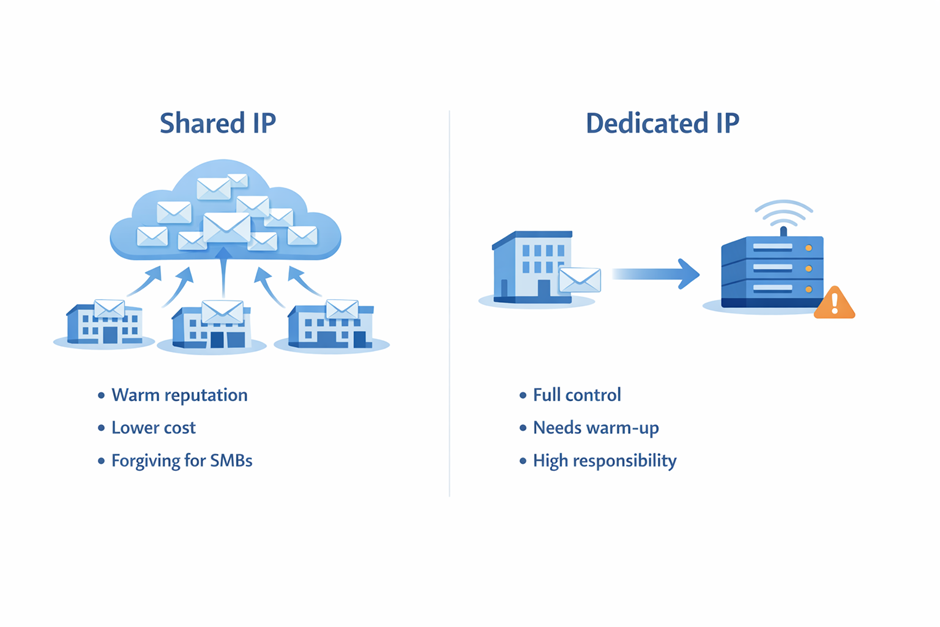
| Factor | Shared IP | Dedicated IP |
|---|---|---|
| Default SMB choice | ✅ Yes | ❌ No |
| Warm-up required | No | Yes |
| Cost | Low | High |
| Risk tolerance | High | Low |
| Control | Medium | Full |
| Forgiveness | High | Low |
| Best for | SMBs | High-volume teams |
| Recovery Time | Fast (pool buffers issues) | Slow (must rebuild from scratch) |
Real-World Scenarios (This Is Where Clarity Comes From)
Scenario 1: Founder Sending 100–300 Emails/Day
Context: Single domain, lean team, focused ICP
Best choice: Shared IP
Why: Dedicated IP adds complexity with zero upside at this volume.
Scenario 2: Agency Managing 10+ Inboxes
Context: Multiple clients, variable volume, mixed quality data
Best choice: Shared IP (segmented pools)
Why: Dedicated IPs per client would be operationally dangerous and expensive.
Scenario 3: SMB Sales Team Scaling Fast
Context: 800–1,500 emails/day, strong engagement, clear processes
Best choice: Consider dedicated IP only if warm-up discipline exists
Why: This is the edge case where dedicated IPs start to make sense.
Scenario 4: Team Jumping to Dedicated IP Too Early
They move to a dedicated IP after hearing it's "more professional." Volume is inconsistent. Data quality is mixed. Warm-up is rushed.
Result: Deliverability drops, campaigns underperform, and the IP gets blamed.
Lesson: The problem wasn't the IP. It was premature optimization.
What Actually Improves Cold Email Deliverability
If you want inbox placement to improve, prioritize in this order:
1. Lead Relevance
Sending to the wrong audience hurts engagement signals and trains inbox providers to distrust your domain. No IP setup can fix irrelevant targeting.
2. Reply-Driven Copy
Cold emails that get replies follow best practices for cold outreach emails and send positive engagement signals.
3. Consistent Sending
Predictable daily volumes build trust. Sudden spikes look like automation abuse, regardless of IP type.
4. Inbox Hygiene
Managing inboxes properly, rotating responsibly, and avoiding spam complaints protects both domain and IP reputation.
5. Authentication
SPF, DKIM, and DMARC must be configured correctly so inbox providers can verify your identity.
Only after these should you worry about infrastructure.
Everything else is noise.
Common SMB Objections (And Why They're Misleading)
"Won't other senders ruin my shared IP?"
Only on poorly managed platforms. Well-managed shared IP pools actively monitor and remove bad actors.
"Does Gmail prefer dedicated IPs?"
No. Gmail prioritizes sender behavior, engagement, and consistency — not IP ownership.
"Isn't a dedicated IP more professional?"
Professional results come from relevance and replies, not from more complex infrastructure.
"Should I future-proof with a dedicated IP?"
Premature optimization often creates deliverability problems before fundamentals are in place.
Final Verdict (Clear, Honest, Trust-Building)
If you remember one thing from this article, let it be this:
Deliverability is earned, not bought.
For most SMBs:
- ✓ A shared IP is not a compromise
- ✓ It's the smarter, safer default
Dedicated IPs aren't wrong — they're just early-stage distractions for teams that haven't maxed out fundamentals yet.
Inbox placement doesn't improve because you upgraded infrastructure. It improves because recipients care about what you sent.
Next Step:
If you want better deliverability without overengineering infrastructure, start by fixing targeting, copy, and sending discipline using a controlled cold email outreach platform.
Ready to Improve Your Cold Email Deliverability?
Start with SalesTarget.ai's shared IP infrastructure — trusted by SMBs worldwide
Start Free Trial